

Offshore injury claims are governed by overlapping federal statutes, competing compensation systems, and employer classification disputes that change which law applies. Morris & Dewett handles maritime and offshore injury claims.
East Texas Workers and Offshore Platforms
Longview sits in Gregg County at the heart of East Texas oil and gas country. That industry doesn’t stop at the shoreline. Thousands of workers from the Longview area hold rotational jobs on Gulf of Mexico platforms, traveling to the coast for two-week or four-week shifts before returning home. When they’re offshore, federal maritime law governs their work, not Texas workers’ compensation.
This matters because the legal protections available to offshore workers differ significantly from what applies to land-based employees. Texas workers’ compensation covers injuries on Texas soil. Once a worker boards a vessel or steps onto an offshore platform under federal jurisdiction, different statutes control. The first question in any offshore injury case is which law applies.
Whether a worker qualifies as a “seaman” under the Jones Act is the threshold determination. The answer changes everything: the remedies available, the standard of proof, the deadline to file, and who can be held liable. Getting this wrong at the start of a case can permanently damage the recovery.
Jones Act: Federal Protection for Seamen
Jones Act
The Jones Act (46 U.S.C. § 30104) is a federal statute giving seamen the right to sue their employer for negligence causing injury. It is the primary legal remedy for maritime workers who qualify as seamen.
Jones Act The Jones Act (46 U.S.C. § 30104) gives seamen injured by employer negligence the right to sue in federal or state court, with full jury trial rights. This is a critical distinction from workers’ compensation, which is an administrative no-fault system.
Seaman status under the Jones Act requires three elements. First, the worker must perform work in furtherance of a vessel’s mission. Second, the worker must have a connection to a specific vessel or an identifiable fleet of vessels in navigation. Third, that connection must be substantial in both duration and nature. Courts generally look for at least 30% of work time spent in service of the vessel. A crane operator who works exclusively on a semi-submersible drilling rig will likely qualify. A traveling inspector who visits multiple platforms for days at a time probably will not.
The negligence standard under the Jones Act is deliberately low. Courts describe it as “featherweight causation.” Any employer negligence that plays any part, even the slightest part, in causing the injury is sufficient. This is far more favorable to injured workers than the negligence standard in ordinary Texas personal injury cases.
Proportionate Responsibility
Texas’s proportionate responsibility system (Texas CPRC Ch. 33) reduces your recovery by your fault percentage and bars recovery if you are more than 50% at fault. This is the Texas state standard. It does NOT apply to Jones Act maritime claims.
Proportionate Responsibility One critical point: Texas proportionate responsibility rules do not apply in admiralty. Jones Act cases use pure comparative fault. Your recovery is reduced by your own fault percentage, but you are never completely barred from recovery. Even a worker who is 80% at fault can recover 20% of their damages.
Employers routinely contest seaman status because losing that classification eliminates the Jones Act and forces the worker into LHWCA territory. Morris & Dewett reviews the specifics of how and where the worker was employed, the nature of the vessel, and the worker’s job duties before determining which statute to pursue.
LHWCA: Coverage for Non-Seaman Offshore Workers
LHWCA
Longshore and Harbor Workers’ Compensation Act (33 U.S.C. § 901 et seq.). A federal workers’ compensation system covering maritime workers who do not qualify as Jones Act seamen, including most offshore oil and gas workers on fixed platforms.
The LHWCA Longshore and Harbor Workers’ Compensation Act (LHWCA, 33 U.S.C. § 901 et seq.) covers offshore workers who do not qualify as Jones Act seamen. Workers who fall outside the Jones Act retain full federal protection under LHWCA. This includes dock workers, shipyard workers, terminal workers, and workers on the Outer Continental Shelf.
OCSLA
Outer Continental Shelf Lands Act (43 U.S.C. § 1333). A federal statute extending LHWCA coverage to workers on fixed platforms on the Outer Continental Shelf, including Gulf of Mexico oil and gas platforms.
The Outer Continental Shelf Lands Act (OCSLA OCSLA, 43 U.S.C. § 1333) extends LHWCA to workers injured on fixed platforms on the Outer Continental Shelf. Most East Texas workers injured on Gulf of Mexico fixed platforms fall under OCSLA and receive LHWCA benefits.
LHWCA is a no-fault system. Your employer pays regardless of who caused the injury. Benefits cover medical treatment with no dollar cap, disability payments at two-thirds of your average weekly wages, and permanent disability awards. Death benefits are available for surviving dependents. These are federal entitlements. Your employer cannot opt out the way Texas employers can opt out of state workers’ compensation.
LHWCA preserves an important right: you can still sue third parties for negligence while receiving LHWCA benefits. If a vessel owner, equipment manufacturer, or contractor caused or contributed to your injury, you can pursue them separately under general maritime law. This is one of the most significant and most commonly overlooked aspects of LHWCA claims.
What We Handle
Longview Practice Areas
-
 Car Accidents Rear-end, intersection, and highway collisions across Louisiana.
 -
 Truck Accidents 18-wheeler and commercial-vehicle wrecks governed by federal trucking rules.
 -
 Motorcycle Accidents Serious-injury motorcycle crashes where bias against riders is common.
 -
 Pedestrian Accidents Crosswalk and roadway pedestrian injuries with high-stakes liability.
 -
 Premises Liability Slip-and-fall and unsafe-property injuries on someone else's premises.
 - Slip & Fall Falls caused by wet floors, poor maintenance, and hidden hazards.
-
 Catastrophic Injury Brain, spinal-cord, amputation, and severe-burn injuries that change a life.
 -
 Brain Injury Traumatic brain injuries with long-term cognitive and physical effects.
 -
 Burn Injury Severe burns from fires, explosions, chemicals, and electrical contact.
 -
 Wrongful Death Claims brought by families after a fatal accident or act of negligence.
 -
 Product Liability Injuries caused by defective or unreasonably dangerous products.
 -
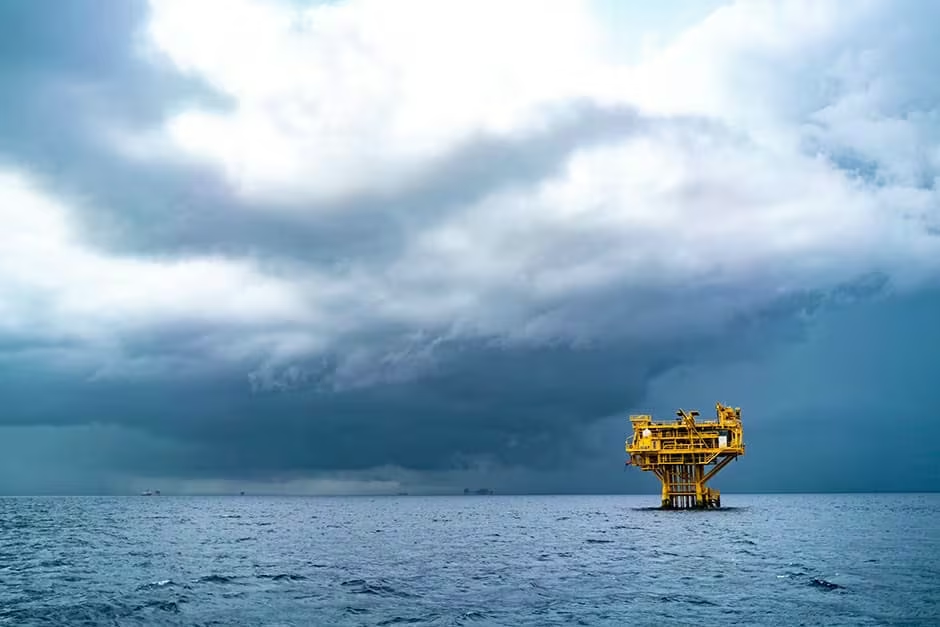 Offshore Accidents Rig, platform, and vessel injuries beyond the shoreline.
 -
 Maritime & Jones Act Jones Act and general-maritime claims for seamen and vessel crews.
 -
 Workers' Compensation On-the-job injuries and the benefits owed to injured workers.
Fixed Platform vs. Floating Vessel: Why the Distinction Matters
The legal classification of the structure where you were injured determines which law applies. This is not a technicality. It directly controls your remedies, your deadline, and your litigation options.
Fixed platforms permanently attached to the seabed are not vessels. A worker injured on a fixed platform cannot bring a Jones Act claim against their employer because there is no vessel. Their remedy is LHWCA via OCSLA. Floating drilling units, by contrast, can qualify as vessels. Semi-submersibles, drillships, and similar mobile offshore drilling units (MODUs) are generally treated as vessels under maritime law.
MODU
Mobile Offshore Drilling Unit. A floating drilling structure, such as a semi-submersible or drillship, that qualifies as a vessel under maritime law. Workers on MODUs may qualify as Jones Act seamen.
MODU Jack-up rigs sit in a contested middle ground. When being towed between locations, most courts treat them as vessels. When jacked up with their legs planted on the seabed and performing drilling operations, some courts find they are not vessels. The specific posture of the rig at the time of injury matters.
Employers often argue their structure is a fixed platform to avoid Jones Act liability. This argument should be challenged by an attorney who knows the specific case law. The Supreme Court’s decisions in Stewart v. Dutra Construction and Lozman v. City of Riviera Beach set the standards federal courts apply. Morris & Dewett evaluates each offshore injury by reviewing the specific design, registration, and operational status of the structure.
Maintenance and Cure
Maintenance and Cure
An ancient maritime remedy owed to seamen injured in service of a vessel. Maintenance is a daily living allowance (food and lodging). Cure is payment of all reasonable medical expenses. Both continue until Maximum Medical Improvement (MMI).
Maintenance and Cure Maintenance and cure is one of the oldest protections in maritime law. It does not require proof of employer negligence. If you are a seaman who was injured while in service of a vessel, your employer owes you maintenance and cure regardless of fault.
MMI
Maximum Medical Improvement. The point at which your treating physician determines your condition has stabilized and further significant improvement from treatment is not expected. This is when maintenance and cure obligations end, not when the worker is fully recovered.
Maintenance is a daily allowance intended to cover food and lodging while you are unable to work. The amount is set by contract or determined by actual reasonable costs in your area. Cure means your employer must pay all reasonable and necessary medical expenses until MMI Maximum Medical Improvement (MMI). MMI is not full recovery. It is the point where treatment will no longer materially improve your condition. You can still have a permanent injury after MMI.
Your employer cannot cut off maintenance and cure without medical evidence supporting an MMI finding. Unilateral termination without that support exposes the employer to additional damages and attorney’s fees. Willful and arbitrary failure to pay maintenance and cure is one of the few areas in maritime law where punitive damages may be available.
Maintenance and cure stacks on top of other remedies. Receiving it does not prevent you from also pursuing a Jones Act negligence claim or an unseaworthiness claim. Many injured seamen pursue all three simultaneously. Sequencing without strategic reason can waive rights. Morris & Dewett files all available maritime claims simultaneously unless there is a specific legal reason not to. See our catastrophic injury practice area for serious offshore injuries involving permanent disability.
Past results do not guarantee future outcomes; each case is decided on its own facts. See our full case results.
Borrowed Servant Doctrine in Offshore Injury Cases
Offshore workers rarely work for just one company in practice. A typical Gulf Coast platform will have the operator (the platform/lease owner), a drilling contractor, several service companies, and various subcontractors all working simultaneously. You may be on the payroll of one company while taking day-to-day direction from another.
The borrowed servant doctrine determines which employer bears Jones Act or LHWCA liability when work relationships are split like this. Courts apply a multi-factor test. The primary factor is who has the right to control the details of the work being performed. Secondary factors include whose equipment is used, who has the power to discharge the worker, and whether the worker consented to the arrangement. No single factor is controlling.
Both the lending employer and the borrowing employer may bear liability in some circumstances. Courts have found situations where a contractor (the lending employer) and an operator (the borrowing employer) share Jones Act obligations to the injured worker. In other cases, only one bears full liability.
Identifying all responsible parties is critical. An attorney who only names your direct employer may leave significant recovery on the table. Determining which entities to name as defendants requires reviewing contract documents, payroll records, and job site control arrangements.
Negligence Under General Maritime Law
General maritime law provides negligence and unseaworthiness claims independent of the Jones Act and LHWCA. These claims apply to a broader range of defendants, including vessel owners who may not be the injured worker’s employer.
Unseaworthiness is a strict liability doctrine. Vessel owners owe seamen an absolute, non-delegable duty to provide a seaworthy vessel. A vessel is unseaworthy when it, its equipment, or its crew is not reasonably fit for the intended purpose. The standard is not perfection. It is fitness for the work being performed. Common unseaworthiness scenarios include slippery deck surfaces without anti-slip treatment, defective lifting equipment, inadequate rigging, insufficient crew, and machinery worn beyond serviceable condition.
Third parties can be liable under general maritime law even if they are not the injured worker’s employer. A vessel owner who allows a contractor’s employees to board their vessel owes those workers an unseaworthy vessel duty. An equipment manufacturer whose defective product injures a worker offshore may face both product liability and general maritime law claims.
Pure comparative fault applies in all admiralty cases. This is different from Texas’s proportionate responsibility standard. In admiralty, your recovery is reduced by your percentage of fault, but you are never completely barred. A worker who is found 90% at fault in a general maritime law claim still recovers 10% of their damages. Texas’s 51% bar does not apply in federal maritime court.
Unseaworthiness carries a higher standard of care (absolute duty vs. reasonable care) than ordinary negligence. When both apply, the unseaworthiness claim may produce a larger recovery.
Your Longview Injury Attorneys
Founding partners Trey Morris and Justin Dewett lead every Longview injury case Morris & Dewett takes.


BSEE Regulations and Offshore Safety Standards
The Bureau of Safety and Environmental Enforcement (BSEE) is the federal agency regulating safety on Outer Continental Shelf oil and gas operations. BSEE enforces regulations under 30 C.F.R. Part 250, which governs all oil and gas and sulphur operations in the OCS. Platform operators must maintain detailed Safety and Environmental Management Systems (SEMS) and comply with specific equipment, training, and procedural requirements.
Violations of BSEE regulations are admissible evidence of negligence in maritime injury cases. When a platform operator violates BSEE-mandated safety procedures and a worker is injured, that violation establishes both the duty and its breach. BSEE inspection records, notice of incidents of noncompliance, and investigation reports are public records accessible through regulatory channels and in litigation discovery.
BSEE incident investigation reports are particularly valuable. When BSEE investigates an offshore accident, its findings can document equipment failures, procedural violations, and causal relationships that support the injured worker’s claims. Getting those reports requires knowing the right administrative channels and often requires legal process.
The 3-Year Statute of Limitations for Maritime Claims
Jones Act claims must be filed within 3 years of the date of injury under 46 U.S.C. § 30106. General maritime negligence and unseaworthiness claims also carry a 3-year limitations period. These are federal deadlines that override Texas state law.
Texas’s 2-year statute of limitations under CPRC § 16.003 does not apply to federal maritime claims. This is a common source of confusion. Workers or their families who are told they have “two years” to file may actually have three under federal maritime law. The reverse danger is equally serious. LHWCA administrative claims must be filed within one year of the injury or the last compensation payment with the Office of Workers’ Compensation Programs (OWCP). Missing that one-year deadline extinguishes the LHWCA claim permanently.
If an offshore accident results in wrongful death, the Death on the High Seas Act (DOHSA) may apply. DOHSA covers deaths occurring more than three nautical miles from shore and carries its own limitations rules.
These deadlines do not extend for a worker who waited to see how their recovery went. The clock starts at injury.
What clients say
- ★★★★★
I hired Morris and Dewett back in November of 2025.
They helped me get through my hard times of being off work, stress, and worry. Anytime I had a question I could call and they always had an answer. Very nice and professtional people. Thank you Morris and Dewett for making this an easy process for me and my family.
- ★★★★★
Morris and Dewett and their team of attorneys and staff go above and beyond.
They always were there to support me and answer all my questions after a shoulder injury that included multiple surgeries. They are caring and compassionate and that goes a long way! Highly recommended!
- ★★★★★
Thanks Morris and Dewett for the excellent work you have done on my behalf.
I want to personally thank Sarah for her kindness.
- ★★★★★
Morris & Dewett does things the right way!
They put their clients first in measurable and impactful ways.
- ★★★★★
First time being injured and needing a lawyer they where very helpful.
They answered my questions Id have very well. Highly recommend them.
- ★★★★★
Wonderful experience with Morris and DeWitt, everyone was articulate and punctual, and open to all my questions about the process.
My case couldn't have been handled by a better team! Caity Nerren, Jessica Christian, and Meghan Nolen were all fantastic and helped every step of the way. Thanks again for all of your hard work.
Reviews reflect individual client experiences. Past results do not guarantee future outcomes.
What Compensation Does Maritime Law Allow?
The compensation available depends on which statute or doctrine applies. These categories are not mutually exclusive. A seaman can pursue Jones Act negligence, unseaworthiness, and maintenance and cure simultaneously.
Loss of Earning Capacity
The difference between what a worker could have earned over their lifetime and what they can earn after the injury. Calculated by vocational rehabilitation experts and economic experts.
Jones Act negligence damages include past and future medical expenses, past and future lost wages, Loss of Earning Capacity loss of earning capacity, pain and suffering, and mental anguish. In limited circumstances, punitive damages are available for willful misconduct.
LHWCA benefits include all necessary medical treatment without a dollar cap, disability compensation at two-thirds of average weekly wages, and scheduled awards for permanent loss of specific body functions. Vocational rehabilitation is available. Death benefits for dependents are set at 50% of wages for a surviving spouse, plus 16.67% per child.
General maritime unseaworthiness damages mirror Jones Act damages. Maintenance and cure adds daily living payments and medical expenses on top of everything else.
Third-party negligence claims under general maritime law can produce recovery beyond what LHWCA allows. If a vessel owner or equipment manufacturer is responsible for the injury, suing them directly under general maritime law is not barred by LHWCA’s exclusivity provisions. This third-party avenue is one of the most significant financial differences between a well-handled offshore claim and a poorly handled one. View Morris & Dewett’s case results to understand the range of offshore and maritime recoveries.
Frequently Asked Questions
- Do I file a Jones Act claim or a workers' comp claim for my offshore injury?
- It depends on whether you qualify as a seaman under the Jones Act. If you do, you can bring a Jones Act negligence claim against your employer directly, with full jury trial rights and access to damages for pain, suffering, and lost earning capacity. If you do not qualify as a seaman, the Longshore and Harbor Workers' Compensation Act (LHWCA, 33 U.S.C. § 901 et seq.) likely applies, providing no-fault benefits through an administrative process. Many offshore workers are surprised to learn Texas workers' compensation does not apply to their injury at all. A maritime attorney evaluates which system governs before advising on how to proceed.
- What is the difference between maintenance and cure and other injury compensation?
- Maintenance and cure does not require proof of negligence. Any seaman injured in service of a vessel is entitled to it automatically. Maintenance is a daily living allowance for food and lodging. Cure is payment of all reasonable medical expenses. Both continue until Maximum Medical Improvement (MMI), the point where treatment will no longer significantly improve the condition. Maintenance and cure is owed in addition to any Jones Act negligence recovery, not instead of it. A seaman who proves employer negligence can collect Jones Act damages (lost wages, pain and suffering, earning capacity) on top of the maintenance and cure they are already receiving.
- Can I sue my employer directly for an offshore injury?
- Yes, if you qualify as a seaman under the Jones Act. The Jones Act (46 U.S.C. § 30104) is specifically a negligence statute allowing seamen to sue their employer directly, with full jury trial access in federal or state court. If you are covered by LHWCA instead, LHWCA is your exclusive remedy against your direct employer. But LHWCA does not bar you from suing third parties, such as vessel owners or equipment manufacturers, who contributed to your injury. Identifying all potentially liable parties beyond the direct employer is one of the most valuable things a maritime attorney does in an LHWCA case.
- How does the borrowed servant doctrine affect who I can sue?
- The borrowed servant doctrine comes into play when you are employed by one company (lending employer) but working under the direction and control of another (borrowing employer) at the time of your injury. Courts apply a multi-factor test to determine which employer bears Jones Act or LHWCA liability, with control of day-to-day work being the primary factor. In some cases, both employers share liability. In others, only one does. The practical consequence is that naming only your payroll employer without investigating the actual control relationship may leave significant claims unfiled. An offshore injury attorney should review all employment contracts and worksite arrangements before determining who to sue.
- I work on a drilling platform off the Texas Gulf Coast. Which law applies to me?
- The answer turns on whether the structure is a vessel or a fixed platform. If you work on a semi-submersible, drillship, or other mobile offshore drilling unit (MODU) that qualifies as a vessel, you may be a Jones Act seaman. If you work on a fixed platform permanently attached to the seabed, the Outer Continental Shelf Lands Act (OCSLA, 43 U.S.C. § 1333) extends LHWCA coverage to you. Jack-up rigs occupy contested legal ground, with courts splitting based on whether the rig was afloat or in position at the time of injury. The specific structure, its operational status, and your job duties all factor into the analysis.
- How long do I have to file an offshore injury claim?
- Jones Act negligence claims carry a 3-year statute of limitations from the date of injury under 46 U.S.C. § 30106. General maritime unseaworthiness claims also carry a 3-year period. Texas's 2-year statute of limitations does not apply to federal maritime claims. However, LHWCA administrative claims must be filed within one year of injury or the last compensation payment with the Office of Workers' Compensation Programs (OWCP). Missing the LHWCA filing deadline can permanently extinguish those benefits. Given the multiple different deadlines that can apply to the same offshore injury, consulting a maritime attorney promptly after an injury is essential.
- What if my employer says the platform is not a vessel?
- Employers frequently argue that the structure is a fixed platform, not a vessel, to avoid Jones Act liability. This argument should be evaluated with specific legal analysis, not accepted at face value. The Supreme Court's decision in *Stewart v. Dutra Construction Co.*, 543 U.S. 481 (2005), established that a structure qualifies as a vessel if it is practically capable of maritime transportation, even if that is not its primary purpose. Whether a jack-up rig, barge, or floating structure qualifies depends on its specific design and operational status. An attorney with offshore injury experience will review the structure's registration, design specifications, and what it was doing at the time of the injury before accepting the employer's characterization.
Last updated June 5, 2026