

Tex. Transp. Code
Texas Transportation Code. The state statute governing traffic laws, vehicle operations, and pedestrian right-of-way rules on Texas roads.
proportionate responsibility
Texas’s fault allocation system under CPRC Chapter 33. If a claimant’s share of fault exceeds 50%, they recover nothing. At 50% or below, damages are reduced by the claimant’s percentage.
Morris & Dewett has handled personal injury cases in Longview and across East Texas for more than 25 years.
How Pedestrian Accidents Happen in Longview
Pedestrian crashes in Longview are concentrated along a predictable set of roads. Loop 281 is a high-speed multi-lane corridor with limited pedestrian infrastructure. Its design prioritizes vehicle throughput. Pedestrian crossings are infrequent and, in some segments, absent entirely.
Eastman Road presents a different problem. The corridor near the Eastman Chemical plant carries high pedestrian volume during shift changes. Marked crosswalks are inadequate for the foot traffic the road generates. When driver attention is split between road conditions and a cell phone or in-vehicle navigation system, that gap becomes dangerous.
Night and low-visibility conditions create additional risk along US-80 and State Highway 149, where commercial blocks lack adequate sidewalk lighting. Texas data on pedestrian crashes consistently identifies intersections and mid-block crossings as the highest-risk locations. NHTSA attributes 94% of all crashes to driver error; recognition failures, where the driver simply did not see the pedestrian in time, account for 41% of that figure.
Impaired driving extends liability beyond the at-fault driver in some cases. Under Tex. Alc. Bev. Code Section 2.02, an establishment that served an obviously intoxicated driver who then strikes a pedestrian can be held liable alongside the driver.
Texas Pedestrian Right-of-Way Law: What the Transportation Code Requires
Texas Transportation Code Section 552.003 requires drivers to yield to pedestrians in crosswalks, but Section 552.006 requires due care for any pedestrian on the roadway regardless of crosswalk location. Understanding both provisions matters because insurance companies use the distinction to dispute fault.
Tex. Transp. Code Section 552.003 requires a driver to yield to a pedestrian in a marked crosswalk or in an unmarked crosswalk at an intersection. Section 552.005 shifts the obligation: when a pedestrian crosses outside a marked crosswalk at a non-intersection location, the pedestrian must yield to vehicles. Section 552.006 is the critical override: a driver must exercise due care to avoid striking any pedestrian on the roadway, regardless of whether the pedestrian had the right of way.
That due care obligation is separate from and additive to the right-of-way rules. A driver can technically have the right of way and still be liable if they failed to exercise due care. Speeding through a commercial block at night, distracted, is a failure of due care even if no marked crosswalk existed at the impact point.
The location of the crossing affects how proportionate responsibility is allocated, not whether a claim exists at all. A pedestrian crossing outside a crosswalk may bear a share of fault for the crossing choice. That does not eliminate the driver’s due care obligation. The question is how fault is divided, and that is where the legal dispute happens.
Government Entity Liability for Crosswalk Infrastructure
If a missing or defective crosswalk contributed to the crash, a separate claim may be available against the City of Longview or the Texas Department of Transportation (TxDOT). Government entity claims under the Texas Tort Claims Act have different notice and filing requirements than standard negligence claims. Those requirements are strict and the deadlines are shorter. This is covered in the statute of limitations section below.
Proportionate Responsibility in Pedestrian Cases
Under CPRC Chapter 33, Texas uses a proportionate responsibility system. If a claimant’s share of fault exceeds 50%, they recover nothing under Section 33.001. At exactly 50%, recovery is allowed but reduced by that percentage.
Insurance adjusters build pedestrian cases around the fault percentage. Their standard arguments: the pedestrian was jaywalking, wore dark clothing at night, stepped into traffic without checking, or was using a cell phone. Each argument is designed to push the pedestrian’s assigned fault above the 51% threshold.
Your response to those arguments depends on evidence. Photos of the impact location showing whether a crosswalk was or was not present, surveillance footage showing the pedestrian’s actual behavior, and witness accounts are all relevant to the fault allocation dispute.
responsible third parties
Under CPRC Section 33.004, defendants can name non-parties who they allege share fault. The claimant then has 60 days to add the designated third party as a defendant or that party’s fault is allocated without being in the lawsuit.
Defendants can also designate responsible third parties under CPRC Section 33.004. In pedestrian cases, potential responsible third parties include the driver’s employer, a dram shop defendant, and a government entity whose failed crosswalk infrastructure contributed to the hazard. The employer designation applies when the driver was working at the time of the crash. The claimant has 60 days after the designation to add the third party as a defendant.
Failing to respond within 60 days can lock in a fault allocation that excludes a party who shares real liability.
What We Handle
Longview Practice Areas
-
 Car Accidents Rear-end, intersection, and highway collisions across Louisiana.
 -
 Truck Accidents 18-wheeler and commercial-vehicle wrecks governed by federal trucking rules.
 -
 Motorcycle Accidents Serious-injury motorcycle crashes where bias against riders is common.
 -
 Pedestrian Accidents Crosswalk and roadway pedestrian injuries with high-stakes liability.
 -
 Premises Liability Slip-and-fall and unsafe-property injuries on someone else's premises.
 - Slip & Fall Falls caused by wet floors, poor maintenance, and hidden hazards.
-
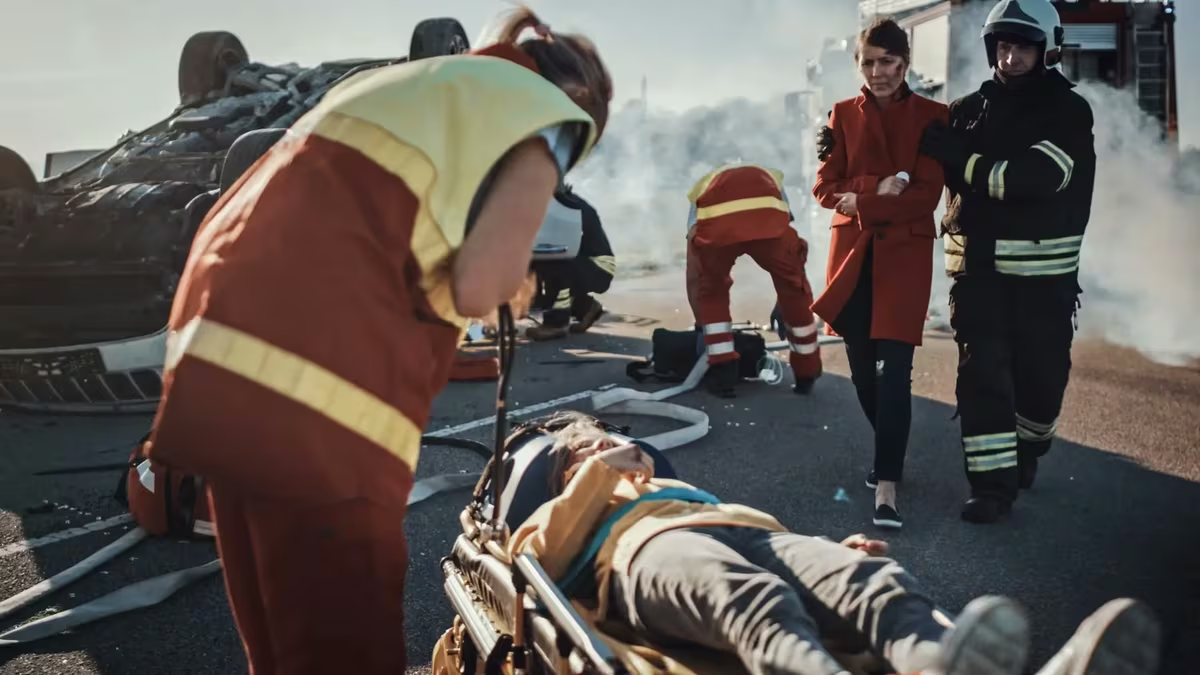 Catastrophic Injury Brain, spinal-cord, amputation, and severe-burn injuries that change a life.
 -
 Brain Injury Traumatic brain injuries with long-term cognitive and physical effects.
 -
 Burn Injury Severe burns from fires, explosions, chemicals, and electrical contact.
 -
 Wrongful Death Claims brought by families after a fatal accident or act of negligence.
 -
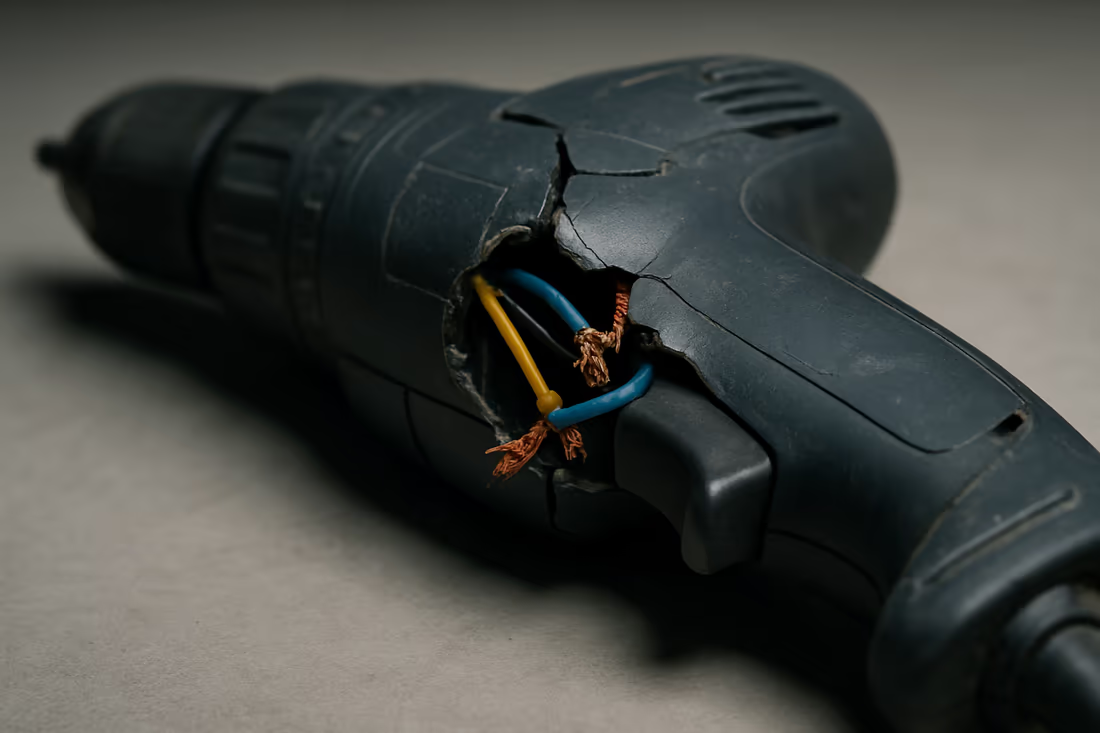 Product Liability Injuries caused by defective or unreasonably dangerous products.
 -
 Offshore Accidents Rig, platform, and vessel injuries beyond the shoreline.
 -
 Maritime & Jones Act Jones Act and general-maritime claims for seamen and vessel crews.
 -
 Workers' Compensation On-the-job injuries and the benefits owed to injured workers.
Injuries Pedestrians Commonly Sustain
A pedestrian has no structural protection in a collision. Injury severity in pedestrian crashes far exceeds what occupants experience in vehicle-to-vehicle impacts at the same speeds.
TBI
Traumatic Brain Injury. A disruption in normal brain function from a blow, bump, or jolt to the head, or a penetrating injury. Ranges from mild concussion to severe injury requiring long-term care.
TBI is the primary cause of pedestrian fatality. Even non-fatal impacts frequently cause concussive TBI. These injuries are often underestimated in the first hours after the crash because concussion symptoms are delayed or masked by adrenaline. Medical evaluation on the day of the crash documents the mechanism of injury even before symptoms fully present.
Spinal cord injuries occur when impact forces from vehicle contact cause cervical or thoracic fractures. Long bone fractures of the femur, tibia, and fibula are common in lower extremity impacts at standard bumper height. Internal organ damage from the secondary ground impact is frequently underdiagnosed in initial emergency department evaluations. Christus Good Shepherd Medical Center is the primary Level II trauma center in Longview. ETMC serves as a secondary facility. The emergency department record from the day of the crash is one of the most important documents in a pedestrian case.
MMI
Maximum Medical Improvement. The point at which a treating physician determines a patient’s condition has stabilized and is unlikely to improve further with continued treatment.
MMI timelines for severe pedestrian TBI and spinal injuries typically run 18 to 36 months. Case valuation is generally assessed at MMI because future medical needs cannot be fully established until the condition stabilizes. Cases with serious injuries take time. That is not a problem; it is a structural feature of getting the damages calculation right.
For cases involving catastrophic injuries, see Longview catastrophic injury lawyers. Brain trauma cases are addressed separately at Longview brain trauma lawyers.
UM/UIM Coverage for Pedestrians Struck by Uninsured Drivers
UM/UIM
Uninsured/Underinsured Motorist coverage. Pays for your injuries when the at-fault driver has no insurance (UM) or insufficient insurance to cover your damages (UIM). In Texas, it must be offered with every auto policy.
When the driver who strikes a pedestrian has no insurance or insufficient insurance, the pedestrian’s own auto policy may cover the gap. Under Tex. Ins. Code Chapter 1952, Texas insurers must offer UM/UIM with every auto policy. If the insured did not reject it in writing, the coverage defaults to the liability limits.
Hit-and-run crashes present a specific scenario. When the at-fault driver flees and their identity is unknown, UM coverage applies because there is no identified driver to file against. UIM applies only when the at-fault driver is identified but their policy limits are insufficient. Most Texas UM policies require a police report and may require physical contact between the fleeing vehicle and the pedestrian. Check your policy language. Filing a police report with the Longview Police Department (for crashes within city limits) or the Gregg County Sheriff’s Office (for unincorporated county) is essential.
subrogation
The right of an insurer who paid a claim to recover those payments from a third-party recovery. If your health insurer paid your medical bills, they may assert a claim against any settlement or verdict you receive.
Health insurance subrogation is a complication in UM/UIM cases. If your health insurer paid your medical bills, they may assert a lien against your recovery. An attorney can negotiate that lien. The existence of subrogation does not eliminate the UM/UIM claim. It affects how the net recovery is structured.
For wrongful death claims involving pedestrians killed by uninsured drivers, see Longview wrongful death lawyers.
Past results do not guarantee future outcomes; each case is decided on its own facts. See our full case results.
Evidence That Matters in a Longview Pedestrian Case
The first 72 hours after a pedestrian crash are the most important for evidence preservation. Video footage from commercial properties along Loop 281 and Eastman Road businesses is typically overwritten within 30 to 72 hours. A preservation demand must be sent before that window closes. Without it, the footage is gone.
The accident report is the starting document. Within Longview city limits, that is the Longview Police Department. In unincorporated Gregg County, it is the Gregg County Sheriff’s Office. If the crash occurred on a state highway, TxDOT may generate a separate crash report with supplemental data. Request all applicable reports.
Whether a marked crosswalk existed at the impact point is central evidence for the proportionate responsibility dispute. Photos of the intersection or mid-block location taken immediately after the crash document what was there and what was not. That record becomes critical when the insurer argues the pedestrian was at fault for crossing outside a marked zone.
EDR
Event Data Recorder. A device in most modern vehicles that captures pre-impact data including speed, braking, throttle position, and steering inputs. Commonly called a “black box.” Data can be overwritten if the vehicle is repaired or totaled without a preservation demand.
Vehicle EDR data records pre-impact speed, braking, and steering inputs. It must be preserved before the vehicle is repaired or totaled. If the at-fault driver’s insurer takes possession of the vehicle, preservation demands need to go out immediately.
Cell phone records establish whether the driver was using a phone at the time of impact. Witness statements collected at the scene, before memories fade, can corroborate or contradict the driver’s account. Medical records from the emergency department document the mechanism of injury and initial findings. Together, this evidence package determines how the fault allocation and damages calculation develop.
Your Longview Injury Attorneys
Founding partners Trey Morris and Justin Dewett lead every Longview injury case Morris & Dewett takes.


Texas Statute of Limitations for Pedestrian Accident Claims
Texas gives injured parties two years to file a personal injury lawsuit. Under CPRC Section 16.003(a), suit must be filed within two years of the date of the pedestrian accident. Missing this deadline eliminates the right to sue in Texas court. No amount of evidence or liability strength can revive a time-barred claim.
Tolling applies for minors under CPRC Section 16.001. A child struck as a pedestrian at age 10 has until age 20 to file. The tolling runs from the minor’s 18th birthday, not from the date of injury.
Wrongful death claims have the same two-year period, but it runs from the date of death under CPRC Section 16.003(b). If the pedestrian survived the initial crash but died from injuries weeks or months later, the clock starts at death, not at the date of the accident.
Government entity claims are on a different and much shorter timeline. A claim against the City of Longview or TxDOT for defective crosswalk infrastructure requires a formal notice of claim within six months of the incident under Tex. Civ. Prac. & Rem. Code Section 101.101. Failure to provide that notice on time can bar the government entity claim entirely, even if the standard two-year window for other defendants is still open.
The two-year limitations clock runs regardless of any ongoing settlement negotiations with the insurer.
What Damages Are Available in a Texas Pedestrian Accident Claim?
Texas pedestrian accident claims can recover economic damages, non-economic damages, and in gross negligence cases, exemplary damages under CPRC Section 41.008.
Economic damages include past and future medical expenses, lost wages, loss of future earning capacity, rehabilitation costs, and assistive devices. Under CPRC Section 41.0105 and Haygood v. De Escabedo, 356 S.W.3d 390 (Tex. 2012), recovery of medical expenses is limited to amounts actually paid or incurred. This is the Texas collateral source rule as modified by statute. If your health insurer negotiated a reduced rate, you generally cannot recover the full billed amount. Keep all billing records, Explanation of Benefits documents, and payment receipts. They define the recoverable amount.
Non-economic damages include physical pain and mental anguish, physical impairment, disfigurement, and loss of consortium. There is no cap on non-economic damages in standard pedestrian accident cases. The CPRC Chapter 74 medical malpractice caps do not apply to vehicle accident claims.
Exemplary damages
What Texas law calls punitive damages. Available under CPRC Section 41.008 on clear and convincing evidence of fraud, malice, or gross negligence. Capped at the greater of two times economic damages plus up to $750K in non-economic damages, or $200K.
Exemplary damages are available under CPRC Section 41.008 on clear and convincing evidence of fraud, malice, or gross negligence. Drunk driving with prior DWI convictions is a common exemplary damages argument in pedestrian cases. The cap is the greater of two times economic damages plus non-economic damages up to $750,000, or $200,000.
Future damages require expert testimony. Life care planners, vocational rehabilitation experts, and economic experts quantify long-term loss of earning capacity and future medical costs. These experts are retained and paid on the contingency in most serious injury cases. View our case results for context on how these cases have resolved.
What clients say
- ★★★★★
I hired Morris and Dewett back in November of 2025.
They helped me get through my hard times of being off work, stress, and worry. Anytime I had a question I could call and they always had an answer. Very nice and professtional people. Thank you Morris and Dewett for making this an easy process for me and my family.
- ★★★★★
Morris and Dewett and their team of attorneys and staff go above and beyond.
They always were there to support me and answer all my questions after a shoulder injury that included multiple surgeries. They are caring and compassionate and that goes a long way! Highly recommended!
- ★★★★★
Thanks Morris and Dewett for the excellent work you have done on my behalf.
I want to personally thank Sarah for her kindness.
- ★★★★★
Morris & Dewett does things the right way!
They put their clients first in measurable and impactful ways.
- ★★★★★
First time being injured and needing a lawyer they where very helpful.
They answered my questions Id have very well. Highly recommend them.
- ★★★★★
Wonderful experience with Morris and DeWitt, everyone was articulate and punctual, and open to all my questions about the process.
My case couldn't have been handled by a better team! Caity Nerren, Jessica Christian, and Meghan Nolen were all fantastic and helped every step of the way. Thanks again for all of your hard work.
Reviews reflect individual client experiences. Past results do not guarantee future outcomes.
Working With a Longview Pedestrian Accident Attorney
Morris & Dewett handles pedestrian accident cases in Longview, Gregg County, and across East Texas. The contingency fee structure means no fee is charged unless there is a recovery. There is no charge for an initial consultation.
Case investigation in pedestrian cases starts with the preservation demands. Surveillance footage from Loop 281 and Eastman Road businesses, EDR data from the at-fault vehicle, and police and TxDOT crash reports are requested immediately. Where liability is genuinely disputed, accident reconstruction experts document the impact point, vehicle speeds, and driver behavior.
Government entity claims require parallel action. The six-month notice requirement under Tex. Civ. Prac. & Rem. Code Section 101.101 runs concurrently with the standard two-year window for the driver. Missing the government entity notice deadline does not affect the driver claim, but it closes the road design angle permanently.
If the at-fault driver’s insurer contacts you before you have spoken with an attorney, do not provide a recorded statement and do not accept an early settlement offer without reviewing it with counsel. Early offers in pedestrian cases routinely undervalue future medical expenses and non-economic damages. Once you accept and sign a release, the claim is closed.
Morris & Dewett is AV Preeminent rated by Martindale-Hubbell and listed in Super Lawyers. The firm has handled personal injury cases in East Texas for more than 25 years. Learn more at about Morris & Dewett.
Frequently Asked Questions
- Who is responsible if I was struck by a car while walking in Longview?
- The at-fault driver is the primary defendant in most pedestrian cases. Depending on the circumstances, additional parties may share liability. If the driver was working at the time of the crash, their employer may be jointly liable under the respondeat superior doctrine. If an establishment over-served an intoxicated driver who then struck a pedestrian, the establishment can be liable under Tex. Alc. Bev. Code Section 2.02. If defective crosswalk infrastructure contributed to the crash, the City of Longview or TxDOT may face a separate claim under the Texas Tort Claims Act.
- Can I recover compensation if I was hit while crossing outside a marked crosswalk?
- Yes, in most cases. Tex. Transp. Code Section 552.006 requires drivers to exercise due care to avoid striking any pedestrian on the roadway regardless of crosswalk status. Crossing outside a crosswalk may result in some fault being assigned to the pedestrian under CPRC Chapter 33. As long as the pedestrian's share does not exceed 50%, recovery is available, reduced by the assigned percentage. The proportionate responsibility dispute is why documenting whether a crosswalk existed at the impact point, and the driver's conduct leading up to impact, matters so much.
- How long do I have to file a pedestrian accident claim in Texas?
- The general deadline is two years from the date of the accident under CPRC Section 16.003(a). If the claim involves a government entity such as the City of Longview or TxDOT, a formal notice of claim must be filed within six months of the incident under Tex. Civ. Prac. & Rem. Code Section 101.101. Missing the government entity notice deadline bars that claim even if the two-year window for other defendants is still open. Wrongful death claims run two years from the date of death, not the date of the accident.
- What if the driver who hit me had no insurance or fled the scene?
- If the driver was uninsured, your own auto insurance UM/UIM coverage applies under Tex. Ins. Code Chapter 1952. Texas requires insurers to offer this coverage with every policy. If you did not reject it in writing, it defaults to your liability limits. For hit-and-run crashes where the driver's identity is unknown, uninsured motorist (UM) coverage applies rather than underinsured motorist (UIM) coverage. Most Texas UM policies require a police report and may require evidence of physical contact with the fleeing vehicle. Filing a report with the Longview Police Department or Gregg County Sheriff's Office as soon as possible preserves these options.
- What compensation is available after a pedestrian accident in Texas?
- Texas pedestrian accident damages include economic damages (past and future medical expenses, lost wages, loss of future earning capacity, rehabilitation), non-economic damages (physical pain and mental anguish, physical impairment, disfigurement, loss of consortium), and in cases involving gross negligence or intoxicated driving, exemplary damages under CPRC Section 41.008. There is no cap on economic or non-economic damages in standard vehicle accident cases. Medical expense recovery is limited to amounts actually paid or incurred under CPRC Section 41.0105. Future damages require expert testimony.
- Can family members file a claim if a pedestrian was killed?
- Yes. Texas wrongful death claims under CPRC Chapter 71 can be filed by the surviving spouse, surviving children, and surviving parents. Siblings, grandchildren, and stepparents who did not adopt the decedent are not eligible beneficiaries. The filing deadline is two years from the date of death. A separate survival action under Section 71.021 can be brought by the estate to recover losses the decedent suffered before death, including pre-death pain and suffering and medical expenses.
- What is the 51% rule and how does it apply to pedestrian accidents?
- Under CPRC Section 33.001, a claimant whose proportionate share of responsibility exceeds 50% recovers nothing. At exactly 50%, the claimant can still recover, but the damages are reduced by 50%. In pedestrian cases, insurance adjusters commonly argue that the pedestrian contributed to the crash by crossing outside a crosswalk, wearing dark clothing at night, or not watching for traffic. The purpose of those arguments is to push the assigned fault percentage above the threshold. How effectively that strategy is countered depends on the evidence gathered and how the liability dispute is framed.
- Does it cost anything to consult with a Longview pedestrian accident lawyer?
- No. Morris & Dewett offers free initial consultations for pedestrian accident cases. The firm handles personal injury cases on a contingency fee basis, which means no legal fee is charged unless there is a recovery. If the case does not resolve in your favor, you owe no attorney fee.
- What should I do immediately after being struck by a vehicle in Longview?
- Call 911 immediately. Stay at the scene and request that a police officer respond so a crash report is filed. Seek medical evaluation on the same day, even if you do not feel seriously injured. Photograph the impact location, the vehicle, any crosswalk markings or absence of markings, and your injuries. Collect the driver's name, insurance information, and license plate. Get contact information for any witnesses. Do not give a recorded statement to any insurance company before consulting an attorney. The days immediately after the crash are when most of the evidence that determines the fault allocation still exists.
- Can the City of Longview or TxDOT be held responsible for a missing crosswalk?
- Potentially. Under the Texas Tort Claims Act, a government entity can be liable for dangerous conditions on public property if it had actual or constructive notice of the condition. A missing or inadequately marked crosswalk at a high-volume pedestrian location may qualify. The critical requirement is that a formal notice of claim must be filed within six months of the incident under Tex. Civ. Prac. & Rem. Code Section 101.101. Missing that deadline bars the government entity claim even if a strong liability argument exists. Government entity claims also require proof that the entity had notice of the hazardous condition. This angle requires early investigation before evidence of prior complaints or maintenance records is lost.
Last updated June 5, 2026