
Morris & Dewett has represented injured clients in Texas for over 25 years.
Texas Personal Injury Law: What Texarkana Residents Need to Know
Texarkana is a twin city. The Texas side sits in Bowie County; the Arkansas side sits in Miller County, across State Line Avenue. That line is not just a street name. It is a legal boundary that decides which state’s law governs your claim, where you file, and how long you have to do it.
proportionate responsibility
Texas’s fault-allocation system under CPRC Chapter 33. Your recovery is reduced by your percentage of fault. If you are 51% or more at fault, you recover nothing. At 50% or less, your damages are reduced proportionally.
Texas gives injured people two years to file a personal injury lawsuit. That deadline is set by CPRC Section 16.003(a) and runs from the date of injury, not the date you discover the full extent of your injuries. Two years sounds like a long time. It is not, once you account for investigation, evidence collection, and reaching maximum medical improvement.
Texas allocates fault under proportionate responsibility. Under CPRC Section 33.001, a claimant who is 51% or more at fault recovers nothing. At exactly 50%, you can still recover, but your damages are reduced by 50%. Insurance adjusters understand this rule well. Their strategy often focuses on pushing your assigned fault above 50%.
Evidence gathered in the first 48 to 72 hours after a crash matters most for defending fault allocation before an insurer builds its narrative. Morris & Dewett works with accident reconstructionists and begins evidence preservation immediately.
duty of care
A legal obligation to act reasonably under the circumstances. Drivers owe a duty of care to other road users. Property owners owe a duty to lawful visitors. The specific duty depends on the relationship between the parties.
To bring a successful personal injury claim in Texas, you must prove four elements: the defendant owed you a duty of care, the defendant breached that duty, the breach caused your injury, and you suffered compensable damages. All four elements must be proven by a preponderance of the evidence.
The State Line Wrinkle: Texas or Arkansas?
In most cities the question of which state’s law applies never comes up. In Texarkana it can decide your whole case. State Line Avenue runs north to south through the heart of the city, and businesses, intersections, and crash sites sit on both sides of it. The general rule is that the law of the place where the injury occurred governs the claim.
The practical consequences are significant. Texas gives you two years to file under CPRC Section 16.003. Arkansas applies a different limitations period. Texas uses the 51% proportionate-responsibility bar under Chapter 33. Arkansas applies its own modified comparative fault standard. A crash a few feet on one side of the line is a Texas case; the same crash a few feet over is not.
That is why the first task in a Texarkana injury claim is fixing the precise location of the crash. The crash report, the responding agency, and GPS data establish which state the injury occurred in. An attorney who handles claims in this market confirms the controlling state before calculating any deadline, because applying the wrong state’s filing deadline can forfeit the claim.
The Texas rules below govern claims arising in Bowie County. An injury on the Arkansas side falls under Arkansas law, which carries a different limitations period and a different comparative fault standard.
Where Are Personal Injury Cases Filed in Bowie County?
Personal injury cases against Texas defendants in Texarkana are filed in the Bowie County District Courts. Unlike many Texas counties, Bowie County’s district courts do not sit in its largest city. They sit at the county seat in New Boston, about 25 miles west of Texarkana, at 710 James Bowie Drive. The 102nd and 5th District Courts carry the civil docket, and civil filings run through the Bowie County District Clerk at that same New Boston courthouse.
Federal civil rights or diversity jurisdiction cases involving Texas defendants may be heard by the U.S. District Court for the Eastern District of Texas, Texarkana Division.
Where you file affects which judge and which jury pool hears your case. The Bowie County jury pool is drawn from the county, a different community than a metro pool, and a firm’s record of trying cases in Bowie County courts, not just settling them, reflects familiarity with that pool.
Morris & Dewett has appeared in Texas courts throughout our 25-plus years of practice. We know which venues present specific challenges for injury plaintiffs and how to prepare for them.
Damages in a Texas Personal Injury Case
Damages in Texas personal injury cases fall into three categories. Economic damages are measurable: past and future medical expenses, lost wages, reduced earning capacity, and property damage. Non-economic damages compensate for pain and suffering, mental anguish, physical impairment, and disfigurement. These are real losses without a receipt.
Exemplary damages
Texas term for punitive damages under CPRC Section 41.008. Requires clear and convincing evidence of fraud, malice, or gross negligence. Capped at the greater of two times economic damages plus noneconomic damages up to $750,000, or $200,000.
Exemplary damages are available in cases involving malice, fraud, or gross negligence, subject to statutory caps under CPRC Section 41.008. Texas places no statutory cap on damages in general personal injury cases. The one significant exception is medical malpractice: under the Texas Medical Liability Act (CPRC Chapter 74), non-economic damages against physicians and health care providers are capped, separate from the rules that govern car accidents, truck accidents, and premises liability.
Texas does not allow direct action against an at-fault driver’s insurer. You sue the person or company that caused the injury. The insurer defends and pays any judgment, but is not a named defendant.
Past results do not guarantee future outcomes; each case is decided on its own facts. See our full case results.
Auto Insurance Minimums and UM/UIM in Texas
Texas requires every driver to carry minimum auto liability coverage of 30/60/25 under Tex. Transp. Code Section 601.072. That is $30,000 per injured person, $60,000 per accident for bodily injury, and $25,000 for property damage. These minimums have not kept pace with the actual cost of serious injuries.
UM/UIM
Uninsured/Underinsured Motorist coverage. Pays you when the at-fault driver has no insurance or insufficient coverage to pay your damages. Texas insurers must offer UM/UIM with every auto policy. You may reject it in writing, but doing so is rarely advisable.
When the at-fault driver carries only minimum coverage, the gap between their policy limit and your actual damages becomes your problem, unless you have UM/UIM. Under Tex. Ins. Code Chapter 1952, Texas insurers must offer UM/UIM coverage with every policy. If you did not reject it in writing, you likely have it. In a state-line crash, identifying every available policy matters even more, because the at-fault driver may be insured under an Arkansas or out-of-state policy.
For practice area detail, see our pages on car accidents, motorcycle accidents, and truck accidents below.
What We Handle
Texarkana Practice Areas
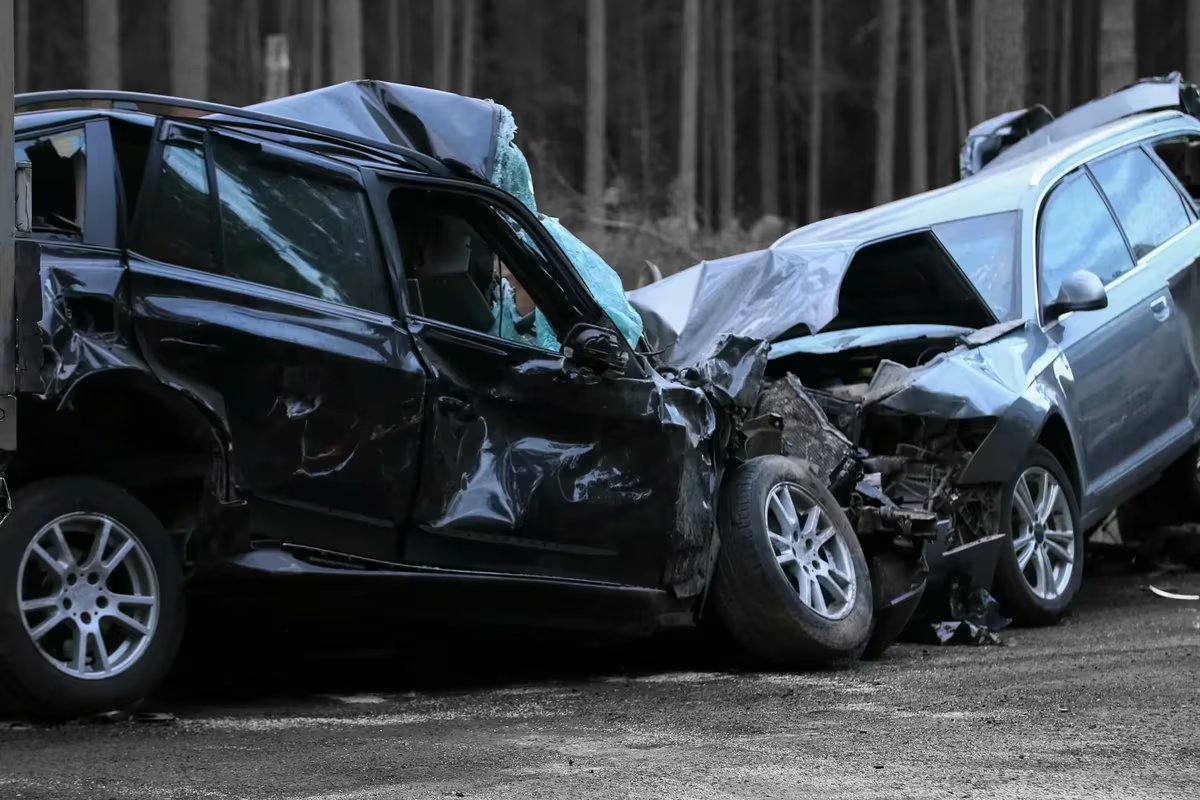
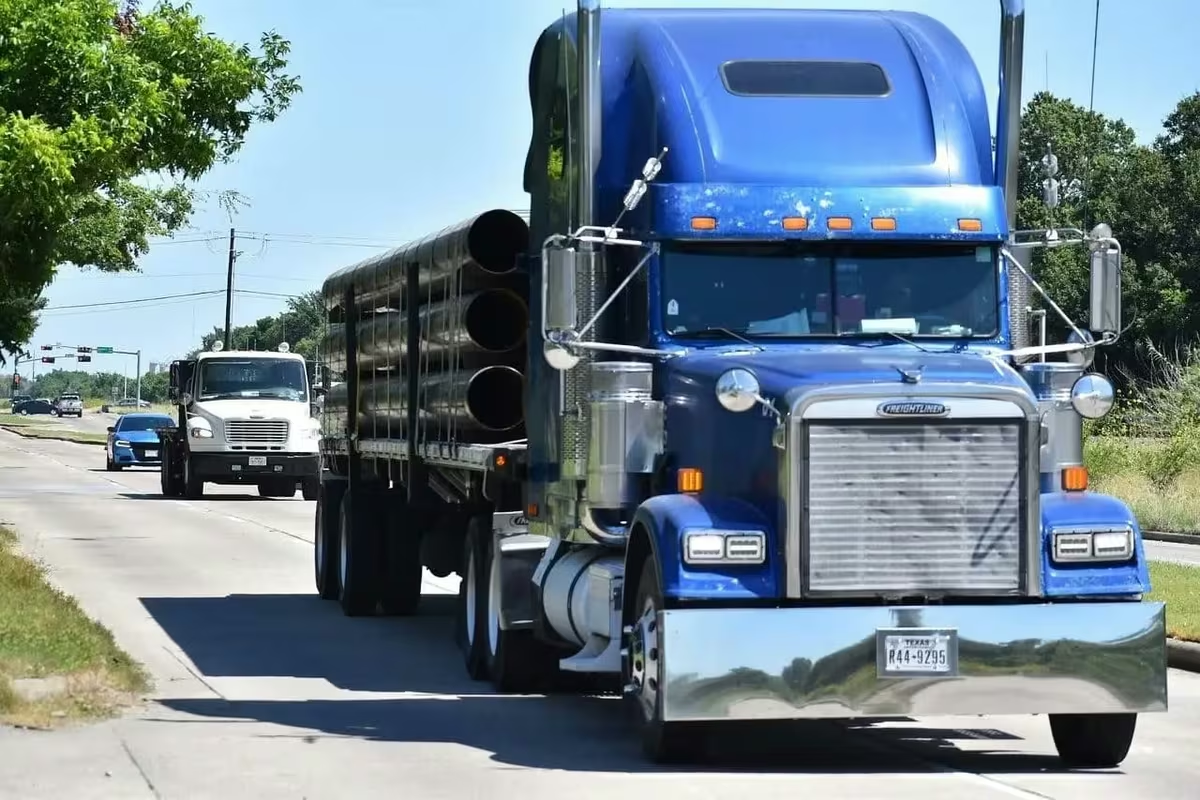

Texarkana Practice Areas and Crash Corridors
Morris & Dewett handles the full range of personal injury cases in Texarkana and Bowie County.
Texarkana sits at a freight crossroads. I-30 runs west toward Dallas and is the primary long-haul corridor through the city, carrying heavy commercial truck traffic. US-59 and US-71 feed regional and interstate freight north and south through Bowie County. State Line Avenue carries dense urban and intersection traffic down the Texas-Arkansas boundary. Each corridor presents a different injury profile, from high-speed interstate truck collisions on I-30 to lower-speed intersection crashes in the urban core.
Commercial truck cases on I-30 and the US-59/US-71 corridors involve evidence that does not exist in passenger car cases: FMCSA hours-of-service logs, electronic logging device data, and post-crash inspection reports. That evidence can be lost if it is not preserved quickly. Surveillance cameras and commercial vehicle dash cams are most prevalent on these major corridors, and acting fast after a crash can preserve video before it overwrites.
Pedestrian, motorcycle, and premises liability claims arise across the Texarkana market as well. In premises cases, Texas liability turns on the visitor’s legal status: an invitee receives the highest protection, a licensee less, and a trespasser almost none. In motorcycle cases, Texas requires helmets only for riders under 21 unless the rider completed a safety course or carries at least $10,000 in first-party medical coverage; helmet non-use does not bar recovery but may affect damages arguments.
Your Texarkana Injury Attorneys
Founding partners Trey Morris and Justin Dewett lead every Texarkana injury case Morris & Dewett takes.


CHRISTUS St. Michael and Texarkana Trauma Care
CHRISTUS St. Michael Health System on St. Michael Drive is the designated Level III trauma center serving the Texarkana area. Level III designation means St. Michael maintains around-the-clock emergency and surgical capacity to evaluate, stabilize, and treat serious injuries, and to transfer the most complex cases to higher-level centers when needed.
The treating physicians, specialists, and records from the hospital that treated you become critical evidence in serious injury litigation. Your attorney should understand how to request complete record sets, how to coordinate with treating physicians, and when to retain them as expert witnesses.
Medical record acquisition, physician coordination, and expert witness retention are substantial work in a serious injury case. A firm that staffs that work separately from legal strategy delivers more thoroughness on both fronts than one where attorneys handle the medical work themselves.
Reporting a Crash in Texarkana
In a car accident, call the police. A formal crash report is among the first documents your attorney will request. It establishes that the accident occurred, identifies the at-fault driver, records any citations, and captures the responding officer’s assessment. The report also documents where the crash happened, which on the state line can decide whether Texas or Arkansas law applies.
Which agency responds depends on where the crash occurred. Crashes within the Texas city limits fall to the Texarkana Texas Police Department, which shares a headquarters building with the Bowie County Sheriff’s Office on North State Line Avenue. The sheriff’s office works crashes on unincorporated Bowie County roads. Crashes on the Texas interstates and state highways through the county, including I-30, are typically worked by the Texas Department of Public Safety. A crash on the Arkansas side falls to Arkansas agencies, which is one more reason the precise location matters.
Wrongful Death in Texas
Texas wrongful death law is narrower than most people expect. Under CPRC Chapter 71, only three categories of family members may bring a wrongful death claim: the surviving spouse, surviving children (including adopted children), and surviving parents (natural or adoptive only). Siblings, grandchildren, stepparents who did not legally adopt, and divorced spouses cannot file.
This limitation creates gaps. If the deceased had no spouse, children, or living parents, no wrongful death claim exists even if the death was clearly someone else’s fault. If no qualifying family member files within three months, the executor or administrator of the estate must bring the action.
The survival action under Section 71.021 runs parallel to wrongful death. It recovers the decedent’s own losses: pain and suffering between injury and death, pre-death medical expenses, and lost earnings. The two claims are separate. Both can be filed simultaneously. Both carry a two-year statute of limitations from the date of death.
Morris & Dewett has handled wrongful death litigation in Texas courts. These cases require building a complete factual record under tight timelines while coordinating with families during an extremely difficult period.
What clients say
- ★★★★★
I hired Morris and Dewett back in November of 2025.
They helped me get through my hard times of being off work, stress, and worry. Anytime I had a question I could call and they always had an answer. Very nice and professtional people. Thank you Morris and Dewett for making this an easy process for me and my family.
- ★★★★★
Morris and Dewett and their team of attorneys and staff go above and beyond.
They always were there to support me and answer all my questions after a shoulder injury that included multiple surgeries. They are caring and compassionate and that goes a long way! Highly recommended!
- ★★★★★
Thanks Morris and Dewett for the excellent work you have done on my behalf.
I want to personally thank Sarah for her kindness.
- ★★★★★
Morris & Dewett does things the right way!
They put their clients first in measurable and impactful ways.
- ★★★★★
First time being injured and needing a lawyer they where very helpful.
They answered my questions Id have very well. Highly recommend them.
- ★★★★★
Wonderful experience with Morris and DeWitt, everyone was articulate and punctual, and open to all my questions about the process.
My case couldn't have been handled by a better team! Caity Nerren, Jessica Christian, and Meghan Nolen were all fantastic and helped every step of the way. Thanks again for all of your hard work.
Reviews reflect individual client experiences. Past results do not guarantee future outcomes.
Why Choose Morris & Dewett
Morris & Dewett Injury Lawyers handles personal injury cases in Texarkana, Bowie County, and the surrounding region. The firm has represented injured clients in Texas for over 25 years.
Morris & Dewett represents personal injury clients on a contingency fee basis. There is no attorney fee unless the firm recovers compensation for you. The fee percentage is agreed in writing at the outset, and court costs are advanced by the firm and deducted from the recovery if the case succeeds. The initial consultation is free. See our case results or contact us to discuss your case.
Frequently Asked Questions
- How long do I have to file a personal injury lawsuit in Texarkana, Texas?
- Texas law gives you two years from the date of injury to file a personal injury lawsuit under CPRC Section 16.003(a). Missing that deadline ends your right to recover, with very limited exceptions for minors and persons of unsound mind. Wrongful death claims also carry a two-year deadline, running from the date of death under Section 16.003(b). The deadline applies to Bowie County crashes the same way it applies anywhere else in Texas.
- My crash happened near the Texas-Arkansas state line. Does Texas or Arkansas law apply?
- Texarkana straddles the state line, and State Line Avenue runs down the middle of it. The general rule is that the law of the state where the injury occurred governs the claim. A crash on the Texas side is a Texas case filed in Bowie County; a crash on the Arkansas side is an Arkansas case with a different limitations period and different fault rules. The exact location of the crash, sometimes within a few feet, can determine which state's law controls. An attorney should confirm the precise crash location before any deadline is calculated, because the two states do not share the same filing deadline or comparative fault standard.
- What does proportionate responsibility mean in a Texas car accident case?
- Texas uses proportionate responsibility under CPRC Chapter 33. If you are 51% or more at fault for the accident, you cannot recover any damages. If you are 50% or less at fault, your recovery is reduced by your fault percentage. For example, if you are found 20% at fault and your damages are $100,000, you recover $80,000. Insurance companies often try to assign fault above 50% to eliminate recovery entirely.
- Can I sue the at-fault driver's insurance company directly in Texas?
- No. Texas does not allow direct action against the at-fault driver's liability insurer. You file suit against the driver or other responsible party. The insurer defends and pays any judgment up to policy limits, but is not a named defendant in the lawsuit. This is a significant difference from states that allow direct action.
- Who can file a wrongful death lawsuit in Texas?
- Texas limits wrongful death claimants to three categories: the surviving spouse, surviving children (including adopted children), and surviving parents (natural or adoptive only). Siblings, grandchildren, divorced spouses, and stepparents without legal adoption cannot file under CPRC Chapter 71. If no eligible family member files within three months of the death, the estate's executor or administrator must bring the action.
- What are the minimum auto insurance limits in Texas?
- Texas requires minimum liability coverage of 30/60/25 under Tex. Transp. Code Section 601.072: $30,000 per person for bodily injury, $60,000 per accident for bodily injury, and $25,000 for property damage. These minimums frequently do not cover the full cost of serious injuries. UM/UIM coverage on your own policy fills the gap when the at-fault driver's limits are insufficient.
- Which hospital handles serious injuries in Texarkana?
- CHRISTUS St. Michael Health System on St. Michael Drive carries the Texas DSHS Level III trauma center designation for the Texarkana area. Level III status means it maintains around-the-clock emergency surgical capacity and stabilizes and treats serious injuries, transferring the most complex cases as needed. The treating hospital's records and physicians become key evidence in a serious injury case.
- Where will my Texarkana injury case be filed and tried?
- Civil personal injury cases for Bowie County are filed in the Bowie County District Courts, which sit at the county seat in New Boston at 710 James Bowie Drive, not in Texarkana itself. The 102nd and 5th District Courts handle the civil docket. Filings run through the Bowie County District Clerk at the same New Boston address. Federal cases involving Texas defendants may go to the U.S. District Court for the Eastern District of Texas, Texarkana Division.
Last updated June 18, 2026