

How Texas Personal Injury Law Works in Longview
statute of limitations
The legal deadline to file a lawsuit. In Texas, the general personal injury deadline is two years from the date of injury under CPRC Section 16.003(a). Miss it and your claim is permanently barred.
Texas statute of limitations gives you two years from the date of injury to file a personal injury lawsuit under CPRC Section 16.003(a). The clock starts on the day of the injury in most cases. The discovery rule applies when an injury is inherently undiscoverable. In those situations, the clock starts when you discovered or should have discovered the injury through reasonable diligence.
proportionate responsibility
Texas’s fault allocation system under CPRC Chapter 33. If you are 51% or more at fault, you recover nothing. At 50% or less, your damages are reduced by your percentage of fault.
Texas uses proportionate responsibility to allocate fault under CPRC Chapter 33. At exactly 50% fault, you can still recover. At 51% or more, you recover nothing. Insurance adjusters build their defense around pushing your percentage above 50%. Your attorney needs a specific strategy for disputing fault allocations before the insurer sets its narrative.
Texas does not allow direct action against an insurer. You file suit against the person who caused your injury, not their insurance company. If you win a judgment, the insurer pays.
Longview cases are filed in Gregg County District Court. The 188th, 124th, and 307th District Courts handle civil litigation in Gregg County. Local court familiarity matters for scheduling, procedural norms, and knowing the judges.
Learn about Texas personal injury law
Texas Auto Insurance Minimums and What They Mean After a Longview Accident
Texas law requires minimum auto liability coverage of 30/60/25 under Tex. Transp. Code Section 601.072. That means $30,000 per person, $60,000 per accident, and $25,000 for property damage. Many serious injuries generate medical bills and lost income that exceed those limits.
UM/UIM
Uninsured/Underinsured Motorist coverage. Pays you when the at-fault driver has no insurance or not enough insurance to cover your damages. Texas insurers must offer UM/UIM with every auto policy. It takes effect automatically unless you reject it in writing.
UM/UIM coverage is your protection when the at-fault driver is uninsured or underinsured. Under Tex. Ins. Code Chapter 1952, every Texas insurer must offer UM/UIM with your policy. If you didn’t reject it in writing, you likely have it. Check your declarations page.
Stowers doctrine
A Texas common law rule. An insurer has a duty to accept a reasonable settlement demand within the policy limits when a prudent insurer would do so. If the insurer refuses and the plaintiff wins more at trial, the insurer is liable for the entire excess judgment, not just the policy limit.
The Stowers doctrine applies when an insurer refuses to settle within policy limits. Three conditions trigger it: the demand falls within coverage, the demand is within the policy limits, and a reasonably prudent insurer would accept it. If the insurer declines and you win more at trial, the insurer owes the full judgment, not just the policy cap.
The Haygood rule under CPRC Section 41.0105 limits your medical expense recovery to amounts actually paid or incurred, not full billed amounts. Texas insurers and defense attorneys use this aggressively. Your attorney needs to understand how it affects the damages calculation before demand is made.
Car accident cases in Longview
What We Handle
Longview Practice Areas
-
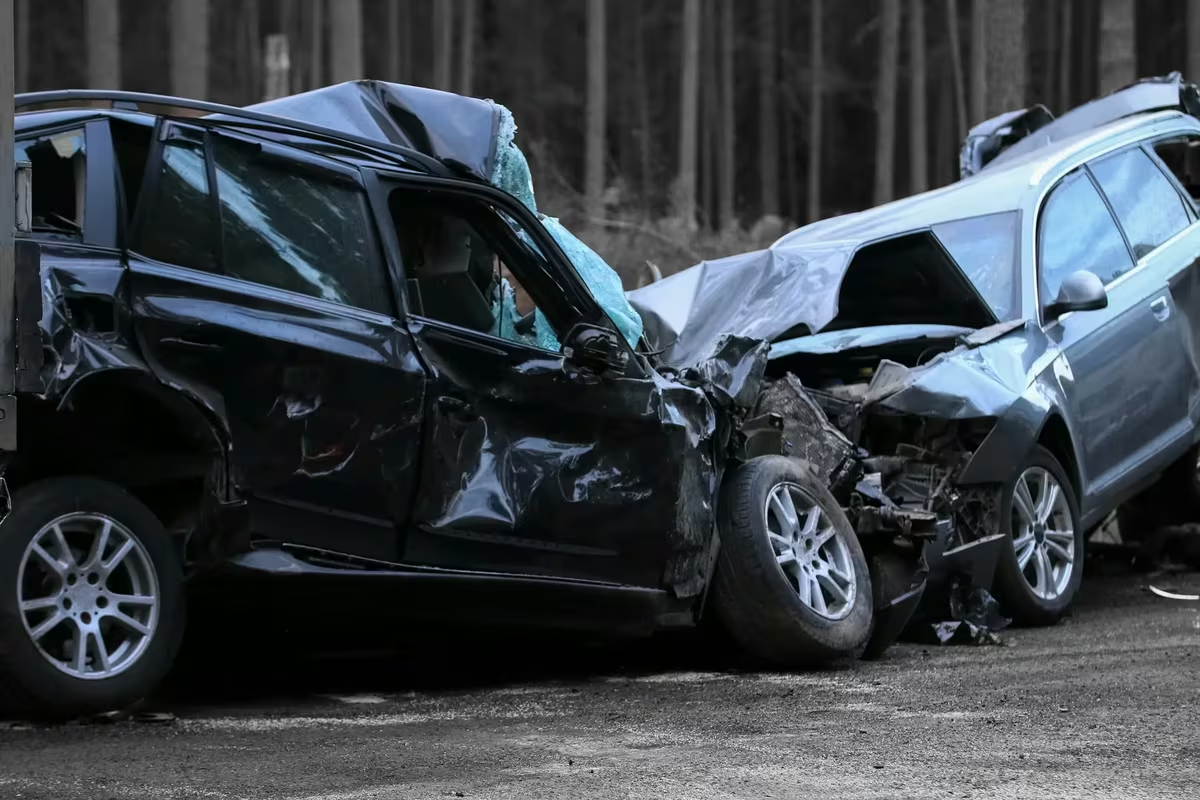 Car Accidents Rear-end, intersection, and highway collisions across Louisiana.
 -
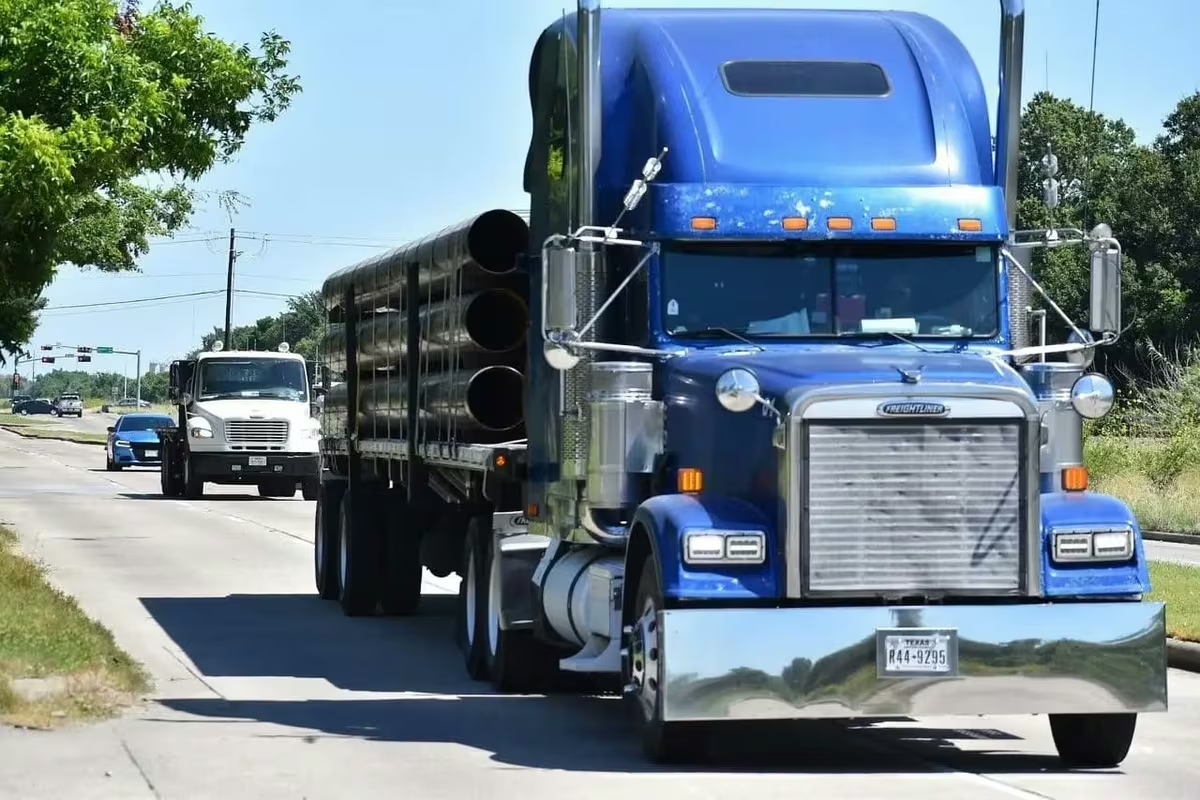 Truck Accidents 18-wheeler and commercial-vehicle wrecks governed by federal trucking rules.
 -
 Motorcycle Accidents Serious-injury motorcycle crashes where bias against riders is common.
 -
 Pedestrian Accidents Crosswalk and roadway pedestrian injuries with high-stakes liability.
 -
 Premises Liability Slip-and-fall and unsafe-property injuries on someone else's premises.
 - Slip & Fall Falls caused by wet floors, poor maintenance, and hidden hazards.
-
 Catastrophic Injury Brain, spinal-cord, amputation, and severe-burn injuries that change a life.
 -
 Brain Injury Traumatic brain injuries with long-term cognitive and physical effects.
 -
 Burn Injury Severe burns from fires, explosions, chemicals, and electrical contact.
 -
 Wrongful Death Claims brought by families after a fatal accident or act of negligence.
 -
 Product Liability Injuries caused by defective or unreasonably dangerous products.
 -
 Offshore Accidents Rig, platform, and vessel injuries beyond the shoreline.
 -
 Maritime & Jones Act Jones Act and general-maritime claims for seamen and vessel crews.
 -
 Workers' Compensation On-the-job injuries and the benefits owed to injured workers.
Types of Personal Injury Cases in Longview
Longview sits at the intersection of I-20 and US-259, two of East Texas’s highest-traffic corridors. US-80 and Loop 281 carry additional local and freight traffic through Gregg County. Car accidents on these routes range from minor collisions to multi-vehicle chain crashes.
ECM
Engine Control Module. The truck’s onboard computer that records pre-impact speed, braking, and throttle position. Also called the black box. Data can be overwritten within 30 days without a preservation demand.
Truck accidents are a consistent part of the Longview caseload. US-259 is a primary freight route connecting North Texas to the Gulf Coast. Longview’s rail and distribution infrastructure adds additional commercial vehicle volume. Truck accident claims are more complex than car accidents: multiple potentially liable parties, federal FMCSA regulations, ECM data that disappears without a preservation demand, and corporate defendants with active legal teams.
Motorcycle accidents carry distinct challenges. Bias against riders shows up early in insurance negotiations. Helmet use, lane position, and speed all become arguments for assigning fault to the rider. Texas does not require helmets for adults 21 and over who carry certain insurance, but the defense will raise helmet evidence regardless. Your attorney needs experience specifically with how insurance companies handle motorcycle claims.
Bus accident liability depends on who operated the vehicle. School buses involve governmental immunity rules that may limit or change the claims process. Charter buses and private carriers fall under FMCSA commercial vehicle regulations. Municipal buses bring sovereign immunity questions into the analysis. These are not standard auto accident claims.
Dram Shop Act
Tex. Alc. Bev. Code Section 2.02. Holds bars, restaurants, and other sellers of alcohol liable for injuries caused by obviously intoxicated customers they continued to serve.
Drunk driving accidents can extend liability beyond the driver. Texas Dram Shop Act liability under Tex. Alc. Bev. Code Section 2.02 applies when a licensed establishment continues serving someone who is obviously intoxicated. If a bar in Longview over-served the driver who hit you, the establishment may share liability alongside the driver.
Premises liability, catastrophic injuries, and wrongful death complete the picture. Texas uses the invitee/licensee/trespasser framework to determine what duty a property owner owed you. The category matters because the duty owed to a customer at a store differs from the duty owed to a social guest.
Catastrophic injury cases in Longview
Past results do not guarantee future outcomes; each case is decided on its own facts. See our full case results.
Workplace Injuries and Texas Workers’ Compensation Opt-Out
Texas is the only state where private employers can opt out of workers’ compensation entirely under Tex. Labor Code Section 406.002. This distinction determines everything about how your workplace injury claim proceeds.
Non-subscriber
A Texas employer that has opted out of workers’ compensation coverage. Non-subscribers lose three tort defenses: contributory negligence, assumption of risk, and the fellow servant doctrine. An injured employee can sue a non-subscriber employer for negligence without those defenses blocking recovery.
Non-subscriber employers lose the three defenses that protect subscribing employers in court. You don’t need to prove anything beyond the employer’s negligence. You can collect full economic and non-economic damages, not just the fixed schedule of workers’ comp benefits. These cases are substantially more favorable to injured workers.
The first question in any workplace injury case is: was your employer a subscriber or non-subscriber? Your employer is required to post notice of whether they carry coverage. Get that information before you decide how to proceed.
Oil field accidents are a significant East Texas category. Gregg County sits within the Permian Basin extension, and drilling, pipeline, and service operations are active throughout the region. These accidents typically involve multiple parties: the well operator, the drilling contractor, and multiple service companies. Each party will try to shift liability to the others. OSHA and TCEQ may both have jurisdiction depending on the nature of the incident. Identifying all responsible parties early is essential because the statute of limitations runs regardless of whether you’ve sorted out who’s liable.
Workers’ compensation claims in Longview
Your Longview Injury Attorneys
Founding partners Trey Morris and Justin Dewett lead every Longview injury case Morris & Dewett takes.


What Hospital Treats Serious Injuries in Longview?
Good Shepherd Medical Center at 700 E. Marshall Ave. is Longview’s Level II Trauma Center. Level II designation requires 24-hour immediate coverage by general surgeons, prompt availability of specialists, and full surgical capability. Serious injuries from Gregg County and surrounding East Texas counties are routed here.
Your initial treatment records from Good Shepherd establish the foundation of your personal injury claim. They document the injuries, the mechanism of injury, and the immediate medical response. Gaps in treatment create arguments for the defense. Consistent follow-up with your treating physicians builds a documented medical history that supports your damages.
Longview Regional Medical Center provides additional hospital resources in the area. Long-term treatment often involves specialists, physical therapists, and potentially out-of-area providers for complex injuries. All of these costs, present and future, are recoverable as economic damages when caused by someone else’s negligence.
Future medical costs are often the largest component of a serious injury claim. Documenting them involves life care planners and medical experts, not guesswork, and they require expert support to prove.
What Damages Does Texas Law Allow After a Personal Injury?
loss of earning capacity
The difference between what you could have earned over your working lifetime and what you can earn after the injury. Requires testimony from a vocational rehabilitation expert and an economist to quantify.
loss of consortium
A separate damage claim available to a spouse for the loss of companionship and support caused by the injured person’s condition. It is not the injured person’s claim. It belongs to the spouse.
Texas allows two categories of damages in personal injury cases. Economic damages cover your actual financial losses: past and future medical expenses, lost wages, loss of earning capacity, property damage, and out-of-pocket costs. Non-economic damages cover pain and suffering, mental anguish, disfigurement, and loss of consortium.
The Haygood rule limits medical expense recovery to amounts actually paid or incurred, not the full amount billed. If your insurer negotiated a reduced rate, the at-fault party benefits from that reduction under CPRC Section 41.0105. Defense attorneys use this to reduce damage calculations. Your attorney needs an accurate account of what was actually paid before making a demand.
Exemplary damages
Texas’s term for punitive damages under CPRC Section 41.008. Available only when clear and convincing evidence shows fraud, malice, or gross negligence. Capped at the greater of two times economic damages plus up to $750,000 in non-economic damages, or $200,000.
Exemplary damages require proof of fraud, malice, or gross negligence by clear and convincing evidence under CPRC Section 41.008. The cap applies in most cases. Certain felony conduct removes the cap: murder, aggravated assault, and sexual assault. These are the exception, not the rule.
Medical malpractice has its own damage framework. Non-economic damages are capped at $250,000 per individual healthcare provider and $500,000 across all institutions under CPRC Section 74.301. There is no cap on economic damages in med mal cases. Additionally, you must serve an expert report within 120 days of filing under Section 74.351. Failure to do so results in mandatory dismissal with prejudice.
What clients say
- ★★★★★
I hired Morris and Dewett back in November of 2025.
They helped me get through my hard times of being off work, stress, and worry. Anytime I had a question I could call and they always had an answer. Very nice and professtional people. Thank you Morris and Dewett for making this an easy process for me and my family.
- ★★★★★
Morris and Dewett and their team of attorneys and staff go above and beyond.
They always were there to support me and answer all my questions after a shoulder injury that included multiple surgeries. They are caring and compassionate and that goes a long way! Highly recommended!
- ★★★★★
Thanks Morris and Dewett for the excellent work you have done on my behalf.
I want to personally thank Sarah for her kindness.
- ★★★★★
Morris & Dewett does things the right way!
They put their clients first in measurable and impactful ways.
- ★★★★★
First time being injured and needing a lawyer they where very helpful.
They answered my questions Id have very well. Highly recommend them.
- ★★★★★
Wonderful experience with Morris and DeWitt, everyone was articulate and punctual, and open to all my questions about the process.
My case couldn't have been handled by a better team! Caity Nerren, Jessica Christian, and Meghan Nolen were all fantastic and helped every step of the way. Thanks again for all of your hard work.
Reviews reflect individual client experiences. Past results do not guarantee future outcomes.
How Morris & Dewett Handles Longview Cases
Morris & Dewett handles personal injury cases for Longview, Marshall, Tyler, and East Texas clients. Our attorneys are admitted in Texas and licensed to litigate in Gregg County and across the state. Texas clients are served alongside our Louisiana caseload, using the same investigative and litigation approach.
ELD
Electronic Logging Device. Required on most commercial trucks since 2019. Records driving hours, speed, and location. Key evidence in truck accident cases because it documents whether the driver violated hours-of-service limits.
In truck and commercial vehicle cases, we send spoliation letters immediately after engagement. Those letters go to the carrier, the fleet manager, and any maintenance contractor. They demand preservation of ELD data, ECM data, maintenance records, driver qualification files, and any surveillance footage. Without a preservation demand, that evidence disappears on the carrier’s standard retention schedule. We send the letter before the insurer can move first.
contingency fee
A fee arrangement where the attorney is paid a percentage of the recovery and only if there is a recovery. No upfront cost. No fee if the case is unsuccessful.
Representation is on a contingency fee basis. There is no cost to consult with us, and no attorney fee unless there is a recovery. Initial consultations are evaluations: we tell you whether we think you have a viable claim and what the process looks like. No obligation.
Morris & Dewett attorneys hold the AV Preeminent rating from Martindale-Hubbell and Super Lawyers recognition. These are peer-evaluated credentials, not self-reported. AV Preeminent is the highest rating in the Martindale-Hubbell system, based on peer review by attorneys and judges. “Top-rated” and “best” are marketing language. AV Preeminent and Super Lawyers are verified.
Frequently Asked Questions
- How long do I have to file a personal injury lawsuit in Texas?
- Texas law gives you two years from the date of injury to file a personal injury lawsuit under CPRC Section 16.003(a). Miss the deadline and your claim is permanently barred regardless of how strong the case is. The clock starts on the date of the injury, not the date you first sought medical treatment. For wrongful death, the two years runs from the date of death under Section 16.003(b).
- What is proportionate responsibility and how does it affect my case?
- Proportionate responsibility is Texas's fault allocation system under CPRC Chapter 33. If you are found 51% or more at fault for your own injury, you recover nothing. At 50% or less, your damages are reduced proportionally. A $200,000 recovery where you are 20% at fault yields $160,000. Insurance adjusters routinely try to push the plaintiff's fault percentage above 50% to eliminate any recovery. Your attorney needs a documented fault analysis from the start.
- Does Texas allow me to sue the other driver's insurance company directly?
- No. Texas does not allow direct action against insurers. You file suit against the at-fault party, not their insurance company. The insurer defends the case and pays any judgment, but the lawsuit names the person who caused the injury. After obtaining a judgment or settlement, you can pursue the insurer for payment if necessary.
- What are Texas auto insurance minimums and what happens if the other driver has only the minimum?
- Texas requires minimum liability coverage of 30/60/25 under Tex. Transp. Code Section 601.072. That is $30,000 per person, $60,000 per accident, and $25,000 for property damage. When your damages exceed those limits, your own uninsured/underinsured motorist (UM/UIM) coverage becomes relevant. If you rejected UM/UIM in writing, it's not available. If you did not reject it in writing, it likely applies.
- What is the Stowers doctrine?
- The Stowers doctrine is a Texas common law rule requiring an insurer to accept a reasonable settlement demand within its policy limits when a prudent insurer would do so. If the insurer refuses and the plaintiff wins more at trial than the policy limit, the insurer is liable for the entire judgment, not just the policy. The three elements are: the demand is within coverage, the demand is within the policy limits, and a reasonably prudent insurer would have accepted it.
- What if my employer in Longview does not carry workers' compensation insurance?
- If your employer is a non-subscriber under Tex. Labor Code Section 406.002, you can sue them directly for negligence. Non-subscribers lose their three primary defenses: contributory negligence, assumption of risk, and the fellow servant doctrine. You only need to prove the employer was negligent. You are not limited to the fixed benefit schedule under workers' compensation and can recover full economic and non-economic damages.
- What is the difference between a wrongful death claim and a survival action in Texas?
- A wrongful death claim under CPRC Chapter 71 is brought by surviving family members (spouse, children, or parents) for their own losses from the death: lost financial support, loss of companionship, and grief. A survival action recovers the deceased person's own damages between the injury and the death: their pain and suffering, medical bills, and lost earnings. The two claims are separate and can be filed together. Only a spouse, children, or parents can bring a wrongful death claim in Texas.
- Can I recover punitive damages for a personal injury in Texas?
- Texas calls them exemplary damages under CPRC Section 41.008. They require clear and convincing evidence of fraud, malice, or gross negligence. The cap is the greater of: two times economic damages plus non-economic damages up to $750,000, or $200,000. The cap does not apply for certain felony conduct including murder and aggravated assault. Exemplary damages are awarded in a small percentage of personal injury cases. Their availability depends entirely on the defendant's conduct.
- Do I have a valid Texas personal injury claim?
- A valid personal injury claim requires four elements: duty (the defendant owed you a duty of care), breach (they violated that duty), causation (their breach caused your injury), and damages (you suffered actual harm). In a car accident, every driver owes a duty of reasonable care to others on the road. Running a red light breaches that duty. The injury and medical bills are the damages. If all four elements are present, you likely have a claim. Whether it's worth pursuing depends on the severity of the injuries, the available insurance coverage, and the clarity of the fault picture.
- How do oil field accident cases work in East Texas?
- Oil field accidents in Gregg County typically involve multiple potentially liable parties: the well operator, the drilling contractor, and various service companies. Each will attempt to assign liability to the others. The first step is identifying every party with a role in the operation and obtaining the relevant contracts, safety protocols, and equipment records. OSHA recordkeeping and TCEQ reports often contain pre-incident safety violations that establish the negligence picture. Texas workers' comp subscriber status also affects whether the worker files a compensation claim or a direct negligence lawsuit against the employer.
Last updated June 5, 2026