

Truck accidents on I-20 create complicated legal situations. Multiple parties. Federal regulations. Corporate defendants with in-house legal teams.
Morris & Dewett has handled truck accident cases for over 25 years.
Truck Accidents on I-20 Through Longview
I-20 through Gregg County is one of the highest-volume commercial freight corridors in East Texas, connecting Dallas to Shreveport with thousands of 18-wheelers per day. Longview sits at the junction of I-20 and US-259, making it a convergence point for truck traffic from multiple directions. I-20 is a primary east-west corridor connecting Dallas to Shreveport and the Gulf ports beyond. Thousands of 18-wheelers pass through every day. Loop 281 and US-259 add additional truck traffic within the Longview metro area.
The Federal Motor Carrier Safety Administration reported that 5,237 large trucks and buses were involved in fatal crashes in 2019 alone, a 2% increase from the prior year. The national trend continued upward after that. East Texas freight corridors carry a disproportionate share of that traffic given the region’s role as a distribution hub.
When a crash happens on I-20 or the surrounding corridors, Longview Regional Medical Center and Good Shepherd Medical Center are the primary acute care facilities in the area. Serious truck accident injuries often require trauma-level care. Documenting medical treatment from the first day matters for both your health and your legal claim.
View the Longview Texas injury lawyers practice overview
Who Can Be Held Liable in a Texas Truck Accident
Truck accident cases differ from car accident cases in one important way: the number of potentially liable parties. A collision with an 18-wheeler can involve the driver, the motor carrier that employed the driver, the company that loaded the cargo, and the manufacturer of any defective components. Each one may bear independent legal responsibility.
respondeat superior
Latin for “let the master answer.” A legal doctrine holding employers liable for negligent acts committed by employees within the scope of their employment.
Texas proportionate responsibility rules (CPRC Chapter 33) apply to all defendants. respondeat superior means the carrier is liable when the driver was acting in the scope of employment when the crash occurred. That is the baseline. But carriers can also face liability under their own independent theories.
negligent entrustment
A legal theory holding a vehicle owner or employer liable for knowingly allowing an unqualified, incompetent, or reckless person to operate a vehicle. Applies when the company knew or should have known about the driver’s unfitness.
negligent entrustment applies when the carrier put a driver behind the wheel knowing of disqualifying history, failed drug tests, or medical certifications that should have barred them. Negligent hiring and negligent supervision are parallel theories that go directly to the carrier’s conduct in selecting and overseeing the driver.
Shipper and loader liability applies separately. A company that improperly loaded or secured cargo can be named as a defendant even if they did not own the truck. Cargo shift, unsecured loads, and overloaded trailers cause catastrophic crashes. The responsible party in those cases is often not the carrier at all.
View wrongful death claims in Longview
How FMCSA Regulations Create Liability
FMCSA
Federal Motor Carrier Safety Administration. The federal agency that regulates commercial vehicles, sets safety standards, and enforces trucking rules including hours of service, vehicle inspections, and driver qualifications.
The FMCSA sets binding rules for every commercial carrier operating in interstate commerce. Violations of those rules do not merely suggest negligence. Under Texas law, violation of a federal safety regulation can establish negligence per se, meaning the carrier breached their legal duty as a matter of law.
HOS
Hours of Service. Federal rules limiting commercial drivers to 11 driving hours within a 14-hour on-duty window, with a mandatory 30-minute break after 8 hours.
HOS rules limit drivers to 11 hours of driving within a 14-hour on-duty window. They require a 30-minute break after 8 consecutive hours. They mandate 10 hours off-duty before a new shift. These rules exist because fatigue causes impairment equivalent to intoxication. When a carrier pressures drivers to exceed these limits, they assume liability for what happens.
ELD
Electronic Logging Device. A device installed in commercial trucks that automatically records driving time. Required by federal law since 2019. ELD data is key evidence in truck accident cases because it documents hours behind the wheel.
The ELD mandate took full effect in December 2019. Every commercial truck is required to have a device that records driving time automatically. That data does not lie. When an attorney sends a preservation demand immediately, the ELD file becomes one of the most powerful pieces of evidence in the case.
CDL
Commercial Driver’s License. A federally required license for operating vehicles over 26,001 lbs GVWR, vehicles carrying hazardous materials, or vehicles transporting 16+ passengers.
Carriers must also maintain CDL driver qualification files (DQFs) that document hiring background, medical certificates, drug and alcohol test records, and motor vehicle record checks. Vehicle inspection and maintenance requirements under 49 CFR Part 396 require pre-trip inspections and documented repair histories. The FMCSA Compliance, Safety, Accountability portal makes each carrier’s violation history publicly searchable.
Pulling CSA scores and DQF records early in a case often reveals a pattern of violations that strengthens the damages case significantly.
What We Handle
Longview Practice Areas
-
 Car Accidents Rear-end, intersection, and highway collisions across Louisiana.
 -
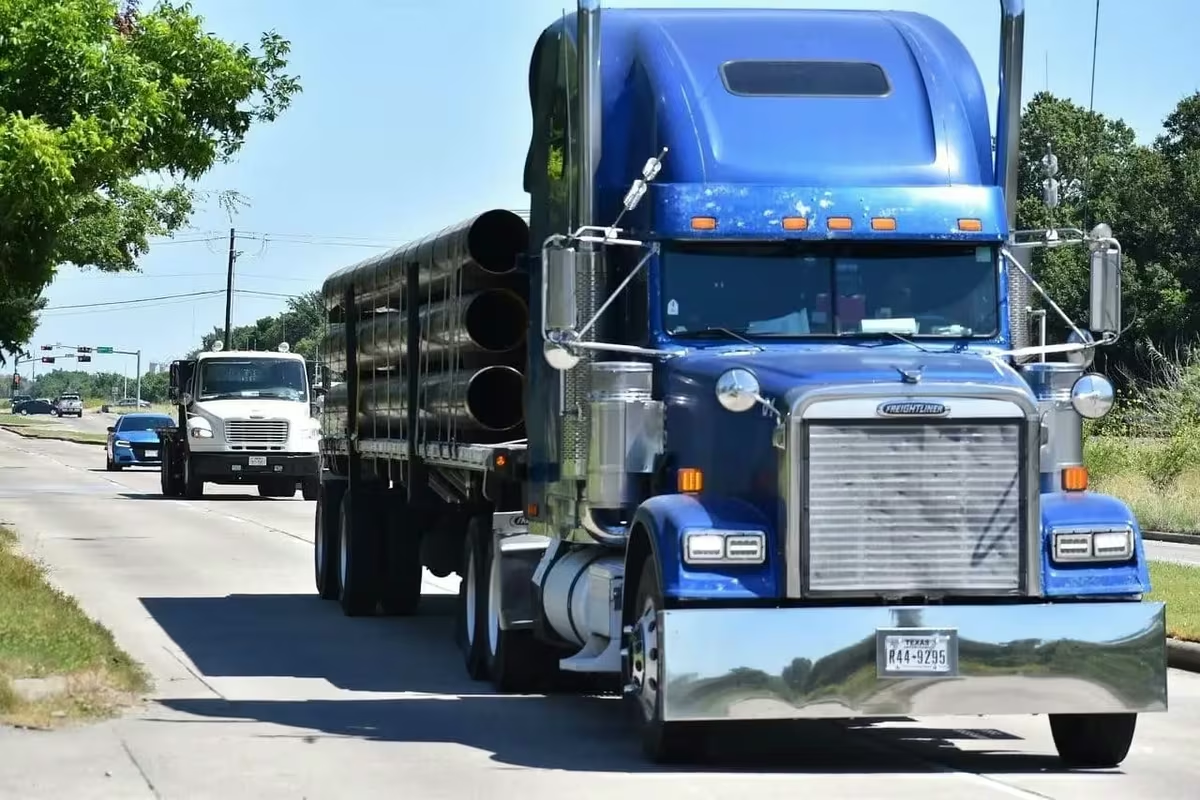 Truck Accidents 18-wheeler and commercial-vehicle wrecks governed by federal trucking rules.
 -
 Motorcycle Accidents Serious-injury motorcycle crashes where bias against riders is common.
 -
 Pedestrian Accidents Crosswalk and roadway pedestrian injuries with high-stakes liability.
 -
 Premises Liability Slip-and-fall and unsafe-property injuries on someone else's premises.
 - Slip & Fall Falls caused by wet floors, poor maintenance, and hidden hazards.
-
 Catastrophic Injury Brain, spinal-cord, amputation, and severe-burn injuries that change a life.
 -
 Brain Injury Traumatic brain injuries with long-term cognitive and physical effects.
 -
 Burn Injury Severe burns from fires, explosions, chemicals, and electrical contact.
 -
 Wrongful Death Claims brought by families after a fatal accident or act of negligence.
 -
 Product Liability Injuries caused by defective or unreasonably dangerous products.
 -
 Offshore Accidents Rig, platform, and vessel injuries beyond the shoreline.
 -
 Maritime & Jones Act Jones Act and general-maritime claims for seamen and vessel crews.
 -
 Workers' Compensation On-the-job injuries and the benefits owed to injured workers.
Evidence That Determines Truck Accident Cases
The evidence in a truck accident case starts disappearing within 30 days of the crash. This is not a figure of speech. It is how trucking company data retention policies work, and it is one of the primary reasons that acting promptly matters.
ECM
Engine Control Module. The truck’s onboard computer that records pre-impact speed, braking, throttle position, and other data. Sometimes called the “black box.” Data can be overwritten within 30 days without a preservation demand.
preservation letter
A formal legal demand sent to the trucking company requiring them to preserve all evidence related to the crash. Stops the carrier from overwriting black box data or destroying driver logs on their normal retention schedule.
The ECM records pre-impact speed, hard-braking events, throttle position, and other data in the seconds before a crash. Without a preservation letter, that data is gone on the carrier’s normal 30-day overwrite cycle. ELD records documenting actual hours driven face the same window.
The driver qualification file tells you who the carrier hired and what they knew about that driver. Medical certification records confirm whether the driver met federal health requirements. Drug and alcohol test history reveals whether the carrier caught and responded to prior violations. Vehicle maintenance records show whether the carrier knew about the defect and failed to repair it.
Spoliation
The destruction or alteration of evidence after a party has notice of pending litigation. Courts can instruct juries to assume the destroyed evidence was unfavorable to the party that destroyed it.
Dashcam footage from the truck and from nearby business surveillance cameras can show lane changes, speed, and road conditions. Police crash reports from the Texas Department of Public Safety provide the official record but are rarely the whole story. Spoliation doctrine protects against carriers who destroy evidence after receiving a demand, but the demand has to arrive first.
View catastrophic harm cases in Longview
Past results do not guarantee future outcomes; each case is decided on its own facts. See our full case results.
How Long Do You Have to File a Texas Truck Accident Lawsuit?
Texas gives injured people two years to file a personal injury lawsuit under CPRC Section 16.003. That clock runs from the date of the accident. Wrongful death claims have the same two-year period running from the date of death under Section 16.003(b).
Two years sounds like a long time. It is not, for this type of case. The preservation window for ECM and ELD data is 30 days. Witness memories fade within months. Carrier personnel change. The practical deadline for preserving the strongest evidence is far shorter than the legal deadline to file.
Tolling applies in specific situations. Minors injured before age 18 have until their 20th birthday to file. The discovery rule extends the deadline when an injury was inherently undiscoverable despite reasonable diligence, but courts apply this exception narrowly.
One additional timing issue specific to truck accident cases: after you file suit, the carrier’s defense team can designate responsible third parties under CPRC Section 33.004. You have 60 days after that designation to add the third party as a defendant or lose the ability to pursue them. Miss that window and a potentially liable party escapes the lawsuit entirely.
Your Longview Injury Attorneys
Founding partners Trey Morris and Justin Dewett lead every Longview injury case Morris & Dewett takes.


What Truck Accident Injuries Cost
Truck accident injuries are different in magnitude from car accident injuries. An 18-wheeler can weigh 80,000 lbs at full load. A passenger vehicle weighs 3,000 to 5,000 lbs. The physics produce injuries that car accident cases rarely see: traumatic brain injury, spinal cord damage, internal organ trauma, crush injuries, and amputations. Paralysis and amputation cases involve lifelong care costs that require expert economic analysis.
loss of earning capacity
The difference between what you could have earned over your working lifetime and what you can earn now after the injury. Calculated by a vocational expert and converted to present value by an economist.
Texas law allows recovery of economic and noneconomic damages in truck accident cases. Economic damages cover past and future medical expenses, lost wages, loss of earning capacity, and rehabilitation costs. loss of earning capacity in severe injury cases often exceeds the medical costs because it projects decades of reduced income.
loss of consortium
A legal claim available to a spouse for the loss of companionship, affection, and support caused by the injured person’s condition. It is a separate damage category from the injured person’s own claims.
Noneconomic damages cover pain and suffering, physical impairment, mental anguish, and loss of consortium. Texas does not cap noneconomic damages in truck accident cases. The caps in CPRC Chapter 74 apply to medical malpractice only.
The Texas modified collateral source rule under CPRC Section 41.0105 limits medical expense recovery to amounts actually paid or incurred, not full billed amounts. The Texas Supreme Court in Haygood v. De Escabedo, 356 S.W.3d 390 (Tex. 2012) interpreted this rule: if your insurer negotiated a lower rate, the defendant is entitled to the benefit of that negotiation on the economic damages calculation.
Exemplary damages under CPRC Section 41.008 are available when gross negligence or malice is proven by clear and convincing evidence. In truck accident cases, a carrier with a documented history of HOS violations or a pattern of ignoring maintenance failures can present a viable exemplary damages claim.
View catastrophic harm cases in Longview
A case that looks like a policy-limits case based on current bills may be worth multiples of that once future medical expenses and lost earning capacity are quantified by a vocational expert and an economist.
Texas House Bill 19 and Trucking Cases
In 2021, Texas passed House Bill 19, which created a bifurcated trial structure for cases involving commercial motor vehicles. It is one of the most significant Texas-specific procedural rules you will not see covered on most legal websites. Understanding it matters if your case goes to trial.
Under HB 19, the jury hears evidence about the driver’s direct negligence in Phase 1. If the carrier has admitted that the driver was acting within the scope of employment, the carrier’s own independent negligence is withheld from the jury until Phase 2. That independent negligence includes negligent hiring, negligent training, and negligent supervision. The carrier only faces Phase 2 if the Phase 1 jury finds the driver liable.
The practical effect is that plaintiff attorneys must build a strong Phase 1 case focused on the driver before they can present the carrier’s independent violations to the jury. HB 19 does not eliminate carrier liability. It controls the sequence in which the jury learns about it.
HB 19 applies specifically to commercial motor vehicles as defined by the statute, under CPRC Chapter 72. Not every commercial vehicle accident triggers the bifurcation rule. Whether HB 19 applies to your case depends on the vehicle type and the claims you bring.
This is one of the reasons that truck accident cases require attorneys with specific Texas commercial vehicle experience. An attorney unfamiliar with HB 19 sequencing can inadvertently limit the damages case at trial.
What clients say
- ★★★★★
I hired Morris and Dewett back in November of 2025.
They helped me get through my hard times of being off work, stress, and worry. Anytime I had a question I could call and they always had an answer. Very nice and professtional people. Thank you Morris and Dewett for making this an easy process for me and my family.
- ★★★★★
Morris and Dewett and their team of attorneys and staff go above and beyond.
They always were there to support me and answer all my questions after a shoulder injury that included multiple surgeries. They are caring and compassionate and that goes a long way! Highly recommended!
- ★★★★★
Thanks Morris and Dewett for the excellent work you have done on my behalf.
I want to personally thank Sarah for her kindness.
- ★★★★★
Morris & Dewett does things the right way!
They put their clients first in measurable and impactful ways.
- ★★★★★
First time being injured and needing a lawyer they where very helpful.
They answered my questions Id have very well. Highly recommend them.
- ★★★★★
Wonderful experience with Morris and DeWitt, everyone was articulate and punctual, and open to all my questions about the process.
My case couldn't have been handled by a better team! Caity Nerren, Jessica Christian, and Meghan Nolen were all fantastic and helped every step of the way. Thanks again for all of your hard work.
Reviews reflect individual client experiences. Past results do not guarantee future outcomes.
Steps to Take After a Truck Accident in Longview
If you were in a truck accident on I-20, Loop 281, or anywhere in the Longview area, the actions you take in the first 30 days shape the evidence available for your case. Here is what matters.
Call 911 immediately. Request medical assistance even without obvious injury. Get a crash report number from the Texas Department of Public Safety or the responding Gregg County Sheriff’s Office officer. Photograph every vehicle, the truck’s DOT number and carrier name on the door, license plates, skid marks, and road conditions before vehicles are moved.
Collect the names and contact information of all parties and witnesses. Do not provide a recorded statement to the carrier’s insurance company or their accident response team. These teams often arrive at crash scenes quickly and their goal is to document facts in a way that limits carrier liability.
Seek medical evaluation at Longview Regional Medical Center or Good Shepherd Medical Center, even if you do not feel seriously injured. Some injuries, including traumatic brain injury and internal organ trauma, do not produce immediate obvious symptoms. Gaps in early medical documentation create leverage for carriers to argue that your injuries came from somewhere else.
Contact an attorney before the 30-day ECM data window closes. The single most important reason to act promptly is preservation of black box and ELD evidence. That window is fixed. Nothing can reopen it after the data is overwritten.
Morris & Dewett handles truck accident cases in Texas and Louisiana. We have worked these cases for over 25 years. You can reach the firm through the contact app on this site.
Frequently Asked Questions
- How long do I have to file a truck accident lawsuit in Texas?
- Texas imposes a two-year statute of limitations for personal injury claims under CPRC Section 16.003(a). That period runs from the date of the accident. Wrongful death claims follow the same two-year period under Section 16.003(b), starting from the date of death. Missing this deadline ends your right to file, with very limited exceptions.
- Can I sue the trucking company, not just the driver?
- Yes. In most truck accident cases, the motor carrier is a proper defendant separately from the driver. Under the respondeat superior doctrine, the carrier is liable for the driver's negligence when the driver acted within the scope of employment. Carriers also face independent liability under negligent hiring, negligent training, negligent entrustment, and negligent supervision theories. Texas HB 19 affects the sequence in which jury hears carrier-specific evidence, but it does not shield the carrier from liability.
- What is the "black box" and why does it matter in a truck accident case?
- The ECM (Engine Control Module) is the truck's onboard computer. It records pre-impact speed, braking force, throttle position, and other data in the seconds before a crash. This data is often the clearest evidence of whether the driver was speeding, braking late, or driving unsafely. Without a preservation demand, ECM data is overwritten on the carrier's standard 30-day retention cycle. Attorneys must send this demand immediately after a crash to lock the data in place.
- What does Texas proportionate responsibility mean for my truck accident claim?
- Under CPRC Chapter 33, your damages are reduced by your percentage of fault. If you are found 50% or less at fault, you recover. If you are found 51% or more at fault, you recover nothing. This is a hard cutoff. Defense teams in truck accident cases often argue that the smaller vehicle contributed to the crash. An attorney with accident reconstruction resources can counter that argument before it reaches a jury.
- What FMCSA violations make a carrier liable?
- Any FMCSA regulation violation that contributed to the crash can support a negligence per se claim under Texas law. High-value violations include hours-of-service exceedances in ELD records and driver qualification file deficiencies showing the carrier hired an unqualified driver. Failure to maintain pre-trip inspection logs under 49 CFR Part 396 and CSA scores showing a pattern of violations are equally significant. A carrier with prior out-of-service orders for the same equipment that failed in your crash faces a strong negligence argument.
- Does Texas limit compensation in truck accident cases?
- Texas does not cap economic or noneconomic damages in truck accident cases. The damage caps in CPRC Chapter 74 apply only to medical malpractice claims. The modified collateral source rule under CPRC Section 41.0105 limits medical expense recovery to amounts actually paid or incurred, not full billed amounts. That rule affects the economic damages calculation but does not cap your total recovery. Exemplary damages under CPRC Section 41.008 are capped at the greater of two times economic damages plus up to $750,000 in noneconomic damages, or $200,000. They require clear and convincing evidence of gross negligence or malice.
- What should I do immediately after a truck accident on I-20 near Longview?
- Call 911, request medical assistance, and get a crash report number. Photograph the truck's DOT number, carrier name, license plates, and all vehicles. Do not give a recorded statement to the carrier's insurer. Seek medical evaluation at Longview Regional Medical Center or Good Shepherd Medical Center that day. Contact an attorney before the 30-day ECM data window closes. Evidence preservation is the most time-sensitive priority in the first 30 days.
- What is Texas HB 19 and how does it affect my truck accident case?
- Texas House Bill 19, effective September 1, 2021, created a bifurcated trial structure for commercial motor vehicle cases under CPRC Chapter 72. In Phase 1, the jury hears evidence about the driver's direct negligence. If the carrier has admitted the driver was in the scope of employment, evidence of the carrier's independent negligence (hiring, training, supervision) is withheld until Phase 2, which only happens if Phase 1 results in a finding against the driver. HB 19 does not eliminate carrier liability. It controls when the jury hears it, which affects how an attorney must structure the case from the start.
- Why should I hire a truck accident lawyer instead of handling my claim myself?
- Truck accident claims against carriers are contested by legal and insurance teams the carrier has on retainer specifically for these situations. Those teams act quickly to investigate, gather evidence, and build a defense. The evidentiary rules in Texas commercial vehicle cases, including HB 19 bifurcation and FMCSA regulatory framework, require knowledge that goes beyond general personal injury practice. An attorney who handles truck accidents regularly knows when to send preservation demands, how to pull CSA scores, how to retain accident reconstruction experts, and how to navigate HB 19 strategy. That specialized knowledge affects outcomes.
Last updated June 5, 2026