
How Motorcycle Accidents Happen on Longview Roads
proportionate responsibility
Texas’s fault-allocation system under CPRC Chapter 33. Your recovery is reduced by your percentage of fault. If your fault exceeds 50%, you recover nothing.
proportionate responsibility
Motorcyclists are 28 times more likely per mile traveled to die in a motorcycle accident than passenger car occupants, according to NHTSA data. That disparity is not random. It reflects the specific ways roads and driver behavior interact with motorcycles.
I-20 through Longview is the primary high-crash corridor. Heavy freight traffic and commuter volume create conditions where motorcycles disappear from drivers’ awareness. Lane changes without mirror checks are a recurring cause of sideswipe crashes on I-20’s multi-lane sections. See our Longview truck accident lawyers page for more on commercial vehicle liability.
Loop 281 and Highway 80 are secondary crash corridors with a different profile. Intersections and on-ramps on Loop 281 produce left-turn violations at a disproportionate rate. A driver turning left across oncoming traffic misjudges a motorcycle’s speed or fails to see it entirely. This is the single most common crash type for motorcyclists nationwide, and Longview’s road geometry concentrates it at predictable locations.
Road hazard exposure on Highway 80 frontage roads is also elevated. Potholes, debris, and crumbling pavement that a car drives through without incident can cause a motorcycle to lose control entirely. When a public road defect causes a crash, the City of Longview or TxDOT may be a responsible party, depending on who maintains that road segment.
One issue that frequently comes up in Texas motorcycle cases: lane splitting. It is not legal in Texas. Riders who split lanes when the crash occurs may have their proportionate responsibility percentage raised by the insurer. This is not automatic, and it does not bar recovery if fault stays at 50% or below, but it is a real exposure that changes the liability calculus.
Texas Helmet Law and How It Affects Your Case
Tex. Transp. Code 661.003
Texas’s motorcycle helmet statute. Requires helmets for all riders under 21. Riders 21 and over may ride without a helmet only if they have completed a TxDOT-approved motorcycle safety course or carry health insurance with at least $10,000 in medical benefits.
Tex. Transp. Code 661.003
Under Tex. Transp. Code 661.003, helmets are required for all riders under 21 with no exceptions. Riders 21 and over may ride without a helmet only if they have completed a TxDOT-approved motorcycle operator safety course or carry health insurance providing at least $10,000 in medical benefits. Riders 21 and over can ride without a helmet, but only if they meet one of two conditions: they have completed a motorcycle operator safety course approved by TxDOT, or they carry health insurance that provides at least $10,000 in medical benefits.
A rider who does not meet either exemption and rides without a helmet is technically violating state law. That violation will be raised by the insurance adjuster as a basis for increasing the rider’s proportionate responsibility share under CPRC Chapter 33. This is not a technicality. Adjusters build fault arguments around it deliberately.
Texas does not bar helmetless riders from recovery entirely. It is a proportionate responsibility factor, not an absolute bar. If your fault share stays at 50% or below, you still recover. The amount is reduced by your percentage. The adjuster’s job is to push that percentage high enough to eliminate or severely reduce your claim.
The more specific dispute is medical causation. If you were not wearing a helmet and sustained a head or brain injury, the insurer will argue the choice to forgo a helmet directly worsened the injury. Countering that argument requires a biomechanical or medical expert who can establish what a helmet would or would not have changed for the specific mechanism of this crash.
Morris & Dewett has handled motorcycle cases where helmet absence was raised as a fault basis. The approach starts with securing medical records early and identifying the right expert before the insurer has already built its narrative.
What We Handle
Longview Practice Areas
-
 Car Accidents Rear-end, intersection, and highway collisions across Louisiana.
 -
 Truck Accidents 18-wheeler and commercial-vehicle wrecks governed by federal trucking rules.
 -
 Motorcycle Accidents Serious-injury motorcycle crashes where bias against riders is common.
 -
 Pedestrian Accidents Crosswalk and roadway pedestrian injuries with high-stakes liability.
 -
 Premises Liability Slip-and-fall and unsafe-property injuries on someone else's premises.
 - Slip & Fall Falls caused by wet floors, poor maintenance, and hidden hazards.
-
 Catastrophic Injury Brain, spinal-cord, amputation, and severe-burn injuries that change a life.
 -
 Brain Injury Traumatic brain injuries with long-term cognitive and physical effects.
 -
 Burn Injury Severe burns from fires, explosions, chemicals, and electrical contact.
 -
 Wrongful Death Claims brought by families after a fatal accident or act of negligence.
 -
 Product Liability Injuries caused by defective or unreasonably dangerous products.
 -
 Offshore Accidents Rig, platform, and vessel injuries beyond the shoreline.
 -
 Maritime & Jones Act Jones Act and general-maritime claims for seamen and vessel crews.
 -
 Workers' Compensation On-the-job injuries and the benefits owed to injured workers.
Does Texas Proportionate Responsibility Apply Differently to Motorcyclists?
Stowers doctrine
A Texas common law rule holding that an insurer has a duty to accept a reasonable settlement demand within policy limits. If the insurer refuses and a larger verdict results, the insurer may be liable for the entire excess judgment above policy limits.
Stowers doctrine
Texas proportionate responsibility under CPRC Chapter 33 applies the same rule regardless of vehicle type: at 50% or less fault you recover, reduced by your percentage; at 51% or more you recover nothing. The statute does not treat motorcyclists differently.
In practice, motorcycle riders face documented perceptual bias from adjusters and jurors. The “they take risks” assumption affects how fault percentages are estimated in pre-litigation negotiations and how jurors evaluate credibility at trial. This bias is not an insurmountable barrier, but it is a real factor that needs to be addressed actively, not assumed away.
Evidence that counters it: dashcam footage from the at-fault vehicle establishing the driver’s behavior before impact; eyewitness accounts that place the driver’s action as the initiating cause; accident reconstruction establishing sight lines and vehicle speeds; and police report fault notations, which carry significant weight with adjusters.
The Stowers doctrine creates leverage in these cases. If the at-fault driver’s insurer has a reasonable settlement demand within policy limits in front of it and refuses, and a larger verdict results, the insurer can be liable for the entire judgment, not just the policy limit. This changes the negotiation dynamic when the insurer is being unreasonable.
Under CPRC Section 33.004, defendants can designate responsible third parties to split the fault allocation. A road authority, a vehicle manufacturer, or another driver might be designated to reduce the defendant’s share. You have 60 days after the designation to add them as a defendant. Missing that window closes an avenue of recovery. Your attorney needs to track it.
Past results do not guarantee future outcomes; each case is decided on its own facts. See our full case results.
Texas Auto Insurance Minimums and Coverage Gaps for Motorcyclists
Texas requires minimum liability coverage of 30/60/25 under Tex. Transp. Code 601.072: $30,000 per person, $60,000 per accident, $25,000 property damage. Serious motorcycle injuries exceed that $30,000 per-person limit quickly. A single surgery for a femur fracture, a week in the ICU at Christus Good Shepherd Medical Center, or a skin graft procedure for road rash can each independently approach or exceed that limit.
UM/UIM
Uninsured/Underinsured Motorist coverage. Pays you when the at-fault driver has no insurance (UM) or insufficient insurance (UIM) to cover your damages. Texas law requires insurers to offer it with every auto policy.
When the at-fault driver carries only the minimum, your own UM/UIM coverage becomes the primary recovery source. Under Tex. Ins. Code Chapter 1952, insurers must offer UM/UIM with every auto policy. The insured can reject it in writing. If not rejected, it defaults to the liability limits. Many people do not realize they have it or what it covers.
Motorcycle policies can carry separate UM/UIM endorsements. The coverage structure for a motorcycle policy is not identical to a standard personal auto policy. Verify your own coverage with an attorney before assuming what you have. Hit-and-run scenarios on I-20 are a real exposure. If the at-fault driver flees and is never identified, your UM coverage is the only source of recovery for your injuries.
See the Longview injury lawyers hub for the full practice area overview.
Your Longview Injury Attorneys
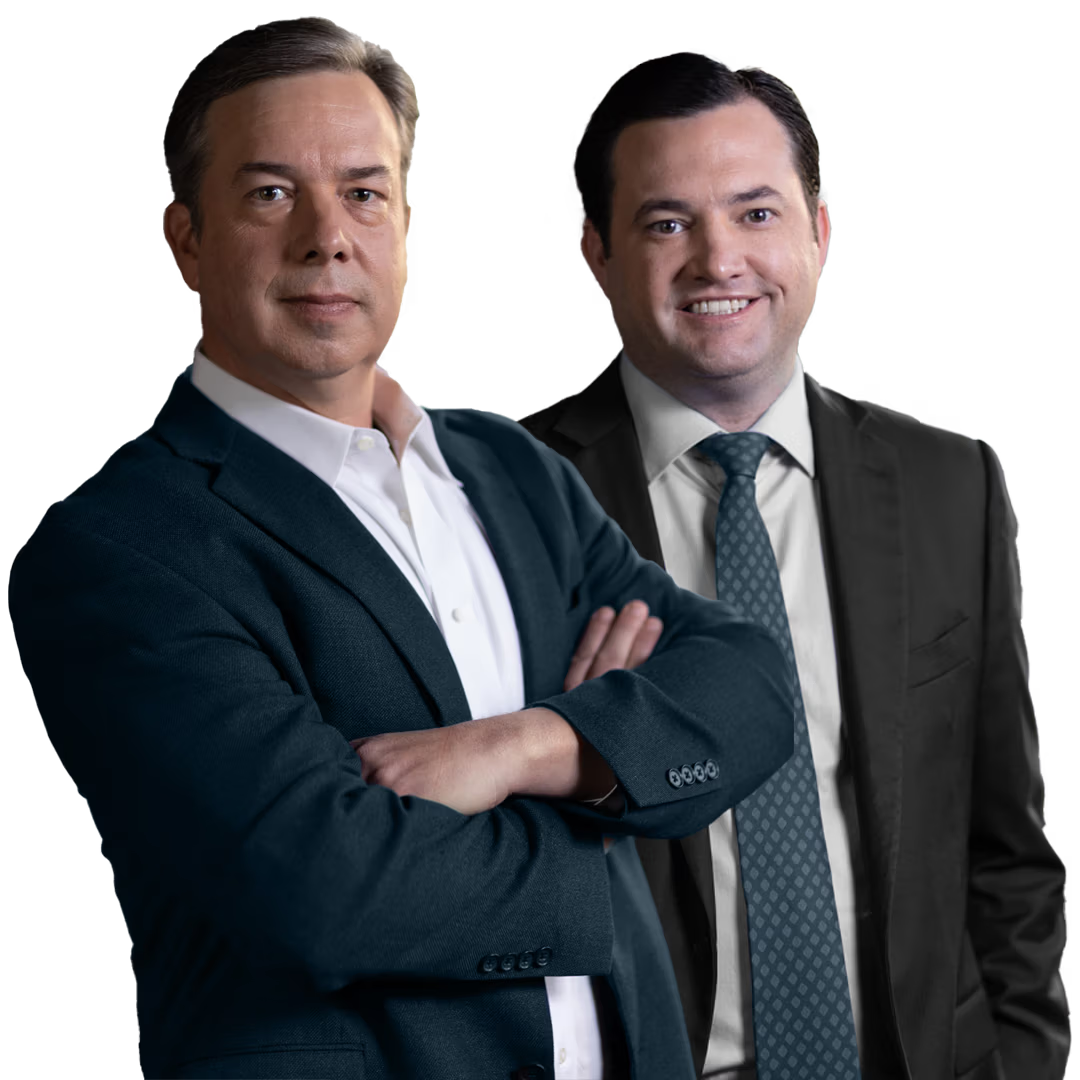
Founding partners Trey Morris and Justin Dewett lead every Longview injury case Morris & Dewett takes.


What Motorcycle Injuries Mean for Your Claim
MMI
Maximum Medical Improvement. The point at which your treating physician determines your condition has stabilized and further treatment will not significantly improve the outcome. The timing of MMI affects when your damages can be fully calculated.
MMI
Motorcycle crashes produce a predictable injury spectrum, and each category carries a distinct damages profile that shapes claim value differently.
TBI
Traumatic Brain Injury. Physical damage to the brain caused by external force. Can range from concussion to severe diffuse axonal injury. Long-term cognitive and behavioral effects are common and may not be fully apparent for months after injury.
Traumatic brain injury occurs even with a properly worn helmet at sufficient impact speeds. TBI severity determines the long-term care cost projections and loss of earning capacity calculations. A mild TBI with full recovery has a different valuation than a moderate TBI with permanent cognitive deficits. Both require specific expert testimony to establish damages correctly.
Spinal fractures and cord injuries represent the most catastrophic end of the spectrum. Partial or full paralysis requires a life care plan projecting lifetime medical costs, equipment needs, and attendant care. These projections require a certified life care planner and an economist to convert future costs to present value. The damages in these cases are substantial, and the insurer’s response is often to dispute the extent of the injury or the reasonableness of the projected care.
Road rash sounds minor and is often treated that way by adjusters. Full-thickness abrasion stripping multiple skin layers requires skin graft surgery, carries infection risk, and produces significant non-economic damages including scarring. The real economic cost of road rash treatment is routinely underestimated by insurers.
Fractures of the lower extremities (tibia, fibula, femur) involve hardware implantation, inpatient rehabilitation, and long-term orthopedic follow-up. Internal organ injuries from handlebar or pavement impact require immediate surgical evaluation. Both categories can have lasting consequences that extend well beyond the initial hospitalization.
The injury documentation timeline matters as much as the injuries themselves. Initial ER records at Christus Good Shepherd Medical Center, follow-up specialist records, and the MMI determination together define the evidentiary record for your claim. Gaps in treatment create openings for the insurer to argue that injuries either did not occur or were pre-existing. Consistent treatment documentation closes those gaps.
For catastrophic injuries, see our catastrophic injury claims page.
What clients say
- ★★★★★
I hired Morris and Dewett back in November of 2025.
They helped me get through my hard times of being off work, stress, and worry. Anytime I had a question I could call and they always had an answer. Very nice and professtional people. Thank you Morris and Dewett for making this an easy process for me and my family.
- ★★★★★
Morris and Dewett and their team of attorneys and staff go above and beyond.
They always were there to support me and answer all my questions after a shoulder injury that included multiple surgeries. They are caring and compassionate and that goes a long way! Highly recommended!
- ★★★★★
Thanks Morris and Dewett for the excellent work you have done on my behalf.
I want to personally thank Sarah for her kindness.
- ★★★★★
Morris & Dewett does things the right way!
They put their clients first in measurable and impactful ways.
- ★★★★★
First time being injured and needing a lawyer they where very helpful.
They answered my questions Id have very well. Highly recommend them.
- ★★★★★
Wonderful experience with Morris and DeWitt, everyone was articulate and punctual, and open to all my questions about the process.
My case couldn't have been handled by a better team! Caity Nerren, Jessica Christian, and Meghan Nolen were all fantastic and helped every step of the way. Thanks again for all of your hard work.
Reviews reflect individual client experiences. Past results do not guarantee future outcomes.
Evidence That Determines Motorcycle Accident Case Outcomes
The police crash report from the Longview Police Department or Gregg County Sheriff’s Office is the foundational document in every motorcycle accident case. It records the investigating officer’s observations, the parties involved, and often an initial fault notation. Errors in the narrative can be contested, but they must be contested before they harden into the insurer’s accepted version of events.
Dashcam footage from the at-fault vehicle or nearby businesses is time-sensitive. Most dashcam systems and commercial security cameras overwrite footage within 24 to 72 hours without a preservation demand. A preservation letter must go to the relevant parties within days of the crash. Waiting until representation is formal can mean the best evidence is already gone.
Cell phone records matter when distracted driving is a factor. Left-turn failures against motorcyclists frequently involve a driver who was looking at a phone in the seconds before the turn. Subpoenaing those records is a standard litigation step, but the subpoena has to be served before the carrier purges records on its retention schedule.
Accident reconstruction
A forensic engineering analysis of a crash that uses physical evidence, vehicle damage, road marks, and physics calculations to establish vehicle speeds, positions, and the sequence of events leading to impact.
Accident reconstruction is often necessary in motorcycle cases. Motorcycle crash mechanics are different from car-to-car crashes. A reconstructionist can establish sight lines from the at-fault driver’s position, calculate the motorcycle’s speed from physical evidence, and establish the point of impact. This evidence counters speculative fault arguments.
EDR
Event Data Recorder. The vehicle’s onboard module that captures pre-crash speed, braking, and acceleration data during the seconds before impact. Data can be overwritten in subsequent crashes. A preservation demand prevents it.
Black box data from the at-fault vehicle records pre-impact speed, braking, and throttle position. In newer vehicles, event data recorders EDR capture the last several seconds of vehicle operation. That data must be preserved before the vehicle is repaired or the EDR is overwritten. A preservation demand to the at-fault driver’s insurer is standard procedure.
Morris & Dewett works with accident reconstructionists, biomechanical experts, and life care planners on motorcycle cases.
For wrongful death motorcycle crashes, see our wrongful death page.
Frequently Asked Questions
- What is the statute of limitations for a motorcycle accident in Texas?
- Texas gives injured people two years to file a personal injury lawsuit under CPRC Section 16.003(a). The clock typically starts on the date of the crash. Wrongful death claims also carry a two-year deadline, running from the date of death under Section 16.003(b). Missing the deadline bars the claim entirely.
- Does Texas law require motorcyclists to wear a helmet?
- Under Tex. Transp. Code 661.003, helmets are required for all riders under 21 with no exceptions. Riders 21 and over may ride without a helmet only if they have completed a TxDOT-approved motorcycle operator safety course or carry health insurance providing at least $10,000 in medical benefits. Riding without a helmet and without meeting either exemption is a statutory violation.
- Can I still recover if I was not wearing a helmet at the time of the accident?
- Yes, in most cases. Texas proportionate responsibility under CPRC Chapter 33 does not bar recovery based on helmet absence alone. The insurer will raise it to increase your fault percentage. If your assigned fault stays at 50% or below, you still recover, reduced by that percentage. The more specific dispute is medical causation: the insurer will argue the lack of a helmet worsened your head injuries. A biomechanical or medical expert is needed to counter that argument with the specific mechanics of your crash.
- What does UM/UIM insurance cover for motorcycle accidents?
- UIM UM/UIM coverage pays you when the at-fault driver has no insurance (UM) or insufficient insurance to cover your damages (UIM). Under Tex. Ins. Code Chapter 1952, Texas insurers must offer UM/UIM with every auto policy. If the at-fault driver carries only the $30,000 Texas minimum and your medical costs exceed that, your own UIM coverage pays the gap up to your policy limits. Motorcycle policies carry their own UM/UIM endorsements -- verify your coverage with an attorney before assuming what applies.
- Is lane splitting legal in Texas?
- No. Lane splitting is not legal in Texas. Unlike California, Texas has no statute permitting motorcycles to ride between lanes of moving or stopped traffic. A rider who splits lanes at the time of the crash may have their proportionate responsibility percentage increased by the insurer as a result. This does not automatically bar recovery -- fault must reach 51% or more to eliminate it -- but it is a real factor that the insurer will use in fault negotiations.
- How does the Stowers doctrine affect motorcycle accident settlements?
- The Stowers doctrine is a Texas common law rule that creates insurer liability for unreasonable refusal to settle. If you make a reasonable settlement demand within the at-fault driver's policy limits and the insurer refuses, and a court later awards a verdict above those limits, the insurer can be liable for the full judgment, not just the policy amount. This applies when three conditions are met: the demand is within the scope of coverage, it is within policy limits, and an ordinarily prudent insurer would accept it. In motorcycle cases where injuries are severe and liability is clear, a Stowers demand changes the insurer's risk calculation significantly.
- What should I do immediately after a motorcycle accident in Longview?
- Get emergency medical attention first. Christus Good Shepherd Medical Center at 700 E Marshall Ave is the Level II Trauma Center for Gregg County. Do not decline medical evaluation at the scene. Call Longview police to generate a crash report -- you can order the report later through the Texas DPS Crash Report Online Purchase System. Get names and contact information from witnesses before they leave. Take photographs of both vehicles, road conditions, and any visible injuries. Do not sign any document or accept any payment from an insurance adjuster before speaking with an attorney. Early statements made without legal counsel can limit your recovery.
Last updated June 5, 2026