

Arcadia Injury Claims: Where They Are Filed and How They Work
Arcadia is the parish seat of Bienville Parish, a small town on Interstate 20 in north-central Louisiana, roughly midway between Shreveport to the west and Monroe to the east. If your injury claim does not settle, it is the parish where the case will be tried.
Louisiana is a civil law state, and that distinction shapes how a negligence claim is built. Claims here run on the duty-risk analysis of La. C.C. Art. 2315, not the common law framework used in most other states. You must establish duty, the scope of the risk, breach, causation, and damages, each on the evidence.
Civil injury suits for Bienville Parish are filed in the 2nd Judicial District Court at the Bienville Parish Courthouse in Arcadia. The Second Judicial District is unusual in that it serves three parishes together, Bienville, Claiborne, and Jackson, so the same district bench rotates among courthouses in Arcadia, Homer, and Jonesboro. A Bienville Parish crash is filed in Arcadia even though the same judges hear Claiborne and Jackson matters elsewhere in the district.
Serving Arcadia
Served from our Ruston office.
1831 N Trenton St, Ste 2
Ruston, LA 71270
Open 24/7 for injured Arcadia residents
Get directions →What Types of Cases We Handle in Bienville Parish
Morris & Dewett represents clients in Arcadia, Bienville Parish, and the surrounding parishes in cases involving:
- Car accidents
- Truck and 18-wheeler accidents
- Motorcycle accidents
- Pedestrian accidents
- Bicycle accidents
- Bus accidents
- Slip and fall accidents
- Premises liability
- Product liability
- Workplace and industrial accidents
- Oilfield accidents
- Wrongful death
Wrongful death claims for Bienville Parish families proceed under La. C.C. Art. 2315.2, which lets surviving spouses, children, and other named relatives recover for their own losses. Defective-product claims run under the Louisiana Products Liability Act, La. R.S. 9:2800.52, which sets the exclusive theories against a manufacturer.
Most Bienville Parish injury cases stay in state court at the 2nd JDC in Arcadia. Federal court in the Western District of Louisiana takes jurisdiction when the parties are citizens of different states and the amount in dispute exceeds $75,000, or when a federal statute controls. Morris & Dewett handles cases in both the Second Judicial District Court and the Western District, depending on the facts of the claim.
What We Handle
Arcadia Practice Areas
-
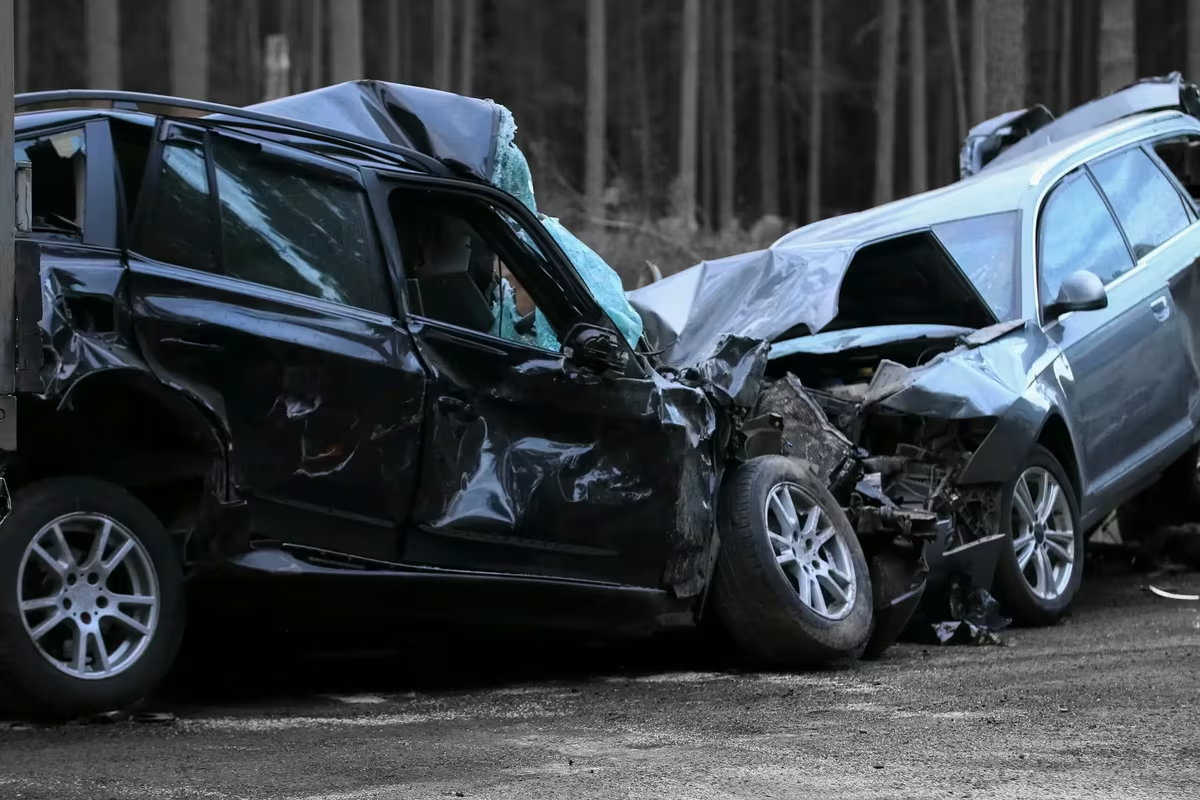 Car Accidents Rear-end, intersection, and highway collisions across Louisiana.
 -
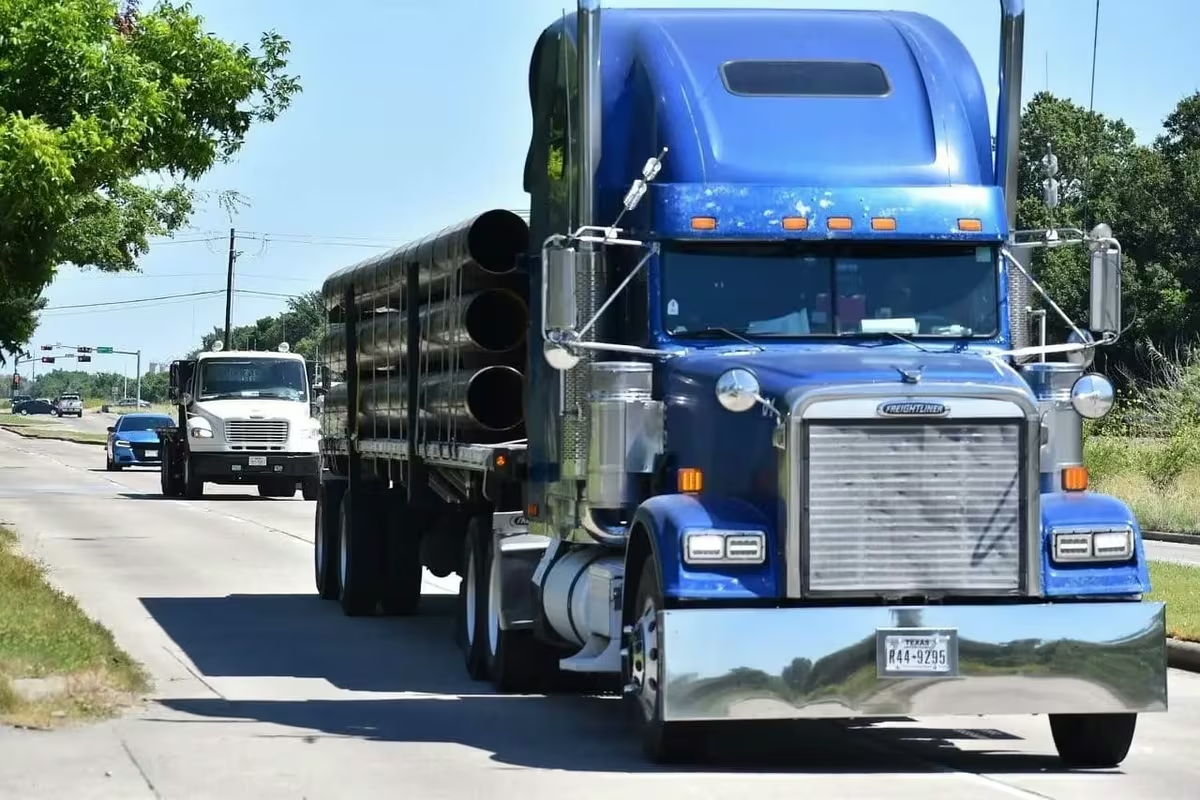 Truck Accidents 18-wheeler and commercial-vehicle wrecks governed by federal trucking rules.
 -
 Motorcycle Accidents Serious-injury motorcycle crashes where bias against riders is common.
 -
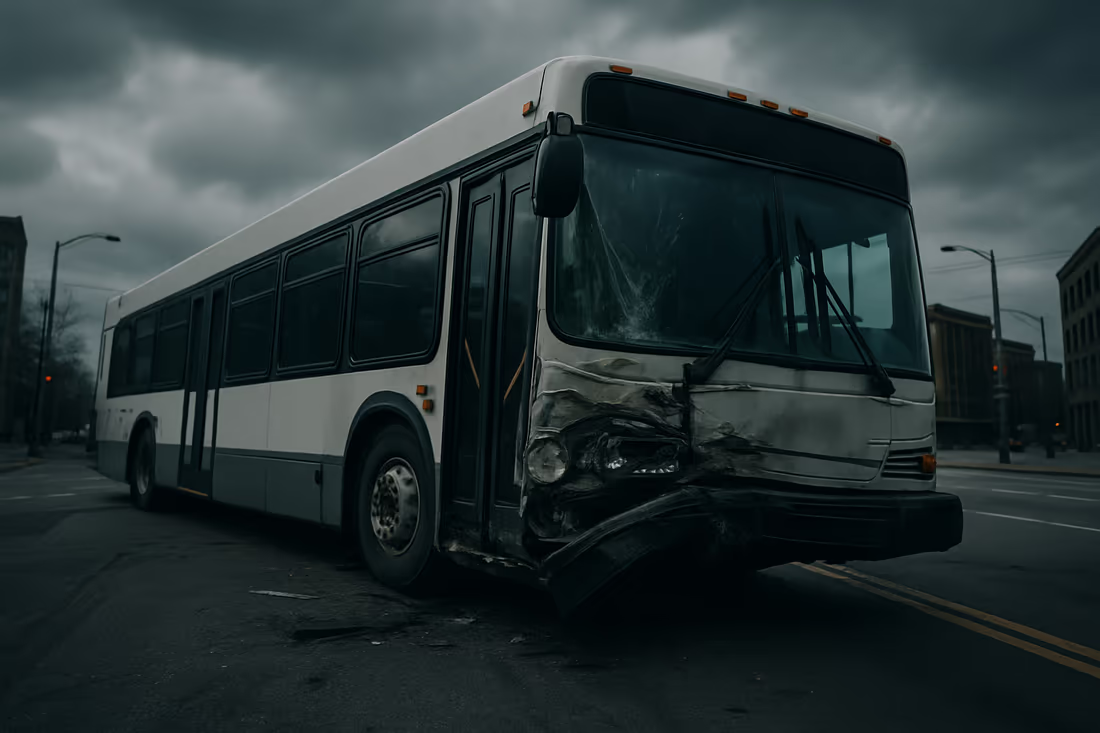 Bus Accidents Transit, school, and charter-bus crashes involving public and private carriers.
 -
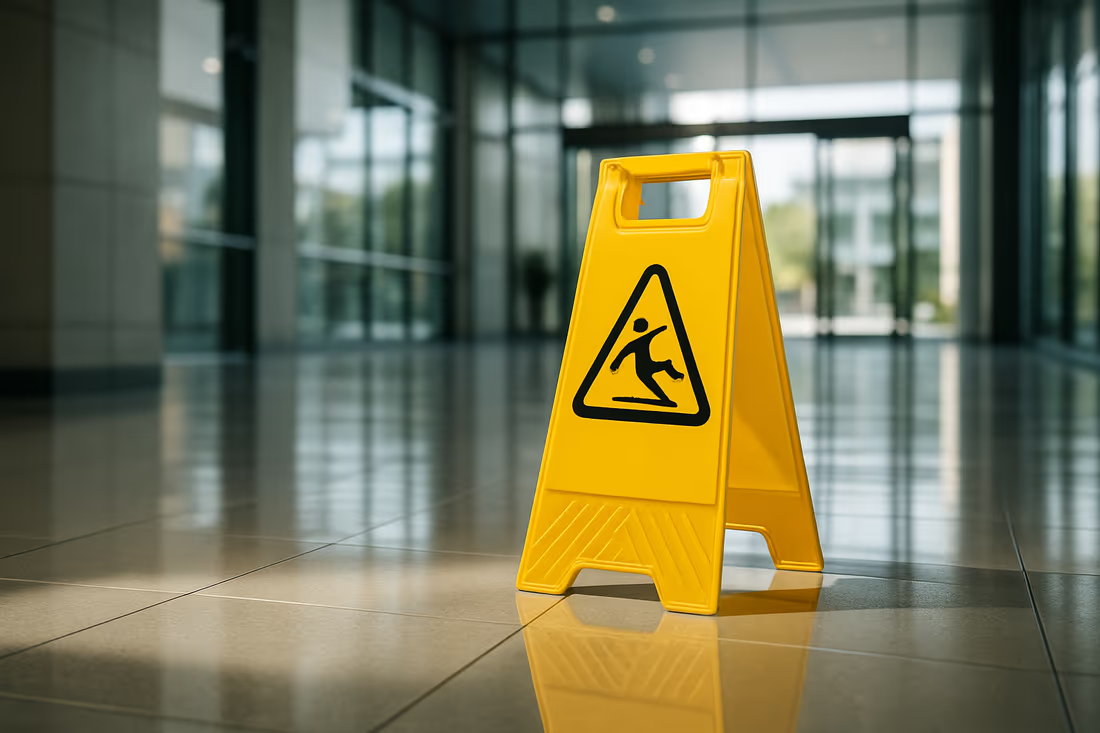 Slip & Fall Falls caused by wet floors, poor maintenance, and hidden hazards.
 -
 Catastrophic Injury Brain, spinal-cord, amputation, and severe-burn injuries that change a life.
 -
 Brain Injury Traumatic brain injuries with long-term cognitive and physical effects.
 -
 Burn Injury Severe burns from fires, explosions, chemicals, and electrical contact.
 -
 Wrongful Death Claims brought by families after a fatal accident or act of negligence.
 -
 Construction Accidents Falls, struck-by, and equipment injuries on the job site.
 -
 Offshore Accidents Rig, platform, and vessel injuries beyond the shoreline.
 -
 Workers' Compensation On-the-job injuries and the benefits owed to injured workers.
The corridor that runs through Arcadia is what gives the parish its crash volume. I-20 crosses Bienville Parish from east to west, carrying freight between the Shreveport-Bossier market and Monroe, and a steady share of that traffic is commercial trucking. A loaded tractor-trailer at interstate speed produces a different injury profile than a town-street collision, and a truck crash on I-20 brings a motor carrier, its insurer, and federal safety records into the case. U.S. 80 parallels the interstate through the parish, and Louisiana 9 and Louisiana 151 carry the local traffic into and out of Arcadia. Each route presents its own hazards, from high-speed interstate truck collisions to two-lane highway crashes on the parish roads.
The parish economy widens the range of injury contexts. Bienville Parish is rural and timber-and-agriculture oriented, with logging trucks, farm equipment, and oilfield service vehicles sharing the same two-lane highways as local drivers. Heavy-vehicle work carries its own injury risk, on the road and on the job. When a third party’s negligence causes a workplace injury, La. R.S. 23:1101 preserves the right to pursue a civil claim against that party in addition to workers compensation benefits.
Proving Negligence in Louisiana
To recover, you must prove the defendant was negligent. Louisiana’s duty-risk analysis requires five elements, and each must be established with evidence.
Duty. The defendant owed you a legal duty of care. Drivers owe a duty to others on the road. Property owners owe a duty to lawful visitors.
Scope of the risk. Your injury fell within the range of harm the duty was meant to guard against.
Breach. The defendant failed to meet the duty. Running a stop sign on a parish road is a breach. Leaving a wet floor unmarked in an Arcadia store is a breach.
Causation. The breach caused your injury. The connection between the conduct and the harm must be shown.
Damages. You suffered actual harm. Without measurable injury or loss, there is no compensable claim.
Negligence Per Se
When a defendant violated a safety statute and that violation caused your injury, the violation can establish duty and breach without separate proof. Traffic violations are the common example: a driver who ran a signal and struck you supplies the duty and breach, and the focus shifts to causation and damages.
Government and Premises Claims
Some Bienville Parish injuries involve a government defendant rather than a private one. A claim against the Town of Arcadia, the Bienville Parish Police Jury, or LaDOTD for a road defect, a dangerous condition, or a government vehicle runs on the same general prescriptive period as any other delict, with no pre-suit notice of claim required. The distinct rule under La. R.S. 13:5107 applies once the suit is filed: service of citation on the government defendant must be requested within 90 days of filing, or the suit may be dismissed without prejudice as to that defendant.
Louisiana’s Comparative Fault Law and the 51% Bar
Louisiana follows comparative fault, the rule that divides responsibility when more than one party contributed to an accident.
For causes of action arising on or after January 1, 2026, the state applies a modified comparative fault system under La. C.C. Art. 2323, enacted by Act 15 of the 2025 Regular Session (HB 431). If you are 51% or more at fault, you recover nothing. If you are 50% or less at fault, your damages are reduced by your percentage of fault.
In practice: say you were 20% at fault and your total damages are $100,000. You recover $80,000. At 51% fault, you recover zero.
That one-percentage-point line between 50% and 51% separates partial recovery from no recovery. Insurance carriers now have a direct financial incentive to argue you were more than half at fault, because pushing your share past 50% does not just shrink the payout, it eliminates it. Documentation, early investigation, and evidence preservation carry more weight in a Bienville Parish case because of this rule.
For injuries before January 1, 2026, pure comparative fault applies, and your damages are reduced by your fault percentage no matter how high it is.
Past results do not guarantee future outcomes; each case is decided on its own facts. See our full case results.
Louisiana Tort Reform: What Changed and When
Louisiana’s personal injury law changed substantially between 2024 and 2026. Here is what directly affects Bienville Parish claims.
Filing deadline. For injuries on or after July 1, 2024, you have two years to file suit (La. C.C. Art. 3493.1), enacted by Act 423 of the 2024 session. This replaced the one-year deadline in place since 1825. Product liability claims keep the one-year prescriptive period. Injuries before July 1, 2024 remain governed by the one-year rule. A prescriptive period is the legal filing deadline, and a Bienville Parish suit filed after it runs is usually dismissed even when liability is strong.
No Pay, No Play. Since August 1, 2025, a driver who carried no automobile insurance at the time of a crash cannot recover the first $100,000 in bodily injury damages or the first $100,000 in property damage, even if the crash was not their fault (La. R.S. 32:866).
Causation standard. For injuries on or after May 28, 2025, the absence of prior similar symptoms no longer creates a presumption that the accident caused the injury (La. Code Evid. Art. 306.1). Medical or expert testimony is now required on causation, so prompt and documented treatment matters more than before.
Medical expense recovery. For causes of action on or after January 1, 2026, recovery of past medical expenses is limited to amounts actually paid by your health insurer or Medicare plus your out-of-pocket costs (La. R.S. 9:2800.27).
Seat belt evidence. Since January 1, 2021, failure to wear a seat belt is admissible in civil cases and can support a comparative fault argument.
These changes apply prospectively. The law that governs your claim depends on when your injury occurred.
Damages You May Recover
If negligence is established, two main categories of damages are available.
Economic damages are measurable financial losses backed by bills, pay records, and repair estimates.
- Past and future medical costs
- Rehabilitation costs
- Lost wages and income
- Lost earning capacity
- Property damage
Non-economic damages compensate for human harm that carries no fixed bill.
- Pain and suffering
- Mental anguish
- Emotional distress
- Loss of enjoyment of life
- Loss of consortium and companionship
Punitive damages are a separate category aimed at punishment, not compensation. In Louisiana they apply only in narrow circumstances, such as DWI crashes and certain other statutory cases, and are not available in ordinary negligence claims.
There is no statutory cap on damages in general personal injury cases in Louisiana. Medical malpractice cases carry a separate $500,000 cap under La. R.S. 40:1231.2, which does not apply to car accidents, truck accidents, premises liability, or other general tort claims.
Uninsured and Underinsured Motorist Coverage
Approximately 12% of Louisiana drivers carry no automobile insurance, according to Insurance Research Council data, roughly one in eight on Bienville Parish roads. Uninsured motorist (UM) coverage is the part of your own policy that pays when the at-fault driver has none. Underinsured motorist (UIM) coverage activates when the at-fault driver’s insurance is not enough to cover your damages.
Louisiana requires insurers to offer UM coverage, and you can reject it in writing. Many drivers have rejected it without understanding what they gave up.
If an uninsured driver injured you, review your own policy before concluding there is no recovery. The fastest practical step is to pull the declarations page for every policy in your household, then confirm in writing whether UM/UIM was accepted and at what limits. That documentation helps your lawyer find available coverage before bills and lost wages push you toward an early low settlement.
Common Injuries
Physical injuries in these cases range from soft tissue damage to catastrophic harm. Common injuries include:
- Traumatic brain injury
- Spinal cord injury
- Neck and back injuries, including herniated discs
- Broken bones
- Amputation
- Severe burns
- Internal injuries
- Scarring and disfigurement
Not every injury shows at the scene. Concussion, internal bleeding, and disc injuries can develop over days, so prompt medical evaluation matters regardless of how you feel immediately after a crash.
Psychological injuries are recognized under Louisiana law. Anxiety, depression, post-traumatic stress disorder, and adjustment disorder can follow a serious accident and require diagnosis and documentation from a licensed mental health professional to support a claim.
Your Arcadia Injury Attorneys
Founding partners Trey Morris and Justin Dewett lead every Arcadia injury case Morris & Dewett takes.


What to Do After an Accident in Arcadia
1. Get medical attention
- Seek evaluation even if you do not believe you were seriously hurt.
- Records from the date of the accident are important evidence.
- Attend all follow-up appointments and follow your doctor’s instructions.
Prompt treatment protects your health and creates dated records that tie the accident to your injuries. Gaps in treatment are among the first things an insurer uses to challenge a claim. Bienville Medical Center in Arcadia handles emergency care close to home. For the most serious injuries, the nearest Level I trauma center is in Shreveport at Ochsner LSU Health, with additional trauma capacity in Monroe; either is the kind of facility equipped to handle traumatic brain injury, spinal cord injury, severe burns, and multiple fractures.
2. Report the incident
- In a car accident, call the police.
- In a workplace injury, notify your supervisor in writing.
- A formal report documents that the accident occurred.
A police report is among the first documents your attorney will request. It establishes that the accident happened, identifies the at-fault driver, records any citations, and captures the responding officer’s assessment. The Louisiana State Police work crashes on I-20 and the state highways through Bienville Parish; crashes on Arcadia town streets fall to the Arcadia Police Department, and unincorporated parish roads to the Bienville Parish Sheriff’s Office.
3. Gather evidence
- Photograph the scene, your injuries, and the property damage if you are able.
- Collect witness names and contact information.
4. Consult an attorney before speaking to the other side’s insurer
- Adjusters may contact you quickly after a crash.
- Their goal is to resolve the claim for as little as possible.
- A recorded statement given before you understand your injuries can be used against you.
- An attorney can advise you before that conversation happens.
5. Track deadlines and preserve documents
- Save towing invoices, pharmacy receipts, mileage logs, and every insurer letter or email in one place.
- Ask your providers for complete records and itemized billing, not just visit summaries.
- Early organization helps your lawyer value damages and avoid preventable deadline mistakes.
Why the 2nd Judicial District Matters for Your Case
Bienville Parish civil injury cases that go to trial are heard in the 2nd Judicial District Court at the courthouse in Arcadia. A civil jury seats 12 people, and 9 of the 12 must agree to return a verdict.
Because the Second Judicial District spans Bienville, Claiborne, and Jackson Parishes, the same bench of judges hears cases from all three, but a Bienville Parish jury is drawn from the Bienville Parish population, a different and smaller community than the urban pools in Shreveport or Monroe. The demographics, community context, and local knowledge jurors bring to a rural parish case differ from what an interstate truck defendant’s insurer is used to in a metro venue, and an attorney who understands the Bienville Parish pool has a practical advantage in deciding how to frame a case. The 2nd JDC also carries its own local rules, case management procedures, and judicial assignments, which come from working in that courthouse rather than from a statute book.
Why Choose Morris & Dewett
Morris & Dewett Injury Lawyers handles personal injury cases in Arcadia, Bienville Parish, and throughout North Louisiana. Both partners were raised in Northwest Louisiana and have practiced in these courts throughout their careers.
The firm is a member of the Multi-Million Dollar Advocates Forum, a national organization that recognizes trial attorneys for significant case results. View our case results to weigh the track record for yourself.
Morris & Dewett represents personal injury clients on a contingency fee basis. There is no attorney fee unless the firm recovers compensation for you. The fee percentage is agreed in writing at the outset, and court costs are advanced by the firm and deducted from the recovery. The initial consultation is free. If you want to talk through your case, contact us.
What clients say
- ★★★★★
I hired Morris and Dewett back in November of 2025.
They helped me get through my hard times of being off work, stress, and worry. Anytime I had a question I could call and they always had an answer. Very nice and professtional people. Thank you Morris and Dewett for making this an easy process for me and my family.
- ★★★★★
Morris and Dewett and their team of attorneys and staff go above and beyond.
They always were there to support me and answer all my questions after a shoulder injury that included multiple surgeries. They are caring and compassionate and that goes a long way! Highly recommended!
- ★★★★★
Thanks Morris and Dewett for the excellent work you have done on my behalf.
I want to personally thank Sarah for her kindness.
- ★★★★★
Morris & Dewett does things the right way!
They put their clients first in measurable and impactful ways.
- ★★★★★
First time being injured and needing a lawyer they where very helpful.
They answered my questions Id have very well. Highly recommend them.
- ★★★★★
Wonderful experience with Morris and DeWitt, everyone was articulate and punctual, and open to all my questions about the process.
My case couldn't have been handled by a better team! Caity Nerren, Jessica Christian, and Meghan Nolen were all fantastic and helped every step of the way. Thanks again for all of your hard work.
Reviews reflect individual client experiences. Past results do not guarantee future outcomes.
How to Request Records in Bienville Parish
The hospitals, police agencies, and courts that serve a Bienville Parish injury claim are mapped in the sections above, beside the steps where you need them. This is how to pull the documents those agencies hold.
Accident reports. The Arcadia Police Department handles reports for crashes on town streets within Arcadia. The Louisiana State Police, which work crashes on I-20 and the state highways through Bienville Parish, post reports at crashreports.dps.la.gov, typically 10 to 15 business days after the crash. For unincorporated parish roads, the Bienville Parish Sheriff’s Office records division handles the request. If you are unsure which agency responded, your attorney can obtain the report once you provide the date, location, and names of the parties.
Court filings. Civil suits are filed with the 2nd Judicial District Court for Bienville Parish at the Bienville Parish Courthouse in Arcadia; civil filings run through the Bienville Parish Clerk of Court. The same district also serves Claiborne Parish at Homer and Jackson Parish at Jonesboro, but a Bienville Parish crash is filed in Arcadia.
Driving records. Driving and vehicle-registration records come from the Louisiana OMV ExpressLane portal. A defendant’s prior violation history can be relevant evidence in some cases.
Frequently Asked Questions
- How long do I have to file a personal injury lawsuit in Arcadia?
- For injuries occurring on or after July 1, 2024, you have two years from the date of injury to file under La. C.C. Art. 3493.1. For injuries before that date, the prior one-year deadline applies under La. C.C. Art. 3492. Product liability claims keep a one-year prescriptive period regardless of the injury date. Some exceptions extend these deadlines. The discovery rule applies when an injury was not apparent at first. The deadline is tolled for claimants under age 18. Claims against the Town of Arcadia, the Bienville Parish Police Jury, or a state agency run on the same general prescriptive period, with no pre-suit notice required; the only special rule is that service of citation must be requested within 90 days after the suit is filed under La. R.S. 13:5107. Because a Bienville Parish suit that misses prescription is usually dismissed even when liability is clear, the safer course is to consult counsel promptly rather than assume time remains.
- What if I was partly at fault for the accident?
- For accidents occurring on or after January 1, 2026, Louisiana applies a 51% bar under La. C.C. Art. 2323. If you are 50% or less at fault, you recover your damages reduced by your fault percentage. If you are 51% or more at fault, you recover nothing. For accidents before January 1, 2026, pure comparative fault applies and your damages are reduced by your percentage no matter how high it runs. Fault is allocated on the evidence, so partial fault does not automatically end your claim. Early investigation and documentation produce a more accurate account of what happened on the road.
- What if my crash happened on I-20 through Bienville Parish?
- I-20 carries heavy freight traffic across Bienville Parish between Shreveport and Monroe, and truck collisions on that corridor are a recurring source of serious injury. A commercial-vehicle claim adds layers a passenger-car claim does not have, including a motor carrier's insurance, federal hours-of-service and inspection records, and the truck's electronic logging data. Those records can be lost or overwritten if no one preserves them. The Louisiana State Police work crashes on I-20, and counsel can move quickly to preserve a carrier's records before they cycle out of retention.
- What happens if the driver who hit me had no insurance or too little?
- Your own uninsured/underinsured motorist (UM/UIM) coverage may be your primary source of recovery. Louisiana requires insurers to offer UM coverage, but a driver can reject it in writing, and many people have without realizing it. Pull the declarations page for every policy in your household and confirm whether UM/UIM was accepted and at what limits. If you were in a commercial vehicle, rideshare, or bus, that vehicle's insurer may add coverage. Counsel can identify every available source before treatment bills force an early settlement.
- What is the No Pay, No Play rule in Louisiana?
- Louisiana's No Pay, No Play law (La. R.S. 32:866) applies to drivers who carried no automobile insurance at the time of a crash. Since August 1, 2025, an uninsured driver cannot recover the first $100,000 in bodily injury damages or the first $100,000 in property damage, even when the other driver was entirely at fault. Maintaining coverage protects both your legal obligations and your right to recover if you are hurt.
- My case involves the Town of Arcadia or a state highway. What changes?
- A claim against the Town of Arcadia, the Bienville Parish Police Jury, or a state agency such as LaDOTD runs on the same general prescriptive period as any other delict, now two years for injuries on or after July 1, 2024. Louisiana imposes no pre-suit notice of claim for a tort suit against a political subdivision. The special rule under La. R.S. 13:5107 comes after the suit is filed: service of citation on the government defendant must be requested within 90 days of filing, or the suit may be dismissed without prejudice as to that defendant. If a road defect, a dangerous condition, or a government vehicle contributed to your injury on an Arcadia street, a parish road, or I-20, consult an attorney promptly so the filing and service steps are handled correctly.
- Where will my Arcadia injury case be filed and tried?
- Civil injury suits for Bienville Parish are filed in the 2nd Judicial District Court at the Bienville Parish Courthouse in Arcadia. The 2nd Judicial District serves three parishes together, Bienville, Claiborne, and Jackson, so the same district bench hears cases from all three. If the case does not settle, a 12-person jury drawn from the Bienville Parish pool decides it, and 9 of the 12 jurors must agree to reach a verdict in a civil case. Some cases instead proceed in the U.S. District Court for the Western District of Louisiana when federal jurisdiction applies.
- Does it cost anything to hire Morris & Dewett?
- There is no attorney fee unless the firm recovers compensation for you. The fee is a contingency percentage agreed in writing before representation begins. Court costs and case expenses are advanced by the firm and deducted from the recovery if the case succeeds. The initial consultation is free.
- What should I bring to my first meeting with a personal injury lawyer?
- Bring the core documents that let counsel evaluate liability, damages, and deadlines quickly: the crash or incident report number, photos, witness names, your health insurance card, any medical records you already have, and all insurer correspondence. If a vehicle is involved, bring the declarations page showing your UM/UIM elections and policy limits. You do not need every record before the first meeting. A complete timeline with dates of treatment, missed work, and insurer contact is usually enough for the lawyer to identify immediate next steps and preservation tasks.
Last updated June 18, 2026