

LHWCA
Longshore and Harbor Workers’ Compensation Act. A federal workers’ compensation system covering maritime workers who are not Jones Act seamen, including longshoremen, dock workers, ship repairers, and offshore platform workers on fixed structures.
OCSLA
Outer Continental Shelf Lands Act. A federal statute (43 U.S.C. Section 1333) that extends federal jurisdiction and workers’ compensation coverage to workers on fixed offshore platforms on the Outer Continental Shelf, beyond 3 nautical miles from U.S. shorelines.
Morris & Dewett has handled offshore and maritime injury claims for over two decades.
East Texas Workers and Gulf Coast Offshore Claims
Tyler sits roughly 400 miles from the Gulf of Mexico. That distance doesn’t change the legal framework that governs your injury. East Texas workers travel to Gulf of Mexico platforms on rotational schedules: 7 days on and 7 off, 14 and 14, 28 and 28. Those commuting patterns create seaman status questions that insurers routinely exploit.
proportionate responsibility
Texas’s fault-based system under CPRC Chapter 33. If you are 51% or more at fault for your own injury, you recover nothing. At 50% or less, your damages are reduced by your percentage of fault. This rule does NOT apply to Jones Act claims. Federal maritime law uses pure comparative fault with no percentage bar.
Federal maritime law, not Texas state law, governs offshore injuries. The Jones Act, LHWCA, and OCSLA are the operative statutes. Texas proportionate responsibility rules under CPRC Chapter 33 do not apply to Jones Act claims. Under pure comparative fault in federal maritime law, there is no percentage bar. A worker who is 75% at fault can still recover 25% of damages. That distinction matters.
East Texas has a significant oil-field workforce. Permian Basin contractors, pipeline workers, and petrochemical workers often move between onshore and offshore assignments. If any part of your work involved a vessel or a fixed OCS platform, federal maritime law may cover your injury.
Offshore injury cases are not filed in Smith County District Court. They are filed in the Eastern District of Texas.
Jones Act Seaman Status: The Chandris Test
seaman
A maritime worker who qualifies for Jones Act protection. To qualify, your duties must contribute to a vessel’s function or navigation, and you must have a substantial connection to a vessel in navigation. Courts use a 30% time-at-sea threshold as a benchmark.
The Jones Act (46 U.S.C. Section 30104) gives seamen the right to sue their employer for negligence. It also entitles them to maintenance and cure. The threshold question is whether you qualify as a seaman in the first place.
Courts apply the Chandris test from Chandris, Inc. v. Latsis, 515 U.S. 347 (1995). It has two requirements. First, your duties must contribute to the vessel’s function or mission. Second, you must have a substantial connection to a vessel in navigation. Courts treat spending at least 30% of work time aboard a vessel as the benchmark. It is not a hard cutoff.
FPSO
Floating Production Storage and Offloading unit. A floating vessel used to process and store oil or gas produced from nearby platforms. Courts generally treat FPSOs as vessels in navigation for Jones Act purposes.
MODU
Mobile Offshore Drilling Unit. A floating drilling rig, including semi-submersibles and drillships, designed to move from location to location. Generally treated as a vessel for Jones Act purposes.
What counts as a vessel matters. Jack-up rigs, semi-submersible drilling rigs, drillships, crew boats, supply boats, and tender vessels are all vessels in navigation. FPSO units and MODU units are treated as vessels. Fixed platforms permanently attached to the seabed are not vessels. Workers injured on fixed platforms typically fall under LHWCA or OCSLA, not the Jones Act.
The borrowed servant doctrine applies when a staffing contractor supplies workers to an oil company operator. Both the contractor and the operator may be liable as Jones Act employers. Insurers dispute this frequently. Courts look at who controlled the details of the work, not just who signed the paycheck.
The statute of limitations for Jones Act claims is 3 years from the date of injury (46 U.S.C. Section 30106). Do not let that deadline pass without getting legal advice.
Maintenance and Cure Rights Under the Jones Act
Maintenance and cure are two separate obligations your employer owes you if you’re a Jones Act seaman injured aboard a vessel.
Maintenance
A daily living allowance paid by the Jones Act employer while an injured seaman is unable to work. Courts have ordered maintenance rates ranging from $35 to $55 per day and higher, depending on the seaman’s actual daily living expenses. The rate is not fixed by statute.
MMI
Maximum Medical Improvement. The point at which a physician determines your condition has stabilized and further treatment will not significantly change the outcome. The employer’s cure obligation continues until you reach MMI. The employer cannot unilaterally declare you at MMI to end medical payments.
Maintenance covers your daily living costs while you cannot work. Cure is the employer’s obligation to pay all reasonable and necessary medical expenses until you reach MMI.
Maintenance and cure is owed regardless of fault. You do not have to prove the employer was negligent to receive it. It runs concurrently with your Jones Act negligence claim. They are separate legal bases for recovery, not alternatives.
Employers sometimes refuse to pay or deliberately underpay. That is not a negotiating tactic with no consequences. If an employer willfully or wantonly fails to pay maintenance and cure, punitive damages are available under Atlantic Sounding Co. v. Townsend, 557 U.S. 404 (2009). Willful refusal means the employer knew what was owed and refused to pay it anyway.
The employer cannot terminate cure by unilaterally declaring you at MMI. Your treating physician controls that determination. If your employer’s company doctor says you’ve reached MMI but your own doctor disagrees, you have the right to contest it.
What We Handle
Tyler Practice Areas
-
 Car Accidents Rear-end, intersection, and highway collisions across Louisiana.
 -
 Truck Accidents 18-wheeler and commercial-vehicle wrecks governed by federal trucking rules.
 -
 Motorcycle Accidents Serious-injury motorcycle crashes where bias against riders is common.
 -
 Pedestrian Accidents Crosswalk and roadway pedestrian injuries with high-stakes liability.
 -
 Premises Liability Slip-and-fall and unsafe-property injuries on someone else's premises.
 - Slip & Fall Falls caused by wet floors, poor maintenance, and hidden hazards.
-
 Catastrophic Injury Brain, spinal-cord, amputation, and severe-burn injuries that change a life.
 -
 Brain Injury Traumatic brain injuries with long-term cognitive and physical effects.
 -
 Burn Injury Severe burns from fires, explosions, chemicals, and electrical contact.
 -
 Wrongful Death Claims brought by families after a fatal accident or act of negligence.
 -
 Product Liability Injuries caused by defective or unreasonably dangerous products.
 -
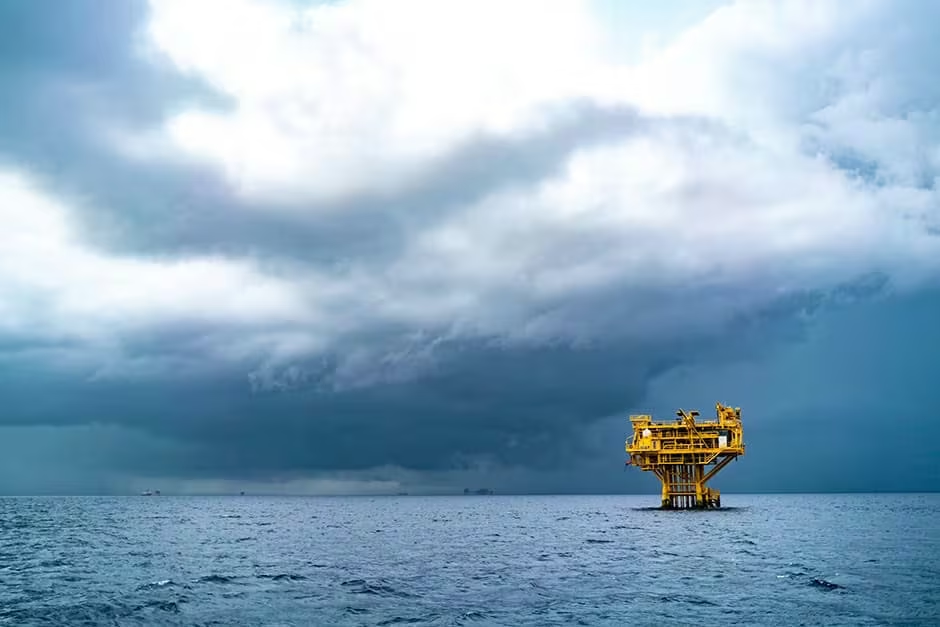 Offshore Accidents Rig, platform, and vessel injuries beyond the shoreline.
 -
 Maritime & Jones Act Jones Act and general-maritime claims for seamen and vessel crews.
 -
 Workers' Compensation On-the-job injuries and the benefits owed to injured workers.
What Is Unseaworthiness and How Does It Differ from Jones Act Negligence?
Unseaworthiness is a strict liability doctrine under general maritime law. You do not need to prove the vessel owner was negligent. You need to prove the vessel or its equipment was not reasonably fit for its intended purpose.
A vessel is unseaworthy if any part of it, including its appurtenances, fails that standard. Equipment covers cranes, winches, rigging, safety gear, tools, and machinery. The crew is also an appurtenance. An incompetent or understaffed crew makes a vessel unseaworthy. Slippery or unguarded decks, malfunctioning blowout preventers, faulty safety equipment, and improperly stowed materials are all unseaworthy conditions.
Unseaworthiness runs against the vessel owner, not the Jones Act employer. When the employer and vessel owner are different entities, unseaworthiness gives you a separate claim against the owner. A staffing agency providing workers to a platform operator is one common scenario. This is not an academic distinction. It directly affects who is a defendant and what insurance is in play.
The standard of proof is lower than negligence. Unseaworthiness is an absolute, non-delegable duty. The vessel owner cannot outsource that duty or hide behind a contractor. Unseaworthiness and Jones Act negligence are typically pled together. They overlap but remain legally distinct claims.
OCSLA Coverage: Fixed Offshore Platforms on the Outer Continental Shelf
OCS
Outer Continental Shelf. The submerged land and seabed of the United States beyond state coastal waters, generally starting 3 nautical miles from the shoreline (9 miles off Texas). Federal jurisdiction applies to all OCS installations.
The Outer Continental Shelf Lands Act (OCSLA, 43 U.S.C. Section 1333) governs workers on fixed platforms and drilling structures on the U.S. OCS. OCSLA extends federal jurisdiction to all fixed installations beyond 3 nautical miles from the shoreline. Off the Texas coast, that boundary sits 9 miles from shore, where the state’s coastal zone is wider.
OCSLA applies the LHWCA as the exclusive federal workers’ compensation remedy for covered OCS workers. Workers on fixed platforms who do not qualify as Jones Act seamen file claims under LHWCA, administered by the U.S. Department of Labor.
OCSLA also incorporates adjacent state law as surrogate federal law for issues not specifically addressed by federal statute. Off the Texas coast, Texas law fills gaps where federal law is silent. This creates a layered framework. Federal law governs first.
BSEE (Bureau of Safety and Environmental Enforcement) regulates offshore platform safety under OCSLA. BSEE inspection records, incident reports, and citations are key evidence in platform injury cases. The threshold question in most East Texas offshore injury cases is this: was the structure a fixed platform under OCSLA, or a floating vessel under the Jones Act? That single determination controls which body of law applies.
Insurance carriers and platform operators routinely argue the wrong classification to limit recovery.
Past results do not guarantee future outcomes; each case is decided on its own facts. See our full case results.
Who Does the LHWCA Cover and What Benefits Does It Provide?
The Longshore and Harbor Workers’ Compensation Act (33 U.S.C. Section 901 et seq.) covers maritime workers who do not qualify as Jones Act seamen. Covered workers include longshoremen, harbor workers, ship repairers, dock workers, and OCS workers on fixed platforms.
LHWCA provides medical benefits and disability compensation across four categories: temporary total, temporary partial, permanent total, and permanent partial disability. It also provides vocational rehabilitation. These benefits are available without proving fault.
LHWCA Section 905(b) creates a separate negligence claim against the vessel owner when the owner’s negligence contributed to the injury. That claim is in addition to your LHWCA workers’ comp benefits, not instead of them. It is a tort remedy layered on top of the compensation system.
The filing deadlines under LHWCA are strict. Notice of injury must be given within 30 days. A formal claim must be filed within one year of the injury or the last payment of compensation, whichever is later (33 U.S.C. Section 913). Missing these deadlines can bar your claim entirely. LHWCA claims are initially heard by Administrative Law Judges within the Department of Labor, not federal district court judges.
LHWCA proceedings follow different procedural rules than federal court. The Section 905(b) vessel negligence claim must be preserved alongside the compensation claim, which requires familiarity with DOL administrative practice.
Your Tyler Injury Attorneys
Founding partners Trey Morris and Justin Dewett lead every Tyler injury case Morris & Dewett takes.


Death on the High Seas Act (DOHSA)
The Death on the High Seas Act (46 U.S.C. Section 30301 et seq.) provides a federal wrongful death remedy for maritime deaths occurring beyond 3 nautical miles from U.S. shorelines. It is the exclusive federal remedy for qualifying deaths at sea.
Eligible claimants are the surviving spouse, parent, child, or dependent relative of the deceased worker. DOHSA damages are strictly limited to pecuniary losses: lost future income, loss of financial support, and funeral expenses. Non-pecuniary damages like loss of companionship and grief are not recoverable under DOHSA. This limitation distinguishes DOHSA from general maritime law wrongful death claims in closer waters, where non-pecuniary damages may be available.
For deaths in state waters (within 3 nautical miles), state wrongful death statutes or general maritime law governs instead. The 3-year statute of limitations applies under 46 U.S.C. Section 30306. When DOHSA applies, survivors cannot also bring state law claims for the same death. It is the exclusive remedy.
This limitation on non-pecuniary damages matters significantly to families. An attorney handling a DOHSA case must build the strongest possible pecuniary loss case. Lifetime income projection, benefits value, and future earning capacity are the claims. Pain and suffering damages are not available to offset a weak economic case.
Offshore Accident Causes and Evidence
Offshore accidents follow common patterns: blowouts, fires, crane failures, falls from height, chemical exposure (hydrogen sulfide, benzene, asbestos), and crew transport accidents. Each cause has a different evidentiary trail and potentially a different set of defendants.
BSEE incident reports and data from the Near Miss Voluntary Information Sharing System show documented safety violations and prior near-miss events. These records establish whether the responsible parties knew about a hazard before your injury.
OSHA’s Process Safety Management standard (29 CFR 1910.119) applies to offshore drilling and processing facilities handling highly hazardous chemicals. OSHA inspection records and citations are separate evidence sources from BSEE records. Both agencies may have documented the same hazard from different regulatory angles.
spoliation
Destruction or alteration of evidence after a party has notice of potential litigation. In maritime cases, courts can instruct juries to assume the destroyed evidence was unfavorable to the party that destroyed it.
Preservation demands should go out immediately after an offshore injury. The evidence you need includes: incident reports, safety logs, maintenance records, BSEE inspection records, crew manifests, drug and alcohol test results, radio logs, and CCTV footage. Maritime spoliation can occur when offshore operators follow normal retention and destruction schedules. A preservation letter stops that clock.
Multiple parties often share liability. In a typical offshore accident, the vessel owner, platform operator, drilling contractor, service company, and equipment manufacturer may each bear responsibility. Identifying all defendants early affects which insurance programs are triggered and how much total coverage is available.
What clients say
- ★★★★★
I hired Morris and Dewett back in November of 2025.
They helped me get through my hard times of being off work, stress, and worry. Anytime I had a question I could call and they always had an answer. Very nice and professtional people. Thank you Morris and Dewett for making this an easy process for me and my family.
- ★★★★★
Morris and Dewett and their team of attorneys and staff go above and beyond.
They always were there to support me and answer all my questions after a shoulder injury that included multiple surgeries. They are caring and compassionate and that goes a long way! Highly recommended!
- ★★★★★
Thanks Morris and Dewett for the excellent work you have done on my behalf.
I want to personally thank Sarah for her kindness.
- ★★★★★
Morris & Dewett does things the right way!
They put their clients first in measurable and impactful ways.
- ★★★★★
First time being injured and needing a lawyer they where very helpful.
They answered my questions Id have very well. Highly recommend them.
- ★★★★★
Wonderful experience with Morris and DeWitt, everyone was articulate and punctual, and open to all my questions about the process.
My case couldn't have been handled by a better team! Caity Nerren, Jessica Christian, and Meghan Nolen were all fantastic and helped every step of the way. Thanks again for all of your hard work.
Reviews reflect individual client experiences. Past results do not guarantee future outcomes.
Federal Forum: Eastern District of Texas
Offshore injury claims are federal cases. They are not filed in Smith County District Court. Admiralty jurisdiction under 28 U.S.C. Section 1333 governs Jones Act and general maritime law claims in federal district court.
The Eastern District of Texas handles East Texas offshore worker claims. The Tyler Division courthouse is at 211 West Ferguson Street, Tyler, Texas 75702. The Eastern District has a well-established docket for maritime and admiralty matters affecting Gulf Coast workers from East Texas.
Jones Act plaintiffs have the right to elect a jury trial. General maritime law claims for unseaworthiness and maintenance and cure may be tried as bench trials unless joined with a Jones Act claim. Joining the Jones Act claim preserves the right to a jury for all claims.
The Fifth Circuit Court of Appeals (New Orleans) handles appeals from the Eastern District of Texas in maritime matters. The Fifth Circuit covers the Gulf Coast region and has extensive offshore injury case law directly applicable to Gulf of Mexico platform and vessel claims.
Frequently Asked Questions
- Does Texas law or federal law cover my offshore injury?
- Federal law governs offshore injuries. The Jones Act (46 U.S.C. Section 30104), the LHWCA (33 U.S.C. Section 901), and OCSLA (43 U.S.C. Section 1333) are the operative statutes depending on your work situation. Texas proportionate responsibility rules under CPRC Chapter 33 do not apply to Jones Act claims. Federal maritime law uses pure comparative fault, with no percentage bar on recovery.
- How do I know if I qualify as a Jones Act seaman?
- Courts apply the Chandris test from Chandris, Inc. v. Latsis, 515 U.S. 347 (1995). It requires two showings. First, your duties contributed to the vessel's function or navigation. Second, you had a substantial connection to a vessel in navigation, generally meaning at least 30% of work time aboard. Workers on fixed platforms do not qualify as seamen under the Jones Act. Workers on drillships, jack-up rigs, crew boats, and supply vessels typically do. The analysis is fact-specific to your work assignment and rotation.
- What is the deadline to file an offshore injury claim?
- It depends on the statute. Jones Act claims have a 3-year statute of limitations (46 U.S.C. Section 30106). LHWCA claims require notice within 30 days and a formal claim within one year of injury (33 U.S.C. Section 913). DOHSA wrongful death claims have a 3-year limit (46 U.S.C. Section 30306). Missing any of these deadlines can bar your claim entirely. Get legal advice before the deadline, not after.
- Can I receive maintenance and cure and also sue for negligence?
- Yes. Maintenance and cure is owed regardless of fault. It does not depend on proving the employer was negligent. Jones Act negligence and the separate unseaworthiness doctrine are additional legal bases for recovery. All three run concurrently. Receiving maintenance and cure does not waive your right to pursue the employer for Jones Act negligence or the vessel owner for unseaworthiness.
- What if I was injured on a fixed platform rather than a vessel?
- Workers on fixed OCS platforms are not Jones Act seamen. OCSLA (43 U.S.C. Section 1333) applies the LHWCA as the compensation system for these workers. LHWCA provides medical benefits and disability compensation without proving fault, and LHWCA Section 905(b) adds a tort claim against the vessel owner if a vessel's negligence contributed to the injury. The Jones Act's 3-year limitations period does not apply; LHWCA's 30-day notice and 1-year filing rules apply instead.
- Can my employer fire me for filing an offshore injury claim?
- Retaliation for filing a Jones Act or LHWCA claim is prohibited under federal law. Termination, demotion, or blacklisting in response to an injury claim may create an independent legal claim separate from your injury case. Some employers do retaliate despite the prohibition. If you believe you were fired or demoted because of your injury claim, that conduct should be documented and reported to your attorney immediately.
- What evidence is most important in an offshore injury case?
- The most important evidence is time-sensitive. A preservation demand must go out immediately after an offshore injury. Incident reports, maintenance records, BSEE inspection records, drug and alcohol test results, crew manifests, radio logs, and CCTV footage are subject to normal retention and destruction schedules. Electronic platform data can be overwritten within days. Witness statements deteriorate fast as rotation schedules move crew to different assignments. Your attorney needs to act before this evidence disappears.
- Who can be held liable when multiple companies operate on the same offshore platform?
- Offshore platforms typically involve multiple entities: the vessel or platform owner, the drilling or production operator, one or more service contractors, and equipment manufacturers. Each may bear separate liability. The vessel owner owes unseaworthiness obligations. The operator controls platform safety. Contractors may be responsible for their specific operations. Equipment manufacturers face product liability claims when defective gear causes injury. Identifying all potentially liable parties early determines which insurance programs are triggered and what total coverage is available.
Last updated June 5, 2026