
Morris & Dewett has handled personal injury cases for over 25 years. We represent motorcycle accident victims across East Texas from our offices in Shreveport and Covington.
Texas Motorcycle Laws Every Rider in Tyler Should Know
Texas helmet law is conditional for adults. Under Tex. Transp. Code 661.003, riders under 21 must wear a helmet. Riders 21 and older may ride without one if they have completed a state-approved motorcycle safety course or carry health insurance with at least $10,000 in medical benefits. That is the law. Choosing not to wear a helmet is legal, but it creates legal risk in a different way.
Lane splitting is not legal in Texas. Some states permit motorcycles to travel between lanes of slow-moving traffic, but Tex. Transp. Code Chapter 545 does not allow it. A rider who is lane-splitting at the time of a crash faces an immediate fault argument from the insurer.
Texas requires drivers to carry minimum auto liability of 30/60/25: $30,000 per person, $60,000 per accident, and $25,000 for property damage under Tex. Transp. Code 601.072. That minimum is rarely enough to cover a serious motorcycle injury.
UM/UIM
Uninsured/Underinsured Motorist coverage. An optional add-on to your own auto policy that pays you when the at-fault driver has no insurance (UM) or not enough insurance (UIM) to cover your losses. Texas insurers must offer it; riders who decline must do so in writing.
UM/UIM coverage is important for this reason. Texas insurers must offer it with every policy under Tex. Ins. Code Chapter 1952. If you ride and did not specifically decline UM/UIM in writing, you may have it. Check your policy before accepting any settlement from the at-fault driver’s insurer.
How Helmet Use Affects Your Proportionate Responsibility in Texas
proportionate responsibility
Texas’s fault-allocation system under CPRC Chapter 33. All parties to an accident are assigned a percentage of fault. If the injured person is more than 50% responsible, they recover nothing. At 50% or less, recovery is reduced by their percentage.
Texas follows proportionate responsibility under CPRC Chapter 33. If you are found 51% or more at fault, you recover nothing. At exactly 50%, you can still recover but your award is reduced by half.
Riding without a helmet as a 21+ rider is legal. But insurers do not separate legal choices from fault arguments. If you were in a crash without a helmet and suffered a head injury or facial fractures, the adjuster will argue that your injuries were worse because of your choice. The insurer will frame this as fault allocation, not a personal decision.
This argument requires a medical expert who can testify about causation specifically: would this injury have occurred even with a helmet, and to what degree? Without that testimony, you are at a disadvantage. An accident reconstructionist handles the crash sequence. A treating neurosurgeon or physiatrist handles the injury causation. Both are often necessary in disputed-helmet cases.
Countering a helmet-causation argument turns on expert retention, early medical record review, and a proactive strategy before the insurer files its own expert report. View our catastrophic injury cases.
Right-of-Way Violations: The Leading Cause of Tyler Motorcycle Crashes
The most common cause of fatal motorcycle crashes nationally is a driver turning left into an oncoming motorcyclist who had the right of way. This is not a new finding. NHTSA has reported it consistently across multiple years of fatality data. The driver does not see the motorcycle, misjudges its speed, and turns.
In Tyler, the corridors where this pattern repeats are known: Loop 323, US-69 (South Broadway Avenue), SH-110 (East Erwin Street), and particularly the US-69/Loop 323 interchange. These are high-traffic, multi-lane corridors with complex turning movements and limited sightlines at peak hours.
When the driver says they did not see you, that is not a defense. Tex. Transp. Code 545.151-545.158 places the duty to yield on the turning driver. Failure to yield is a traffic violation that becomes evidence of negligence in the civil case.
Evidence that establishes a right-of-way violation includes intersection surveillance footage, dashcam recordings from either vehicle, eyewitness accounts, and physical evidence at the scene (skid marks, debris fields, point of impact). Intersection cameras are often owned by TxDOT or the City of Tyler and may only retain footage for 24 to 72 hours. A preservation demand must go out immediately. See our wrongful death cases if the crash was fatal.
What We Handle
Tyler Practice Areas
-
 Car Accidents Rear-end, intersection, and highway collisions across Louisiana.
 -
 Truck Accidents 18-wheeler and commercial-vehicle wrecks governed by federal trucking rules.
 -
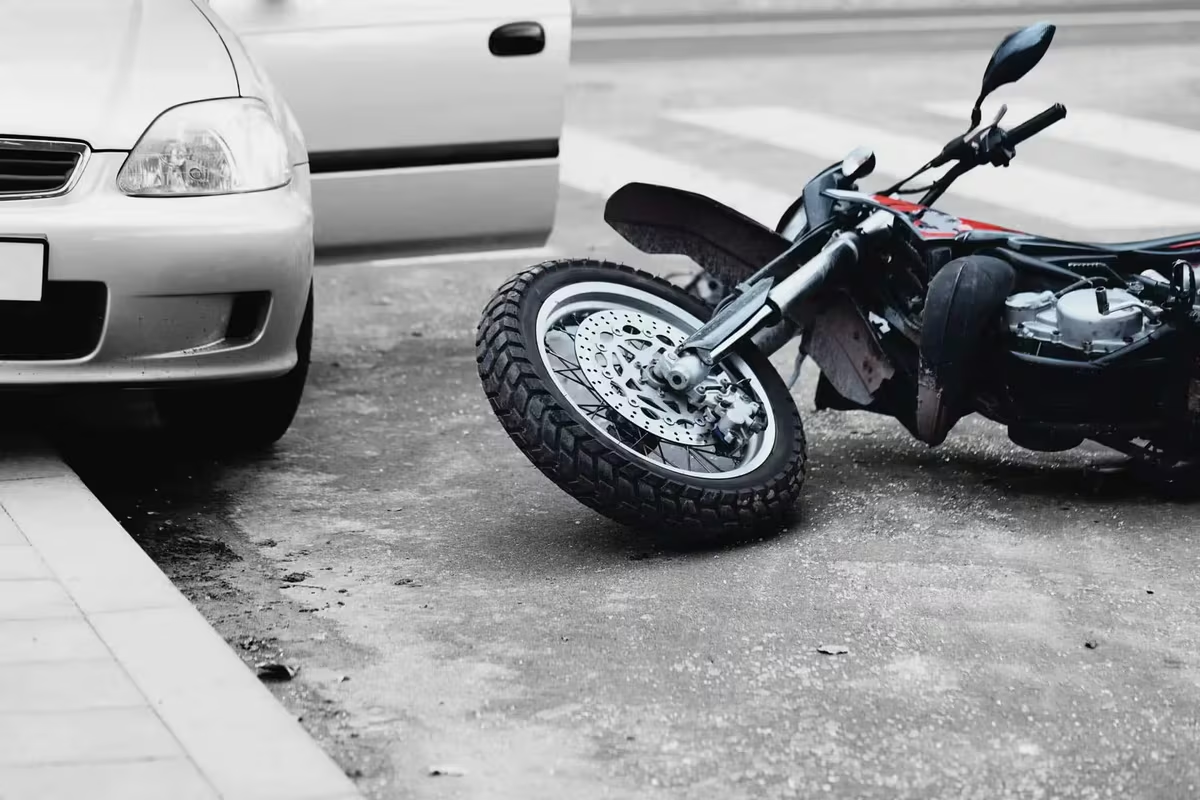 Motorcycle Accidents Serious-injury motorcycle crashes where bias against riders is common.
 -
 Pedestrian Accidents Crosswalk and roadway pedestrian injuries with high-stakes liability.
 -
 Premises Liability Slip-and-fall and unsafe-property injuries on someone else's premises.
 - Slip & Fall Falls caused by wet floors, poor maintenance, and hidden hazards.
-
 Catastrophic Injury Brain, spinal-cord, amputation, and severe-burn injuries that change a life.
 -
 Brain Injury Traumatic brain injuries with long-term cognitive and physical effects.
 -
 Burn Injury Severe burns from fires, explosions, chemicals, and electrical contact.
 -
 Wrongful Death Claims brought by families after a fatal accident or act of negligence.
 -
 Product Liability Injuries caused by defective or unreasonably dangerous products.
 -
 Offshore Accidents Rig, platform, and vessel injuries beyond the shoreline.
 -
 Maritime & Jones Act Jones Act and general-maritime claims for seamen and vessel crews.
 -
 Workers' Compensation On-the-job injuries and the benefits owed to injured workers.
Common Injuries in Tyler Motorcycle Accidents
Road rash is the most common motorcycle injury and the one most often minimized by adjusters. It is a friction burn caused by pavement contact. Classified by degree like a thermal burn, severe road rash can involve full-thickness skin loss, nerve damage, exposed bone, and significant infection risk. Reconstructive surgery and skin grafts are not unusual outcomes. Permanent scarring is common.
TBI
Traumatic Brain Injury. A disruption in brain function caused by an external force. In motorcycle crashes, this can result from direct impact, rotational acceleration, or both. Symptoms range from concussion to permanent cognitive impairment.
TBI is present in a significant percentage of motorcycle fatalities and a substantial share of survivable crashes. Even helmeted riders face TBI risk from rotational acceleration forces. Unhelmeted riders face higher risk of direct-impact injuries. Symptoms range from concussion to permanent cognitive impairment, and mild TBI is frequently underdiagnosed in emergency departments.
Orthopedic injuries in motorcycle crashes follow recognizable patterns. Clavicle fractures occur when a rider braces on impact. Wrist fractures (FOOSH injuries, or fall-on-outstretched-hand) are common. Femur and pelvis fractures result from direct impact with the other vehicle. Spinal fractures at the cervical and thoracic levels occur in T-bone and rear-end collisions where axial loading is high.
MMI
Maximum Medical Improvement. The point at which a treating physician determines the patient’s condition has stabilized and further treatment will not significantly improve the outcome. Settlement value is tied to the final injury picture, which is not fully known until MMI is reached.
MMI matters significantly for settlement timing. Insurers often push for early settlement before MMI. Accepting a settlement before MMI means settling before you know the permanent extent of your injuries. See our catastrophic injury practice for context.
What to Do After a Motorcycle Accident in Tyler
Call 911. A police report is required evidence in your claim. Without it, you are relying on your own account against the other driver’s account.
At the scene, document everything you can: the position of both vehicles, skid marks, road conditions, signal timing, and the damage to your bike. Take photos of your injuries before emergency personnel clean or cover wounds. Do not remove your helmet or any protective gear if you suspect a spinal injury. Gear removal by untrained personnel has caused secondary spinal cord injuries.
Decline to give a recorded statement to the at-fault driver’s insurance adjuster without counsel. You are not legally required to speak to the opposing insurer. Anything you say will be used in fault allocation discussions. The adjuster’s job is to gather information that limits the insurer’s payout. Your job at that stage is to say as little as possible.
Surveillance footage, ring cameras, and business cameras along Loop 323 or US-69 are typically overwritten within 24 to 72 hours. If you wait for the adjuster’s investigation timeline, that footage is gone. Retaining an attorney early means a preservation letter goes to the City, TxDOT, and any businesses along the route before the data is destroyed. Morris & Dewett sends preservation demands as one of the first actions after retention.
Past results do not guarantee future outcomes; each case is decided on its own facts. See our full case results.
The Stowers Doctrine and What It Means for Your Motorcycle Claim
Stowers doctrine
A Texas common law rule holding an insurance company liable for the full amount of an excess verdict if the insurer refused a reasonable settlement demand within policy limits before trial. Named for G.A. Stowers Furniture Co. v. American Indemnity Co. (1929).
The Stowers doctrine holds an insurer liable for the full amount of an excess verdict when it refuses a reasonable settlement demand within policy limits. If the insurer declines a qualifying demand and a jury later awards more than the policy limits, the insurer owes the entire judgment. The insured is personally exposed only if the insurer made a bad-faith decision to reject a valid demand.
Three conditions are required: the demand must be within policy limits, the demand must propose a release of the insured, and a reasonable insurer would accept it given the evidence. When all three conditions exist, a properly structured Stowers letter forces the insurer to make a real decision. Refusing a meritorious demand at that point shifts the excess exposure to the insurer.
In motorcycle cases with significant injuries, the at-fault driver often carries only the 30/60/25 minimum. That may be well under the cost of your treatment. This is where UM/UIM coverage in your own policy becomes essential, and where the Stowers doctrine may not fully apply because there is no excess judgment against the insured. The UM/UIM insurer is your own carrier. Different rules apply to how that negotiation proceeds.
Your Tyler Injury Attorneys
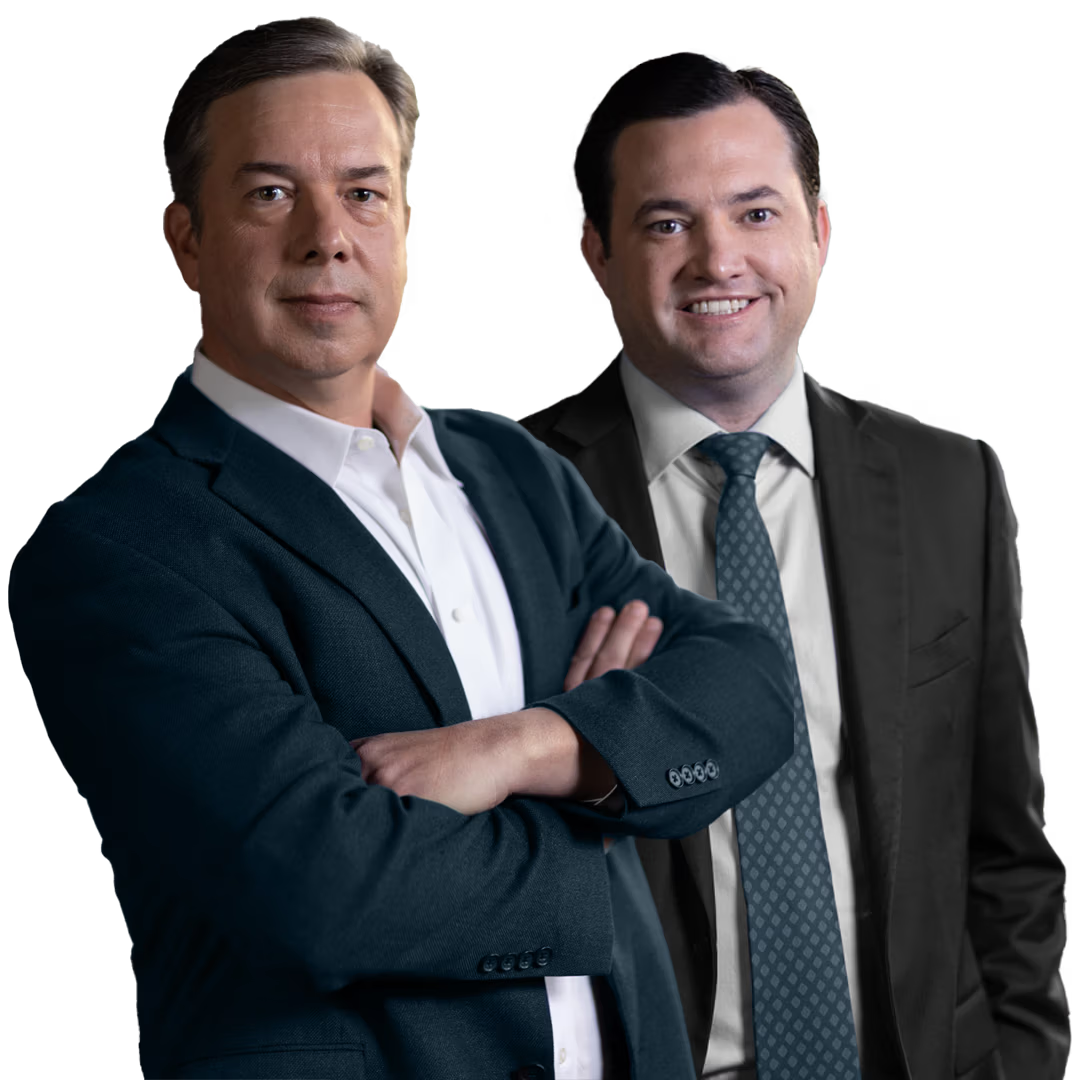
Founding partners Trey Morris and Justin Dewett lead every Tyler injury case Morris & Dewett takes.


Damages Available in a Texas Motorcycle Accident Claim
Texas personal injury claims divide damages into economic and noneconomic categories.
Economic damages include: all past and future medical expenses, lost wages from time missed, loss of earning capacity if your injuries limit your future work, rehabilitation and long-term care costs, and property damage to your motorcycle and gear. Texas limits medical expense recovery to amounts actually paid or incurred, not full billed amounts. This rule comes from CPRC Section 41.0105 and the Supreme Court’s Haygood v. De Escabedo, 356 S.W.3d 390 (Tex. 2012). When your health insurer negotiated a discount, you recover the paid amount, not the sticker price.
Noneconomic damages include: pain and suffering, mental anguish, disfigurement, physical impairment, and loss of consortium for a spouse. There is no cap on noneconomic damages in standard personal injury cases. Medical malpractice is the exception, not motorcycle accident cases.
exemplary damages
Called “punitive damages” in most states. In Texas, exemplary damages require clear and convincing evidence of fraud, malice, or gross negligence under CPRC 41.008. They are capped: the greater of two times economic damages plus noneconomic damages up to $750,000, or $200,000.
exemplary damages are available when the at-fault driver acted with gross negligence or malice, such as drunk driving. The standard is clear and convincing evidence, which is higher than the preponderance standard for liability. Not every case supports an exemplary damages claim, but drunk driving crashes frequently do.
Loss of earning capacity requires a vocational expert who evaluates your pre-injury and post-injury work capacity, and an economist who converts that difference into a present value figure. This calculation is often the most significant component of a serious injury claim.
The 2-Year Statute of Limitations for Texas Motorcycle Claims
Texas gives injured people exactly two years to file a personal injury lawsuit under CPRC Section 16.003(a). The clock starts on the date of the accident. Wrongful death claims begin from the date of death under CPRC Section 16.003(b).
Missing the deadline is final. Courts do not grant extensions because you were unaware of the deadline or were still treating. The discovery rule exists in Texas but applies narrowly: only when injuries are inherently undiscoverable through reasonable diligence. A motorcycle crash is not that kind of case.
For minors, CPRC Section 16.001 tolls the limitations period. A child injured in a motorcycle crash as a passenger has until age 20 to file: the two-year period does not begin until the minor turns 18.
The two-year window can feel long, but evidence does not last two years. Surveillance footage at most commercial locations is overwritten in days. Witness memories degrade. The at-fault vehicle may be repaired. Retaining a Tyler motorcycle accident lawyer quickly is about evidence, not just deadlines.
Preservation demands are the first protective action after retention, not an afterthought, and should go out before the initial case review rather than after it. See our wrongful death practice if the crash resulted in a fatality.
What clients say
- ★★★★★
I hired Morris and Dewett back in November of 2025.
They helped me get through my hard times of being off work, stress, and worry. Anytime I had a question I could call and they always had an answer. Very nice and professtional people. Thank you Morris and Dewett for making this an easy process for me and my family.
- ★★★★★
Morris and Dewett and their team of attorneys and staff go above and beyond.
They always were there to support me and answer all my questions after a shoulder injury that included multiple surgeries. They are caring and compassionate and that goes a long way! Highly recommended!
- ★★★★★
Thanks Morris and Dewett for the excellent work you have done on my behalf.
I want to personally thank Sarah for her kindness.
- ★★★★★
Morris & Dewett does things the right way!
They put their clients first in measurable and impactful ways.
- ★★★★★
First time being injured and needing a lawyer they where very helpful.
They answered my questions Id have very well. Highly recommend them.
- ★★★★★
Wonderful experience with Morris and DeWitt, everyone was articulate and punctual, and open to all my questions about the process.
My case couldn't have been handled by a better team! Caity Nerren, Jessica Christian, and Meghan Nolen were all fantastic and helped every step of the way. Thanks again for all of your hard work.
Reviews reflect individual client experiences. Past results do not guarantee future outcomes.
Proving Fault in a Smith County Motorcycle Case
Texas uses proportionate responsibility. Every party to the accident, including the injured rider, is assigned a percentage of fault by the jury. The injured rider collects their proportionate share from the other parties, reduced by their own percentage. At 51% or more fault, they recover nothing.
Smith County District Courts handle civil personal injury claims above the jurisdictional threshold for county courts. The 125th, 241st, 321st, and 354th Judicial Districts all sit in Tyler and handle Smith County civil litigation.
Under CPRC Section 33.004, defendants can designate responsible third parties who are not named defendants. In a motorcycle case, this could be TxDOT for a road defect, a vehicle manufacturer for a defective component, or a bar under the dram shop statute. Claims against TxDOT require compliance with the Texas Tort Claims Act under CPRC Chapter 101, which imposes specific notice requirements and damages caps.
Tex. Alc. Bev. Code Section 2.02 makes a bar or restaurant jointly liable if it served a visibly intoxicated person who later caused a crash. These claims run parallel to the claim against the driver. They are valuable when the driver’s policy limits are insufficient.
Accident reconstruction is often necessary in disputed-liability cases. Reconstructionists analyze skid marks, debris fields, vehicle damage profiles, and post-impact positions to calculate pre-impact speeds and trajectories. This is not something that can be done from photos alone. The police report establishes a citation, not a fault percentage, which is why independent reconstruction is what fixes the fault split in a disputed case. Learn more about our commercial vehicle accident practice.
Frequently Asked Questions
- Does riding without a helmet in Texas hurt my motorcycle accident case?
- Riding without a helmet is legal in Texas for riders 21 and older who have completed a safety course or carry sufficient medical insurance under Tex. Transp. Code 661.003. However, insurance adjusters often argue that head injuries or facial injuries were worsened by the absence of a helmet, and will attempt to increase the rider's proportionate responsibility percentage under CPRC Chapter 33. A medical expert who can testify to specific injury causation, and whether a helmet would have changed the outcome, is essential to countering this argument. The legal choice to ride without a helmet does not automatically increase your fault percentage.
- What is the deadline to file a motorcycle accident lawsuit in Tyler, Texas?
- Texas gives injured people two years from the date of the accident to file a personal injury lawsuit under CPRC Section 16.003(a). For wrongful death cases, the two-year period begins on the date of death. Missing this deadline bars the claim permanently with very narrow exceptions. If the injured person was a minor at the time of the crash, the statute of limitations is tolled until they turn 18, giving them until age 20 to file under CPRC Section 16.001.
- Can I recover damages if I was partially at fault for my motorcycle accident?
- Yes, as long as your percentage of fault does not exceed 50%. Texas follows proportionate responsibility under CPRC Chapter 33: your recovery is reduced by your share of fault, but you can still recover if you are 50% or less at fault. At exactly 50% fault, you can still collect, reduced by half. At 51% or more, you recover nothing. Insurance adjusters routinely push fault allocations against motorcyclists.
- What does UM/UIM coverage do for a motorcycle rider in Texas?
- UM/UIM (Uninsured/Underinsured Motorist) coverage, governed by Tex. Ins. Code Chapter 1952, pays you from your own policy when the at-fault driver has no insurance (UM) or not enough insurance to cover your losses (UIM). Texas requires insurers to offer it with every policy; you can decline it only in writing. For motorcyclists, whose injuries often exceed the 30/60/25 state minimum carried by most drivers, UM/UIM coverage is the difference between adequate compensation and a claim limited by the at-fault driver's policy.
- How does the Stowers doctrine affect my claim against the at-fault driver's insurer?
- The Stowers doctrine holds an insurer liable for the full amount of an excess verdict if the insurer rejected a reasonable settlement demand within policy limits before trial. If your attorney makes a demand within the at-fault driver's policy limits that a reasonable insurer would accept, and the insurer refuses, and a jury later returns a verdict above those limits, the insurer owes the entire judgment, not just the policy maximum. This doctrine creates real pressure on insurers to fairly evaluate serious claims. It applies to liability policies, not to your own UM/UIM insurer.
- What evidence matters most in a Tyler motorcycle accident case?
- The most time-sensitive evidence is surveillance footage from intersections, businesses, and dashcams along the route of the crash. This footage is typically overwritten within 24 to 72 hours and requires a written preservation demand to preserve. After footage, the next most important evidence is the official police report, eyewitness statements taken early, photographs of the scene and vehicle positions, the at-fault vehicle's event data recorder (EDR), and medical records documenting the nature and extent of injuries from the date of the crash forward.
- Is lane splitting legal in Texas?
- No. Lane splitting, the practice of riding between lanes of traffic, is not permitted under Tex. Transp. Code Chapter 545. Texas does not have a lane-filtering statute. A motorcyclist who is lane-splitting at the time of a crash will face a fault argument based on that conduct, which can affect their proportionate responsibility calculation.
- What damages can I recover after a motorcycle accident in Texas?
- You can recover economic damages (medical bills, lost wages, loss of earning capacity, rehabilitation costs, property damage) and noneconomic damages (pain and suffering, mental anguish, disfigurement, physical impairment, loss of consortium). Under CPRC Section 41.0105, medical expense recovery is limited to amounts actually paid or incurred, not full billed amounts. Exemplary (punitive) damages are available under CPRC 41.008 if the at-fault driver acted with fraud, malice, or gross negligence, such as in a drunk driving crash, and require clear and convincing evidence.
- What should I do immediately after a motorcycle accident in Tyler?
- Call 911 to create a police report. Document the scene with photos before anything is moved: vehicle positions, skid marks, road conditions, damage, and your visible injuries. Do not give a recorded statement to the at-fault driver's insurer without counsel. Contact a Tyler motorcycle accident lawyer as soon as you are able, because surveillance footage along corridors like Loop 323 and US-69 is overwritten within days. Early retention allows your attorney to send preservation demands to the City of Tyler, TxDOT, and nearby businesses before that footage is permanently lost.
Last updated June 5, 2026