

Federal maritime law is a separate legal system from Texas state law. The rules are different. The deadlines are different. The fault standards are different.
Morris & Dewett has represented offshore workers and their families for over 25 years. Our attorneys handle cases under the Jones Act, general maritime law, LHWCA, and OCSLA.
Who Qualifies as a Jones Act Seaman: The Chandris Test
Jones Act
A federal law (46 U.S.C. Section 30104) that gives seamen the right to sue their employers for negligence. It is the primary federal remedy for maritime workers injured at sea and provides jury trial rights not available under workers’ compensation.
Federal maritime law governs offshore worker injuries, not Texas state law. The threshold question in most maritime cases is whether you qualify as a “seaman” under the Jones Act.
The U.S. Supreme Court set the test in Chandris, Inc. v. Latsis, 515 U.S. 347 (1995). Two requirements must be met. First, your duties must contribute to the function of a vessel or to the accomplishment of its mission. Second, you must have a substantial connection to a vessel in navigation. Courts apply a rough 30% threshold: if you spend less than 30% of your work time aboard vessels, seaman status is difficult to establish.
A “vessel in navigation” is broader than most workers expect. It includes offshore drilling rigs, jack-up rigs, semi-submersibles, supply boats, crew boats, and pipe-laying barges. It does not include fixed platforms permanently attached to the seabed. Workers on fixed platforms may have different claims under OCSLA.
Many East Texas offshore workers commute to Gulf platforms on 14-on/14-off or 28-on/28-off rotations. Vessel owners and their insurers often dispute seaman status for these workers, arguing the rotation schedule breaks the continuity of connection. This argument has been contested in courts, and the outcome depends heavily on the specific terms of your work assignment.
If you do not qualify as a seaman, you may still have claims under LHWCA or OCSLA. See offshore injury claims for a broader overview of available frameworks.
Maintenance and Cure: What the Shipowner Owes You
Maintenance and Cure
Two separate obligations owed to an injured seaman under general maritime law. Maintenance is a daily living allowance. Cure is payment of medical expenses. Both are owed regardless of fault from the date of injury until maximum medical improvement.
Maintenance and Cure is owed to every qualifying seaman, regardless of fault. You do not have to prove your employer was negligent. The obligation arises automatically when you are injured in the service of a vessel.
Maintenance is a daily living allowance covering basic living expenses while you are unable to work. The historical rate has been $35 to $45 per day, though that figure is outdated in many jurisdictions. Courts increasingly require amounts that reflect actual housing and food costs. Your employment contract may specify a rate, but courts can increase the contractual rate if it is inadequate.
MMI
Maximum Medical Improvement. The point at which your treating physician determines your condition has stabilized and further treatment will not significantly improve the outcome. Maintenance and cure obligations end at MMI.
Cure requires the vessel owner to pay all reasonable and necessary medical treatment until you reach MMI. The employer cannot terminate cure simply by offering a cheaper treatment alternative or by obtaining an independent medical examination that declares you at MMI prematurely. If the employer willfully or wantonly refuses to pay maintenance and cure, you may be entitled to punitive damages under Atlantic Sounding Co. v. Townsend, 557 U.S. 404 (2009).
Maintenance and cure runs as a separate legal basis alongside your Jones Act negligence claim. You can pursue both simultaneously. See also workers compensation claims for how these maritime benefits differ from Texas workers’ comp.
What Is Unseaworthiness and How Does It Differ from Negligence?
Unseaworthiness is a strict liability doctrine under general maritime law. You do not need to prove the vessel owner was negligent. You need to prove the vessel was not reasonably fit for its intended use at the time of your injury.
The doctrine covers the vessel itself, its equipment, its gear, and its crew. A vessel is unseaworthy when it has defective machinery, faulty rigging, improperly maintained decks, inadequate safety equipment, or a crew that is incompetent or understaffed for the operation. The standard is objective: would a reasonable shipowner have considered this vessel fit for its mission?
The unseaworthiness claim runs against the vessel owner, not just your employer. This distinction matters. In many offshore operations, the Jones Act employer (the company that hired you) and the vessel owner are different entities. Unseaworthiness lets you pursue the owner directly. The owner cannot delegate the duty to make the vessel seaworthy to a contractor or third party. It is absolute and non-delegable.
What We Handle
Tyler Practice Areas
-
 Car Accidents Rear-end, intersection, and highway collisions across Louisiana.
 -
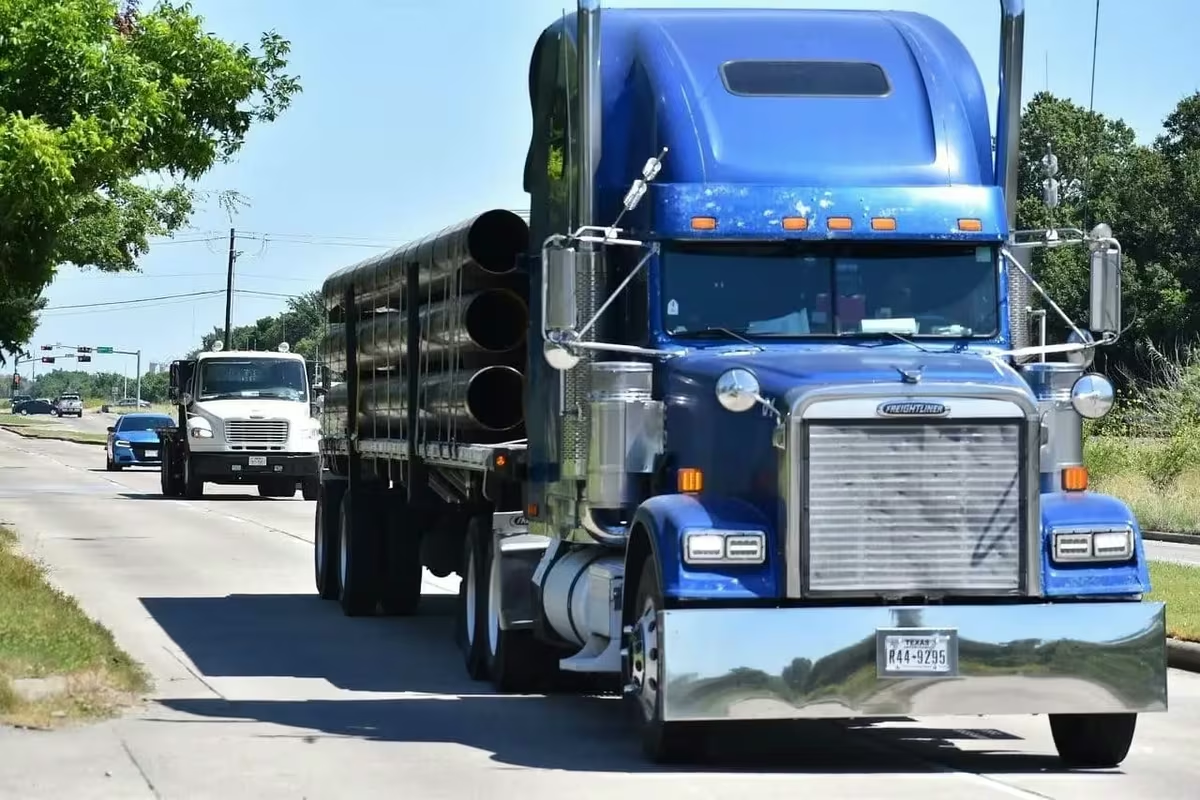 Truck Accidents 18-wheeler and commercial-vehicle wrecks governed by federal trucking rules.
 -
 Motorcycle Accidents Serious-injury motorcycle crashes where bias against riders is common.
 -
 Pedestrian Accidents Crosswalk and roadway pedestrian injuries with high-stakes liability.
 -
 Premises Liability Slip-and-fall and unsafe-property injuries on someone else's premises.
 - Slip & Fall Falls caused by wet floors, poor maintenance, and hidden hazards.
-
 Catastrophic Injury Brain, spinal-cord, amputation, and severe-burn injuries that change a life.
 -
 Brain Injury Traumatic brain injuries with long-term cognitive and physical effects.
 -
 Burn Injury Severe burns from fires, explosions, chemicals, and electrical contact.
 -
 Wrongful Death Claims brought by families after a fatal accident or act of negligence.
 -
 Product Liability Injuries caused by defective or unreasonably dangerous products.
 -
 Offshore Accidents Rig, platform, and vessel injuries beyond the shoreline.
 -
 Maritime & Jones Act Jones Act and general-maritime claims for seamen and vessel crews.
 -
 Workers' Compensation On-the-job injuries and the benefits owed to injured workers.
LHWCA Section 905(b): When You Can Sue the Vessel Owner
LHWCA
Longshore and Harbor Workers’ Compensation Act. A federal workers’ compensation statute covering maritime workers who do not qualify as seamen, including longshoremen, harbor workers, ship repairers, and dock workers. Administered by the U.S. Department of Labor.
The LHWCA covers non-seamen maritime workers. If your work is on docks, in shipyards, at marine terminals, or in ship repair, you likely fall under LHWCA rather than the Jones Act. LHWCA provides medical benefits, wage replacement for temporary and permanent disability, and vocational rehabilitation.
LHWCA is workers’ compensation. It does not allow you to sue your employer for negligence in most cases. However, Section 905(b) creates an important exception: a negligence claim against the vessel owner. This is separate from your LHWCA benefits and can produce significantly higher recoveries.
The categories of vessel negligence under 905(b) were defined by the Supreme Court in Scindia Steam Navigation Co. v. De Los Santos, 451 U.S. 156 (1981). The first is the turnover duty: the vessel must be in safe condition when delivered to the stevedore. The second is the active control duty: the owner cannot negligently exercise control over the stevedore’s work. The third is the duty to intervene: when the owner knows of an unreasonably dangerous condition the stevedore will not correct.
LHWCA workers on the Sabine-Neches Waterway near Port Arthur and Orange, TX, or at the Port of Beaumont, are a significant population in East Texas. If you work in that corridor and were injured on or adjacent to a vessel, a 905(b) claim may apply. LHWCA claims have a one-year filing deadline under 33 U.S.C. Section 913. See Jones Act claims to understand how the two frameworks differ.
OCSLA: Federal Jurisdiction on Offshore Platforms
OCSLA
Outer Continental Shelf Lands Act. A federal statute (43 U.S.C. Section 1333) extending federal jurisdiction to fixed platforms and other structures on the Outer Continental Shelf. Determines which laws apply to workers on fixed offshore installations.
The OCSLA extends federal law to fixed platforms permanently attached to the seabed on the Outer Continental Shelf. For workers who do not qualify as Jones Act seamen, OCSLA may apply the adjacent state’s workers’ compensation law as surrogate federal law.
The key distinction is between fixed and floating. A fixed platform (attached to the seabed by legs or pilings) falls under OCSLA. A floating rig (semi-submersible, drillship, or jack-up in certain configurations) may qualify as a vessel under general maritime law, making the Jones Act potentially available. The classification of your worksite is a threshold legal question, and it directly determines which remedies you have.
OCSLA workers who do not qualify for Jones Act benefits may have tort claims against third-party contractors or vessel operators who worked alongside them on the platform. The framework is complex, and the applicable fault standard and deadlines differ from both the Jones Act and Texas state law. Morris & Dewett handles cases under both frameworks for East Texas clients who work Gulf Coast platforms.
Past results do not guarantee future outcomes; each case is decided on its own facts. See our full case results.
The Borrowed Servant Doctrine: Who Is Your Employer?
The borrowed servant doctrine determines which of multiple offshore entities is your Jones Act employer. A Gulf of Mexico platform operation might involve a platform operator, a vessel owner, a drilling contractor, a service company, and a staffing agency. Each entity has its own insurance and its own interest in denying responsibility for your injury.
Borrowed Servant Doctrine
A maritime and general employment law doctrine that can shift Jones Act employer liability from your nominal (paycheck) employer to a temporary employer who directed your day-to-day work. Courts use a multi-factor test to determine who exercised actual control.
The Borrowed Servant Doctrine addresses this directly. It can make a temporary employer liable for a Jones Act claim even if that entity did not formally hire you. Courts apply a four-factor test. Which entity had the right to direct and control your work? Which had the power to discharge you? Which furnished the tools and worksite? Which paid your wages?
You can pursue both the nominal employer (the company that issued your paycheck) and the borrowed employer (the entity that controlled your work) simultaneously. You do not have to choose one at the outset. The defendants will dispute this question vigorously, because whoever qualifies as the Jones Act employer bears the negligence liability.
East Texas workers placed through staffing agencies for Gulf Coast assignments should document every entity in their employment chain before filing. This means gathering all contracts, work orders, orientation documents, and badges from every company you reported to.
Your Tyler Injury Attorneys
Founding partners Trey Morris and Justin Dewett lead every Tyler injury case Morris & Dewett takes.


Pure Comparative Fault in Maritime Law vs. Texas Proportionate Responsibility
Texas personal injury law uses proportionate responsibility under CPRC Chapter 33. A plaintiff who is 51% or more at fault recovers nothing. At exactly 50% fault, you recover but your damages are cut in half.
Pure Comparative Fault
A fault allocation system used in federal maritime cases. Under pure comparative fault, a plaintiff can recover damages even if they were 99% at fault. Recovery is reduced by the plaintiff’s fault percentage, but never eliminated entirely. This differs from Texas proportionate responsibility, which bars recovery at 51% fault.
Federal maritime law uses Pure Comparative Fault. Under the maritime system, you can recover even if a jury finds you were 90% responsible for your own injury. Your recovery is reduced by your fault percentage, but it is never cut to zero.
This is one of the most consequential distinctions in maritime practice. A vessel owner’s insurer may argue that Texas law governs your case, which would eliminate your claim if your fault exceeds 50%. Your attorney’s ability to argue that federal maritime law applies and its pure comparative fault standard controls can be the difference between a recovery and no recovery.
Which fault system applies depends on which legal framework governs your case: Jones Act, general maritime law, OCSLA, or LHWCA. Each has different standards. The choice of law analysis is not straightforward. See also Tyler Texas injury lawyers for a general overview of Texas personal injury standards.
How Long Do You Have to File a Jones Act or Maritime Injury Claim?
Jones Act claims must be filed within three years of the date of injury under 46 U.S.C. Section 30106. General maritime law unseaworthiness claims follow the same three-year period.
This deadline is longer than the two-year statute of limitations for standard Texas personal injury claims under CPRC Section 16.003. The difference matters for East Texas workers who may not immediately recognize their case as a maritime claim. An attorney who tells you that you have two years may be applying Texas law to a federal maritime case.
Maintenance and cure claims have no fixed limitations period, but they are subject to laches: a doctrine that bars claims where unreasonable delay has caused prejudice to the opposing party. In practice, you should pursue maintenance and cure as promptly as you pursue your Jones Act claim.
LHWCA claims operate on a different and shorter deadline. You must file a claim with the U.S. Department of Labor within one year of disability or death under 33 U.S.C. Section 913. This one-year window can be tolled if the employer or carrier provides voluntary compensation, but relying on tolling is risky. Missing the correct deadline is an unrecoverable error.
What clients say
- ★★★★★
I hired Morris and Dewett back in November of 2025.
They helped me get through my hard times of being off work, stress, and worry. Anytime I had a question I could call and they always had an answer. Very nice and professtional people. Thank you Morris and Dewett for making this an easy process for me and my family.
- ★★★★★
Morris and Dewett and their team of attorneys and staff go above and beyond.
They always were there to support me and answer all my questions after a shoulder injury that included multiple surgeries. They are caring and compassionate and that goes a long way! Highly recommended!
- ★★★★★
Thanks Morris and Dewett for the excellent work you have done on my behalf.
I want to personally thank Sarah for her kindness.
- ★★★★★
Morris & Dewett does things the right way!
They put their clients first in measurable and impactful ways.
- ★★★★★
First time being injured and needing a lawyer they where very helpful.
They answered my questions Id have very well. Highly recommend them.
- ★★★★★
Wonderful experience with Morris and DeWitt, everyone was articulate and punctual, and open to all my questions about the process.
My case couldn't have been handled by a better team! Caity Nerren, Jessica Christian, and Meghan Nolen were all fantastic and helped every step of the way. Thanks again for all of your hard work.
Reviews reflect individual client experiences. Past results do not guarantee future outcomes.
East Texas Workers and Gulf Coast Platforms: What Tyler Clients Need to Know
East Texas has a significant offshore worker population. Workers from Tyler, Longview, Lufkin, Nacogdoches, and Marshall regularly work Gulf of Mexico platforms on rotation schedules. The typical pattern is a fly-out from DFW, Shreveport Regional, or Houston airports to a helideck or crew boat pickup point. The commute itself is not the dangerous part. The crew boat transfer to the platform is.
Injuries during crew boat transfer are among the most common and most legally complex in offshore work. Whether the injury creates a Jones Act claim, a LHWCA 905(b) claim, or a general maritime negligence claim depends on your classification and which entity operated the crew boat. Morris & Dewett has handled cases for East Texas clients injured in exactly this pattern.
Closer to Tyler, Lake Palestine in Anderson and Henderson Counties and the Sabine River system see recreational and some commercial vessel traffic. Injuries on navigable waterways can fall under general maritime law even if they occur well inland. A boating accident on Lake Palestine or an injury on the Sabine River may invoke federal maritime jurisdiction.
Workers and families in Smith County can file federal maritime claims in the U.S. District Court for the Eastern District of Texas, Tyler Division. Morris & Dewett represents clients in East Texas and knows the Gulf platform operators, vessel owners, and insurers active in this region.
Frequently Asked Questions
- Does Texas law or federal maritime law apply to my offshore injury case?
- Federal maritime law applies to most offshore worker injuries. If you worked aboard a vessel or on a floating rig, the Jones Act and general maritime law likely govern your claim. If you worked on a fixed platform on the Outer Continental Shelf, OCSLA may apply with Texas law used as surrogate federal law for workers' comp purposes. If you worked as a longshoreman or dock worker, LHWCA applies. Texas state tort law applies only when federal maritime law does not reach the facts of your case. The specific classification matters because it changes your remedies, your deadlines, and the fault standard that applies.
- What is the difference between the Jones Act and the LHWCA?
- The Jones Act applies to seamen: workers whose duties contribute to vessel function and who have a substantial connection to a vessel in navigation. It allows you to sue your employer for negligence and requires proof of only slight causation. The LHWCA applies to non-seaman maritime workers, including longshoremen, dock workers, ship repairers, and harbor workers. LHWCA functions as workers' compensation, so you cannot sue your employer for negligence in most cases, but Section 905(b) allows a negligence claim against the vessel owner. The two systems are mutually exclusive: you are either a seaman under the Jones Act or a covered worker under LHWCA, not both.
- Can I get fired for filing a Jones Act claim against my employer?
- Filing a Jones Act claim does not eliminate your job, but it does not prevent retaliation either. The Jones Act has no explicit anti-retaliation provision comparable to OSHA whistleblower protections. However, retaliatory discharge in response to a Jones Act claim may support a separate wrongful discharge or breach of contract claim depending on your employment terms. Document any change in your employment status after you file or announce a claim. If you are terminated, consult an attorney before signing any separation agreement or release.
- How long do I have to file a maritime injury lawsuit in Texas?
- Jones Act negligence claims and general maritime law unseaworthiness claims must be filed within three years of the date of injury under 46 U.S.C. Section 30106. This is one year longer than the standard two-year Texas statute of limitations for personal injury. LHWCA claims have a one-year deadline to file with the U.S. Department of Labor under 33 U.S.C. Section 913. OCSLA claims follow the applicable federal or state limitations period depending on the specific claim. Applying the wrong deadline is an unrecoverable mistake.
- What is maintenance and cure, and can my employer cut it off?
- Maintenance is a daily living allowance the vessel owner pays while you cannot work due to a maritime injury. Cure is payment for all reasonable and necessary medical treatment until you reach maximum medical improvement (MMI). Both are owed regardless of fault. The employer can terminate maintenance and cure only when you reach MMI, as determined by a treating physician. The employer cannot cut off cure simply because a company-selected doctor declares MMI before your treating physician agrees. If your employer willfully refuses to pay maintenance and cure after it is due, you may be entitled to punitive damages under Atlantic Sounding Co. v. Townsend, 557 U.S. 404 (2009).
- I work for a staffing contractor on an offshore platform. Who is my employer for Jones Act purposes?
- It depends on who directed and controlled your day-to-day work. Under the borrowed servant doctrine, courts look at four factors: which entity had the right to direct your activities, which entity could discharge you, which entity furnished your tools and worksite, and which entity paid your wages. The entity that exercised the most actual control over your work may be your Jones Act employer even if your paycheck came from a staffing contractor. You can name multiple entities as defendants and let the court allocate responsibility. Gather all contracts, work orders, and documentation showing which companies you reported to before filing.
- Does pure comparative fault mean I can recover even if I was partly at fault?
- Yes. Federal maritime law uses pure comparative fault. Your recovery is reduced by your percentage of fault, but it is never eliminated entirely. If a jury finds you were 70% at fault, you recover 30% of your proven damages. This is meaningfully different from Texas proportionate responsibility, which bars recovery entirely if you are 51% or more at fault. Vessel owners and their insurers sometimes argue that Texas law governs a maritime claim, which would allow them to use the 51% bar. Whether maritime law or Texas law applies depends on the legal framework governing your specific case.
Last updated June 5, 2026