
What Does a Texas Motorcycle Accident Lawyer Do?
A Texas motorcycle accident lawyer builds the proof, the parties, and the dollar figure for an injured rider’s claim. The work breaks into five jobs: figuring out how the crash actually happened, naming every party and policy that can pay, keeping the insurer from pinning the wreck on the rider, putting a defensible number on the losses, and then either settling the claim or filing suit. None of these happen on their own. An adjuster will not investigate a crash in your favor, and a hospital will not tally your future losses for you.
Investigates how the motorcycle crash happened
The investigation comes first because every later decision depends on it. A lawyer pulls the crash report, locates and interviews witnesses, photographs the scene and the bike, and preserves vehicle data before it disappears. Skid marks fade, dashcam footage gets overwritten, and the other driver’s memory improves in their own favor. Early work locks down the facts while they still exist.
Motorcycle crashes also leave different evidence than car wrecks. Lean angle, road position, and visibility all matter, and reconstructing them takes someone who knows how a bike behaves in traffic.
Identifies every liable party and insurance policy
The driver who hit you is rarely the only source of payment. A lawyer maps out each party whose conduct contributed to the crash and each insurance policy that might respond, because the at-fault driver’s coverage is often too thin to cover serious injuries. That search can reach an employer, a commercial carrier, a vehicle or parts maker, or your own uninsured and underinsured coverage.
Finding the policies is half the value. Two layers of coverage on one defendant, plus your own UM/UIM coverage, can change a claim from underfunded to fully covered. A lawyer reads the declarations pages, sends preservation letters, and confirms what limits actually exist rather than accepting the first policy an adjuster mentions.
Protects the rider from insurer blame tactics
Riders walk into a built-in headwind. Adjusters lean on the assumption that the motorcyclist was speeding, weaving, or simply hard to see, and they look for any statement that supports shifting fault to the rider. A lawyer manages communication with the insurer so the rider does not hand the other side ammunition by accident.
This is also where Texas fault rules raise the stakes, since the share of blame assigned to a rider directly reduces what the claim is worth. A lawyer documents the rider’s lawful conduct, gathers neutral witness accounts, and answers the bias with evidence. How a claim affects fault percentages under Texas comparative fault gets its own treatment later on this page.
Calculates medical, wage, pain, and future-loss damages
A claim is only worth what you can prove, so a lawyer builds the damages picture from the records. That means current and projected medical bills, wages already lost, reduced earning capacity going forward, and non-economic harm such as pain, physical impairment, and disfigurement. Motorcycle crashes tend to produce orthopedic and head injuries that carry long treatment arcs, which makes the future-loss number large and easy for an insurer to dispute.
Getting the future right often requires treating physicians, vocational experts, and a life-care plan, not a guess. The full menu of recoverable Texas damages is covered in a later section.
Negotiates settlement or files a lawsuit when needed
With the facts, the parties, and the damages established, the lawyer presents a demand and negotiates. Most claims resolve without trial, but the credible threat of trial is what moves an insurer off a lowball offer. An attorney who never files suit has little leverage, and adjusters know the difference.
If negotiation stalls, the lawyer files a lawsuit and works the case through discovery, expert disclosures, and trial preparation inside the Texas court system. The deadline to file is firm, so this step cannot wait indefinitely. The specific filing window and how it runs are explained later on this page.
What Should You Do Immediately After a Motorcycle Accident in Texas?
The hours after a motorcycle crash shape the claim that follows. Evidence disappears, memories fade, and adjusters start building a file. Riders who take a few specific steps at the scene and in the days after protect both their health and their ability to be compensated for what happened. The steps below hold up whether the crash was a minor scrape or a serious wreck.
Call 911 and ask for a police crash report
Report the crash to law enforcement and ask that an officer come to the scene. A responding officer typically completes a written crash report, and that report becomes a foundational document in any later claim. It records the date, location, parties, vehicles, statements, and the officer’s diagram of how the collision happened. Request the report number before you leave so you can obtain a copy later.
A police report is not the final word on fault, but it carries weight with insurers and, if needed, a jury. When an officer documents the other driver’s admission, a citation, or the position of the vehicles, that record is harder to contradict months later. If officers do not respond, document everything yourself and follow up with the responsible agency about obtaining a report as soon as you are able.
Document the scene and photograph the evidence
If you are physically able, photograph everything before vehicles are moved. Capture the motorcycle, the other vehicle, skid marks, debris fields, traffic signals, road conditions, and any visible injuries. Wide shots show the overall scene; close shots show damage and contact points. Note the time of day, weather, and lighting, because those details matter when a defense expert later argues a rider was hard to see.
Collect the other driver’s name, license, insurance, and license plate. Get contact information for any witnesses before they leave, because independent witnesses often decide disputed-fault cases and they rarely stick around. A short voice memo describing what you remember, recorded the same day, preserves details that blur within a week.
Seek immediate medical attention even if you feel fine
Adrenaline masks pain. Riders routinely walk away from a crash feeling sound and discover a fracture, internal injury, or concussion days later. Get evaluated the same day, whether by EMS at the scene or at an emergency room or urgent care soon after. A prompt medical record links your injuries to the crash and removes a favorite insurer argument, that the injury came from something else.
Follow the treatment plan and keep every appointment. Gaps in care give an adjuster room to claim you healed or were never hurt. The medical file is the spine of an injury claim, and it starts the moment you are examined.
Do not give a recorded statement to the adjuster
The other driver’s insurer may call within days, often friendly and eager to “get your side.” A recorded statement is not required to start your own claim, and early statements are routinely used to lock a rider into a version of events before the injuries are fully known. You can report the basic facts, that a crash occurred, the date, the vehicles involved, without submitting to a recorded interview.
Do not accept a quick settlement offer or sign a medical release before you understand the full extent of your injuries. Once you settle, the claim is closed, even if surgery follows next month. Decline politely and say you will follow up after you have spoken with an attorney.
Contact a Texas motorcycle accident lawyer before the deadline runs
Texas sets a deadline to file a personal injury lawsuit, and waiting risks losing the right to sue entirely. Delay also lets physical evidence vanish, vehicles get repaired or scrapped, and witness memories degrade. Speaking with a lawyer early lets someone preserve evidence, send spoliation letters, and handle the insurer while you focus on medical treatment.
A consultation costs nothing and carries no obligation. Bring the crash report number, your photographs, the other driver’s information, and your medical records. The earlier the investigation begins, the more of the scene survives to prove what actually happened.
Do You Have a Texas Motorcycle Accident Case?
You probably have something worth looking into when another driver did something careless and you came away actually hurt. Most situations come down to two practical questions. Did someone else drive in a way they should not have, and did that leave you with real injuries or losses. A motorcyclist rear-ended at a red light by a texting driver who ends up in the hospital is in a strong position. A solo low-speed tip-over with a scratched fender and no other vehicle involved usually is not.
Most real situations land somewhere between those two, which is why the strength of any claim depends on the specific facts. The honest answer for most riders is that a short conversation settles the question faster than weeks of guessing. The situations below are the ones that most often signal a claim worth pursuing.
When should you contact a motorcycle accident lawyer in Texas?
Sooner is better than later, and “later” arrives faster than riders expect. Evidence degrades. Skid marks fade, vehicles get repaired, and witnesses forget. The other driver’s insurer starts building its file the day of the crash, often before you are out of the emergency room. Talking to a lawyer early does not commit you to a lawsuit. It puts someone on your side who can preserve evidence and handle the insurer while you concentrate on medical treatment.
A free consultation is worth having whenever the crash involved another vehicle, an injury that needed medical care, or any disagreement about who was at fault. If you are unsure whether your situation qualifies, that uncertainty is itself a reason to ask.
After serious injuries or hospitalization
Serious injuries are the clearest signal that a claim is worth pursuing. Motorcyclists have no airbags, no crumple zones, and no metal cage. A collision that leaves a car driver shaken can leave a rider with broken bones, spinal injuries, internal trauma, or a brain injury. Those injuries generate large medical bills, time away from work, and long-term physical effects.
The larger the harm, the harder an insurer works to minimize the payout. A hospitalization, surgery, or any injury expected to affect you for months or years is the kind of situation that benefits from legal representation. When the medical records are this substantial, the harm side of a claim is rarely in doubt, and the dispute usually shifts to fault and value.
If the other driver blames the motorcyclist
The at-fault driver, and the driver’s insurer, often point the finger at the rider. They will suggest you were speeding, splitting lanes, or simply too hard to see. Do not assume that blame ends your case. Who was at fault is a question of evidence, not the other side’s assertion.
How shared responsibility affects a claim is addressed in a separate section of this page. What matters here is the takeaway. Being accused of partial fault is a reason to talk to a lawyer, not a reason to walk away. An attorney can gather the proof that rebuts the blame and protects your claim.
If the crash involved a commercial vehicle, rideshare, or defective road
Some crashes are more complicated than a single rider and a single car, and that complexity usually points toward a stronger need for representation. When the other vehicle is a delivery truck, an 18-wheeler, a work van, or a rideshare car, more than one party and more than one insurance policy may be involved. These cases carry larger potential exposure and tougher opponents.
Crashes caused by a dangerous road condition raise their own questions about who is responsible and how a claim must be presented. The specifics of identifying every responsible party are covered elsewhere on this page. For now, the point is simple. If your crash involved a business vehicle, a rideshare driver, or a road defect, the situation is likely too involved to handle alone.
After a fatal motorcycle accident
When a motorcycle crash takes a life, the family is left with both grief and a set of legal questions. These are serious matters with their own deadlines and their own categories of damages. The rules on who may bring such a claim and what may be sought are addressed in the wrongful death and compensation sections of this page.
If you have lost a family member in a motorcycle crash, the most useful next step is to speak with a lawyer who can explain your specific options before any deadline narrows them.
Who Can Be Held Liable in a Texas Motorcycle Crash?
More than one party often shares responsibility for a motorcycle crash. The driver who hit you is the obvious target, but the full set of liable parties usually surfaces only after someone investigates the wreck, the vehicles, the roadway, and the events leading up to it. Identifying every responsible party matters because each one may carry a separate insurance policy, and a serious injury can exhaust a single driver’s coverage long before the bills stop coming.
Sorting out who breached which duty is the work that determines how much coverage is actually available. Different parties answer for different conduct. The subsections below walk through the parties an investigation tends to reach.
Negligent car, truck, or SUV drivers
Most motorcycle crashes trace back to another motorist. A driver who turns left across a rider’s path, changes lanes without checking a blind spot, follows too closely, or runs a light has failed the basic responsibility every driver carries to share the road safely. When that conduct causes the collision, the at-fault driver and their liability insurer are the primary source of compensation.
Riders are physically exposed in a way enclosed-vehicle occupants are not, so the same crash that dents a car can leave a motorcyclist with fractures, road rash, or a head injury. The severity of those injuries is why a single driver’s policy limits are often the first thing an attorney checks, and why the search for additional responsible parties begins right away.
Commercial trucking companies and employers (respondeat superior)
When the driver who caused the crash was working at the time, the employer can be on the hook alongside the driver. Under the doctrine of respondeat superior, an employer is responsible for the negligent acts an employee commits within the scope of employment. That includes a delivery driver, a service-fleet operator, or the driver of a commercial truck.
This matters for two reasons. A company usually carries far larger insurance limits than an individual, and a commercial defendant may also bear independent fault for negligent hiring, training, or supervision. Crashes involving an 18-wheeler or other commercial vehicle add federal motor-carrier rules to the picture, which is why these cases are investigated differently from ordinary two-vehicle wrecks.
Government entities responsible for unsafe roads
Sometimes the road itself contributes to a wreck. A missing sign, a poorly designed intersection, a defective traffic signal, or a hazardous pavement condition can turn a survivable situation into a crash. When the condition of the road may have contributed, the road authority and its maintenance history belong in the investigation.
Treat a possible road-condition issue as an early investigation priority rather than a routine add-on. The reason is practical: the physical evidence of a road hazard gets repaired, repaved, or re-signed quickly, and witness memory of the condition fades. Securing photographs, maintenance records, and witness accounts of the hazard has to happen before the file is built out.
Motorcycle or parts manufacturers (product liability)
A crash is not always caused by a person. If a defective brake, tire, fuel system, or other component failed and caused the wreck or made the injuries worse, the manufacturer of the motorcycle or the part may be responsible under product-liability principles. The same applies to a defect that surfaces during or after the impact.
These cases require preserving the motorcycle and the failed component before they are repaired, scrapped, or altered. Engineering analysis usually drives the proof, so the physical evidence has to be secured early.
Bars or restaurants that served a drinking driver
When a drunk driver causes a crash, the driver is the first defendant, but the business that served that driver alcohol may also belong in the investigation. Whether a serving establishment should be pursued is a fact question that turns on what witnesses saw, what receipts and service records show, and whether surveillance footage captured the patron at the time of service. Those records are gathered before they are gone, so treat the serving establishment as an investigation focus whenever a crash involves a drinking driver.
The practical point for an injured rider is that a separate policy may exist beyond the driver’s own coverage, and finding it depends on moving quickly to lock down the evidence. An attorney evaluating a drunk-driving crash should be looking for that evidence early, because the receipts, footage, and service records that would point to a serving establishment are among the first things to disappear.
How Does Texas Comparative Fault Affect a Motorcycle Accident Claim?
In a Texas motorcycle case, fault is rarely all on one side. The driver who turned across the rider’s lane may carry most of the blame. The insurer will still try to assign some of it to the rider. How that split gets decided is one of the most consequential parts of the whole claim, because the share attached to the rider directly shapes what the rider can collect.
This is the part of the case where an early, thorough investigation pays off. The defense theory is usually built fast, before the rider has counsel. A motorcycle lawyer’s job is to test that theory and put the actual evidence in front of the adjuster, the mediator, or the jury.
How fault gets divided between the parties
Texas cases allocate a share of responsibility to each party involved in the crash. The motorcyclist may be assigned a share. The other driver may be assigned a share. A road authority or a third vehicle can be brought in and assigned a share too.
That allocation is not a footnote. It is the number much of the case turns on. The defense spends real effort moving responsibility onto the rider, and a lawyer who has tried these cases knows how to move it back.
Why an apportioned share changes the result
Once a share is attached to the rider, it does not sit there harmlessly. It can shrink the damages a rider takes home, and the work to drive that share down is some of the most valuable work in the case. That is exactly why the defense pushes so hard to inflate the rider’s number and why building the counter-record early matters so much.
A good lawyer treats every point of fault as money. The difference between a small assigned share and a large one is often the difference between a result that covers a rider’s medical care and one that does not. That is why the effort to drive the rider’s share down happens at the start of the case, not on the courthouse steps.
Why insurer blame-shifting matters
Insurers know that the fault split is their lever. If they can convince a decision-maker that the rider was speeding, sat in a blind spot, or was simply hard to see, they move responsibility onto the rider and move dollars off their own ledger. None of those assertions are true by default. They are arguments, and arguments can be answered.
The adjuster’s opening position is not the law and it is not the verdict. It is a negotiating stance built to drive the number down. Riders carry a built-in disadvantage with adjusters who assume the motorcyclist was reckless, and rebutting that assumption is real work, not a form letter.
Evidence used to rebut rider bias
An inflated fault share is beaten with proof, not protest. The same record that establishes the other driver’s negligence also pulls assigned blame off the rider. The pieces that do that work most often include:
- The crash report and the investigating officer’s diagram of how the collision happened.
- Scene and vehicle photographs that show points of impact and final rest positions.
- Independent witnesses who saw the other driver turn, drift, or fail to yield.
- Signal-timing, dashcam, or nearby surveillance footage that fixes the sequence.
- Medical records that tie the injuries to the mechanism of the crash and undercut a claim that the rider caused his own harm.
- Accident reconstruction that translates speed, sight lines, and timing into a defensible account of who did what.
Each of these answers a specific blame argument. Speed claims meet reconstruction. Blind-spot claims meet sight-line analysis and witness accounts. Hard-to-see claims meet lighting and lane-position evidence. The earlier a rider’s lawyer locks this material down, the harder it is for an insurer to manufacture a fault share the evidence will not support.
How Long Do You Have to File a Motorcycle Accident Lawsuit in Texas?
Texas law sets a firm deadline for filing a motorcycle accident lawsuit, and missing it usually ends the case before it begins. The exact length of that window and the date it starts running turn on the specific facts of the crash, so the safest move is to confirm the controlling deadline with a Texas attorney early. What follows explains how filing deadlines work in practice, why they matter to your claim, and why waiting carries real risk even when the deadline feels far off.
The Texas filing deadline
Personal injury claims in Texas, including motorcycle crash claims, are governed by a statute of limitations. That statute fixes the period in which you must file suit in court. Once the period closes, the defendant can ask the court to dismiss the case on timing alone, no matter how strong the underlying facts are.
Confirm the precise deadline and start date for your situation with a Texas motorcycle accident lawyer rather than relying on a general rule of thumb.
Deadlines after a fatal motorcycle accident
When a motorcycle crash is fatal, the family’s claims follow their own timing rules. A wrongful death claim brought by surviving relatives and a survival claim brought on behalf of the deceased rider’s estate are separate causes of action, and each carries its own filing deadline.
The date a deadline starts running can differ for a wrongful death claim depending on the circumstances. Surviving family members weighing whether to pursue a claim should have a Texas attorney confirm which deadlines apply and when they begin. Acting early preserves the option to file while the evidence is still available.
Why evidence should be preserved immediately
The filing deadline is the outer limit, not the practical one. The strongest motorcycle cases are built on evidence gathered close to the crash, and that evidence degrades fast. Skid marks fade. Vehicles get repaired or scrapped. Surveillance and traffic camera footage is often overwritten within days or weeks.
Waiting until a deadline approaches forces a lawyer to reconstruct a case from records that may no longer exist. Witnesses move, change phone numbers, and forget details. Engaging counsel early lets an attorney send preservation letters, secure footage, and document the scene while the proof is still fresh. The earlier the investigation starts, the more of the record survives.
Exceptions that may change the timing
A handful of circumstances can change when a deadline starts or how long it runs. The discovery rule can delay the start in narrow situations where an injury or its cause could not reasonably have been known at the time of the crash. Claims involving a minor, a person who lacks legal capacity, or a governmental defendant follow different rules, and government claims often carry short, strict notice requirements that come due well before any lawsuit deadline.
These exceptions are fact-specific and easy to misjudge. Do not assume one applies to your case, and do not assume the standard deadline gives you more time than it does. Have a Texas motorcycle accident lawyer evaluate which rules govern your claim so the right deadline is calendared from the start.
What Texas Motorcycle Laws Affect Your Accident Claim?
A handful of Texas traffic and insurance rules tend to drive how a motorcycle claim gets investigated and argued. Most of them have nothing to do with how the crash actually happened. Insurers raise them anyway, because each one gives an adjuster a reason to shift blame toward the rider. Knowing which rules matter, and which are noise, is the first step in keeping a claim on track.
The honest answer on most of these points is that the specific statutory language controls, and the exact text matters. The sections below explain why each topic comes up and what a rider should pin down with a lawyer before accepting any version of the facts an insurer offers.
Texas helmet law and any age-based exemption
Helmet requirements are a frequent talking point for adjusters, often paired with an exemption that some riders qualify for under certain conditions. The precise wording, any age threshold, and the conditions that trigger an exemption all need to be confirmed against the current statute before anyone treats helmet status as decisive. Ask a Texas motorcycle accident lawyer to read the governing section against your facts rather than relying on an adjuster’s summary.
Even where a helmet was required, that is a separate question from whether helmet use affected the injuries actually suffered. An injury that did not involve the head does not become the rider’s fault because of headgear. Pin down both the statutory question and the medical causation question, because insurers blur the two on purpose.
Lane position and riding between lanes
Whether riding between lanes of stopped or slow traffic is permitted in Texas is a question an insurer will press hard, and the answer turns on specific statutory language about lane position and the rules of the road. Do not accept an adjuster’s characterization of what the rider was doing or what the law allowed. Confirm the controlling statute and how courts have read it with a lawyer before conceding anything about lane position.
The factual question of where the motorcycle was when the collision occurred is often disputed, and physical evidence frequently contradicts the driver’s account. That makes lane position both a legal question to verify with counsel and a reconstruction question to investigate.
Lane-change and lane-discipline duties
Lane-discipline rules cut both ways. The same kind of statute an insurer cites against a rider can establish that the other driver changed lanes or drifted without confirming the lane was clear. A driver who moved into a motorcycle’s space without making sure it was safe is a common basis for assigning fault to the four-wheel driver. Ask a lawyer to identify the exact lane-change provision that applies and confirm its text before treating it as settled.
Whether the other driver violated a lane-change duty is a fact question answered by witness accounts, vehicle damage patterns, and roadway evidence.
Minimum liability coverage and the real policy limits
Texas sets minimum liability coverage that drivers must carry, expressed as per-person, per-accident, and property-damage limits. The exact figures should be confirmed against the current statute rather than assumed. Those minimums set a floor, not a ceiling, and the actual policy limits available in a given crash can be far higher or, with a minimally insured driver, dangerously low. Confirm the specific minimums and, more importantly, the real limits on every applicable policy before assuming what is available.
When the at-fault driver’s coverage falls short of the harm caused, the gap is usually filled, if at all, by the rider’s own coverage. That makes the exact limits a question worth running down early.
Texas is an at-fault, not no-fault, insurance state
Texas resolves crash claims by fault. The driver responsible for causing the wreck, and that driver’s insurer, are responsible for the resulting damages. This differs from no-fault states, where each person turns first to their own coverage regardless of who caused the crash.
In an at-fault system, fault is the central battleground, which is why every rule above gets used as leverage. An adjuster who can attach a helmet, lane-position, or coverage argument to the rider is really arguing about fault. Treat each of these as a fault dispute, document the scene and the injuries, and have a lawyer confirm the governing statutes rather than accepting the insurer’s framing of the law.
What Are the Most Common Causes of Texas Motorcycle Accidents?
Most Texas motorcycle crashes trace back to another driver who failed to see the rider or failed to yield. Motorcycles are narrow, fast-moving, and easy for a distracted or careless driver to overlook in traffic. The cause of a crash shapes the entire claim, because it points to who was negligent, what evidence will prove it, and which injuries the rider is likely to have suffered. Knowing the common patterns helps a rider understand why the same dangerous mistakes show up again and again on Texas roads.
Left-turn collisions at intersections
Left-turn crashes are among the deadliest situations a motorcyclist faces. A driver waiting to turn left across oncoming traffic misjudges the speed of an approaching motorcycle, or never registers it at all, and turns directly into the rider’s path. The motorcyclist often has no time to brake or swerve. These crashes happen at intersections, driveways, and parking lot exits, and they frequently produce serious head, chest, and lower-body injuries because the rider strikes the side of the turning vehicle. The turning driver’s duty to yield to oncoming traffic is what establishes fault in these cases.
Unsafe lane changes and blind-spot crashes
A motorcycle can sit squarely in a car or truck driver’s blind spot, and a driver who changes lanes without checking mirrors and shoulder-checking can sideswipe a rider or force them off the road. These crashes are common on multi-lane highways and during merges, where speeds are high and a moment of inattention has serious consequences. The narrow profile of a motorcycle is exactly what makes blind-spot collisions so frequent, since a quick mirror glance does not always reveal it. Lane-change cases turn on driver attentiveness and proper signaling, so witness accounts and dashcam footage matter.
Rear-end collisions and tailgating
Riders who are stopped at a light or slowing in traffic are vulnerable to drivers who follow too closely or fail to brake in time. A rear-end impact that a car might absorb as a fender-bender can throw a motorcyclist from the bike and cause catastrophic injuries. Tailgating leaves no margin for the sudden stops that ordinary driving demands. The following driver is usually the one who failed to maintain a safe distance, which is central to proving negligence in these cases.
Road debris, potholes, and defective roadways
A hazard that a four-wheeled vehicle would shrug off can be devastating to a motorcyclist. Loose gravel, spilled cargo, deep potholes, uneven pavement, and poorly marked construction zones can cause a rider to lose control even when no other driver is involved. These crashes raise questions about who created or failed to fix the hazard, which can include a cargo hauler, a construction contractor, or a government entity responsible for maintaining the road. Identifying the responsible party in a roadway-defect case takes careful investigation of how long the hazard existed and who had a duty to address it.
Drunk and distracted driving collisions
Impaired and distracted drivers cause a large share of serious motorcycle crashes in Texas. A driver who is texting, looking at a navigation screen, or reaching for something has their attention off the road at the exact moment a motorcyclist needs to be seen. A driver who is intoxicated has slowed reactions and poor judgment that put every rider nearby at risk. These crashes often involve clear evidence of fault, such as phone records, field-sobriety results, or chemical tests, and in some cases the driver’s conduct supports more than ordinary negligence. Pinning down distraction or impairment early protects that evidence before it disappears.
What Compensation Can You Recover After a Texas Motorcycle Crash?
Compensation in a Texas motorcycle crash claim falls into two broad buckets: money for measurable financial losses and money for the human costs that do not arrive with a receipt. A rider with a shattered leg and six weeks out of work has both. The value of a claim depends on the severity of the injuries, the strength of the liability evidence, and the available insurance, not on a fixed formula. Below is how each category works.
Economic damages: medical bills, lost wages, future earning capacity
Economic damages cover the dollars-and-cents losses the crash caused. That starts with medical bills: emergency transport, hospitalization, surgery, imaging, physical therapy, and the cost of care still ahead. It includes wages lost while a rider is out of work, and it can include diminished future earning capacity when an injury limits what someone can do for a living going forward. A construction worker who can no longer lift, or a driver who can no longer sit for long hauls, has a real and provable loss even after the immediate bills are paid. Future earning capacity is documented with medical and vocational records, not estimated from a round number.
Non-economic damages: pain, suffering, impairment, disfigurement
Non-economic damages compensate the harms that have no invoice. Physical pain and mental anguish are the obvious ones. So is physical impairment, the lasting loss of the ability to do things a rider could do before, and disfigurement, which matters acutely in motorcycle cases because road-rash scarring, amputations, and burns are common in crashes where the rider has no metal cage around them. These damages are harder to quantify than a hospital bill, which is exactly why insurers attack them first. Solid medical documentation and treating-physician testimony are what make them stick.
Property damage and motorcycle repair or replacement
A wrecked motorcycle is its own claim. Property damage compensation covers repair when the bike can be fixed and replacement value when it is totaled. It can also reach personal gear destroyed in the crash, such as a helmet, jacket, or boots, items that often took the impact meant for the rider. Keep the damaged gear and get the bike appraised before any insurer hauls it off or writes it down. Once the property is gone, proving what it was worth gets much harder.
Exemplary (punitive) damages in drunk or gross negligence cases
Beyond compensating the rider, Texas law allows exemplary damages, also called punitive damages, in a narrower set of cases. These are not available in an ordinary negligence claim. They come into play when the at-fault conduct rises to something more serious than carelessness, such as gross negligence or driving drunk, where the purpose is to punish and deter rather than to make the injured rider whole. Whether a specific case qualifies for exemplary damages, what a claimant must prove to establish that kind of conduct, and whether any limit applies are questions to put directly to a Texas lawyer reviewing the file. Treat any firm that promises a punitive figure up front with skepticism.
Wrongful death and survival damages for surviving family
When a motorcycle crash is fatal, the claim shifts to the family and the estate. Two distinct categories come into play. A survival claim belongs to the decedent’s estate and addresses the losses the rider experienced before death, including conscious pain and the medical and funeral costs. A wrongful death claim addresses the losses of surviving family members, such as lost financial support, lost companionship, and grief. Who is eligible to bring a wrongful death claim is the threshold question that gets answered before any damages question is reached. A family weighing a claim after a fatal crash should have a Texas attorney confirm who has standing and which avenues are available at the outset, because the standing and timing decisions made early shape everything that follows.
What If the Insurance Company Blames the Motorcyclist?
Insurers shift blame onto the rider almost by reflex. The adjuster knows that the more fault they pin on the motorcyclist, the less they pay, and Texas fault rules give them a strong incentive to try. A claim that looks straightforward to a rider can become a fight over who really caused the crash. Knowing how that blame game works lets you answer it with evidence instead of arguments.
The bias riders face
Many adjusters and jurors carry an assumption that motorcyclists are reckless, that they speed, weave, and take risks car drivers would not. That assumption colors how a claim gets evaluated before anyone looks at the facts. The rider walks in already cast as the risky party, even when the other driver ran the light or turned across the lane.
This bias is a starting posture, not a finding. The way to overcome it is to make the record speak louder than the stereotype. A documented account of who did what, backed by physical evidence, displaces the assumption that the rider must have been doing something wrong.
Common tactics insurers use to assign blame
Adjusters reach for a familiar set of arguments when they want to reduce a payout. Recognize them and you will see them coming.
- Claiming the rider was speeding, often without any measured proof.
- Attacking lane position, arguing the rider was where the driver could not expect.
- The “I never saw the motorcycle” defense, treating the bike’s smaller profile as the rider’s fault rather than the driver’s failure to look.
- Pointing to helmet use or the lack of it, or to riding gear, to suggest the rider invited the harm.
None of these is proof of fault on its own. Each is an opening position that has to be tested against the physical facts of the crash. A rider who understands that an adjuster’s first theory is a negotiating stance, not a verdict, is in a much stronger spot.
Pressure to settle early and low
A fast settlement offer often arrives before the rider knows the full extent of injuries. The number sounds like relief after a wreck, but it is calibrated to close the file cheaply, before future medical needs and lost earning capacity come into focus. Once a release is signed, the claim is over even if the medical picture worsens.
Early offers also tend to land while the blame narrative is still being built. Accepting one forecloses the chance to develop the evidence that would have rebutted the insurer’s fault theory. A settlement cannot be evaluated until the medical course and the liability facts are both clear.
Using records and witnesses to rebut the blame
Medical records do quiet work in a fault dispute. They tie the injuries to the mechanism of the crash and undercut suggestions that the rider was hurt some other way or exaggerated. Consistent, contemporaneous treatment records are hard for an adjuster to argue around.
Independent witnesses carry weight precisely because they have nothing to gain. A bystander who saw the driver turn left across the rider’s path, or run the signal, supplies an account that no stereotype can override. Statements gathered while memories are fresh, paired with the officer’s observations, build a version of events grounded in what people actually saw.
Accident reconstruction to prove fault
When the insurer disputes speed, position, or who had the right of way, accident reconstruction turns the argument into physics. A reconstruction expert reads skid marks, vehicle damage, rest positions, and roadway evidence to calculate speeds and recreate the sequence of the collision. That analysis can confirm the rider was traveling within the limit or that the driver crossed into the lane.
Reconstruction matters most when it is the rider’s word against the driver’s and the adjuster is betting on bias to break the tie. A measured, evidence-based reconstruction takes the assumption off the table.
What Are Your Options If the Driver Was Uninsured or Underinsured?
A rider can be hit by a driver who carries no insurance, carries too little to cover serious injuries, or flees the scene entirely. When that happens, the at-fault driver’s policy is not the only place to look. Coverage on the rider’s own motorcycle or auto policy can step in, and several first-party coverages exist for these situations. Knowing which coverage applies, and how it is triggered, often determines whether medical bills and lost wages get paid.
Uninsured and underinsured motorist coverage on your policy
Uninsured motorist (UM) coverage applies when the at-fault driver has no liability insurance. Underinsured motorist (UIM) coverage applies when the at-fault driver has some coverage, but not enough to pay for the full extent of the injuries. Both pay out of the injured rider’s own policy, so the rider does not have to depend on the other driver’s nonexistent or undersized policy to be made whole.
These coverages matter most after catastrophic crashes. A severe injury can produce hospital bills, surgeries, and future care costs that far exceed a low liability limit. UIM coverage fills the gap between what the at-fault driver’s insurer pays and what the rider actually lost, up to the rider’s own UM/UIM limit.
Accepting the at-fault carrier’s tender without protecting the UIM claim can forfeit it, so the tender has to be handled carefully. A rider should confirm what UM/UIM limits exist on every policy in the household before assuming the only money available is the at-fault driver’s.
PIP vs. MedPay coverage
Personal Injury Protection (PIP) and Medical Payments (MedPay) are first-party coverages that pay regardless of who caused the crash. PIP typically covers medical expenses and a portion of lost income, and it pays without waiting for a fault determination. MedPay covers medical and funeral expenses but does not include the lost-wage component that PIP carries.
For an injured motorcyclist, this distinction is practical. PIP can replace some income while the rider is out of work, which MedPay does not do. Both pay quickly compared to a liability claim, which makes them useful while a larger fault dispute is still being worked out. A rider should check the declarations page of every applicable policy to see which of these coverages is in place and at what limit.
Hit-and-run motorcycle accidents
When the at-fault driver flees and is never identified, there is no liability policy to pursue at all. UM coverage is the primary path in a hit-and-run because an unidentified driver is treated as an uninsured driver under most policies. This is one of the strongest reasons for a rider to carry meaningful UM limits.
Documentation becomes critical in these cases. A police crash report, any available camera footage, debris from the fleeing vehicle, and witness descriptions all support the UM claim and counter an insurer’s argument that no phantom vehicle existed. Prompt reporting of the hit-and-run to both law enforcement and the rider’s own insurer protects the claim.
How UM/UIM claims are filed and disputed
A UM/UIM claim is filed against the rider’s own insurer, which means the rider’s carrier sits in the position of the opposing party on that claim. The insurer evaluates fault, the severity of injuries, and the value of the loss, and it can dispute any of those points just as a third-party insurer would. A first-party relationship does not make these claims automatically friendly.
Common disputes involve whether the other driver was truly at fault, whether the injuries are as serious as claimed, and whether the loss exceeds the at-fault driver’s available limits enough to trigger UIM. Medical records, wage documentation, and proof of the at-fault driver’s coverage limits all factor into resolving these questions. Riders frequently find that the carrier’s first valuation falls well below the documented loss, and that the claim has to be built out and pressed before a fair number is reached.
What Evidence Helps Prove a Texas Motorcycle Accident Case?
A Texas motorcycle accident case is won or lost on evidence, and most of it starts disappearing within days of the crash. Skid marks fade. Vehicles get repaired or scrapped. Witnesses forget details and move. The stronger the record built early, the harder it is for an insurer to rewrite what happened. The categories below are the ones that carry the most weight when fault and injury are in dispute.
Police crash reports and officer diagrams
The investigating officer’s crash report is usually the first documented account of what happened. It records the date, location, drivers, vehicles, weather, and the officer’s diagram of how the collision unfolded. It often notes citations, statements, and the officer’s impression of contributing factors. That report is not the final word on fault, and an officer’s conclusion can be challenged, but it anchors the timeline and identifies who else was on scene. The first version filed is not always complete, and supplemental narratives can add detail the initial report left out.
Photos, videos, and traffic or dashcam footage
Images taken at the scene capture facts that no later description can recreate: vehicle resting positions, debris fields, lane markings, sightlines, and the rider’s gear. Photographs of the motorcycle and the other vehicle show impact angles that help reconstruct speed and point of contact. Beyond scene photos, nearby traffic cameras, business surveillance systems, and dashcams in other vehicles may have recorded the collision itself. Much of that footage is overwritten on a short cycle, sometimes within days. A lawyer who sends preservation letters fast can lock down video that would otherwise be gone before a claim is even filed.
Witness statements
Independent witnesses who saw the crash and have no stake in the outcome are among the most persuasive evidence a rider can offer. They counter the common insurer claim that the motorcyclist was speeding or appeared out of nowhere. Their contact information should be collected at the scene whenever possible, because once people leave, they are hard to find. Recorded or written statements taken while memory is fresh carry more weight than recollections gathered months later. Locating witnesses often means canvassing nearby businesses and residents soon after the crash.
Medical records linking injuries to the crash
Medical records do two jobs. They document the nature and severity of the injuries, and they connect those injuries to the collision. A gap between the crash and the first treatment gives an insurer room to argue the harm came from something else, which is one reason prompt medical attention matters so much. Records that show a consistent course of care, diagnostic imaging, and a treating physician’s opinion on causation make it far harder to discount the injury. For long-term harm, records also support future medical costs and the lasting effects a rider will live with.
Accident reconstruction and expert testimony
When fault is genuinely contested, a qualified accident reconstructionist can translate physical evidence into a coherent account of the collision. Using skid marks, vehicle damage, final positions, and the laws of physics, a reconstructionist can estimate speeds, establish who had the right of way, and rebut the assumption that the rider caused the wreck. Other experts add depth where it is needed: a treating or consulting physician on the extent of injuries, an economist on lost earning capacity, a vocational expert on a rider’s ability to return to work. This is the level of proof that becomes decisive in serious-injury and wrongful death cases, where the relationships and resources to bring those experts to bear can determine the outcome.
How Much Does a Texas Motorcycle Accident Lawyer Cost?
Most motorcycle accident lawyers in Texas charge nothing upfront. They work on a contingency fee, which means the fee comes out of the settlement or court award at the end, not from the rider’s pocket along the way. If there is no compensation, there is no fee. That structure exists so a person who just lost income and faces medical bills can still hire experienced counsel.
Contingency fee structure explained
A contingency fee is a percentage of the amount the lawyer obtains for the client. The percentage is agreed on before the work starts and is described in the fee agreement. Common arrangements set one percentage if the case resolves before a lawsuit is filed and a higher percentage if the case proceeds into litigation or trial, because a tried case demands far more work.
The fee is set out in a written fee agreement the rider can read before any work begins.
No upfront legal fees or out-of-pocket costs
Riders do not pay an hourly rate and do not write a retainer check to start a contingency case. The firm carries the financial weight of building the claim while the case is pending. That includes the attorney’s time spent investigating the crash, dealing with the insurer, and preparing for negotiation or trial.
This matters most after a serious crash. A rider healing from injuries should not have to choose between paying rent and paying a lawyer. The contingency model removes that choice at the front end.
Case costs and litigation expenses
Attorney fees and case costs are two separate things. Case costs are the out-of-pocket expenses a claim generates: filing fees, charges for medical records, deposition transcripts, fees for accident reconstruction experts, and similar items. In a contingency arrangement, the firm typically advances these costs and is reimbursed from the settlement or award.
How costs are handled if the case does not succeed, and whether costs come out before or after the fee percentage is calculated, both affect the final number a client takes home.
Free consultation for injured riders and families
Most Texas motorcycle accident firms offer a free initial consultation. There is no charge to sit down, describe what happened, and learn whether there is a viable claim. The consultation is also the client’s chance to evaluate the lawyer: how the crash gets analyzed, which liable parties and insurance policies come into focus, and how the fee and costs are explained. Bring the crash report and any photographs to that meeting.
Your Injury Attorneys
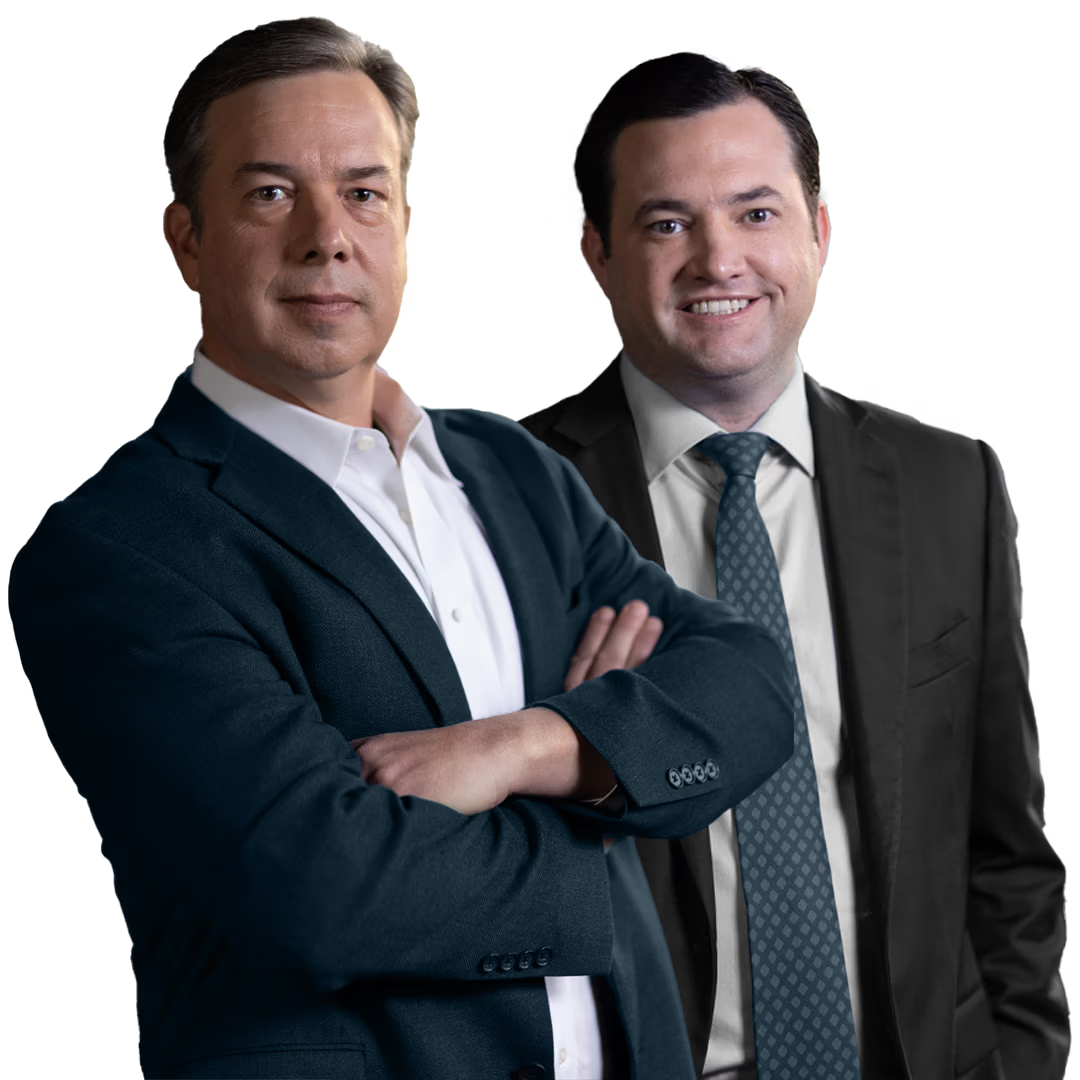
Founding partners Trey Morris and Justin Dewett lead every injury case Morris & Dewett takes.


What clients say
- ★★★★★
I hired Morris and Dewett back in November of 2025.
They helped me get through my hard times of being off work, stress, and worry. Anytime I had a question I could call and they always had an answer. Very nice and professtional people. Thank you Morris and Dewett for making this an easy process for me and my family.
- ★★★★★
Morris and Dewett and their team of attorneys and staff go above and beyond.
They always were there to support me and answer all my questions after a shoulder injury that included multiple surgeries. They are caring and compassionate and that goes a long way! Highly recommended!
- ★★★★★
Thanks Morris and Dewett for the excellent work you have done on my behalf.
I want to personally thank Sarah for her kindness.
- ★★★★★
Morris & Dewett does things the right way!
They put their clients first in measurable and impactful ways.
- ★★★★★
First time being injured and needing a lawyer they where very helpful.
They answered my questions Id have very well. Highly recommend them.
- ★★★★★
Wonderful experience with Morris and DeWitt, everyone was articulate and punctual, and open to all my questions about the process.
My case couldn't have been handled by a better team! Caity Nerren, Jessica Christian, and Meghan Nolen were all fantastic and helped every step of the way. Thanks again for all of your hard work.
Reviews reflect individual client experiences. Past results do not guarantee future outcomes.
Our Shreveport Office
509 Milam St
Shreveport, LA 71101
Open 24/7 for injured Shreveport residents
Get directions →Past results do not guarantee future outcomes; each case is decided on its own facts. See our full case results.
Frequently Asked Questions
- Can I still file a claim if I wasn't wearing a helmet?
- Yes. Texas does not require every rider to wear a helmet, and not wearing one does not bar a claim. Riders over 21 are exempt from the helmet requirement if they carry qualifying health insurance or complete an approved safety course. An insurer may still argue that the lack of a helmet worsened a head injury, which feeds into a fault dispute. Whether helmet use affects a head-injury claim is a factual question, not an automatic defense, and medical evidence is what settles it.
- How long does a Texas motorcycle accident case take to settle?
- Timelines vary by the injuries, the disputes, and the willingness of the insurer to deal honestly. A claim with clear liability and finished medical treatment can resolve in months. A serious-injury case where treatment is ongoing, fault is contested, or a lawsuit becomes necessary takes longer because the value of the case is not fully known until the medical picture stabilizes. Settling before treatment is complete almost always undervalues the claim, so the calendar should follow the medicine.
- Can passengers on a motorcycle file a claim in Texas?
- Yes. A passenger injured in a motorcycle crash can pursue a claim against any at-fault party. That may include the driver of another vehicle, the motorcycle operator, or both, depending on who caused the collision. Because a passenger usually bears no responsibility for how the motorcycle was operated, passenger claims often turn on identifying every responsible driver and every applicable insurance policy.
- What if I was partly at fault for the accident?
- Being partly at fault does not necessarily end a claim in Texas. The state follows a modified comparative fault rule. A claimant who is 50 percent or less at fault can still pursue damages, reduced by the assigned percentage of fault. A claimant found more than 50 percent at fault is barred from compensation. That 51 percent threshold is why insurers push to inflate a rider's share of blame, and why the percentage assigned to each party matters so much to the outcome.
- Can family members sue after a fatal motorcycle accident?
- Yes. Texas law allows a wrongful death claim to be brought by the surviving spouse, children, and parents of the person who died. These claims address the family's losses, while a separate survival claim addresses what the decedent endured before death. Both are subject to their own filing deadlines.
Last updated June 20, 2026