

Morris & Dewett has handled offshore and maritime injury claims for offshore workers for over 25 years.
Fort Worth Workers and the Gulf Coast Offshore Industry
DFW Metroplex
The Dallas-Fort Worth-Arlington metropolitan area, covering Tarrant County and surrounding counties in North Texas. Home to major oil and gas industry corporate offices and a large offshore energy workforce.
The DFW Metroplex is a major labor source for Gulf of Mexico offshore platforms. Thousands of workers from the Fort Worth area travel to the Gulf Coast on rotational schedules. Common rotations are 14 days on, 14 days off, or 28 on, 28 off.
These workers hold jobs in oil and gas extraction, offshore drilling, pipeline construction, and floating production operations. They leave Fort Worth, work a hitch on a rig or platform in Louisiana or federal waters, and return home. When an injury happens on that platform, where you live does not control which law applies.
Federal maritime law governs offshore injuries regardless of the worker’s home state. Living in Tarrant County does not make Texas personal injury law applicable to a claim that arises in federal waters. This matters because federal maritime law and Texas state law have different deadlines, different causation standards, and different fault systems. Getting the jurisdiction wrong can end a viable claim.
Federal maritime law and Texas state tort law are different bodies of law, and an attorney without specific maritime experience may apply the wrong framework from the start. Morris & Dewett handles both federal maritime and Texas state claims and can identify which applies to your situation before the first deadline passes.
What Law Governs Your Offshore Injury Claim?
LHWCA
Longshore and Harbor Workers’ Compensation Act, 33 U.S.C. 901 et seq. A federal workers’ compensation statute covering maritime workers who do not qualify as Jones Act seamen, including workers on fixed offshore platforms.
OCSLA
Outer Continental Shelf Lands Act, 43 U.S.C. 1331 et seq. Extends federal jurisdiction to fixed platforms on the OCS and imports the law of the adjacent state as surrogate federal law.
Three federal statutes govern most offshore injury claims for Gulf Coast workers: the Jones Act, the LHWCA, and OCSLA. Which statute applies depends on two factors: your worker classification and the type of structure where the injury occurred.
proportionate responsibility
Texas’s fault system under CPRC Chapter 33. If you are 51% or more at fault, you recover nothing. If you are 50% or less at fault, your recovery is reduced by your percentage of fault. This system does NOT apply to Jones Act or general maritime law claims.
These are federal laws. Texas proportionate responsibility rules under CPRC Chapter 33 do not govern Jones Act or general maritime law claims. That is not a technicality. It changes everything about how fault is calculated.
Maritime law follows pure comparative fault, an admiralty doctrine separate from Texas state law. Under pure comparative fault, you can recover even if you are 99% at fault. Your recovery is reduced by your percentage of fault, but it is never eliminated by it. A worker who is 80% responsible for their own injury still recovers 20% of their damages under maritime law. The Texas 51% bar that applies to state tort claims does not exist in federal admiralty.
Offshore platforms on the Outer Continental Shelf, beyond three nautical miles from shore, fall under OCSLA. OCSLA imports the law of the adjacent state as surrogate federal law. For Gulf of Mexico platforms, that means Louisiana workers’ compensation and tort law apply to injury claims on fixed OCS structures, not Texas law. A Fort Worth worker injured on a fixed Gulf platform may find that Louisiana law, not Texas law, governs the substance of their claim.
For workers covered by Texas workers’ compensation, the interaction with maritime claims can be complicated. Texas employers can opt out of workers’ comp entirely. If your employer is a non-subscriber, the maritime framework may be your primary remedy. Sorting this out early determines your legal path.
Jones Act: The Primary Law for Injured Seamen
Jones Act
46 U.S.C. 30104. A federal law allowing maritime workers who qualify as seamen to sue their employer for negligence. Provides a lower causation standard than common law and a three-year statute of limitations.
The Jones Act (46 U.S.C. 30104) is the primary federal remedy for injured offshore workers who qualify as seamen. Not every offshore worker qualifies. The distinction is critical.
The Seaman Status Test
To qualify as a Jones Act seaman, a worker must spend at least 30% of their working time aboard a vessel or fleet of vessels in navigation. The vessel must be in actual navigation, not drydocked or permanently moored. Drillships, semi-submersible rigs, jack-up rigs (when floating), supply boats, crew boats, and pipe-lay barges can all qualify as vessels. Fixed platforms bolted to the seabed are not vessels. Workers on fixed platforms cannot be Jones Act seamen.
This 30% test is a threshold, not a guarantee. Courts look at the nature of the worker’s duties, which vessels they were assigned to, and the permanence of the assignment. An employer who wants to avoid Jones Act liability will argue that a worker’s time aboard vessels falls below 30%. Your attorney should analyze your actual work records, not just your job title, to determine seaman status.
Seaman status is one of the most contested issues in maritime law, and an attorney who accepts the employer’s characterization without independent analysis may cost you the most favorable legal framework for your case. We examine payroll records, work schedules, and deployment logs to build the seaman status case from the evidence up.
Jones Act Causation and Filing Deadline
featherweight causation
The Jones Act negligence standard. A worker only needs to show that employer negligence played any part, no matter how small, in causing the injury. This is a lower standard than the common-law “but for” causation test.
The Jones Act uses a featherweight causation standard. The employer’s negligence only needs to have played any part, however slight, in causing the injury. This is a significantly lower bar than the common-law “but for” causation test that applies to Texas state tort claims.
The Jones Act statute of limitations is three years from the date of injury under 46 U.S.C. 30106. This is not the same as the two-year Texas statute of limitations under CPRC Section 16.003. If you apply the Texas deadline to a maritime claim, you may believe you have more time than you do under the shorter of the applicable periods, or less flexibility than you think. Know which deadline controls your claim.
For workers who may also have claims against third parties under construction site accident theories, the interaction of maritime and state law deadlines requires careful attention.
What We Handle
Fort Worth Practice Areas
-
 Car Accidents Rear-end, intersection, and highway collisions across Louisiana.
 -
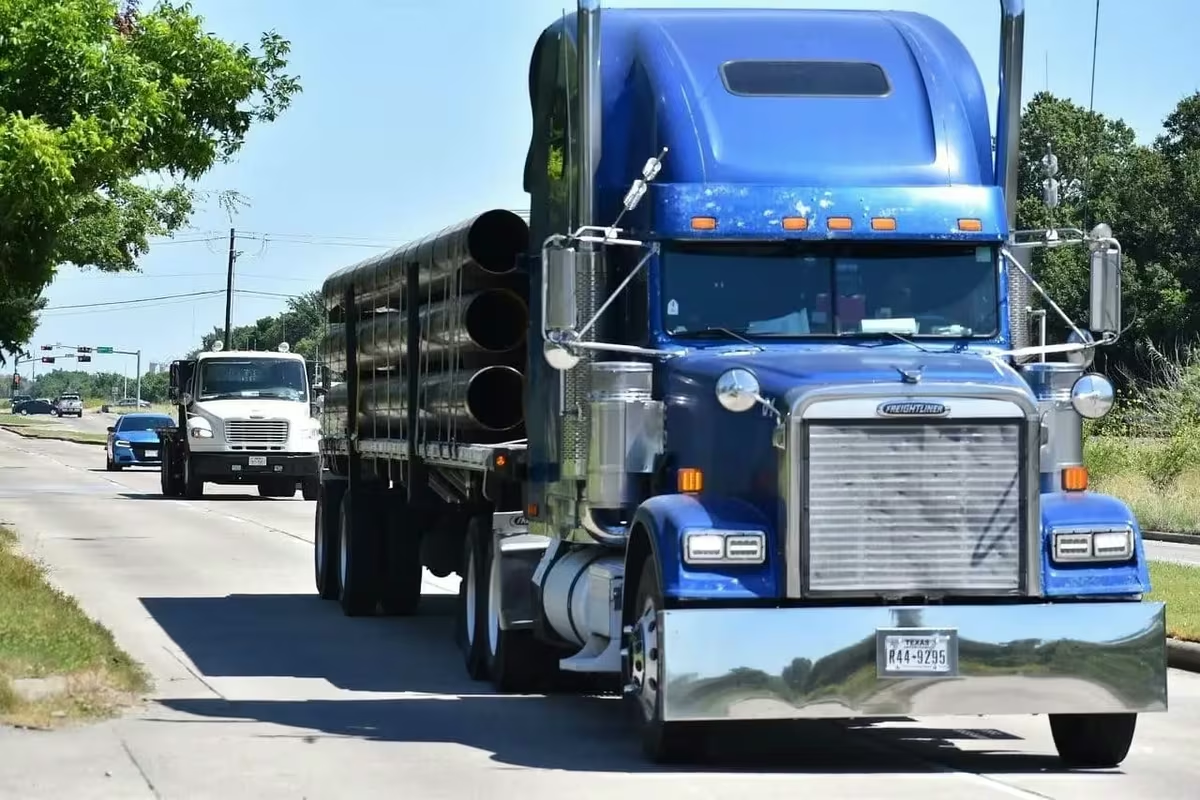 Truck Accidents 18-wheeler and commercial-vehicle wrecks governed by federal trucking rules.
 -
 Motorcycle Accidents Serious-injury motorcycle crashes where bias against riders is common.
 -
 Bus Accidents Transit, school, and charter-bus crashes involving public and private carriers.
 -
 Catastrophic Injury Brain, spinal-cord, amputation, and severe-burn injuries that change a life.
 -
 Brain Injury Traumatic brain injuries with long-term cognitive and physical effects.
 -
 Burn Injury Severe burns from fires, explosions, chemicals, and electrical contact.
 -
 Wrongful Death Claims brought by families after a fatal accident or act of negligence.
 -
 Construction Accidents Falls, struck-by, and equipment injuries on the job site.
 -
 Offshore Accidents Rig, platform, and vessel injuries beyond the shoreline.
 -
 Workers' Compensation On-the-job injuries and the benefits owed to injured workers.
Maintenance and Cure: The Seaman’s Safety Net
Maintenance and cure
A centuries-old maritime doctrine separate from Jones Act negligence. Requires an employer to pay a daily living allowance (maintenance) and all reasonable medical costs (cure) to an injured seaman until Maximum Medical Improvement, regardless of fault.
Maintenance and cure is the oldest protection in American maritime law. It predates the Jones Act by centuries. An employer owes maintenance and cure to any seaman who becomes ill or injured in the service of the vessel. Fault does not matter.
MMI
Maximum Medical Improvement. The point at which a treating physician determines that a seaman’s condition has stabilized and further treatment will not produce significant improvement. Reaching MMI ends the employer’s cure obligation.
Maintenance is a daily living allowance. Cure is the employer’s obligation to pay all reasonable and necessary medical treatment until the seaman reaches Maximum Medical Improvement. MMI is the endpoint of cure, not recovery. A seaman may still be disabled and in pain when an employer declares MMI. The distinction matters for what comes after.
Willful refusal to pay maintenance and cure is one of the few situations in maritime law where punitive damages and attorney’s fees are available. Employers know this. They dispute maintenance rates and challenge MMI determinations as a standard tactic to reduce their exposure. These disputes run parallel to the negligence claim and require separate attention.
Maintenance rates have historically been set low by contracts and custom. Current rates in many cases are well below actual living costs. Challenging the maintenance rate and the employer’s MMI determination requires an attorney who handles maintenance and cure disputes as a distinct practice area, not as a side note to the main case.
Maintenance and cure disputes and the Jones Act negligence claim require different strategies and separate negotiation timelines, and an attorney who treats maintenance and cure as a formality, not a contested benefit, may leave money on the table.
LHWCA: Coverage for Non-Seaman Maritime Workers
Workers who do not qualify as Jones Act seamen may be covered by the Longshore and Harbor Workers’ Compensation Act (33 U.S.C. 901 et seq.), a federal no-fault compensation system. LHWCA claimants typically include dock workers, crane operators, shipbuilders, and workers on fixed offshore platforms who spend their time on a structure bolted to the seabed rather than a vessel.
LHWCA is a no-fault compensation system. It provides wage replacement at two-thirds of your average weekly wage and full medical benefits without requiring proof of employer negligence. That sounds straightforward. It is not always favorable.
LHWCA compensation does not bar a separate third-party negligence suit. If the platform owner, a vessel operator, or an equipment manufacturer contributed to your injury, you can pursue a negligence claim against that third party while collecting LHWCA compensation. Understanding whether such third parties exist is often where the real recovery is.
The LHWCA filing deadline is one year from the date of injury under 33 U.S.C. 913. This is significantly shorter than the Jones Act’s three-year period. Workers who assume the Texas two-year statute of limitations applies, or who assume they have three years because they heard that somewhere, may miss the LHWCA deadline entirely. One missed year permanently bars the claim.
Whether you are a Jones Act seaman or an LHWCA claimant is the first question that must be answered correctly. It controls your available remedies, your deadlines, and your recovery ceiling.
OCSLA: Outer Continental Shelf Accidents
Fixed platforms on the Gulf of Mexico OCS are governed by the Outer Continental Shelf Lands Act (43 U.S.C. 1331 et seq.), which extends federal jurisdiction to structures located beyond three nautical miles from shore and imports Louisiana law as surrogate federal law for injury claims. Fixed platforms on the Gulf of Mexico OCS are subject to OCSLA.
OCSLA’s key provision for injury claims is the surrogate law rule. OCSLA imports the law of the adjacent state as surrogate federal law for claims that are not covered by another federal statute. For Gulf of Mexico platforms, the adjacent state is Louisiana. This means Louisiana’s workers’ compensation law and tort law apply to injury claims on fixed OCS platforms, not Texas law.
A DFW-area worker injured on a fixed OCS platform may have claims governed substantially by Louisiana law. This is not intuitive. The worker lives in Fort Worth. The employer may be based in Houston. The platform sits in the Gulf. But Louisiana law is the surrogate federal law for that claim.
BSEE, the Bureau of Safety and Environmental Enforcement, regulates offshore platform safety under 30 C.F.R. Part 250. BSEE enforces Safety and Environmental Management Systems requirements, which impose specific operator duties for hazard identification, equipment inspection, emergency response, and incident investigation. A BSEE violation creates evidence of negligence. Operators who fail to maintain SEMS programs or who ignore inspection findings have documented failures that support a negligence claim.
Past results do not guarantee future outcomes; each case is decided on its own facts. See our full case results.
Fixed Platform vs. Floating Vessel: Why the Distinction Matters
The legal framework for your injury claim depends on one threshold question: was the worksite a fixed structure or a floating vessel? This is not always obvious from the name of the equipment.
Fixed structures include production platforms, wellhead structures, and caissons permanently attached to the seabed. Fixed platform workers are covered by LHWCA and OCSLA, not the Jones Act. Floating structures include semi-submersible rigs, drillships, and floating production storage and offloading vessels. Workers on floating vessels may qualify as Jones Act seamen.
Jack-up rigs occupy contested legal ground. A jack-up is a mobile offshore drilling unit that can be floated to location and then extended on legs to the seabed during drilling operations. Courts have split on whether a jack-up engaged in drilling operations is a vessel or a fixed platform. The Fifth Circuit addressed this in Barker v. Hercules Offshore, 713 F.3d 208 (5th Cir. 2013), holding that a jack-up in the elevated drilling position was not a vessel. Other cases have reached different conclusions on different facts.
The classification determines three things: whether Jones Act seaman status is possible, which statute provides the compensation framework, and whether state law applies. Employers and their insurers invest resources in arguing that a worker was on a fixed structure rather than a vessel. That argument reduces their exposure significantly. An experienced maritime attorney checks the actual equipment, the operational status at the time of injury, and the applicable case law, not just the employer’s characterization.
Borrowed Servant Doctrine in Offshore Cases
borrowed servant doctrine
A legal doctrine that can shift Jones Act employer status to the entity that exercises day-to-day operational control over a worker, even if that entity did not issue the worker’s paycheck. Common in offshore cases where workers are employed by staffing companies but supervised by platform operators.
Many offshore workers are employed by a staffing company or drilling subcontractor. They show up on a platform operated by a major oil company that did not hire them directly. The borrowed servant doctrine can make the platform operator, not the staffing company, the Jones Act employer for purposes of the injury claim.
The test is operational control. If the platform operator controls how you do your work, directs your day-to-day tasks, and supervises your activities on the rig, it may be your Jones Act employer. The entity that signs your paycheck is not necessarily the employer for maritime law purposes.
This matters because the Jones Act defendant is the employer. If you name only the staffing company and the platform operator was your actual borrowed employer, you may have sued the wrong party. Both the nominal employer and the borrowing employer can have liability depending on the facts, but the analysis requires examining the actual supervisory relationship on the platform.
Vessel owners face a parallel exposure under the unseaworthiness doctrine of general maritime law, separate from the Jones Act employer analysis.
Unseaworthiness Claims Against Vessel Owners
Unseaworthiness
A general maritime law claim against a vessel owner for failing to provide a reasonably fit vessel, equipment, or crew. This is a strict liability standard — the owner does not need to have known about the defect. It is separate from Jones Act employer negligence.
Under general maritime law, vessel owners owe an absolute duty to provide a seaworthy vessel. Unseaworthiness means the vessel, its equipment, or its crew were not reasonably fit for their intended purpose at the time of the injury. This is a strict liability standard.
The vessel owner does not need to have known about the condition that caused the injury. A defective winch, a slippery deck without adequate traction, a safety system that failed under normal operating conditions, or an inadequately trained crew member can all support an unseaworthiness claim without proof that the owner had advance notice.
Unseaworthiness runs against the vessel owner. The Jones Act claim runs against the employer. These are separate defendants in many cases. The same accident can produce parallel Jones Act negligence claims and unseaworthiness claims, potentially against different parties. Building both claims at the outset requires understanding both legal theories and identifying every potentially liable party.
Your Fort Worth Injury Attorneys
Founding partners Trey Morris and Justin Dewett lead every Fort Worth injury case Morris & Dewett takes.


What Compensation Does Federal Maritime Law Allow?
The available damages depend on which statute covers your claim.
loss of earning capacity
The difference between what you could have earned over your working lifetime before the injury and what you can earn after. Calculated using vocational expert testimony and present-value economic analysis.
Under the Jones Act and general maritime law, an injured seaman can recover past and future medical expenses, past and future lost wages, loss of earning capacity, pain and suffering, mental anguish, and disfigurement. These are broad damages that reflect the full economic and human impact of the injury.
LHWCA provides wage replacement at 66.67% of your average weekly wage and full medical coverage. Non-economic damages like pain and suffering are not available through LHWCA compensation. This is one reason why identifying third-party liability alongside the LHWCA claim matters. The LHWCA compensation covers the floor; a negligence claim against a third party provides the ceiling.
For deaths at sea, the Death on the High Seas Act (46 U.S.C. 30301 et seq.) applies to deaths occurring more than three nautical miles from shore. DOHSA limits recovery to pecuniary damages only. Pain and suffering of the deceased is not recoverable under DOHSA. For deaths within three nautical miles, state wrongful death law may allow broader recovery including non-economic damages.
Loss of consortium claims for surviving spouses may be available depending on which law applies and where the death occurred. These are claims in their own right, separate from the estate’s claims, and they require their own analysis.
View our case results to see our offshore and maritime recovery record. We do not list dollar amounts on practice area pages.
Filing Deadlines for Offshore Injury Claims
Offshore injury claims carry three different deadlines: three years under the Jones Act, one year under the LHWCA, and three years under general maritime law. The Texas two-year statute of limitations does not govern federal maritime claims.
Jones Act claims have a three-year statute of limitations from the date of injury under 46 U.S.C. 30106. General maritime claims for personal injury and death also carry a three-year period. These are federal deadlines and are not the same as the two-year Texas statute of limitations under CPRC Section 16.003. The Texas deadline does not govern federal maritime claims.
The LHWCA filing deadline is one year from the date of injury under 33 U.S.C. 913. Claims must be filed with the Office of Workers’ Compensation Programs within that year. DOHSA carries a three-year period from the date of death.
The one-year LHWCA deadline is the most commonly missed. Workers assume they have two or three years because that is what they have heard about injury claims. The LHWCA deadline is shorter and non-obvious. Missing it permanently bars the claim, with very limited exceptions.
Your attorney should identify which statute or statutes apply to your claim on the first consultation and calendar all applicable deadlines immediately.
What clients say
- ★★★★★
I hired Morris and Dewett back in November of 2025.
They helped me get through my hard times of being off work, stress, and worry. Anytime I had a question I could call and they always had an answer. Very nice and professtional people. Thank you Morris and Dewett for making this an easy process for me and my family.
- ★★★★★
Morris and Dewett and their team of attorneys and staff go above and beyond.
They always were there to support me and answer all my questions after a shoulder injury that included multiple surgeries. They are caring and compassionate and that goes a long way! Highly recommended!
- ★★★★★
Thanks Morris and Dewett for the excellent work you have done on my behalf.
I want to personally thank Sarah for her kindness.
- ★★★★★
Morris & Dewett does things the right way!
They put their clients first in measurable and impactful ways.
- ★★★★★
First time being injured and needing a lawyer they where very helpful.
They answered my questions Id have very well. Highly recommend them.
- ★★★★★
Wonderful experience with Morris and DeWitt, everyone was articulate and punctual, and open to all my questions about the process.
My case couldn't have been handled by a better team! Caity Nerren, Jessica Christian, and Meghan Nolen were all fantastic and helped every step of the way. Thanks again for all of your hard work.
Reviews reflect individual client experiences. Past results do not guarantee future outcomes.
Fort Worth Offshore Accident Attorneys: What Morris and Dewett Brings
Morris & Dewett represents offshore workers from the DFW area with claims arising on Gulf Coast platforms and vessels. Our attorneys are Board Certified Personal Injury Trial Lawyers by the Texas Board of Legal Specialization, one of the highest credentials available to Texas trial lawyers. Board certification in personal injury trial law requires a demonstrated record of trial work and a peer-reviewed examination.
We have handled maritime injury cases for over 25 years, including Jones Act seaman claims, LHWCA coverage disputes, unseaworthiness claims against vessel owners, and maintenance and cure enforcement. We have 2,498 five-star Google reviews across our offices. Our Fort Worth clients are part of a firm that has built its practice on complex injury cases, not volume settlement work.
When you consult with us about a maritime claim, we identify your worker classification, the applicable law, and all filing deadlines at the outset. We do not assume the Texas framework applies until we have confirmed it. If your claim is governed by federal maritime law, we treat it accordingly from day one.
Frequently Asked Questions
- I live in Fort Worth but was injured on an offshore platform in the Gulf. Which state's law applies to my case?
- Your home state does not control which law applies to an offshore injury. Federal maritime law governs based on the nature of the work and the location of the structure. If you were injured on a fixed OCS platform, OCSLA (43 U.S.C. 1331 et seq.) imports Louisiana law as surrogate federal law, not Texas law. If you were on a floating vessel, the Jones Act (46 U.S.C. 30104) and general maritime law apply. Texas personal injury law applies only to state-law claims that are not preempted by federal maritime law, which is rarely the case for Gulf offshore injuries.
- What is the difference between a Jones Act seaman and a regular offshore worker?
- A Jones Act seaman is a maritime worker who spends at least 30% of their working time aboard a vessel or fleet of vessels in navigation. This includes drillship crews, semi-submersible rig workers, and supply boat crew. A worker on a fixed platform bolted to the seabed does not qualify as a seaman because a fixed platform is not a vessel. The distinction is not based on job title or what your employer tells you. It requires analysis of where you actually worked and how much time you spent aboard qualifying vessels. Seaman status determines whether you can bring a Jones Act negligence claim, which carries a significantly lower causation standard than other legal theories.
- My employer is telling me to file a Texas workers' compensation claim after my offshore injury. Is that correct?
- Not necessarily. If your injury occurred on a vessel or in federal waters, federal maritime law may preempt the Texas workers' comp system entirely. Jones Act seamen cannot be directed into state workers' comp programs that would strip them of their maritime rights. LHWCA claimants have their own federal compensation system that operates separately from Texas workers' comp. Filing a Texas workers' comp claim when a federal maritime claim applies could limit your recovery. Before filing anything, consult a maritime attorney to determine which legal framework actually governs your injury. The employer's direction to file a state claim may reflect their interest in limiting exposure, not your legal rights.
- How long do I have to file an offshore injury claim?
- The deadline depends on which statute applies. The Jones Act gives you three years from the date of injury under 46 U.S.C. 30106. General maritime law claims also carry a three-year period. The LHWCA requires you to file a claim with the Office of Workers' Compensation Programs within one year of your injury under 33 U.S.C. 913. The Death on the High Seas Act carries a three-year period from the date of death. The Texas two-year statute of limitations under CPRC Section 16.003 does not apply to federal maritime claims. The one-year LHWCA deadline is the most dangerous because workers assume they have more time. A missed LHWCA deadline permanently bars the claim.
- What is maintenance and cure, and does my employer have to pay it?
- Maintenance and cure is a maritime doctrine requiring an employer to pay a daily living allowance (maintenance) and all reasonable medical costs (cure) to an injured seaman until the seaman reaches Maximum Medical Improvement. It is not fault-based. Your employer owes maintenance and cure regardless of who caused your injury, even if you were partly at fault. Willful refusal to pay maintenance and cure can result in punitive damages and attorney's fees, which is a rare remedy in maritime law. Employers routinely dispute the daily maintenance rate and challenge MMI determinations to reduce their obligation. These disputes run independently of the negligence claim and require separate legal attention.
- Can I sue the platform owner even if my employer is a separate company?
- Yes, potentially on multiple theories. The borrowed servant doctrine may make the platform operator your Jones Act employer if it exercises operational control over your work, even if your paycheck came from a staffing company. Separately, the platform owner may be liable under the unseaworthiness doctrine of general maritime law if the platform or its equipment was not reasonably fit for its intended purpose. That is a strict liability claim that does not require proving the owner knew about the defect. A third-party negligence claim may also run against the platform owner independently of any workers' compensation framework. All three theories require separate analysis against the specific facts of your accident.
- What if the offshore platform was in international waters?
- For platforms on the Outer Continental Shelf beyond three nautical miles, the Outer Continental Shelf Lands Act extends federal jurisdiction and imports adjacent state law. Beyond the OCS, general maritime law and potentially international law apply. For deaths occurring more than three nautical miles from shore, the Death on the High Seas Act limits recovery to pecuniary damages only, excluding pain and suffering. The further from shore the platform was located, the more specific the applicable legal framework becomes. This is not an area where general personal injury law applies. Maritime attorneys with offshore platform experience are necessary for claims arising in deep water or international waters.
- Does maritime law allow punitive damages?
- Generally, punitive damages are not available in maritime personal injury cases under general maritime law after the Supreme Court's decision in *Townsend v. Atlantic Sounding Co.* and related cases. There are two recognized exceptions: willful failure to pay maintenance and cure, and claims under the Jones Act where the employer's conduct meets the statutory standard. Outside these exceptions, punitive damages are not available in maritime injury claims, unlike Texas state tort cases where exemplary damages can be pursued under CPRC Section 41.008 for fraud, malice, or gross negligence. The difference in available remedies is one of many reasons why identifying the correct legal framework at the outset matters for your case.
Last updated June 5, 2026