
Texas Car Accident Law: What Governs Your Case
MMI
Maximum Medical Improvement. The point at which your treating physician determines your condition has stabilized and further significant improvement is unlikely. Settling before MMI means you may not know the full cost of future treatment.
Texas gives injured people two years to file a personal injury lawsuit. That deadline comes from CPRC Section 16.003(a) and runs from the date of injury. Two years sounds like a long time. It is not, once you factor in reaching MMI, building a complete damages picture, and preparing a demand package. Cases filed last-minute lose negotiating leverage.
Texas is a fault-based state. You must prove the other driver’s negligence. That means proving four things: the driver owed you a duty of care, the driver breached that duty, the breach caused your injury, and you suffered measurable damages. All four elements are required. A case missing any one of them cannot proceed.
proportionate responsibility
Texas’s fault-allocation system under CPRC Chapter 33. Your recovery is reduced by your percentage of fault. If you are 51% or more at fault, you recover nothing. At 50% or less, you recover your damages reduced by your fault percentage.
Texas uses proportionate responsibility to allocate fault. Under CPRC Section 33.001, a claimant who is found 51% or more at fault recovers nothing. At exactly 50%, recovery is cut in half. Insurance adjusters know this rule. Their strategy often focuses on pushing your assigned fault above the 50% threshold.
The first 72 hours after a crash produce evidence that cannot be recovered later. Morris & Dewett begins evidence preservation immediately, including preservation demands for surveillance footage that overwrites quickly on major corridors.
Haygood rule
The rule from Haygood v. De Escabedo, 356 S.W.3d 390 (Tex. 2012), interpreting CPRC Section 41.0105. Recovery of medical expenses is limited to amounts actually paid or incurred by or on behalf of the plaintiff, not the full billed amount. If your insurer negotiated a reduced rate, you recover the reduced rate, not the billed amount.
The Haygood rule affects how medical damages are calculated. Under CPRC Section 41.0105, you cannot recover the full billed amount if your insurer paid a negotiated lower rate. This rule can significantly affect the medical damages component of your case.
Texas does not allow direct action against the at-fault driver’s liability insurer. You sue the driver. The insurer defends and pays any judgment, but is not a named defendant. See our Fort Worth personal injury lawyers hub page for overview of all Texas personal injury rules.
What Causes Most Fort Worth Car Accidents?
Six causes account for the majority of Tarrant County crash litigation: distracted driving, speeding, DWI, fatigued driving, failure to yield, and poor vehicle maintenance. Each creates a different evidence and liability profile.
Distracted driving is a leading cause of crash liability in Texas courts. Texas Transportation Code Section 545.4251 prohibits handheld phone use while driving (effective September 1, 2017). Cell phone carrier records can be subpoenaed to establish that a driver was actively using their phone at the time of impact. Texting violations establish negligence per se, which shifts the burden in proportionate responsibility arguments.
Speeding and aggressive driving produce the most severe crashes on DFW’s high-speed corridors. Speed differential between vehicles at impact determines injury severity. Following too close, unsafe lane changes, and cutting across traffic on Loop 820 and SH-121 are common patterns. Post-crash vehicle inspection, skid mark analysis, and EDR speed data establish pre-impact speeds.
DWI
Driving While Intoxicated. Under Texas Penal Code Section 49.04, a person is intoxicated while driving if their BAC is .08 or higher, or if they have lost the normal use of their mental or physical faculties due to alcohol or drugs.
Exemplary damages
Texas term for punitive damages under CPRC Section 41.008. Required clear and convincing evidence of malice, fraud, or gross negligence. In DWI cases, gross negligence is often established. Capped at the greater of two times economic damages plus noneconomic damages up to $750,000, or $200,000.
DWI crashes create two parallel legal tracks. The criminal case proceeds separately from your civil claim. A DWI conviction or guilty plea creates collateral estoppel in the civil case, making liability significantly easier to establish. Exemplary damages may be available in DWI crashes under CPRC Section 41.008.
Fatigued driving is harder to establish than DWI but equally serious. Commercial drivers are subject to FMCSA hours-of-service limits. ELD records document driving time for commercial vehicles. For non-commercial drivers, phone records, gas station receipts, and surveillance footage can establish extended waking hours before a crash.
Red light running and failure to yield are common in Fort Worth’s commercial zones and busy arterials. Traffic signal timing data and red light camera footage are subpoenable from the city or county. Acting quickly matters, as some systems overwrite on rolling cycles.
Poor vehicle maintenance creates product and owner liability theories alongside driver negligence. Defective brakes, worn tires, and faulty lighting are all conditions that should appear in vehicle inspection records. If a third party maintained the vehicle, that creates additional defendants.
For commercial vehicle crashes, see our Fort Worth truck accidents page for specific FMCSA rules and evidence requirements.
Common Car Accident Injuries in Tarrant County Cases
Tarrant County car accident cases most commonly involve traumatic brain injury, spinal cord and disc injuries, soft tissue damage, broken bones, internal injuries, and psychological conditions including PTSD. Each injury type requires different expert evidence and affects how damages are calculated.
TBI
Traumatic Brain Injury. A disruption in normal brain function caused by external force. Ranges from concussion (mild TBI) to severe TBI with permanent cognitive impairment. Symptoms may not appear immediately. Neuropsychological testing is required to document cognitive, emotional, and behavioral changes.
TBI is among the most under-documented injuries in car accidents. Symptoms are often delayed. Emergency rooms may discharge patients who later develop significant cognitive or behavioral changes. Neuropsychological evaluation and neuroimaging are required to fully document TBI for litigation.
Spinal cord injuries range from cervical disc herniations to complete spinal cord disruption with permanent paralysis. MRI is required for full documentation; initial X-rays miss soft tissue and disc pathology. Permanent disability claims for spinal cord injuries require a life-care plan prepared by a certified life-care planner and converted to present value by an economist.
Soft tissue injuries, including whiplash, muscle tears, and ligament damage, are the most frequently disputed category. Insurers routinely argue these conditions are pre-existing or exaggerated. A complete treatment timeline, consistent medical imaging, and treating physician opinions are your primary defense against those arguments.
Broken bones are quantifiable: surgical records, hardware implants, physical therapy timelines, and return-to-work restrictions are all documented. Femur, rib, and wrist fractures produce extended recovery periods with measurable work capacity loss.
Internal injuries from high-speed crashes may not be apparent at the scene. Organ damage and internal bleeding require emergency imaging at JPS Health Network or Texas Health Harris Methodist Hospital. Delayed treatment of internal injuries creates both a medical risk and a causation argument in litigation.
Psychological injuries, including PTSD, anxiety disorders, and driving phobia, are compensable as non-economic damages in Texas. They require documentation from a treating mental health provider or independent expert evaluation. Insurers do not concede psychological damages without that record.
What We Handle
Fort Worth Practice Areas
-
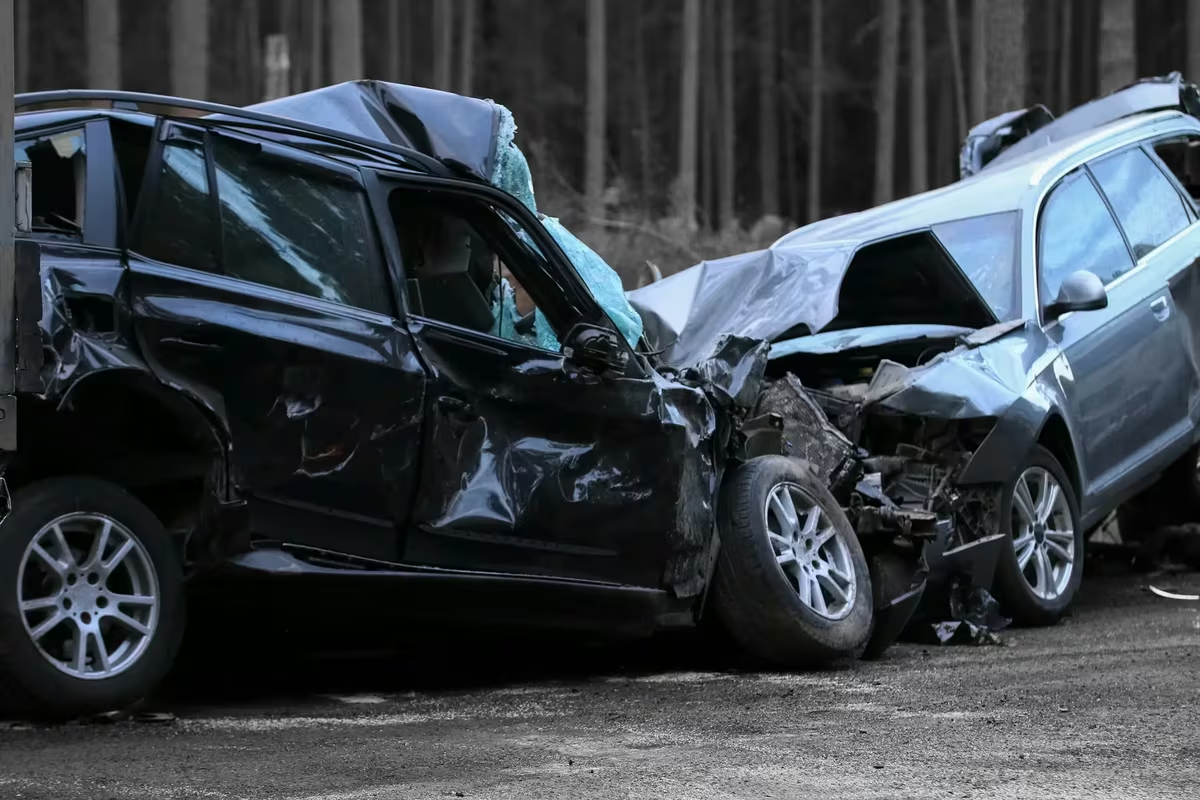 Car Accidents Rear-end, intersection, and highway collisions across Louisiana.
 -
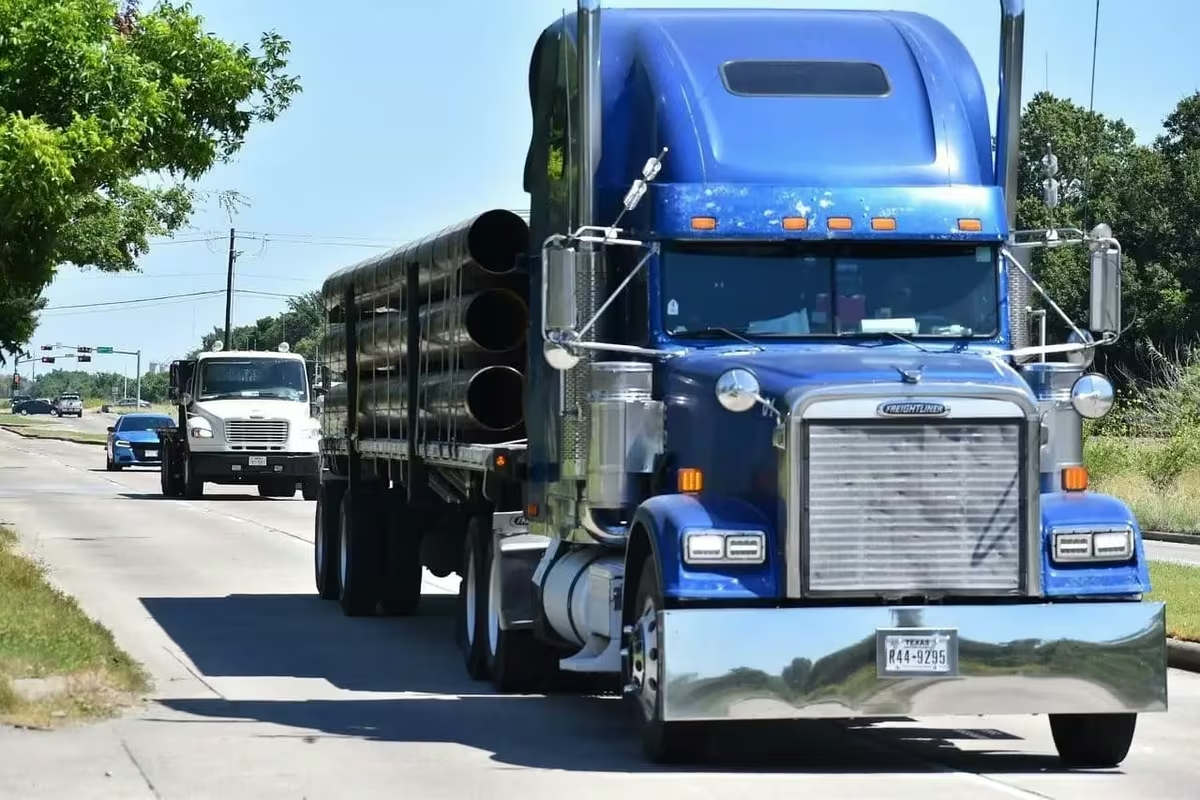 Truck Accidents 18-wheeler and commercial-vehicle wrecks governed by federal trucking rules.
 -
 Motorcycle Accidents Serious-injury motorcycle crashes where bias against riders is common.
 -
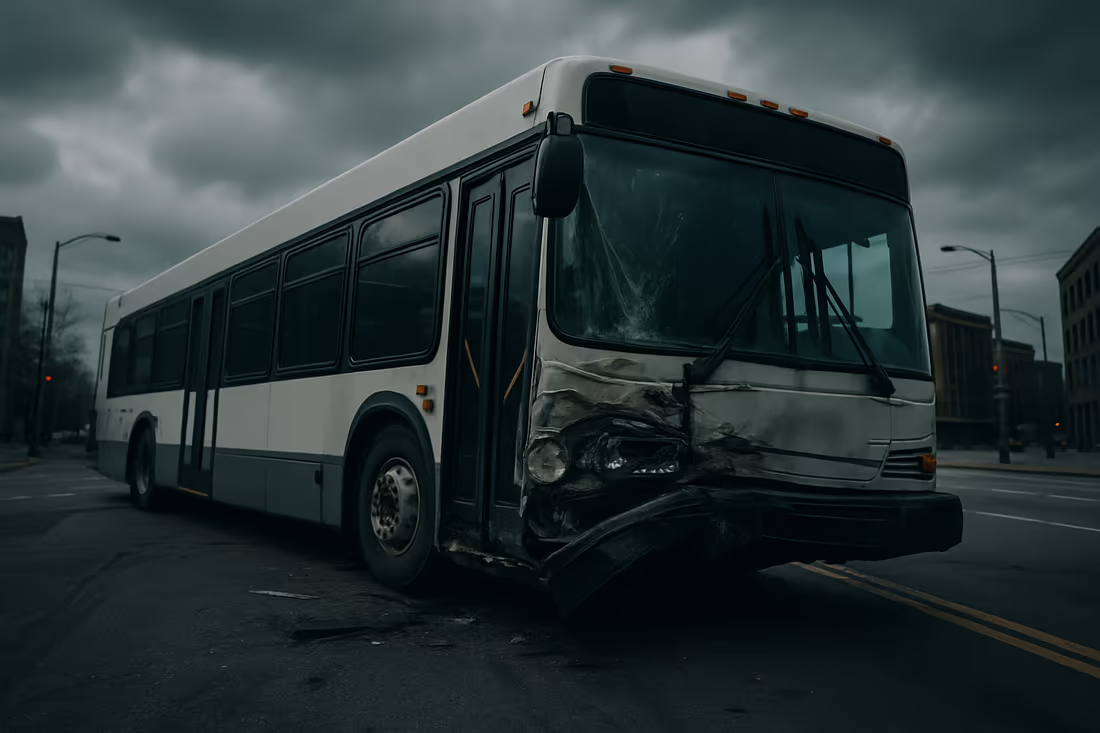 Bus Accidents Transit, school, and charter-bus crashes involving public and private carriers.
 -
 Catastrophic Injury Brain, spinal-cord, amputation, and severe-burn injuries that change a life.
 -
 Brain Injury Traumatic brain injuries with long-term cognitive and physical effects.
 -
 Burn Injury Severe burns from fires, explosions, chemicals, and electrical contact.
 -
 Wrongful Death Claims brought by families after a fatal accident or act of negligence.
 -
 Construction Accidents Falls, struck-by, and equipment injuries on the job site.
 -
 Offshore Accidents Rig, platform, and vessel injuries beyond the shoreline.
 -
 Workers' Compensation On-the-job injuries and the benefits owed to injured workers.
Texas Auto Insurance Minimums and Coverage Gaps
Texas requires minimum auto liability coverage of 30/60/25 under Tex. Transp. Code Section 601.072. That is $30,000 per injured person, $60,000 per accident, and $25,000 for property damage. In the DFW metro, serious crash injuries routinely exceed those limits within the first hospital admission.
UM/UIM
Uninsured/Underinsured Motorist coverage. Pays you when the at-fault driver has no insurance or insufficient insurance to cover your damages. Texas insurers must offer UM/UIM with every auto policy. You may reject it in writing, but that rejection must be explicit and documented.
UM/UIM coverage under Tex. Ins. Code Chapter 1952 is your protection against the coverage gap. If you did not reject UM/UIM in writing, you likely have it. Pull your declarations page and verify the limits. If the at-fault driver carries only minimum coverage and your damages exceed their limit, your own UM/UIM policy is often the only additional source of recovery.
Stowers doctrine
A Texas common law rule requiring insurers to accept a reasonable settlement demand within policy limits when the claim is covered and a reasonable insurer would accept. Named after G.A. Stowers Furniture Co. v. American Indemnity Co. (1929). If the insurer refuses a qualifying demand and the jury returns a verdict above the policy limits, the insurer pays the full judgment.
The Stowers doctrine creates insurer accountability in settlement negotiations. When liability is clear and the demand is within policy limits, an insurer that refuses faces liability for the entire verdict. This doctrine creates real leverage before trial for plaintiffs with strong cases.
Property damage is handled separately from your bodily injury claim. Texas insurers have 30 days to accept or reject a claim. Rental car reimbursement is a separate coverage under most policies and should be claimed immediately.
Contingency Fee
A fee arrangement where the attorney receives a percentage of the recovery and nothing if the case is unsuccessful. The client pays no upfront legal fees.
Morris & Dewett handles car accident cases on a Contingency Fee basis. If there is no recovery, there is no attorney fee.
Fort Worth and Tarrant County Crash Corridors
Tarrant County’s highest-crash corridors are I-30, I-35W, I-20, Loop 820, and SH-121. Surveillance footage on these corridors overwrites within 30 to 72 hours, making immediate evidence preservation critical after any serious crash.
I-30 runs east-west through downtown Fort Worth. Rear-end and lane-change crashes near the downtown interchange and the I-30/I-35W “Mixmaster” are common. The Mixmaster is one of the most structurally complex interchanges in North Texas, with multiple split levels, short merge distances, and high through-traffic volume.
I-35W runs north-south through Fort Worth carrying heavy commercial truck traffic between the Alliance Airport logistics corridor and the broader DFW network. Commercial vehicle crashes on I-35W involve federal regulations that do not apply to passenger car cases. The Alliance Airport area north of Fort Worth is one of the most concentrated commercial vehicle zones in the region.
I-20 runs east-west along Fort Worth’s southern corridor, connecting the DFW metro to Midland, El Paso, and West Texas. Commercial vehicle volume is consistent and sustained. Construction zone activity on I-20 creates specific crash patterns involving lane closures and speed reductions.
Loop 820 encircles inner Fort Worth with high-volume interchange accident points at I-30, I-35W, and I-20. SH-121 is a high-speed commuter connector to Denton and Collin Counties with a serious-injury crash profile driven by speed differential and merge conflicts.
TxDOT crash statistics for Tarrant County are publicly available. Tarrant County consistently ranks among the highest-crash counties in Texas by total collision count. Corridor-specific crash data supports claims about location-specific hazards.
On major corridors, surveillance footage from traffic management systems, commercial properties, and dash cams overwrites within 30 to 72 hours.
Past results do not guarantee future outcomes; each case is decided on its own facts. See our full case results.
Evidence in a Fort Worth Car Accident Case
The Texas Peace Officer’s Crash Report (CR-3) is your starting point. It documents the officer’s observations, diagram of the collision, citations issued, and narrative of fault. You can request it from TxDOT or the investigating agency. Read it carefully. Errors in the CR-3 can be contested, but you need to know what it says before your attorney builds a demand.
Surveillance and traffic camera footage from major corridors overwrites quickly. Preservation demands must go out within hours of the crash on I-30, I-35W, and Loop 820. Once footage is overwritten, it is gone. Morris & Dewett sends preservation demands the same day we are engaged.
EDR
Event Data Recorder. An onboard device in most vehicles manufactured after 2013 that records pre-impact speed, brake application, throttle position, seat belt status, and airbag deployment. Sometimes called the “black box.” Data must be downloaded with specialized equipment before the vehicle is repaired or salvaged.
EDR data is available in most modern vehicles. The vehicle’s EDR captures pre-impact speed, braking inputs, steering angle, and airbag deployment. This data must be downloaded before the vehicle is repaired or totaled. A court order or agreement with the owner is required to preserve and download the data if the at-fault party controls the vehicle.
Witness statements are critical in disputed-fault cases. Witnesses leave the scene. Their memories fade. Contact information captured at the scene is worth more than any statement taken weeks later. If you can photograph the scene and collect witness contact information before leaving, do it.
Cell phone records establish distracted driving. Subpoenas to wireless carriers can produce call logs and data usage records that show the driver was actively using their phone at the moment of impact. Carrier retention policies vary, but records from major carriers typically exist for 12 to 24 months.
Accident reconstruction
A scientific analysis of a crash performed by a licensed engineer or accident reconstruction specialist. Uses vehicle damage, skid marks, EDR data, road geometry, and physics to calculate pre-impact speeds, braking distances, and point of impact. Used in contested-fault and serious injury cases to counter the at-fault driver’s narrative.
Accident reconstruction is used in serious injury and contested-fault cases. A reconstruction specialist can establish pre-impact speeds and the dynamics of the collision when the physical evidence and witness accounts conflict. Morris & Dewett retains reconstruction experts for cases where causation and fault are disputed.
Your Fort Worth Injury Attorneys
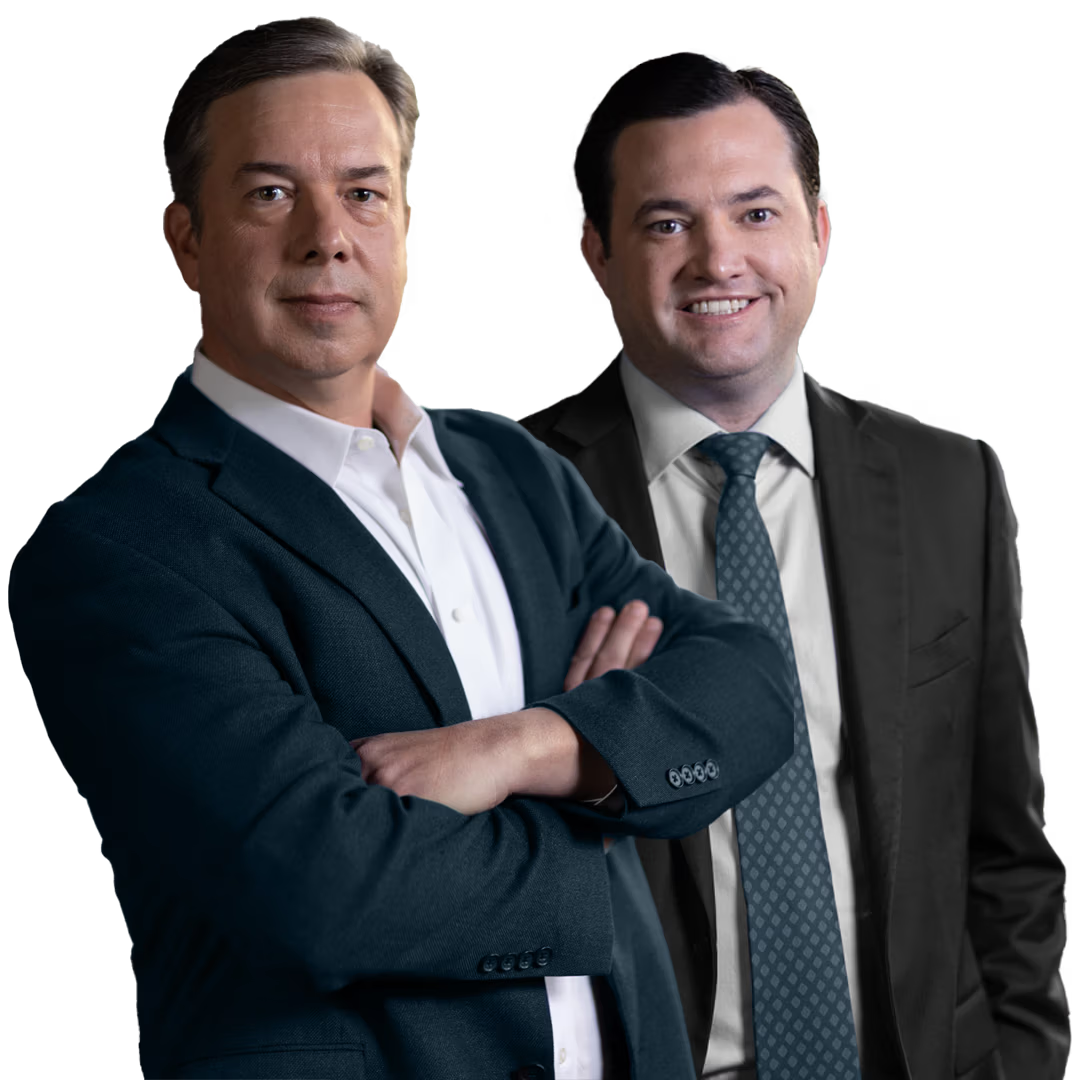
Founding partners Trey Morris and Justin Dewett lead every Fort Worth injury case Morris & Dewett takes.


Damages in a Texas Car Accident Case
Texas personal injury damages fall into three categories. Economic damages cover past and future medical expenses (subject to the Haygood rule), lost wages from missed work, reduced earning capacity if the injury affects your ability to work long-term, and property damage to your vehicle.
Non-economic damages compensate for pain and suffering, mental anguish, physical impairment, and disfigurement. These are real losses, but they have no receipt. The medical record, treating physician opinions, and sometimes expert testimony establish them. Loss of consortium, a spouse’s claim for loss of companionship and support, is a separate non-economic category.
Exemplary damages
Texas punitive damages under CPRC Section 41.008. Require clear and convincing evidence of fraud, malice, or gross negligence. The cap is the greater of two times economic damages plus noneconomic damages up to $750,000, or $200,000. The cap does not apply to certain felonies.
Exemplary damages under CPRC Section 41.008 are available when the defendant’s conduct rises to gross negligence, malice, or fraud. DWI crashes involving a repeat offender or high BAC often support exemplary damage claims. The cap still applies, but the claim itself creates negotiating leverage.
Texas places no cap on economic damages in standard personal injury cases. There is also no cap on non-economic damages in car accident cases (medical malpractice caps do not apply here).
Timing matters. Settling before MMI means you do not know what future treatment will cost. Morris & Dewett does not push clients to settle before their medical picture is complete.
For wrongful death crashes, only the surviving spouse, children, and parents may bring a claim under CPRC Chapter 71. A survival action runs parallel and recovers the decedent’s own losses. See our case results for examples of prior outcomes.
JPS Health Network and Injury Documentation
JPS Health Network at 1500 S. Main St. is the Level I trauma center for Tarrant County. Level I designation requires 24/7 readiness for the most severe injuries: penetrating trauma, polytrauma, spinal cord damage, and traumatic brain injuries. Not every DFW area hospital holds this designation.
Level I centers see higher volumes of severe trauma, which translates to more experienced trauma surgeons and more thorough initial documentation. The treating physicians, specialist opinions, imaging studies, and surgical records from JPS form a significant part of the evidence in serious injury litigation.
Texas Health Harris Methodist Hospital at 1301 Pennsylvania Ave. and Medical City Fort Worth at 900 Eighth Ave. also provide emergency and surgical care for crash victims in Tarrant County. Records from any treating facility are part of your case file.
Treating physician opinions matter more than insurer-retained doctors. The treating physician has ongoing knowledge of your condition. Their opinions on causation, severity, and future treatment needs carry significant weight.
Return to the Fort Worth personal injury lawyers hub for coverage of other practice areas.
What clients say
- ★★★★★
I hired Morris and Dewett back in November of 2025.
They helped me get through my hard times of being off work, stress, and worry. Anytime I had a question I could call and they always had an answer. Very nice and professtional people. Thank you Morris and Dewett for making this an easy process for me and my family.
- ★★★★★
Morris and Dewett and their team of attorneys and staff go above and beyond.
They always were there to support me and answer all my questions after a shoulder injury that included multiple surgeries. They are caring and compassionate and that goes a long way! Highly recommended!
- ★★★★★
Thanks Morris and Dewett for the excellent work you have done on my behalf.
I want to personally thank Sarah for her kindness.
- ★★★★★
Morris & Dewett does things the right way!
They put their clients first in measurable and impactful ways.
- ★★★★★
First time being injured and needing a lawyer they where very helpful.
They answered my questions Id have very well. Highly recommend them.
- ★★★★★
Wonderful experience with Morris and DeWitt, everyone was articulate and punctual, and open to all my questions about the process.
My case couldn't have been handled by a better team! Caity Nerren, Jessica Christian, and Meghan Nolen were all fantastic and helped every step of the way. Thanks again for all of your hard work.
Reviews reflect individual client experiences. Past results do not guarantee future outcomes.
The Tarrant County Legal Process
Most car accident cases in Fort Worth are resolved before a lawsuit is filed. The pre-suit phase involves gathering medical records, calculating damages, and sending a demand letter to the insurer after MMI. Insurers respond, negotiate, and either settle or decline. If they decline or underpay, the lawsuit phase begins.
Civil personal injury lawsuits in Fort Worth are filed in Tarrant County District Courts at the Tim Curry Justice Center, 401 W. Belknap St. Multiple courts carry civil jurisdiction: the 96th, 141st, 153rd, 236th, 342nd, 348th, 352nd, and 360th District Courts. The 2nd Court of Appeals, also at 401 W. Belknap St., handles appeals. Federal cases may go to the Northern District of Texas, Fort Worth Division at 501 W. 10th St.
Texas discovery follows the Texas Rules of Civil Procedure. Depositions, expert disclosures, and scheduling order deadlines govern the timeline from filing to trial. Most cases settle during or after discovery, when both sides have full information. Insurers in Tarrant County routinely use recorded statement requests, independent medical examinations, and surveillance to minimize their exposure. Your attorney needs a specific protocol for each of these tactics.
Tarrant County’s jury pool demographics and local verdict history affect litigation strategy. An attorney who has not tried cases in Tarrant County courts, specifically not just in Dallas or Houston, may not anticipate the specific dynamics of a Fort Worth jury.
Morris & Dewett has appeared in Texas courts throughout our 25-plus years of practice. We know which venues present specific challenges for injury plaintiffs and how to prepare for them.
Frequently Asked Questions
- How long do I have to file a car accident lawsuit in Fort Worth, Texas?
- Texas law gives you two years from the date of injury to file a personal injury lawsuit under CPRC Section 16.003(a). Missing that deadline ends your right to recover in almost all circumstances. Limited exceptions apply for minors under 18 and persons of unsound mind. Wrongful death claims carry a separate two-year deadline running from the date of death under Section 16.003(b), not the date of the crash.
- What does proportionate responsibility mean if I was partly at fault in a Fort Worth crash?
- Texas uses proportionate responsibility under CPRC Chapter 33. If you are found 51% or more at fault, you recover nothing. If you are 50% or less at fault, your damages are reduced by your fault percentage. For example, at 20% fault on $100,000 in damages, you recover $80,000. Insurance companies focus heavily on pushing your assigned fault percentage above 50% to eliminate your recovery entirely.
- Can I recover if the at-fault driver had no insurance in Texas?
- Yes, if you have uninsured motorist (UM) coverage on your own auto policy. Texas insurers must offer UM/UIM coverage with every policy under Tex. Ins. Code Chapter 1952. If you did not reject it in writing, you likely have it. Check your declarations page. Without UM coverage, recovery from an uninsured driver is limited to what you can collect from the driver personally, which is often nothing.
- What is the Haygood rule and how does it affect my medical expense recovery?
- The Haygood rule comes from *Haygood v. De Escabedo*, 356 S.W.3d 390 (Tex. 2012), which interpreted CPRC Section 41.0105. Under this rule, you can only recover the amount of medical expenses actually paid or incurred, not the full billed amount. If your health insurer negotiated the bill down from $10,000 to $3,000 and paid $3,000, your recoverable medical expense for that item is $3,000. This rule significantly affects damages calculations in cases involving health insurance.
- How does the Stowers doctrine benefit car accident victims in Texas?
- The Stowers doctrine is a Texas common law rule holding that an insurer must accept a reasonable settlement demand within policy limits when the claim is covered and a reasonable insurer would accept. If the insurer refuses a qualifying demand and the jury returns a verdict above policy limits, the insurer pays the entire judgment. This creates real leverage in cases with clear liability and strong damages. A properly structured Stowers demand, sent before trial, can pressure an insurer to pay policy limits rather than risk excess judgment exposure.
- What should I do in the first 72 hours after a car accident in Fort Worth?
- Call 911 if there are injuries or if vehicles cannot move. Seek medical care even if symptoms seem minor. Injuries like TBI and internal damage are not always apparent at the scene. Do not give a recorded statement to any insurance company before consulting an attorney. Preserve all photographs and video from the scene. Get witness contact information while you are still there. Contact an attorney the same day if the crash involved injuries or a commercial vehicle, because evidence on major corridors like I-30 and I-35W overwrites within 30 to 72 hours.
- Does Texas cap damages in car accident cases?
- Texas caps economic damages only in medical malpractice cases, not in standard car accident cases. There is no cap on economic damages (medical bills, lost wages, lost earning capacity) in car accident litigation. Non-economic damages (pain, suffering, mental anguish, disfigurement) are also uncapped in car accident cases. Exemplary damages are capped under CPRC Section 41.008 at the greater of two times economic damages plus noneconomic damages up to $750,000, or $200,000.
- Can I recover for a DWI crash in Texas even if exemplary damages are capped?
- Yes. Economic and non-economic damages are not capped in car accident cases. The cap under CPRC Section 41.008 applies only to exemplary (punitive) damages. In a DWI crash, a criminal conviction or guilty plea by the drunk driver can establish gross negligence or malice in the civil case, which supports an exemplary damages claim on top of your compensatory damages. The total recovery in a DWI crash case can be substantial even within the exemplary damage cap.
- What evidence should I preserve after a car accident on I-30 or I-35W?
- Photograph the crash scene, all vehicle damage, skid marks, road conditions, and any traffic signs or signals. Get the names and contact information of witnesses before they leave. Request the officer's case number so you can obtain the CR-3 crash report. Do not repair or sell your vehicle until an attorney has evaluated whether EDR data needs to be downloaded. Surveillance and traffic camera footage on I-30 and I-35W overwrites within 30 to 72 hours; tell your attorney about the crash immediately so a preservation demand can be sent the same day.
- How long does a car accident case take to resolve in Tarrant County?
- Most car accident cases in Tarrant County resolve before trial, but the timeline varies significantly. Cases with clear liability and documented injuries can settle in 6 to 12 months after MMI is reached. Cases with disputed fault, severe injuries requiring extended treatment, or insurer resistance may take 18 to 36 months through the lawsuit and discovery phase. Cases that go to trial in Tarrant County District Courts add another 12 to 24 months to the timeline from filing. Reaching MMI first and building a complete damages record before demand is the most efficient path to a full recovery.
- What are the most common injuries in Fort Worth car accidents?
- The most common injuries seen in Tarrant County car accident cases are traumatic brain injuries (ranging from concussion to severe TBI), cervical and lumbar disc herniations, soft tissue injuries including whiplash and ligament tears, broken bones, and internal organ injuries. Psychological injuries including PTSD and anxiety are also compensable. TBI and spinal injuries are the most frequently undervalued in early insurer settlements because their full extent is not apparent until neurological and orthopedic evaluations are complete.
- Can I still recover damages if the other driver was convicted of DWI?
- Yes. A criminal DWI conviction or guilty plea by the other driver creates significant advantages in your civil case. The conviction establishes that the driver was intoxicated, which courts treat as collateral estoppel on the intoxication element of your negligence claim. This shifts the proportionate responsibility analysis strongly in your favor. It also supports a claim for exemplary damages under CPRC Section 41.008 when the conduct rises to gross negligence. The criminal case timeline is separate from your civil claim, and you do not need to wait for the criminal case to conclude before pursuing civil recovery.
Last updated June 5, 2026