

How Are Truck Accident Claims Different from Car Accident Cases?
Truck accidents are not just bigger car accidents. They are a different category of legal claim.
Commercial trucks operating in interstate commerce are regulated by the Federal Motor Carrier Safety Administration (FMCSA). Violations of those federal regulations are direct evidence of negligence. That layer of liability does not exist in passenger vehicle cases.
Federal financial responsibility minimums under 49 CFR Part 387 are substantially higher than Texas’s 30/60/25 auto minimums. General freight carriers must carry at least $750,000 in liability coverage. Hazardous materials carriers may be required to carry up to $5,000,000. That coverage gap matters when damages are severe.
Commercial truck crashes also produce more defendants. The driver, the trucking company, the cargo shipper, a freight broker, a vehicle manufacturer, and a third-party maintenance contractor can all carry independent liability. A car accident case usually has one or two defendants. A truck accident case may have six.
ECM
Engine Control Module. The truck’s onboard computer that records pre-impact speed, braking, throttle position, and other data for the seconds before a crash. Sometimes called the “black box.” Data can be overwritten within 30 days if not preserved.
The evidence window is also different. The trucking company’s rapid-response accident investigation team may be on scene within hours of a serious crash. They are there to preserve evidence favorable to the carrier and build a defense narrative before you have counsel. ECM data begins overwriting immediately. Preservation demands must go out the same day you engage an attorney.
See our Fort Worth personal injury lawyers hub for an overview of all Texas personal injury practice areas.
FMCSA Regulations and What They Mean for Your Case
FMCSA
Federal Motor Carrier Safety Administration. The federal agency that regulates commercial vehicles, sets safety standards, and enforces trucking rules including hours of service, vehicle maintenance, and driver qualification requirements.
Every commercial truck operating in interstate commerce must comply with FMCSA regulations. When a driver or carrier violates those regulations and that violation causes a crash, the violation itself is evidence of negligence.
HOS
Hours of Service. Federal rules under 49 CFR 395 limiting commercial drivers to 11 driving hours within a 14-hour on-duty window, with a mandatory 30-minute break after 8 consecutive hours and a mandatory 10-hour off-duty period before the next shift.
The most commonly violated FMCSA regulation is the HOS rule under 49 CFR Part 395. Drivers are permitted to operate for 11 hours within a 14-hour on-duty window, with a mandatory 30-minute break after 8 consecutive hours. They must take 10 consecutive hours off duty before the next shift. A driver who pushed past those limits and fell asleep or lost focus behind the wheel has committed a federal violation that is admissible in your civil case.
ELD
Electronic Logging Device. A device installed in commercial trucks that automatically records driving time. Required by federal law since December 2017. ELD data documents the driver’s complete driving history and is key evidence of hours-of-service violations.
Since December 2017, commercial trucks must use ELD to automatically record driving time under 49 CFR Part 395.8(k). Carriers must retain ELD data for 6 months. That data shows exactly where the driver was, how long they were driving, and whether they complied with rest requirements.
CDL
Commercial Driver’s License. A federally required license for operating vehicles over 26,001 lbs GVWR, vehicles carrying hazardous materials, or vehicles transporting 16+ passengers.
Commercial drivers must hold a valid CDL with the endorsements required for their vehicle type and cargo. CDL records, medical certificates, and drug and alcohol test history are all discoverable in litigation.
Carriers must maintain a driver qualification file for each driver under 49 CFR Part 391. That file contains employment history, license verification, road test results, and medical fitness records. When a carrier fails to properly screen a driver before putting them on the road, that failure creates negligent hiring exposure separate from the driver’s own negligence.
Drug and alcohol testing is mandatory under 49 CFR Part 382: pre-employment, random, and post-accident. A positive post-accident test, or a carrier’s failure to conduct the required test within the federal window, is itself a federal violation admissible at trial.
Vehicle maintenance requirements under 49 CFR Part 396 mandate systematic inspection, repair, and maintenance programs. Maintenance logs are discoverable. When brake failure or a tire blowout causes a crash, those records may show whether the defect was known and ignored.
The FMCSA Safer System is a public database showing carrier inspection history, safety ratings, prior crash records, and violation patterns. An attorney building your case should pull that record on the carrier within the first day.
Identifying All Liable Parties in a Fort Worth Truck Accident
Commercial truck accidents in Texas can involve six or more potentially liable parties: the driver, carrier, cargo shipper, freight broker, maintenance contractor, and vehicle manufacturer. Car accident cases usually have one or two.
Driver liability is the starting point. Direct negligence includes HOS violations, distracted driving, impairment, speeding, and improper lane changes. CDL holders are held to a higher standard of care than ordinary drivers because of their professional licensing and training requirements.
respondeat superior
Latin for “let the master answer.” A legal doctrine holding employers liable for negligent acts committed by employees within the scope of their employment.
The carrier is typically the primary defendant with the deepest insurance coverage. Under the doctrine of respondeat superior, the employer is responsible for a driver acting within the scope of employment. The carrier cannot avoid that liability by arguing the driver made a personal decision.
negligent entrustment
A legal theory holding a vehicle owner or employer liable for knowingly allowing an unqualified, incompetent, or reckless person to operate a vehicle. Applies when the company knew or should have known the driver posed a safety risk.
negligent entrustment applies when the carrier knowingly allowed an unqualified or impaired driver to operate. Triggers include prior violation history, failed drug tests, expired CDL endorsements, or lapses in medical certification. Negligent hiring and negligent supervision are related theories covering the carrier’s failure to screen or to remove a known-risk driver.
Cargo shippers and freight brokers can carry liability when improperly loaded, unsecured, or overweight cargo shifts the truck’s handling characteristics and causes a rollover or jackknife. The shipper retains a duty of care when they control the loading process. When a broker selects an unsafe carrier, broker liability theories may apply.
Third-party maintenance contractors share liability when they serviced the component that failed. A brake job performed by an outside shop that was done incorrectly does not let the carrier shift all liability to the shop, but it adds a defendant and an additional insurance policy.
Vehicle and parts manufacturers can be liable under product liability theories when a manufacturing defect in brakes, tires, coupling systems, or steering components contributed to the crash. These are independent of driver or carrier negligence.
Many trucking operations use lease arrangements where the truck owner and the operating carrier are different legal entities. Both may be jointly liable under lease-on regulations in federal trucking law. Sorting out that ownership structure is part of the early investigation.
See our Fort Worth car accidents page for coverage of Texas proportionate responsibility rules that apply across all motor vehicle cases.
What We Handle
Fort Worth Practice Areas
-
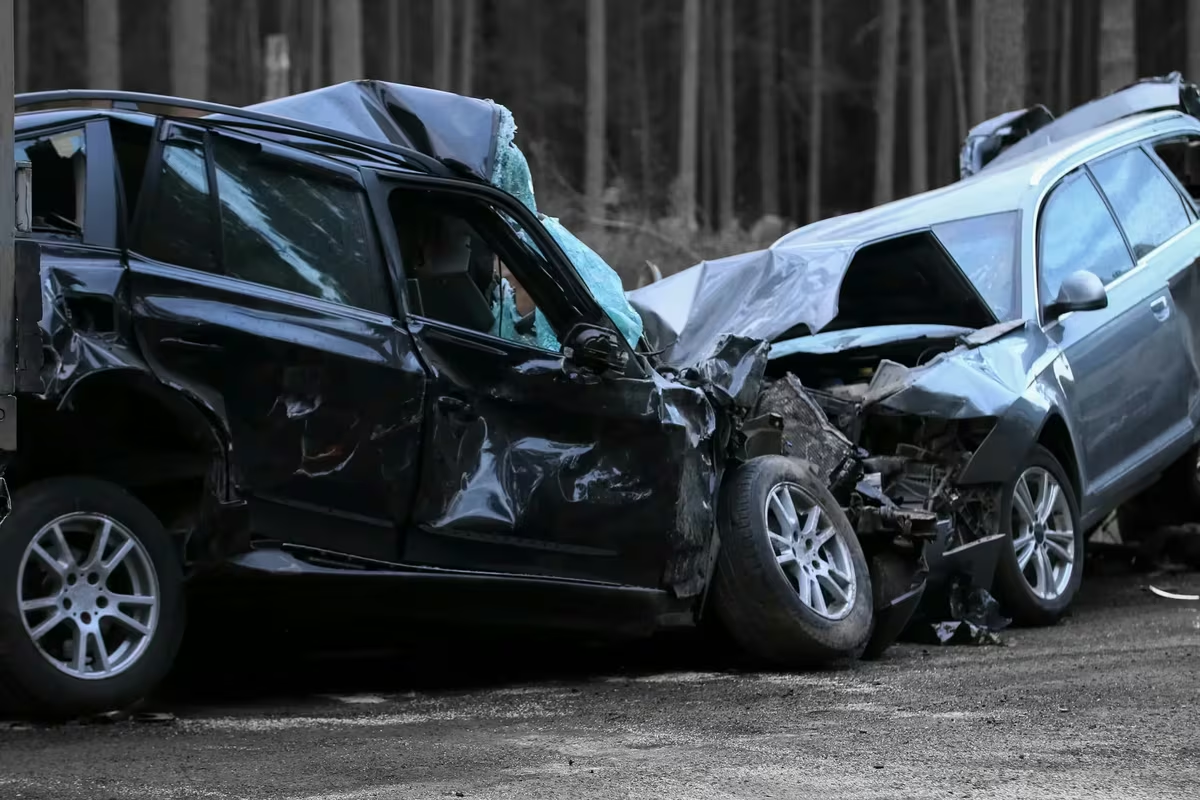 Car Accidents Rear-end, intersection, and highway collisions across Louisiana.
 -
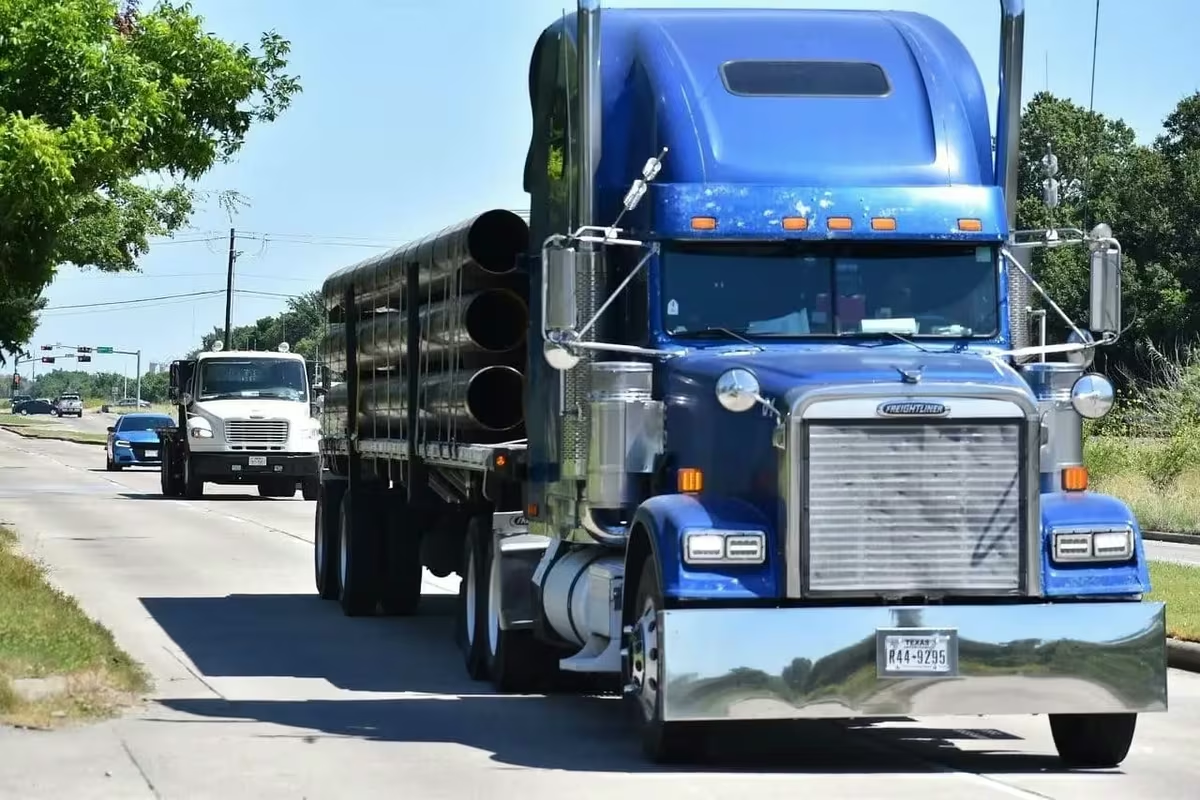 Truck Accidents 18-wheeler and commercial-vehicle wrecks governed by federal trucking rules.
 -
 Motorcycle Accidents Serious-injury motorcycle crashes where bias against riders is common.
 -
 Bus Accidents Transit, school, and charter-bus crashes involving public and private carriers.
 -
 Catastrophic Injury Brain, spinal-cord, amputation, and severe-burn injuries that change a life.
 -
 Brain Injury Traumatic brain injuries with long-term cognitive and physical effects.
 -
 Burn Injury Severe burns from fires, explosions, chemicals, and electrical contact.
 -
 Wrongful Death Claims brought by families after a fatal accident or act of negligence.
 -
 Construction Accidents Falls, struck-by, and equipment injuries on the job site.
 -
 Offshore Accidents Rig, platform, and vessel injuries beyond the shoreline.
 -
 Workers' Compensation On-the-job injuries and the benefits owed to injured workers.
Texas HB 19 and Bifurcated Trial Procedure
Texas House Bill 19, effective September 1, 2021, fundamentally changed how commercial motor vehicle accident cases are tried in Texas courts.
Before HB 19, a single jury trial considered all evidence, including evidence of the carrier’s broader safety culture, prior violation patterns, and systemic negligence. Plaintiffs could present that evidence alongside the specific crash facts, which sometimes produced verdicts the legislature characterized as excessive.
HB 19 created a mandatory two-phase trial structure for cases involving commercial motor vehicles:
Phase 1: Liability and Compensatory Damages
Phase 1 is where the jury decides fault and awards economic and non-economic damages. Evidence in phase 1 is limited to the specific crash: what the driver did, whether the carrier is vicariously liable, and what damages the plaintiff suffered. Evidence of the company’s broader safety record, prior violations, or systemic negligence is excluded from phase 1.
Phase 2: Exemplary Damages
Phase 2 is triggered only if the jury finds in phase 1 that the defendant acted with gross negligence or malice. Once that finding is made, the jury hears additional evidence about the carrier’s conduct and deliberates on exemplary damages. That is when evidence of prior crash history, FMCSA violation patterns, and corporate safety culture becomes admissible.
The practical impact: your attorney needs to build two separate cases. Phase 1 must stand on the crash-specific evidence alone. Phase 2 evidence, including the carrier’s FMCSA safety record and prior violations, must be developed in parallel but held back.
Defendants can also designate responsible third parties under CPRC Section 33.004 to distribute fault allocation across shippers, brokers, and maintenance contractors. Plaintiffs have 60 days after a designation to add the third party as a defendant.
Past results do not guarantee future outcomes; each case is decided on its own facts. See our full case results.
ECM, ELD, and Black Box Evidence
The two most important pieces of electronic evidence in a truck accident case are the ECM and the ELD. Both require immediate action.
The ECM records pre-impact speed, throttle position, brake application, clutch engagement, and RPM data for the final seconds before impact. It tells you exactly how fast the truck was moving, whether the driver braked, and whether the driver was on the accelerator at the moment of the crash. ECM data can overwrite within 30 days on active vehicles. A preservation demand must go out immediately.
ELD data documents the driver’s complete driving history for the prior 7 days. It shows total driving time, rest periods, and GPS location data. Carriers must retain ELD records for 6 months under 49 CFR 395.8(k). That retention window sounds generous, but carriers can argue that individual trip data was legitimately overwritten within those 6 months if no preservation demand was received.
Forward-facing and cab-facing dash cams are increasingly standard on commercial fleets operating in the Alliance Airport logistics corridor and on I-35W. That footage can capture the crash itself, driver behavior before impact, road conditions, and traffic patterns. Footage typically overwrites on a 48- to 72-hour loop unless preserved.
Spoliation
The destruction or alteration of evidence after a party has notice of pending litigation. Courts can instruct juries to assume the destroyed evidence was unfavorable to the party that destroyed it.
A Spoliation demand sent immediately to the carrier, their insurer, and any third-party maintenance provider creates a litigation hold obligation. If the carrier destroys evidence after receiving that demand, Texas courts can instruct the jury to infer the evidence was unfavorable to the carrier. That instruction can be more valuable than the evidence itself.
FMCSA post-accident drug and alcohol testing requirements add another dimension. Carriers must conduct post-accident alcohol testing within 8 hours of a qualifying crash and drug testing within 32 hours. A carrier that fails to conduct the required testing has committed a federal violation. That failure is admissible and creates an adverse inference about what a timely test would have shown.
See our Fort Worth catastrophic injury lawyers page for information about severe injury claims that often arise from commercial truck accidents.
Your Fort Worth Injury Attorneys
Founding partners Trey Morris and Justin Dewett lead every Fort Worth injury case Morris & Dewett takes.


Alliance Airport, I-35W, and Fort Worth Truck Corridors
Fort Worth sits at the center of one of the highest commercial truck traffic concentrations in North Texas, driven by Alliance Airport’s role as a major inland port and logistics hub.
Alliance Airport (Fort Worth Alliance Airport) is one of the largest all-cargo airports and inland port facilities in the United States. The industrial facilities surrounding Alliance generate sustained heavy truck traffic on SH-170 and I-35W north of Fort Worth year-round. SH-170, from Sendera Ranch Boulevard to Alliance Gateway, is the primary route for trucks entering and exiting those facilities. Shift changes produce concentrated truck density on SH-170 and the northbound I-35W approach.
I-35W is the primary north-south commercial truck corridor through Fort Worth. It connects the Alliance logistics hub to downtown, I-20, and south Texas, carrying high commercial vehicle density throughout. Crashes on I-35W involving logistics company defendants require knowledge of the specific carriers operating out of Alliance and the industrial facilities they serve.
The I-30/I-35W interchange, known locally as the Mixmaster, is one of the most structurally complex and crash-prone interchanges in North Texas. Multiple split levels, short merge distances, and high through-traffic volume create conditions where trucks and passenger vehicles mix at high speed with minimal margin for error.
I-20 runs east-west along Fort Worth’s southern corridor, connecting to West Texas, El Paso, and beyond. Commercial vehicle volume on I-20 is consistent and sustained. Construction zone activity on I-20 creates lane closure crash patterns that affect truck and passenger vehicle interactions.
TxDOT crash statistics for Tarrant County show commercial vehicle crash concentrations on I-35W, I-30, and I-20 corridors. Tarrant County consistently ranks among the highest-crash counties in Texas by total collision count.
Proportionate Responsibility and Exemplary Damages in Texas Truck Cases
proportionate responsibility
Texas’s fault-allocation system under CPRC Chapter 33. If you are 51% or more at fault, you recover nothing. At 50% or less, your damages are reduced by your percentage of fault.
Texas uses proportionate responsibility under CPRC Chapter 33. If you are found 51% or more at fault, you recover nothing. At 50% or less, your recovery is reduced by your fault percentage. Trucking companies understand this rule. They deploy post-crash investigators specifically to build a record that pushes your assigned fault percentage above 50%.
That defense tactic is visible in discovery. Watch for rapid deployment of accident reconstruction experts hired by the carrier in the first 48 hours. Watch for requests for your cell phone records, your employment history, and your prior medical records. These are proportionate responsibility strategies, not neutral investigations.
Under CPRC Section 33.004, defendants can designate responsible third parties, including shippers, brokers, and maintenance contractors, to distribute fault allocation. Each designation adds a party to the percentage calculation. A carrier that is 40% at fault in a crash with $2 million in damages pays $800,000, not $2 million. Understanding that allocation structure before trial is essential.
Exemplary damages
Texas term for punitive damages under CPRC Section 41.008. Required clear and convincing evidence of malice, fraud, or gross negligence. In DWI cases, gross negligence is often established. Capped at the greater of two times economic damages plus noneconomic damages up to $750,000, or $200,000.
Exemplary damages are available in truck accident cases under CPRC Section 41.008 when the carrier’s conduct rises to gross negligence or malice. Systemic FMCSA violations, HOS falsification, prior crash history, and a pattern of ignoring safety defects can all support a gross negligence finding. Texas HB 19 segregates that evidence to phase 2, but a phase 1 gross negligence finding unlocks the full record for the jury in phase 2.
The statute of limitations for a truck accident case in Texas is two years from the date of injury under CPRC Section 16.003(a). Wrongful death claims carry a separate two-year deadline running from the date of death under Section 16.003(b), not the date of the crash. There is no tolling for ongoing post-accident investigation. The carrier’s investigation does not pause your deadline.
View our case results for examples of prior outcomes in serious commercial vehicle cases.
What clients say
- ★★★★★
I hired Morris and Dewett back in November of 2025.
They helped me get through my hard times of being off work, stress, and worry. Anytime I had a question I could call and they always had an answer. Very nice and professtional people. Thank you Morris and Dewett for making this an easy process for me and my family.
- ★★★★★
Morris and Dewett and their team of attorneys and staff go above and beyond.
They always were there to support me and answer all my questions after a shoulder injury that included multiple surgeries. They are caring and compassionate and that goes a long way! Highly recommended!
- ★★★★★
Thanks Morris and Dewett for the excellent work you have done on my behalf.
I want to personally thank Sarah for her kindness.
- ★★★★★
Morris & Dewett does things the right way!
They put their clients first in measurable and impactful ways.
- ★★★★★
First time being injured and needing a lawyer they where very helpful.
They answered my questions Id have very well. Highly recommend them.
- ★★★★★
Wonderful experience with Morris and DeWitt, everyone was articulate and punctual, and open to all my questions about the process.
My case couldn't have been handled by a better team! Caity Nerren, Jessica Christian, and Meghan Nolen were all fantastic and helped every step of the way. Thanks again for all of your hard work.
Reviews reflect individual client experiences. Past results do not guarantee future outcomes.
What Should You Do After a Truck Accident in Fort Worth?
Call 911. Do not move injured persons unless there is an immediate hazard. The crash scene is evidence.
Photograph everything you can access safely: all vehicles, road conditions, cargo condition, skid marks, debris field, traffic signs and signals. Photograph the truck’s door placard. The carrier name, DOT number, and license plate on that placard link directly to the carrier’s FMCSA safety record. That information can be searched in the FMCSA Safer System immediately.
Do not give a recorded statement to any insurance company, carrier representative, or their investigator before consulting an attorney. The carrier’s team is trained to ask questions in ways that build a proportionate responsibility defense. Your own insurer’s request for a recorded statement should also be reviewed by counsel first.
TBI
Traumatic Brain Injury. A disruption in normal brain function caused by external force. Ranges from concussion to severe TBI with permanent cognitive impairment. Symptoms may not appear immediately after a crash.
Seek medical care immediately. Internal injuries and TBI are not always apparent at the scene. Delayed symptoms documented before the insurance company builds its narrative are far easier to litigate. Symptoms that appear weeks later without a contemporaneous medical record are routinely disputed.
Contact an attorney the same day. The carrier’s accident team may already be on scene. ECM data begins overwriting on active vehicles. Post-accident alcohol testing must be completed within 8 hours of the crash; drug testing within 32 hours. If those windows pass without testing, the opportunity is gone. The preservation demand needs to go out before the day is over.
Evidence retention timelines:
- Post-accident alcohol test: must be conducted within 8 hours
- Post-accident drug test: must be conducted within 32 hours
- Dash cam footage: typically overwrites within 48 to 72 hours
- ECM data: can overwrite within 30 days on active vehicles
- ELD data: 6-month carrier retention requirement under 49 CFR 395.8(k)
Every one of those windows is shorter than the two-year statute of limitations. Waiting is not an option.
Return to the Fort Worth injury lawyers hub for coverage of other practice areas.
Frequently Asked Questions
- How is a truck accident claim different from a car accident claim in Texas?
- Commercial truck accident claims involve federal FMCSA regulations that do not apply to passenger vehicle cases. Violations of those regulations, including hours-of-service limits, driver qualification requirements, and post-accident drug testing rules, are direct evidence of negligence. Truck cases also involve multiple potentially liable parties beyond the driver: the carrier, cargo shippers, freight brokers, maintenance contractors, and vehicle manufacturers. Insurance minimums for commercial trucks start at $750,000 under 49 CFR Part 387, far above Texas's 30/60/25 auto minimums. Evidence preservation is more urgent because ECM data, ELD records, and dash cam footage overwrite on short cycles.
- What federal regulations apply to 18-wheeler drivers in Fort Worth?
- Commercial truck drivers operating in interstate commerce must comply with FMCSA regulations in 49 CFR. Key rules include hours-of-service limits (11 driving hours within a 14-hour window, 10-hour mandatory rest, 49 CFR Part 395), CDL requirements with appropriate endorsements (49 CFR Part 391), mandatory ELD use to record driving time (effective December 2017), pre-employment and post-accident drug and alcohol testing (49 CFR Part 382), and vehicle inspection and maintenance requirements (49 CFR Part 396). Violations of any of these rules are admissible evidence of negligence in a civil lawsuit.
- Who can be held liable in a commercial truck accident in Texas?
- Potentially liable parties include the driver (direct negligence), the carrier (respondeat superior liability and independent negligent hiring/supervision theories), the cargo shipper or freight broker (when improper loading or carrier selection contributed to the crash), a third-party vehicle maintenance contractor (when a mechanical failure caused by faulty service contributed), and the vehicle or parts manufacturer (product liability for component defects). Lease arrangements where the truck owner and operating carrier are different entities can create joint liability across both. Texas law under CPRC Section 33.004 allows defendants to designate additional responsible third parties to distribute fault allocation.
- What is the statute of limitations for a truck accident lawsuit in Fort Worth?
- The statute of limitations for a personal injury truck accident lawsuit in Texas is two years from the date of injury under CPRC Section 16.003(a). Wrongful death claims have a separate two-year deadline running from the date of death, not the date of the crash, under Section 16.003(b). There is no tolling for the carrier's ongoing post-accident investigation. Missing the two-year deadline eliminates recovery in virtually all circumstances, with narrow exceptions for minors and persons of unsound mind.
- What does Texas HB 19 mean for my truck accident case?
- Texas House Bill 19, effective September 1, 2021, requires that commercial motor vehicle accident cases be tried in two phases. Phase 1 covers fault and compensatory damages (economic and non-economic). Evidence of the carrier's broader safety record, prior violations, and corporate safety culture is excluded from phase 1. If the phase 1 jury finds gross negligence or malice, a phase 2 proceeding is triggered where that additional evidence is admitted and the jury considers exemplary damages. HB 19 requires different trial preparation than a standard personal injury case: compensatory evidence must stand alone in phase 1, while the gross negligence evidence record is developed separately for phase 2.
- What is ECM data and why does it matter in truck accident cases?
- ECM stands for Engine Control Module. It is the truck's onboard computer, sometimes called the "black box." It records pre-impact speed, throttle position, brake application, clutch use, and RPM data for the seconds before a crash. That data can show whether the driver was speeding, whether they braked, and whether they were on the accelerator at the moment of impact. ECM data can overwrite within 30 days on active vehicles. A preservation demand must be sent to the carrier immediately after a crash to prevent destruction of the data. Courts can instruct juries to assume destroyed ECM data was unfavorable to the carrier.
- How does proportionate responsibility work in Texas truck accident cases?
- Texas proportionate responsibility under CPRC Chapter 33 reduces your recovery by your percentage of fault and eliminates it entirely if you are 51% or more at fault. Trucking companies routinely deploy post-crash investigators to build a record pushing your assigned fault percentage above 50%. Carriers can also designate responsible third parties under CPRC Section 33.004, adding shippers, brokers, and maintenance contractors to the fault allocation to reduce the carrier's own percentage. At 50% or less fault, you recover your damages reduced proportionately. At 51% or more, you recover nothing.
- Can I recover exemplary damages in a Texas truck accident case?
- Yes, if the carrier's conduct rises to gross negligence or malice under the clear and convincing evidence standard. Commercial truck cases frequently support gross negligence claims based on systemic FMCSA violations, HOS falsification, prior crash history, or knowingly retaining drivers with disqualifying records. Under Texas HB 19, exemplary damages are determined in a separate phase 2 trial that is triggered only after a phase 1 gross negligence finding. The exemplary damages cap under CPRC Section 41.008 is the greater of two times economic damages plus noneconomic damages up to $750,000, or $200,000.
- What evidence should I preserve immediately after a truck accident on I-35W?
- Photograph the crash scene, all vehicles, cargo, the truck's door placard with carrier name and DOT number, skid marks, road conditions, and any traffic signs or signals. Record witness contact information before they leave. Do not have your vehicle repaired until an attorney has evaluated whether ECM data needs to be downloaded. Contact an attorney the same day so a preservation demand can be sent to the carrier before ELD records are overwritten and post-accident testing windows close. Alcohol testing must occur within 8 hours of the crash; drug testing within 32 hours. Dash cam footage on many Alliance Airport logistics fleets overwrites within 48 to 72 hours.
- What is the FMCSA Safer System and how does it help my case?
- The FMCSA Safer System at safer.fmcsa.dot.gov is a publicly searchable database of carrier inspection history, safety ratings, prior crash records, and violation patterns. Using the carrier's DOT number from the truck's door placard, an attorney can pull the carrier's complete safety record within hours of a crash. That record may show prior HOS violations, out-of-service orders, prior crashes, or a history of failed inspections. In a gross negligence or negligent hiring case, the Safer System record is foundational evidence for phase 2.
- Can the trucking company be liable even if the driver was an independent contractor?
- Possibly. Carriers sometimes classify drivers as independent contractors to reduce direct employment liability. But courts look at the actual working relationship, not just the label. If the carrier controls dispatch, sets routes, requires use of company equipment, or retains supervisory authority over the driver's work, courts may find an employment relationship regardless of the contract classification. Additionally, federal trucking regulations impose direct liability on the carrier for vehicles operating under the carrier's DOT authority regardless of whether the driver is an employee or contractor. Lease-on regulations under federal trucking law can create joint liability between the truck owner and the operating carrier.
- How does the Alliance Airport logistics zone affect truck accident claims in Fort Worth?
- Alliance Airport is one of the largest inland port and logistics hubs in the United States, generating sustained heavy truck traffic on SH-170 and I-35W north of Fort Worth. Crashes in the Alliance zone frequently involve large fleet operators, third-party logistics companies, and contract carriers whose safety records and driver qualification practices are trackable through the FMCSA Safer System. The high commercial vehicle density on SH-170 and the northbound I-35W approach also means dash cam coverage from fleet vehicles is more prevalent than on general highway corridors, which can provide footage of both the crash and pre-crash conditions. An attorney familiar with Alliance zone defendants and evidence sources is better positioned to move quickly on preservation.
Last updated June 5, 2026