

Morris & Dewett has handled catastrophic injury cases in Caddo Parish and across northwest Louisiana for over 25 years.
What Is a Catastrophic Injury?
A catastrophic injury is one that permanently alters a person’s ability to work, care for themselves, or live independently. That distinction matters legally and practically. These cases carry costs that standard injury claims don’t, and they require a different approach from the first day of representation.
spinal cord injury
Damage to the spinal cord that causes partial or complete loss of movement, sensation, or function below the injury site. Injuries are classified by level (cervical, thoracic, lumbar) and completeness (complete vs. incomplete).
traumatic brain injury
TBI. A disruption in normal brain function caused by a blow, jolt, or penetrating injury to the head. Severity ranges from mild concussion to permanent cognitive impairment.
The injuries covered on this page include spinal cord injury, traumatic brain injury, amputation, severe burns, broken bones, and brain trauma. Each of these injury types creates ongoing costs and permanent limitations that are legally recognized in Louisiana’s damages framework. The law acknowledges that calculating what a catastrophic injury is worth requires projecting future care costs over the person’s remaining lifetime, not just tallying up current bills.
The practical difference between a standard personal injury case and a catastrophic one is scope. A broken wrist heals. A severed spinal cord does not. The legal work required to value and prove a catastrophic injury claim is proportionally more demanding.
Our Shreveport Office
509 Milam St
Shreveport, LA 71101
Open 24/7 for injured Shreveport residents
Get directions →How Catastrophic Injuries Happen in Shreveport
Shreveport’s geographic and economic position creates specific injury patterns that experienced local counsel understands. The high-speed corridors of I-20, I-49, and US-80 carry heavy commercial truck traffic daily. When a loaded 18-wheeler hits a passenger vehicle at highway speed, the outcome is rarely minor. Car accidents and truck accidents on these corridors account for a significant portion of catastrophic injury cases in Caddo Parish.
Northwest Louisiana’s energy sector adds another category entirely. Oilfield accidents along the industrial corridor running through the Port of Shreveport-Bossier create crush injuries, falls from height, and explosion exposure. Construction site accidents in downtown Shreveport and surrounding parishes, including Bossier, DeSoto, and Webster, follow predictable hazard patterns: scaffolding collapses, falling objects, and equipment failures.
Premises liability and product liability cases round out the picture. A slip and fall at a commercial property can produce a spinal cord injury just as severe as a highway crash. Defective industrial equipment has caused amputations and permanent neurological damage in Caddo Parish workplaces. The mechanism of injury shapes the evidence you need, and local knowledge of the facilities, roads, and industrial operations matters when building that evidence.
Establishing Liability for a Catastrophic Injury Claim
Proving liability requires three elements: a duty of care, a breach of that duty (negligence), and a direct causal link between the breach and the injury. Each element requires specific evidence. Getting all three right is the foundation of a successful claim.
Duty of care is established differently depending on the context. Drivers owe a duty to other road users under Louisiana traffic statutes. Property owners owe a duty to visitors under La. R.S. 9:2800, Louisiana’s premises liability statute. Employers owe a duty to employees and, in some cases, to third parties harmed by their workers’ conduct.
Negligence takes specific forms in catastrophic injury cases. A driver texting behind the wheel violates La. R.S. 32:300, Louisiana’s handheld device prohibition. An employer who fails to maintain safe equipment may violate OSHA standards and Louisiana worker protection statutes. These violations don’t automatically establish liability, but they are powerful evidence of breach.
Causation requires connecting the negligent act to the catastrophic outcome. Medical records, accident reconstruction, and expert testimony all play roles.
comparative fault
A legal rule that reduces your recovery by your percentage of fault. In Louisiana, if you are 51% or more at fault, you recover nothing. If you are 50% or less at fault, your damages are reduced proportionally.
Louisiana uses a modified comparative fault system under La. C.C. Art. 2323. If you are 50% or less at fault, you can recover. The 51% bar is a hard cutoff. Insurance adjusters build their entire defense around pushing the plaintiff’s fault percentage above 50%, which requires a specific, evidence-based strategy to counter.
respondeat superior
Latin for “let the master answer.” A legal doctrine holding employers liable for negligent acts committed by employees within the scope of their employment.
Identifying all liable parties is one of the most consequential decisions in a catastrophic injury case. It requires investigating vehicle ownership records, employment relationships, product supply chains, and property records. The person who caused the accident is often not the only defendant with legal exposure. Under respondeat superior doctrine (La. C.C. Art. 2320), a commercial truck driver’s negligence can expose the trucking company directly to liability. Product defects can bring in the manufacturer. Multiple defendants mean multiple insurance policies, which matters when the damages are as large as catastrophic injuries produce.
What We Handle
Shreveport Practice Areas
-
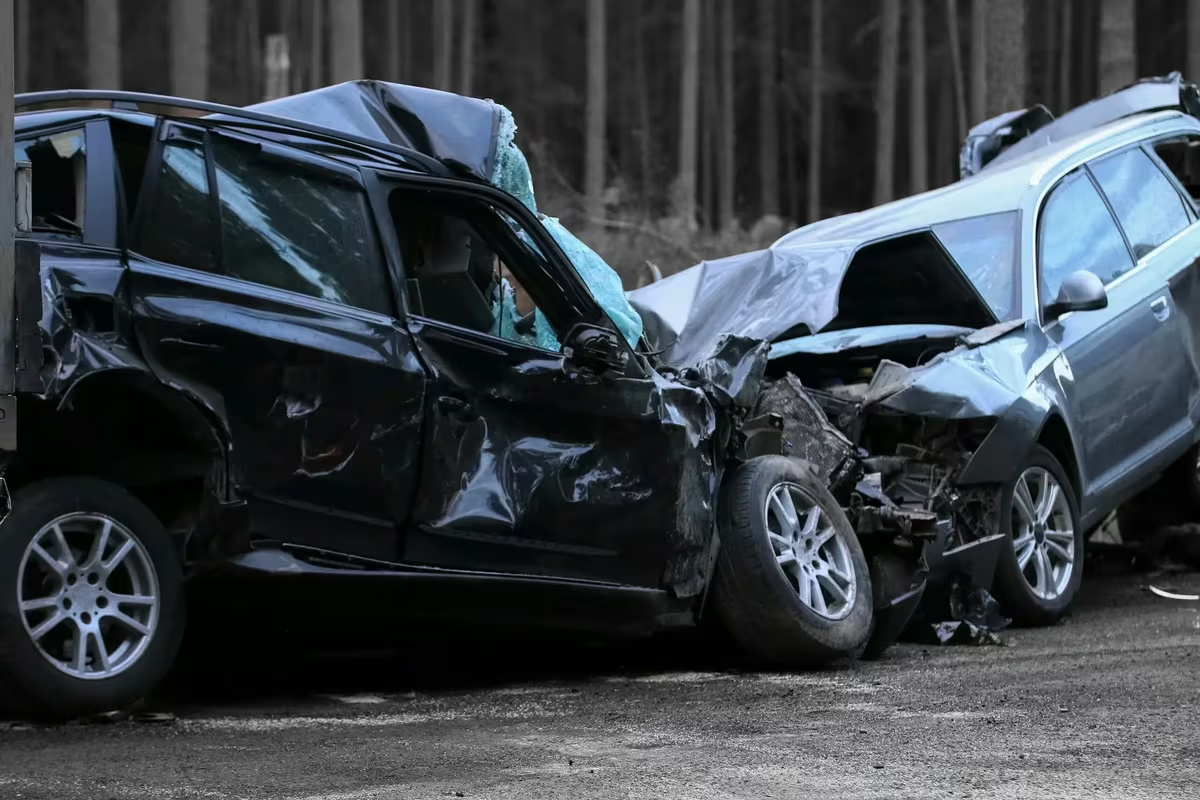 Car Accidents Rear-end, intersection, and highway collisions across Louisiana.
 -
 Truck Accidents 18-wheeler and commercial-vehicle wrecks governed by federal trucking rules.
 -
 Motorcycle Accidents Serious-injury motorcycle crashes where bias against riders is common.
 -
 Pedestrian Accidents Crosswalk and roadway pedestrian injuries with high-stakes liability.
 -
 Bicycle Accidents Cyclists struck by drivers who failed to share the road.
 -
 Bus Accidents Transit, school, and charter-bus crashes involving public and private carriers.
 -
 Slip & Fall Falls caused by wet floors, poor maintenance, and hidden hazards.
 -
 Catastrophic Injury Brain, spinal-cord, amputation, and severe-burn injuries that change a life.
 -
 Wrongful Death Claims brought by families after a fatal accident or act of negligence.
 -
 Construction Accidents Falls, struck-by, and equipment injuries on the job site.
 -
 Oilfield Accidents Drilling, pipeline, and refinery injuries across the energy sector.
 -
 Workers' Compensation On-the-job injuries and the benefits owed to injured workers.
 -
 Nursing Home Abuse Neglect and abuse of residents in long-term-care facilities.
Damages Available in a Shreveport Catastrophic Injury Case
Damages in a catastrophic injury case divide into two categories. Economic damages are calculable. They include documented costs and projected future expenses that can be quantified with records and expert analysis. Non-economic damages are not calculable in the same way. They represent real harm, but they require experienced legal argument to establish fair value.
loss of earning capacity
The difference between what you could have earned over your working lifetime and what you can earn now after the injury. Calculated by a vocational expert and converted to present value by an economist.
Economic damages include lost wages from the date of injury, documented with pay stubs and employer records. They also include loss of earning capacity, which is often the largest single item in a catastrophic injury case. A construction worker who sustains a spinal cord injury and can no longer return to physical labor has lost decades of earning potential. An office worker with a traumatic brain injury affecting cognition may be unable to continue their career.
Medical costs at facilities like Ochsner LSU Health Shreveport or Willis-Knighton, including emergency care, hospitalization, and surgery, are part of the economic damages. So are future medical expenses: ongoing physical therapy, occupational therapy, assistive devices, and home modifications.
loss of consortium
A legal claim available to a spouse for the loss of companionship, affection, and support caused by the injured person’s condition. It is a separate damage category from the injured person’s own claims.
Non-economic damages include physical pain, emotional anguish, disfigurement, and loss of enjoyment of life. loss of consortium is a separate category available to a spouse. Punitive damages are available in Louisiana when a defendant acted with reckless disregard, for example, an impaired commercial driver who chose to operate a vehicle despite being incapacitated.
How a settlement is calculated in a catastrophic injury case is more complex than in a standard case. A life-care planner coordinates with treating physicians to project the injured person’s total care needs over their remaining lifetime. A vocational rehabilitation expert assesses what work, if any, the person can do after the injury. An economist calculates the present value of those future losses. These three experts together produce the foundation of the economic damages number.
Rehabilitation and Long-Term Care After a Catastrophic Injury
Recovery from a catastrophic injury is not a straight line. Setbacks happen. Additional surgeries arise. Care plans adjust. Each of those changes can affect the long-term cost projections that underpin the damages calculation in your case. Understanding what rehabilitation actually looks like matters for your legal claim, not just your health.
In the Shreveport area, Ochsner LSU Health Shreveport and Willis-Knighton both operate inpatient rehabilitation programs for spinal cord and traumatic brain injury patients. Rehabilitation typically involves multiple disciplines: physical therapy to restore movement and strength, occupational therapy to rebuild daily living functions. Speech-language pathology addresses TBI patients with communication deficits.
Cognitive rehabilitation addresses memory, attention, and executive function. The duration and intensity of each therapy type feeds directly into the life-care plan that establishes the future medical expense component of your damages.
Home modification and assistive technology are compensable costs that get documented in a life-care plan. Ramps, widened doorways, hospital beds, wheelchairs, stair lifts, and communication devices all have specific costs that a life-care planner projects over the injured person’s lifespan. These are not speculative. They are itemized costs based on the specific medical evidence in your case.
One of the most consequential decisions in a catastrophic injury case is timing. Accepting a settlement before the full scope of future care is known may leave you without adequate resources for care you’ll need years from now. A life-care plan is the tool that prevents that.
Past results do not guarantee future outcomes; each case is decided on its own facts. See our full case results.
Louisiana’s Prescriptive Period for Catastrophic Injury Claims
prescriptive period
Louisiana’s term for statute of limitations. The legal deadline to file a lawsuit. For personal injury, it is two years from the date of injury under La. C.C. Art. 3493.1 (effective July 1, 2024).
Louisiana’s prescriptive period for personal injury is two years from the date of the accident under La. C.C. Art. 3493.1, which took effect July 1, 2024. This is longer than the one-year deadline that applied before the 2024 tort reform. The change matters, but two years is still a shorter window than most people assume. Evidence degrades. Witnesses’ memories fade. Physical evidence at accident scenes disappears.
There is a discovery rule exception. In some cases where the injury was not immediately apparent, the clock starts from the date you discovered or reasonably should have discovered the injury. This applies more often in toxic exposure and occupational disease cases than in acute traumatic injury cases, but it exists.
Claims against government entities, including the Louisiana Department of Transportation and Development for road defects, follow different rules. These claims require a 90-day notice of claim and have separate procedural requirements. Missing that notice requirement can bar the claim entirely.
Missing the prescriptive period ends most claims. No court will hear a case filed after the deadline, regardless of how strong the evidence is. If there’s any chance your claim involves a government entity, verify the notice requirements immediately.
Your Shreveport Injury Attorneys
Founding partners Trey Morris and Justin Dewett lead every Shreveport injury case Morris & Dewett takes.


How Insurance Companies Handle Catastrophic Injury Claims
Insurance adjusters handling catastrophic injury claims operate under a specific goal: close the claim for the lowest possible amount. That interest is directly opposite to yours. Understanding their methods is part of understanding how to protect your claim.
Denial of liability is the opening position in many catastrophic injury cases. The insurer argues that you were at fault or that the negligence isn’t proven. Disputing injury severity is the second track. Insurers retain their own medical experts who review records and argue that injuries pre-existed the accident or are exaggerated. These aren’t independent opinions. They are paid opinions produced for litigation purposes.
Early settlement offers are common in catastrophic cases. Insurers extend offers before the full extent of long-term costs is known, before the life-care plan is complete, before the vocational assessment is done. An early offer that looks substantial may be a fraction of the case’s actual value once future costs are properly calculated.
Delay tactics, including slow communication, repeated document requests, and adjuster reassignments, are also standard practice. They create pressure to settle before your case is fully built.
Do not give a recorded statement to any insurance adjuster without speaking to an attorney first. Statements made before you understand the full extent of your injuries, the applicable statutes, and your legal rights can be used to minimize or deny your claim. This is not a technicality. It is one of the most common ways catastrophic injury cases lose value before they even begin.
contingency fee
A fee arrangement where the attorney is paid a percentage of the recovery and only if there is a recovery. The client pays nothing upfront and owes no attorney fees if the case is unsuccessful.
Morris & Dewett’s approach to insurance company tactics uses independent medical experts, life-care planners, and vocational rehabilitation specialists to document the full value of the claim. We handle representation on a contingency fee basis. There is no financial barrier to hiring an attorney. You pay nothing unless your case resolves in your favor.
What to Do Immediately After a Catastrophic Injury in Shreveport
The steps taken in the hours and days after a catastrophic injury directly affect what evidence is available later. These actions protect your health and your legal options.
Get emergency medical care first. Ochsner LSU Health Shreveport operates a Level 1 Trauma Center, the highest designation, for the most severe injuries in northwest Louisiana. Getting the right level of care documented from the beginning creates a medical record that accurately reflects the injury’s severity.
Document the scene if you’re physically able. Photographs, witness names, contact information, and video of conditions are evidence. That evidence may not exist a week later. If you cannot document the scene yourself, ask someone who can.
Do not admit fault or give recorded statements to any insurance company before speaking with an attorney. Preserve all medical records, bills, and communications from employers, insurers, or other parties. Contact a catastrophic injury attorney as soon as possible. The investigation must begin while evidence is fresh.
Louisiana’s two-year prescriptive period under La. C.C. Art. 3493.1 starts from the date of the accident. It does not pause while you recover or wait for a full medical diagnosis. Even if you don’t know the full extent of your injury yet, the legal clock is running.
What clients say
- ★★★★★
I hired Morris and Dewett back in November of 2025.
They helped me get through my hard times of being off work, stress, and worry. Anytime I had a question I could call and they always had an answer. Very nice and professtional people. Thank you Morris and Dewett for making this an easy process for me and my family.
- ★★★★★
Wonderful experience with Morris and DeWitt, everyone was articulate and punctual, and open to all my questions about the process.
My case couldn't have been handled by a better team! Caity Nerren, Jessica Christian, and Meghan Nolen were all fantastic and helped every step of the way. Thanks again for all of your hard work.
- ★★★★★
Caity, Coleman, and Brooke worked hard to get our case settled in a timely manner!
I highly recommend Morris & Dewett for any personal injury claims!
- ★★★★★
I am very appreciative for the services they have provided me with, very nice and welcoming staff and they take care of you every possible way.
They are the way to go !
- ★★★★★
Morris and Dewett and their team of attorneys and staff go above and beyond.
They always were there to support me and answer all my questions after a shoulder injury that included multiple surgeries. They are caring and compassionate and that goes a long way! Highly recommended!
- ★★★★★
Thanks Morris and Dewett for the excellent work you have done on my behalf.
I want to personally thank Sarah for her kindness.
Reviews reflect individual client experiences. Past results do not guarantee future outcomes.
Results Morris & Dewett Has Recovered for Catastrophic Injury Clients
Morris & Dewett has recovered significant amounts across catastrophic injury cases involving impaired commercial drivers, oilfield safety violations, highway crashes, and premises liability incidents. The results include cases involving wrongful death, spinal and brain injuries, 18-wheeler crashes, and severe personal injury. View our case results.
The firm has recovered hundreds of millions for clients in Louisiana across thousands of cases. The attorneys at Morris & Dewett hold AV Preeminent ratings from Martindale-Hubbell and recognition from Super Lawyers. The firm has earned more than 2,498 five-star Google reviews from clients across Shreveport, Covington, Lake Charles, and the broader northwest Louisiana region.
Frequently Asked Questions
- What qualifies as a catastrophic injury under Louisiana law?
- Louisiana law does not have a single statutory definition of "catastrophic injury." The term is recognized in damages calculations and case law as describing injuries that permanently alter a person's capacity to work, live independently, or care for themselves. Courts and life-care planners use the classification to justify projecting lifetime care costs, lost earning capacity calculations, and non-economic damages arguments. Spinal cord injuries, traumatic brain injuries, amputations, severe burns, and permanent organ damage typically qualify.
- How long do I have to file a catastrophic injury claim in Louisiana?
- Two years from the date of the accident, under La. C.C. Art. 3493.1, which took effect July 1, 2024. This replaced the prior one-year deadline as part of Louisiana's 2024 tort reform. If your claim involves a government entity, such as the Louisiana Department of Transportation and Development for a road defect, separate rules apply. A 90-day notice of claim is required, and missing that deadline can bar your claim entirely.
- What damages can I recover for a catastrophic injury in Shreveport?
- Economic damages include past and future medical expenses, lost wages, loss of earning capacity, assistive devices, home modifications, and life-care costs projected over your remaining lifetime. Non-economic damages include physical pain, emotional anguish, disfigurement, and loss of enjoyment of life. A spouse may also recover for loss of consortium. Punitive damages are available under Louisiana law when the defendant acted with reckless disregard.
- How is lost earning capacity calculated for a catastrophic injury?
- A vocational rehabilitation expert evaluates the injured person's pre-injury work history, skills, and earning trajectory alongside their post-injury functional limitations. That assessment produces a range of what they can earn now compared to what they would have earned without the injury. An economist then converts that difference into a present-value figure, accounting for inflation, career progression, and the injured person's work-life expectancy. This calculation is often the largest single number in a catastrophic injury damages claim.
- What if the insurance company says my injury is not as serious as I claim?
- Insurers routinely retain their own medical experts to dispute injury severity. These are paid opinions produced for litigation purposes, not independent medical conclusions. The response is independent expert testimony. Your treating physicians, a life-care planner with access to your full medical history, and where appropriate, an independent medical examiner retained by counsel build that record. The goal is to create a documented, expert-supported picture of your actual condition that contradicts the insurer's hired opinion. This is a standard part of catastrophic injury litigation.
- Can I still recover compensation if I was partially at fault for the accident?
- Yes, if your fault is 50% or less. Under Louisiana's modified comparative fault rule (La. C.C. Art. 2323), your recovery is reduced by your percentage of fault. If you are found 20% at fault on a claim valued at $500,000, you receive $400,000. The 51% bar, which took effect as part of the 2020 tort reform, is a hard cutoff. If a jury or court finds you 51% or more at fault, you recover nothing.
- How much does it cost to hire a catastrophic injury lawyer at Morris & Dewett?
- Morris & Dewett handles catastrophic injury cases on a contingency fee basis. You pay no attorney fees upfront. You owe no attorney fees if the case does not resolve in your favor. The firm's fee is a percentage of the recovery, agreed upon before representation begins. There are no financial barriers to getting representation.
- How long does a catastrophic injury case take to resolve in Louisiana?
- It depends on the complexity of the case. Catastrophic injury cases with disputed liability, multiple defendants, or incomplete medical pictures routinely take two to four years to resolve. Cases that settle before trial move faster than cases that go to verdict. The life-care planning process and vocational assessment add time, but rushing a settlement before those assessments are complete often produces inadequate results.
- What should I do immediately after a catastrophic injury in Shreveport?
- Get emergency medical care first. Document the scene if able: photographs, witness contact information, and video. Do not give recorded statements to any insurance company without legal counsel. Preserve all medical records, bills, and communications from employers and insurers. Contact a catastrophic injury attorney as soon as possible. Louisiana's two-year prescriptive period starts on the date of the accident, and the investigation needs to begin while evidence is still available.
- How are catastrophic injury settlements calculated in Louisiana?
- Three experts typically drive the damages calculation. A life-care planner coordinates with treating physicians to project lifetime medical care costs. A vocational rehabilitation expert assesses the injured person's remaining earning capacity. An economist converts both sets of projections into present-value figures. The sum of these calculations, combined with non-economic damages, establishes the case's value. Accepting a settlement before this process is complete means settling without knowing what the case is actually worth.
- Can a family member file a catastrophic injury claim on behalf of someone who is incapacitated?
- Yes. If an injury leaves a person legally incapacitated, a family member or court-appointed curator can be authorized to pursue the legal claim on their behalf. In Louisiana, the court appoints a curator under the interdiction process when someone cannot manage their own affairs. A catastrophic injury attorney can help a family navigate both the legal representation question and the interdiction process simultaneously if needed.
- My catastrophic injury happened at work. Can I file a personal injury claim in addition to workers' compensation?
- Workers' compensation and personal injury claims are separate legal remedies, and both may be available depending on the facts. Workers' compensation covers your employer's liability, but it does not cover third parties whose negligence contributed to the injury. If a co-worker operating equipment caused your injury, workers' compensation applies. If a subcontractor, equipment manufacturer, or property owner caused the injury, a separate personal injury claim against that third party is available. The two claims can proceed simultaneously.
- What if a third party (not my employer) caused my workplace catastrophic injury?
- A third-party personal injury claim is available against any party other than your employer whose negligence caused or contributed to the injury. This is common in oilfield and construction accidents where multiple contractors and equipment manufacturers operate on the same site. Workers' compensation from your employer handles one channel of recovery. A personal injury claim against the third party handles another. The two do not cancel each other out. An attorney handling workplace catastrophic injury cases should evaluate both channels at intake.
Last updated June 5, 2026