

A construction site accident in Caddo Parish falls under two separate legal systems. Each has its own rules, its own defendants, and its own recoveries. The workers compensation and third-party issues that arise most often in these cases are detailed on our construction accident questions page.
Morris & Dewett has handled construction injury claims in Shreveport and across Louisiana for more than two decades.
Construction Site Accidents in Shreveport and Caddo Parish
Construction is one of the most dangerous industries in Louisiana. The Bureau of Labor Statistics tracks fatal occupational injuries by state, and construction consistently ranks among the top categories for Louisiana worker deaths.
Shreveport has active construction zones across the parish. The I-20 and I-49 corridors carry ongoing highway and interchange work. Downtown and medical-district builds continue near the Ochsner LSU Health Shreveport campus. Casino and hospitality development along the Red River waterfront brings heavy equipment and elevated worker populations. Industrial and energy-sector projects across Caddo Parish add their own hazard profiles. Louisiana industrial injury lawyers handle the overlap between construction accidents and industrial worksite injuries across the state. Workers on these projects face elevated exposure to struck-by incidents, fall hazards, and equipment-related injuries.
Civil injury claims from Caddo Parish construction accidents go through the First Judicial District Court at 501 Texas Street in Shreveport. That court handles the full range of personal injury litigation, including third-party construction claims against general contractors, subcontractors, equipment owners, and property owners.
You likely have more than one legal pathway. The two are workers compensation and a third-party civil claim. They operate under different rules, have different defendants, and produce different types of recovery. In many cases, you can pursue both at the same time. Understanding how they interact is the starting point for evaluating your claim. For a broader overview of injury claims in the parish, see Shreveport injury lawyers.
Our Shreveport Office
509 Milam St
Shreveport, LA 71101
Open 24/7 for injured Shreveport residents
Get directions →Workers Compensation and the Exclusive Remedy Doctrine
Exclusive Remedy
A rule in Louisiana workers compensation law that prevents an injured employee from suing their direct employer in civil court. Workers compensation is the only remedy against the employer. It does not prevent claims against third parties who caused or contributed to the injury.
Exclusive Remedy Louisiana workers compensation is the exclusive remedy against your direct employer. It bars you from filing a civil lawsuit directly against the company that hired you. What it does not bar is claims against everyone else on the jobsite. Understanding workers compensation claims and how they interact with third-party civil claims is essential for construction injury cases.
Workers comp covers your medical expenses and a portion of your lost wages, regardless of who was at fault. It does not require you to prove negligence. The tradeoff is that benefits are capped and non-economic damages such as pain and suffering are not available through the workers comp system. That gap is why the third-party civil claim matters.
Here is what matters in practice. The exclusive remedy applies only to your direct employer. If a subcontractor, a general contractor, a property owner, or the owner of defective equipment contributed to your injury, you can file a civil claim against them while you receive workers compensation from your employer. These are parallel tracks.
One complication is the workers compensation lien. Your employer’s workers comp insurer typically holds a right to recover what it paid from any third-party civil recovery you receive. The lien is not always enforced at full value. How it is handled in negotiation directly affects your net recovery.
Third-Party Liability: Who Can You Sue Beyond Your Employer?
The civil claim is where the full range of economic and non-economic damages is available. The question is who the defendants are.
The general right to recover comes from La. C.C. Art. 2315, the foundational Louisiana negligence statute: every act of a person that causes damage to another obliges the one at fault to repair it. In a construction case, that obligation reaches well beyond the company that signed your paycheck.
General contractors who retained control over jobsite safety can be held liable for injuries caused by unsafe site conditions. Control is the key word. If the general contractor had supervisory authority over the specific hazard that injured you, that creates a viable defendant. Courts look at who held safety responsibility in the contract language and in actual practice on the site.
Subcontractors whose employees or equipment caused your injury are also potential defendants. If a subcontractor’s crane operator dropped a load that struck you, that subcontractor faces civil exposure even if you worked for a different company on the same site. Under La. C.C. Art. 2320, respondeat superior makes an employer answerable for the damage its employees cause in the exercise of the functions they are employed for, which is the mechanism that draws a subcontractor into the claim for the conduct of its crew. Property owners can face liability for dangerous conditions on the premises they own or control.
Respondeat Superior
A doctrine under La. C.C. Art. 2320 that makes an employer answerable for the damage caused by its employees in the exercise of the functions for which they are employed. In construction cases, it is how a contractor is held responsible for the negligence of the workers it directed.
Respondeat Superior The respondeat superior principle matters because the negligent worker on a jobsite is rarely the party with the resources to pay a judgment. The employer that directed that worker is. Establishing the employment relationship and the scope of the work at the time of the injury is therefore a central task in building the third-party claim.
What We Handle
Shreveport Practice Areas
-
 Car Accidents Rear-end, intersection, and highway collisions across Louisiana.
 -
 Truck Accidents 18-wheeler and commercial-vehicle wrecks governed by federal trucking rules.
 -
 Motorcycle Accidents Serious-injury motorcycle crashes where bias against riders is common.
 -
 Pedestrian Accidents Crosswalk and roadway pedestrian injuries with high-stakes liability.
 -
 Bicycle Accidents Cyclists struck by drivers who failed to share the road.
 -
 Bus Accidents Transit, school, and charter-bus crashes involving public and private carriers.
 -
 Slip & Fall Falls caused by wet floors, poor maintenance, and hidden hazards.
 -
 Catastrophic Injury Brain, spinal-cord, amputation, and severe-burn injuries that change a life.
 -
 Wrongful Death Claims brought by families after a fatal accident or act of negligence.
 -
 Construction Accidents Falls, struck-by, and equipment injuries on the job site.
 -
 Oilfield Accidents Drilling, pipeline, and refinery injuries across the energy sector.
 -
 Workers' Compensation On-the-job injuries and the benefits owed to injured workers.
 -
 Nursing Home Abuse Neglect and abuse of residents in long-term-care facilities.
OSHA Violations as Evidence of Negligence
An OSHA citation from your Shreveport construction accident is admissible evidence of the standard of care in a Louisiana civil tort claim. OSHA standards set the federal safety floor for construction sites. A citation is not proof of liability by itself. It is evidence that a specific safety rule existed and was violated, which is the starting point for a negligence argument.
The distinction matters. An OSHA violation shows what the rule was and that it was broken. Your attorney then argues that breaking that rule caused your injury. OSHA investigation records, inspector notes, and citation history are primary discovery targets in construction accident litigation.
General contractors can face liability for a subcontractor’s OSHA violation when the general contractor retained control over the specific hazard. Even if your direct employer was the subcontractor who violated the standard, the general contractor’s supervisory role can draw it into the claim.
Past results do not guarantee future outcomes; each case is decided on its own facts. See our full case results.
Evidence Preservation and Spoliation
Evidence preservation is time-sensitive in construction accidents. A Shreveport jobsite changes immediately after an accident. Equipment is moved, repaired, or taken off-site. Witness availability changes fast. The condition that injured you may be corrected within hours, which is good for the next worker and difficult for your claim if no one documented it first.
Spoliation
The destruction, alteration, or loss of evidence that a party had a duty to preserve. When a responsible party allows relevant site conditions, equipment, or records to disappear after notice of a claim, a court may impose consequences for the loss.
Spoliation The risk of spoliation is why the attorney you hire should issue written preservation demands to every responsible party within days of engagement. A preservation demand puts the general contractor, the subcontractors, and the equipment owners on formal notice that they must hold the relevant photographs, maintenance logs, equipment, inspection records, and internal communications. Once that notice is sent, a party that destroys or alters the evidence anyway has exposed itself to consequences in the litigation.
Preserve what you can control on your own side as well. Photographs taken before repairs, the names of witnesses, your medical records, and the equipment and protective gear you were using all matter. The earlier these are secured, the stronger the record your attorney has to work with.
Your Shreveport Injury Attorneys
Founding partners Trey Morris and Justin Dewett lead every Shreveport injury case Morris & Dewett takes.


Types of Construction Accidents in Shreveport
OSHA Fatal Four
OSHA’s designation for the four leading causes of construction fatalities: falls, struck-by incidents, electrocutions, and caught-in or caught-between accidents. These four categories account for the majority of construction worker deaths each year.
OSHA Fatal Four The OSHA Fatal Four accounts for the majority of construction fatalities nationally. All four categories appear regularly in Caddo Parish construction accident claims.
Falls from heights are the most common fatal construction accident. The category includes scaffold collapse, leading-edge falls, ladder failures, and falls from roofs or elevated platforms. When fall protection is absent or inadequately installed, the employer and the general contractor face exposure for each resulting injury or death.
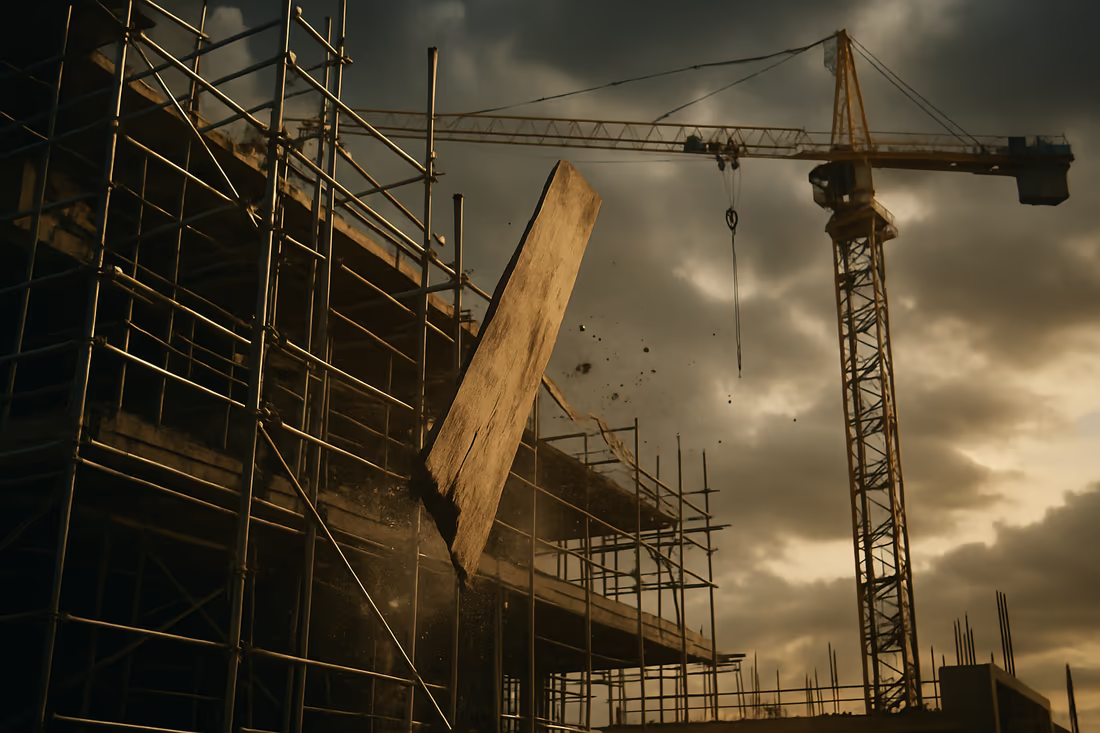
Struck-by incidents involve workers hit by falling objects, swinging equipment, or moving vehicles. Large tools and debris dropped from upper floors can cause fatal injuries before a worker has any opportunity to react. When a crane, forklift, or other piece of equipment strikes a worker, the liability analysis focuses on operator conduct, equipment maintenance records, and jobsite traffic-control protocols.
Caught-in or caught-between accidents occur when a worker is pulled into rotating machinery, pinned between moving equipment and a fixed structure, or trapped in a collapsing trench. Equipment such as bulldozers, excavators, and concrete mixers are common causes. Trench cave-ins are a subset, and collapses are rarely survivable without immediate extraction.
Electrocutions involve contact with overhead power lines, unprotected wiring, or defective electrical equipment. Workers who are not themselves the electrical worker still face exposure from adjacent operations where the area is not properly cleared or energized equipment is not isolated.
Scaffold collapses deserve specific attention. A scaffold collapse rarely injures one person. Multiple workers can be affected in a single event, each with an independent claim against the scaffold installer, the general contractor, and the equipment owner.
Workers injured in Shreveport construction accidents are often treated at Ochsner LSU Health Shreveport, the region’s Level I trauma center, or at Willis-Knighton. Immediate medical documentation from the treating facility is part of the evidentiary record from day one.
Louisiana Tort Reform and Filing Deadlines
Prescriptive Period
Louisiana’s term for the statute of limitations, the legal deadline to file a lawsuit. Missing the prescriptive period almost always bars recovery permanently. For a third-party personal injury claim, the prescriptive period is two years from the date of injury under La. C.C. Art. 3493.1.
The deadline to file a third-party construction accident lawsuit in Louisiana is two years from the date of injury. Prescriptive Period Under La. C.C. Art. 3493.1, this prescriptive period replaced the prior one-year deadline.
If someone tells you that you have one year to file a Louisiana personal injury claim, confirm the date that governs your claim before relying on it.
Comparative Fault
A legal rule in Louisiana that reduces your recovery by your percentage of fault for the accident. Under La. C.C. Art. 2323, effective January 1, 2026, if you are 51% or more at fault, you recover nothing. If you are 50% or less at fault, your damages are reduced proportionally by your fault percentage.
Louisiana’s Comparative Fault comparative fault rule changed effective January 1, 2026. Under La. C.C. Art. 2323, if you are 51% or more at fault for the accident, you recover nothing. If you are 50% or less at fault, your recovery is reduced proportionally. This is the 51% bar. Defense attorneys and insurance adjusters build their strategy around pushing your fault percentage above that threshold, so your attorney needs a specific approach to comparative fault from the beginning of the case.
The court that hears your case is the First Judicial District Court at 501 Texas Street in Shreveport, which serves Caddo Parish. The Shreveport Police Department and the Caddo Parish Sheriff’s Office respond to incidents within their jurisdictions, and the reports and investigation records those agencies generate become part of the evidentiary record. Securing the right records from the right agency early is part of building the claim.
What clients say
- ★★★★★
I hired Morris and Dewett back in November of 2025.
They helped me get through my hard times of being off work, stress, and worry. Anytime I had a question I could call and they always had an answer. Very nice and professtional people. Thank you Morris and Dewett for making this an easy process for me and my family.
- ★★★★★
Wonderful experience with Morris and DeWitt, everyone was articulate and punctual, and open to all my questions about the process.
My case couldn't have been handled by a better team! Caity Nerren, Jessica Christian, and Meghan Nolen were all fantastic and helped every step of the way. Thanks again for all of your hard work.
- ★★★★★
Caity, Coleman, and Brooke worked hard to get our case settled in a timely manner!
I highly recommend Morris & Dewett for any personal injury claims!
- ★★★★★
I am very appreciative for the services they have provided me with, very nice and welcoming staff and they take care of you every possible way.
They are the way to go !
- ★★★★★
Morris and Dewett and their team of attorneys and staff go above and beyond.
They always were there to support me and answer all my questions after a shoulder injury that included multiple surgeries. They are caring and compassionate and that goes a long way! Highly recommended!
- ★★★★★
Thanks Morris and Dewett for the excellent work you have done on my behalf.
I want to personally thank Sarah for her kindness.
Reviews reflect individual client experiences. Past results do not guarantee future outcomes.
What Compensation Does Louisiana Law Allow After a Construction Accident?
A third-party civil construction accident claim in Louisiana allows recovery for economic and non-economic damages. Workers compensation does not cover non-economic damages. That is the primary reason the third-party civil claim matters alongside the workers comp claim.
Loss of Earning Capacity
The difference between what you could have earned over your working lifetime and what you can earn now after the injury. Calculated by a vocational expert and converted to present value by an economist.
Economic damages include current and future medical expenses, lost wages during recovery, and Loss of Earning Capacity loss of earning capacity when the injury permanently reduces what you can earn. Future medical expenses and long-term earning-capacity calculations require expert testimony from medical specialists and vocational economists. These are not line-item estimates. They require documented evidence and expert opinion to hold up in litigation or settlement negotiations.
Non-economic damages cover pain and suffering, mental anguish, and permanent physical limitations from your injuries. Louisiana law allows these damages in civil tort claims. The value depends on the severity of the injury, the duration of the pain, and the long-term impact on daily function.
Permanent disability creates ongoing damages that extend through your working and post-working years.
If a construction worker died from the injuries, surviving family members may have claims under Louisiana’s wrongful death statutes. For injuries that resulted in catastrophic, permanent harm, see our catastrophic injury lawyers page. Both the wrongful death claim and the survival claim are pursued through the same civil pathway as a third-party negligence suit, and the same comparative fault and prescription rules apply.
Frequently Asked Questions
- What is the difference between workers compensation and a third-party construction accident claim in Louisiana?
- Workers compensation is a no-fault system that covers your medical expenses and a portion of your lost wages when you are hurt on the job. It is the exclusive remedy against your direct employer, which means you cannot sue the company that hired you in civil court. A third-party claim is a separate civil lawsuit against parties who contributed to your injury but did not directly employ you: a general contractor, a subcontractor, an equipment owner, or a property owner. The third-party claim allows recovery for pain and suffering, full lost wages, and future damages that workers compensation does not cover. In most cases where a third party contributed to the injury, you can pursue both at the same time.
- Who can be sued in a Shreveport construction site accident besides my direct employer?
- Potential defendants include the general contractor when it retained control over jobsite safety, subcontractors whose workers or equipment caused the injury, the owner of defective or poorly maintained equipment, and the property owner where a dangerous premises condition contributed to the accident. Under the principle of respondent superior in La. C.C. Art. 2320, an employer is answerable for the negligent acts of its employees committed within the course of their work, which is how a subcontractor is drawn in for the conduct of its crew. The specific defendants depend on who controlled the hazard, who employed the negligent worker, and whether any equipment failed. Identifying every viable defendant requires a review of the contract structure, the site control documents, and the OSHA investigation record.
- What is the filing deadline for a construction accident lawsuit in Caddo Parish?
- The prescriptive period for a third-party personal injury claim from a construction accident in Louisiana is two years from the date of injury under La. C.C. Art. 3493.1. A prescriptive period is the Louisiana term for the legal filing deadline, and missing it almost always bars recovery permanently. Civil construction injury claims arising in Caddo Parish are filed in the First Judicial District Court at 501 Texas Street in Shreveport.
- How do OSHA violations affect my construction accident case in Louisiana?
- An OSHA citation issued after your accident is admissible evidence of the standard of care that applied to the site. It shows that a specific safety rule existed and was violated. Your attorney uses that record to establish negligence by connecting the violation to the mechanism of your injury. The citation is not proof of liability by itself, but it establishes what the rule was and that it was broken, which shifts the analysis toward causation. OSHA investigation files, inspector notes, and citation history are primary discovery targets in construction accident litigation, and a general contractor can face exposure for a subcontractor's violation when the general contractor retained control over the condition that caused the harm.
- Can I file both a workers compensation claim and a personal injury lawsuit at the same time?
- Yes. When a third party other than your direct employer contributed to your injury, you can receive workers compensation benefits from your employer's insurer and pursue a civil lawsuit against the third party at the same time. The workers compensation insurer typically holds a lien against any third-party recovery for amounts it paid in benefits, and that lien must be accounted for in the settlement calculation. The lien is not always enforced at full value, and how it is handled in negotiation directly affects your net recovery.
- What evidence should I preserve after a construction site accident in Shreveport?
- Preserve photographs of the accident scene before anything is moved or repaired. Collect the names and contact information of every witness on the site. Keep your medical records from Ochsner LSU Health Shreveport, Willis-Knighton, and every treating provider. Hold onto your equipment and personal protective gear in the condition it was in at the time of the accident. Save any OSHA inspection notices and any communications from your employer or the general contractor after the accident. Write your own account of what happened as soon as you are able. Your attorney should send formal preservation demands to all responsible parties within days of engagement to prevent the loss or alteration of site conditions, equipment data, and contractor records.
- How does Louisiana's 51% comparative fault rule apply to construction accident cases?
- Under La. C.C. Art. 2323, effective January 1, 2026, if you are 51% or more at fault for your accident, you recover nothing. If you are 50% or less at fault, your damages are reduced proportionally by your fault percentage. Defense attorneys and insurance adjusters frequently argue that the injured worker assumed the risk or violated a safety rule in order to push the fault percentage above 50%. Establishing the fault shares of each party, including the general contractor, subcontractors, equipment owners, and the site owner, requires early evidence gathering and expert testimony from safety engineers and accident reconstructionists.
Last updated June 17, 2026