
Motorcycle accidents in Shreveport produce serious injuries and turn on Louisiana-specific legal standards that differ from neighboring states. The negligence framework, the comparative fault rules, the recent prescriptive-period changes, and the way insurers treat riders all affect what an injured motorcyclist can recover in Caddo Parish civil court. A rider has no door, no frame, and no airbag between their body and the road, which is why the same crash that leaves a driver shaken can leave a motorcyclist in the trauma bay. Understanding how Louisiana law applies to that reality helps you ask better questions of any attorney you consult.
Louisiana Negligence Law and Motorcycle Accidents in Caddo Parish
Motorcycle accident claims in Shreveport are built on negligence under La. C.C. Art. 2315. The injured rider, as plaintiff, must prove that the at-fault driver owed a duty of care, breached it, and that the breach caused the injury and resulting damages. Louisiana traffic statutes in Title 32 set the specific duties motorists owe to everyone on the road, including motorcyclists. A car driver owes a rider the same care owed to any other vehicle, and the rider’s smaller profile does not reduce that obligation.
Violations of traffic statutes support negligence per se arguments. Failure to yield, illegal lane changes, following too closely, and running a red light are statutory violations that establish breach of duty directly, without separately proving the driver acted unreasonably. The focus then shifts to causation and damages. Left-turn collisions, where a vehicle turns across the path of an oncoming motorcycle the driver claims not to have seen, account for a large share of serious motorcycle crashes in Caddo Parish. The recurring “I never saw the motorcycle” explanation is not a defense; the duty to look applies to motorcycles as much as to cars.
To recover, the rider must satisfy all four elements of negligence. Duty means the driver had a legal obligation to operate safely. Breach means the driver violated that obligation. Causation connects the breach to the specific injuries, and after recent changes to Louisiana law that connection now generally requires medical or expert testimony rather than an inference from timing alone. Damages means real, documented losses. If any one element is missing, the claim fails, which is why early investigation and thorough medical documentation matter from the first day.
Our Shreveport Office
509 Milam St
Shreveport, LA 71101
Open 24/7 for injured Shreveport residents
Get directions →Common Causes of Shreveport Motorcycle Accidents
Shreveport sits at the intersection of two interstates, and its corridors create specific hazards for riders. Youree Drive from South Shreveport toward Pierremont is a commercial corridor lined with shopping centers, restaurants, and medical offices, with short signal cycles and constant cross-lane turning movements. Those conditions produce the left-turn and T-bone conflicts that are among the most dangerous patterns for motorcyclists, who have little room to brake or swerve when a car turns across their lane.
Interstate 20 carries heavy east-west traffic through downtown Shreveport, with lane merges near the Texas Street and Market Street exits that create congestion pinch points. Interstate 49 runs north-south at highway speeds, and the deceleration zone near the Bert Kouns exit is a documented cluster point for high-speed rear-end crashes. Bert Kouns Industrial Loop itself functions as a de facto highway connecting I-49 to I-20, but it carries at-grade signalized intersections, so drivers traveling at highway speed encounter red lights with limited warning. For a motorcyclist, being struck from behind at those speed differentials, or caught in a merging conflict zone where a driver simply does not register a smaller vehicle, frequently means catastrophic injury.
Surface conditions on Line Avenue, Jewella Avenue, and older stretches of Shreveport roadway present hazards that barely affect passenger cars but can destabilize a motorcycle. Loose aggregate, expansion-joint gaps, uneven pavement, and road-edge drop-offs can cause a rider to lose control. On Jewella Avenue between Greenwood Road and I-20, inconsistent lighting and uneven pavement raise the risk after dark. When such a hazard results from a public entity’s deferred maintenance, a claim against the responsible government body may exist, but those claims carry separate notice requirements and shorter deadlines, so they have to be identified early. The casino and entertainment activity along the Red River also generates late-night traffic with elevated impaired-driving risk, and an impaired driver who hits a rider introduces conduct that can increase the value of a claim.
What We Handle
Shreveport Practice Areas
-
 Car Accidents Rear-end, intersection, and highway collisions across Louisiana.
 -
 Truck Accidents 18-wheeler and commercial-vehicle wrecks governed by federal trucking rules.
 -
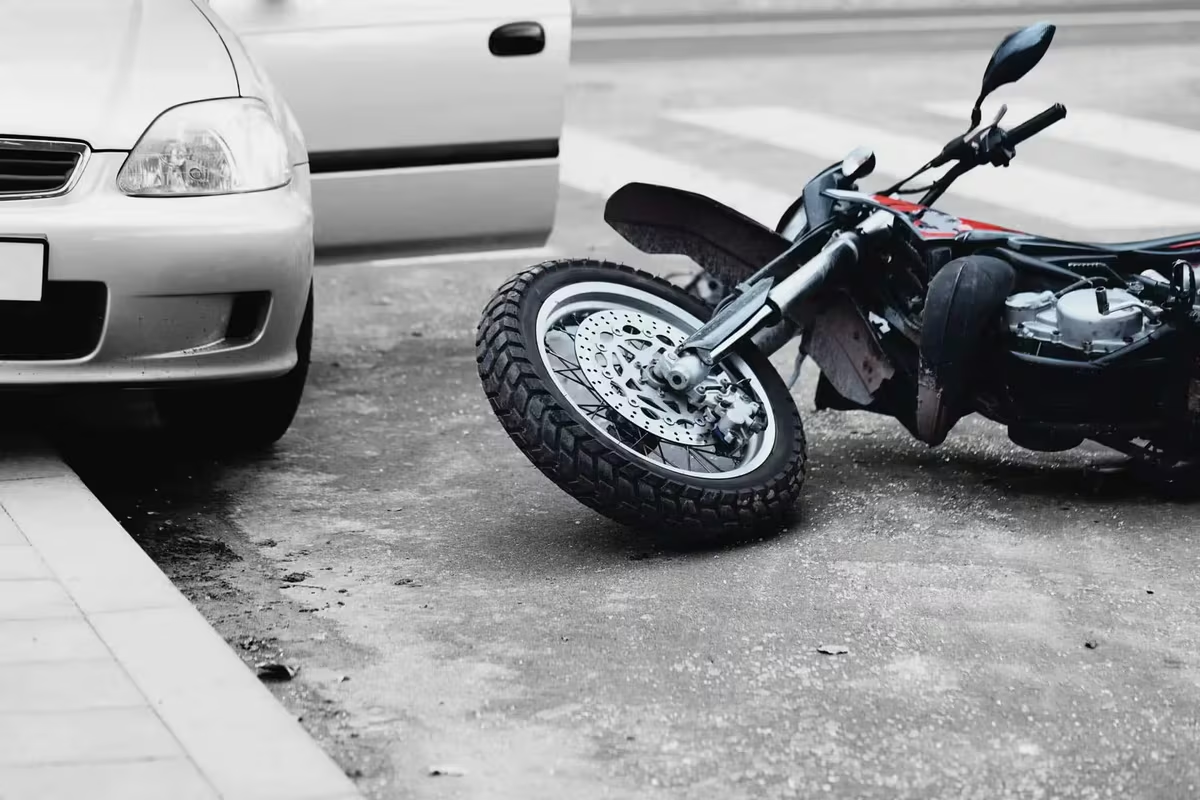 Motorcycle Accidents Serious-injury motorcycle crashes where bias against riders is common.
 -
 Pedestrian Accidents Crosswalk and roadway pedestrian injuries with high-stakes liability.
 -
 Bicycle Accidents Cyclists struck by drivers who failed to share the road.
 -
 Bus Accidents Transit, school, and charter-bus crashes involving public and private carriers.
 -
 Slip & Fall Falls caused by wet floors, poor maintenance, and hidden hazards.
 -
 Catastrophic Injury Brain, spinal-cord, amputation, and severe-burn injuries that change a life.
 -
 Wrongful Death Claims brought by families after a fatal accident or act of negligence.
 -
 Construction Accidents Falls, struck-by, and equipment injuries on the job site.
 -
 Oilfield Accidents Drilling, pipeline, and refinery injuries across the energy sector.
 -
 Workers' Compensation On-the-job injuries and the benefits owed to injured workers.
 -
 Nursing Home Abuse Neglect and abuse of residents in long-term-care facilities.
Comparative Fault and Rider Bias in Caddo Parish
Under La. C.C. Art. 2323, fault is allocated among all parties by the trier of fact, and each party’s recovery is reduced by its assigned percentage. Defense attorneys and adjusters in Caddo Parish motorcycle cases routinely argue that the rider was speeding, lane-splitting, weaving, or riding without adequate attention. These arguments are not always grounded in evidence; they often start from a bias that a motorcyclist must have been doing something risky. The goal is to raise the rider’s fault percentage and shrink the defendant’s exposure.
That bias became far more consequential under Act 15 of 2025, which amends Art. 2323 to impose a 51% fault bar effective January 1, 2026. For any crash on or after that date, a rider assigned 51% or more of the fault recovers nothing. Before this change, Louisiana used pure comparative fault, so a rider could recover something even at a high fault percentage. Now an insurer that can push a rider’s share past the halfway point eliminates the entire claim rather than merely reducing it. That single percentage point between 50% and 51% is the difference between a partial recovery and zero. Building the record with crash reconstruction, witness depositions, and electronic data from the vehicles involved is how that pressure is countered.
Two further changes sharpen the same problem. Act 459 of 2025 eliminated the Housley presumption for civil tort cases. Previously, a plaintiff who was healthy before a crash and symptomatic afterward enjoyed a presumption that the crash caused the injury. That presumption no longer applies, so a rider now needs expert medical testimony to establish the causal link between the collision and the injuries. Separately, Act 460 of 2025 changed Louisiana’s direct action rule effective January 1, 2026: the at-fault driver’s insurer can no longer be named as a defendant until after trial, so the jury does not see the insurance company’s name during deliberations. Both changes shift the balance toward insurers, and a motorcycle case has to account for them from the outset.
Louisiana law requires motorcycle operators and passengers to wear a helmet on public roads. A rider who was not wearing one still has a claim. The question that matters is whether the absence of a helmet actually affected the specific injuries claimed. An insurer cannot use helmet status to discount fractures, road rash, internal injuries, or other harm that headgear would not have prevented. How helmet evidence is treated depends on the documented facts of the crash, not on a blanket assumption.
Past results do not guarantee future outcomes; each case is decided on its own facts. See our full case results.
Injuries and Damages in Shreveport Motorcycle Cases
Because a rider absorbs collision forces directly, motorcycle accident injuries in Shreveport tend toward the severe end of the spectrum: traumatic brain injury, spinal cord damage, long-bone and pelvic fractures, internal organ injury, and extensive road rash that can require skin grafting. These injuries frequently require emergency stabilization at the region’s Level I trauma center at Ochsner LSU Health Shreveport, or at Willis-Knighton, before any transfer to specialized care. The severity and permanence of the injury is the single largest factor in what a claim is worth, because it drives both the medical cost and the degree to which a rider’s life and earning ability are changed.
Louisiana divides damages into two categories. Economic damages cover financial losses you can document: past and future medical expenses, lost wages, diminished earning capacity, property damage to the motorcycle, and out-of-pocket costs such as transportation to appointments and home modifications. Non-economic damages cover the human cost that does not come with a bill: physical pain and suffering, mental anguish, loss of enjoyment of life, permanent scarring and disfigurement, and permanent disability. Louisiana imposes no general statutory cap on these damages in personal injury cases; the $500,000 cap applies only to medical malpractice, not to motor vehicle claims.
Some injuries are obvious at the scene, but others develop over hours or days. A traumatic brain injury can result from the force of the collision moving the brain inside the skull, with confusion, memory problems, and light sensitivity surfacing later. Internal bleeding can produce no external sign while it becomes life-threatening. That delay is exactly why prompt medical evaluation after any motorcycle crash matters, and why gaps in treatment give an insurer an argument that the injuries are unrelated or exaggerated. Neuropsychological testing for brain injury and imaging for spinal damage produce the kind of measurable data that is harder for an insurer to dismiss as subjective.
When a motorcyclist is killed, Louisiana recognizes two separate claims. A wrongful death claim under La. C.C. Art. 2315.2 belongs to the surviving spouse, children, and certain other relatives for their own loss. A survival action under La. C.C. Art. 2315.1 belongs to the estate and recovers for the rider’s own pre-death pain and suffering. Both claims can proceed together in the First Judicial District Court.
What to Do After a Shreveport Motorcycle Crash
The hours after a motorcycle crash shape every claim that follows. If you are able, the steps below protect both your health and your recovery, and skipping any one of them can cost you later. A rider is often more seriously hurt than a driver in the same crash, so the first priority is medical, not legal.
Call 911 and accept medical evaluation even if adrenaline is masking pain. A police report from the Shreveport Police Department or the Caddo Parish Sheriff’s Office documents the crash while the details are fresh, including location, road conditions, driver statements, and any citation issued. That report becomes a key piece of evidence when fault is disputed, and disputes are common in motorcycle cases. Crashes on I-20, I-49, and other state highways are typically worked by the Louisiana State Police instead.
If you can do so safely, photograph the scene from multiple angles, including the vehicles, the road surface, skid marks, debris, traffic signals, and your visible injuries. Wide shots that show the full intersection or roadway matter as much as close-ups. Get the other driver’s name, phone number, insurance carrier, and policy number, along with the plate, make, model, and color. Collect the names and phone numbers of any witnesses before they leave, because a neutral witness can resolve the conflicting accounts that drivers and adjusters tend to offer in motorcycle cases. Do not admit fault, apologize, or discuss your injuries with the other driver or their insurer, and contact a lawyer before signing anything or giving a recorded statement.
Your Shreveport Injury Attorneys
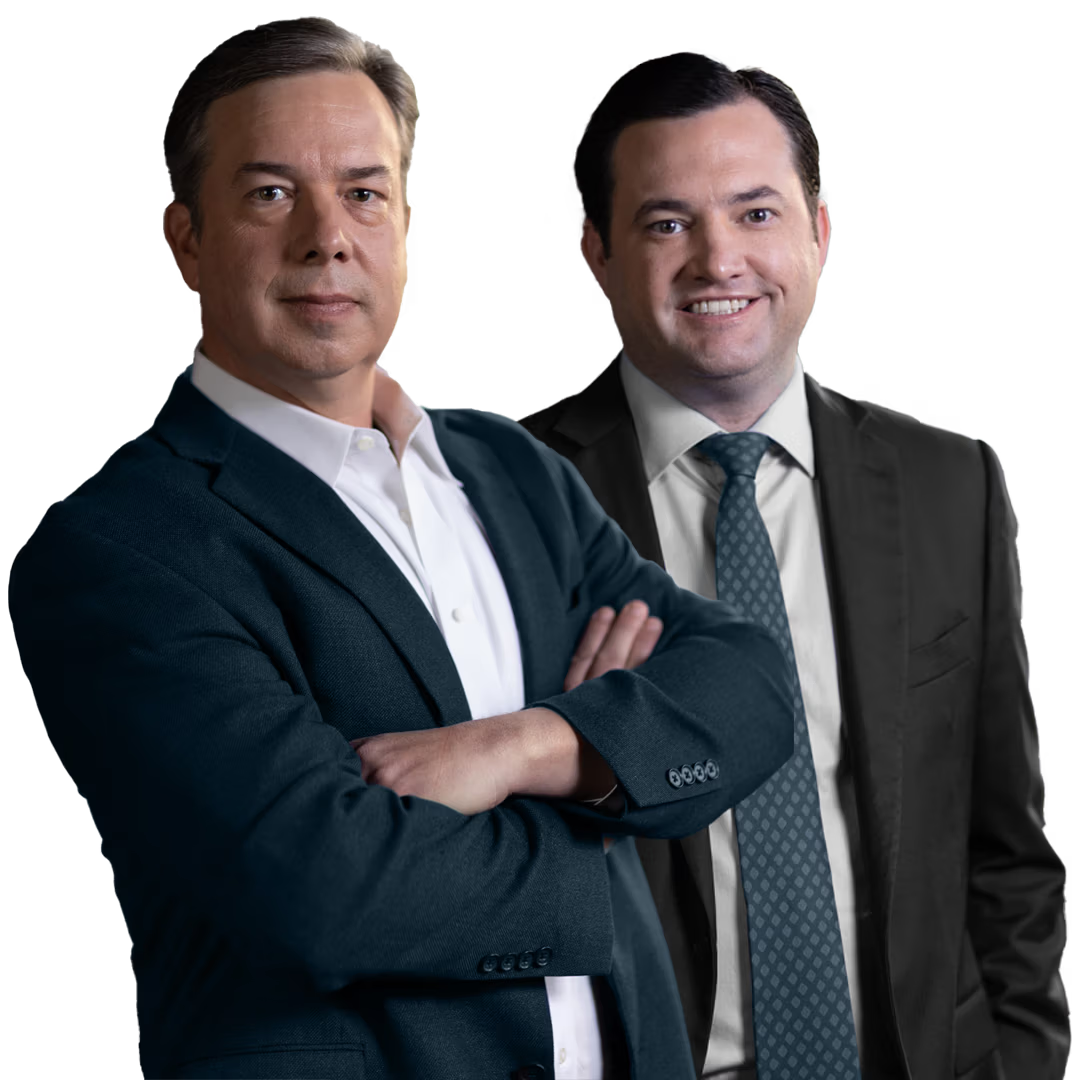
Founding partners Trey Morris and Justin Dewett lead every Shreveport injury case Morris & Dewett takes.


Proving Fault and Preserving Evidence
Winning a motorcycle accident claim in Louisiana requires evidence that another party was negligent, not merely your account of what happened. Because adjusters often start from a bias against riders, the investigation has to be thorough enough to replace assumption with proof. Your attorney’s first job is to build a factual record: securing the police report and EMS records, downloading data from the event data recorders in the vehicles involved, and photographing the scene before conditions change.
Evidence has a short shelf life. Surveillance systems at Shreveport businesses overwrite footage on cycles as short as 48 to 72 hours, and intersection cameras along corridors like Youree Drive, Bert Kouns, and Interstate 20 can capture critical footage that vanishes quickly. Vehicles get repaired or sent to salvage, and witness memories fade within weeks. When liability is disputed, an accident reconstruction expert can use vehicle damage patterns, skid marks, and physical evidence to recreate how the collision happened, and a biomechanical analysis can link those crash forces to the rider’s specific injuries. That linkage matters more than it once did, because the elimination of the Housley presumption by Act 459 of 2025 now requires expert testimony to establish medical causation rather than allowing an inference from the timing of symptoms.
The at-fault driver is not always the only responsible party. If the driver was working at the time of the crash, the employer can be liable under respondeat superior (La. C.C. Art. 2320), which often opens access to larger commercial insurance policies. A government entity responsible for road design and maintenance can bear fault when a defect contributed to the crash, though claims against public entities carry separate notice requirements and shorter deadlines that have to be acted on early. Identifying every potentially liable party affects both the total insurance available and how fault percentages are allocated, which under the 51% bar can determine whether a rider recovers anything at all.
What clients say
- ★★★★★
I hired Morris and Dewett back in November of 2025.
They helped me get through my hard times of being off work, stress, and worry. Anytime I had a question I could call and they always had an answer. Very nice and professtional people. Thank you Morris and Dewett for making this an easy process for me and my family.
- ★★★★★
Wonderful experience with Morris and DeWitt, everyone was articulate and punctual, and open to all my questions about the process.
My case couldn't have been handled by a better team! Caity Nerren, Jessica Christian, and Meghan Nolen were all fantastic and helped every step of the way. Thanks again for all of your hard work.
- ★★★★★
Caity, Coleman, and Brooke worked hard to get our case settled in a timely manner!
I highly recommend Morris & Dewett for any personal injury claims!
- ★★★★★
I am very appreciative for the services they have provided me with, very nice and welcoming staff and they take care of you every possible way.
They are the way to go !
- ★★★★★
Morris and Dewett and their team of attorneys and staff go above and beyond.
They always were there to support me and answer all my questions after a shoulder injury that included multiple surgeries. They are caring and compassionate and that goes a long way! Highly recommended!
- ★★★★★
Thanks Morris and Dewett for the excellent work you have done on my behalf.
I want to personally thank Sarah for her kindness.
Reviews reflect individual client experiences. Past results do not guarantee future outcomes.
Filing Deadlines and Insurance Coverage for Caddo Parish Riders
For crashes on or after July 1, 2024, the prescriptive period is two years from the date of the accident under La. C.C. Art. 3493.1, as established by Act 423 of 2024. For crashes before that date, the prior one-year deadline under La. C.C. Art. 3492 applies. Louisiana calls this filing deadline a prescriptive period, and once it runs the court will dismiss the claim no matter how strong the evidence is. Limited exceptions can suspend prescription, including minority, which tolls the deadline for a claimant under 18, and the discovery rule for an injury that was not immediately apparent. Two years can feel like plenty of time, but building a motorcycle case around a serious injury, with medical records, expert evaluations, and preserved evidence, should begin immediately, and the deadline to preserve evidence is far shorter than the deadline to file suit.
When the at-fault driver carried no insurance or not enough, your own uninsured and underinsured motorist coverage becomes the primary path to recovery. Louisiana law requires every auto insurer to offer UM coverage, and it remains in place unless the insured rejected it in writing on an approved form. A UM claim is filed against your own carrier, which then steps into the adversarial role of the at-fault driver’s insurer. If the driver fled, Louisiana treats an unidentified hit-and-run driver as an uninsured motorist, but you have to report the crash to law enforcement to preserve that claim. Pulling the declarations page for every policy in your household and confirming in writing whether UM coverage was accepted or rejected is a practical first step.
If you were riding without insurance, Louisiana’s No Pay No Play law (La. R.S. 32:866) reduces your recovery. Since August 1, 2025, an uninsured driver cannot recover the first $100,000 in bodily injury damages or the first $100,000 in property damage, even when the crash was entirely the other party’s fault. The law does not bar the claim outright, and damages above those thresholds may still be pursued, but a rider needs to understand that exposure before evaluating any settlement offer.
Motorcycle accident cases in Caddo Parish are filed in the First Judicial District Court at 501 Texas Street in Shreveport, with federal court available in limited circumstances. Most cases resolve through negotiation or mediation before trial, but thorough preparation is often what moves an insurer toward a fair offer, because a prepared case in front of a Caddo Parish jury creates real exposure for the defense. Whether an attorney has actually tried motorcycle cases in the First Judicial District affects every stage of the claim, including knowing when a case is ready to settle and when it is worth taking to trial. Morris & Dewett represents injured riders on a contingency basis, with no attorney fee unless the firm recovers compensation, and the firm handles cases throughout Caddo Parish, Bossier Parish, and Northwest Louisiana.
Frequently Asked Questions
- How much does it cost to hire a Shreveport motorcycle accident lawyer?
- Motorcycle accident attorneys at Morris & Dewett work on contingency. You pay nothing upfront. The attorney fee is a percentage of the recovery, agreed in writing before representation begins and paid only if the case succeeds. Court costs and case expenses are advanced by the firm and deducted from the recovery if the case is successful. If no compensation is recovered, you owe no attorney fee. There is no financial risk to consulting a lawyer about a Caddo Parish motorcycle crash.
- How long do I have to file a motorcycle accident claim in Louisiana?
- Two years from the date of the crash for accidents occurring on or after July 1, 2024, under La. C.C. Art. 3493.1 (Act 423 of 2024). If your crash happened before July 1, 2024, the prior one-year deadline under La. C.C. Art. 3492 applies. Once the prescriptive period runs, the court will dismiss the case regardless of how strong the evidence is. Limited exceptions exist for minors and for injuries that were not immediately apparent. The deadline to preserve evidence is far shorter than the deadline to file suit.
- Does Louisiana require motorcyclists to wear a helmet?
- Louisiana requires helmets for all motorcycle operators and passengers on public roads. A rider who was not wearing a helmet still has a claim. The relevant legal question is whether helmet use would have affected the specific injuries at issue. An insurer cannot use helmet status to dispute injuries that protective headgear would not have prevented, such as fractures, road rash, or internal trauma. How helmet evidence is handled depends on the facts of the crash and the injuries documented.
- Why do insurance companies treat motorcyclists differently?
- Adjusters frequently apply bias against riders, assuming a motorcyclist was speeding, weaving, or riding recklessly before they review the evidence. That assumption is used to inflate the rider's fault percentage under Louisiana's comparative fault rules. For crashes on or after January 1, 2026, pushing a rider to 51% fault eliminates the claim entirely under La. C.C. Art. 2323. Countering this bias with crash reconstruction, electronic data, and witness testimony is central to a motorcycle case.
- What if I was partially at fault for the motorcycle crash?
- Louisiana uses a comparative fault system under La. C.C. Art. 2323. Your recovery is reduced by your percentage of responsibility. If you are 30% at fault and your damages total $100,000, you recover $70,000. For crashes occurring on or after January 1, 2026, a critical change applies under Act 15 of 2025: if you are assigned 51% or more of the fault, you recover nothing. Below that threshold, partial fault reduces but does not eliminate recovery. Insurers now have a strong financial incentive to push a rider past the 51% line.
- What if the driver who hit me was uninsured?
- Your own uninsured motorist coverage becomes the primary recovery path. Louisiana law requires every auto insurer to offer UM coverage, though it can be waived in writing. A UM claim is filed against your own carrier, which then takes an adversarial position. If the driver fled, Louisiana treats an unidentified hit-and-run driver as an uninsured motorist, but you must report the crash to law enforcement to preserve the claim. If you were uninsured yourself, Louisiana's No Pay No Play law (La. R.S. 32:866) bars the first $100,000 in bodily injury and the first $100,000 in property damage.
- Are motorcycle accident injuries treated as more serious?
- A motorcyclist has no structural protection in a collision, so the same impact that dents a car door can break bones, tear skin, and cause traumatic brain or spinal injury for a rider. Severe motorcycle injuries in the Shreveport area are stabilized at the Level I trauma center at Ochsner LSU Health Shreveport or at Willis-Knighton. Higher injury severity generally means higher medical costs and longer treatment, which affects what a claim is worth, but every case is evaluated on its own documented facts.
- Should I give a recorded statement to the insurance company?
- No. You are not legally required to give a recorded statement to the other driver's insurer. Adjusters are trained to ask questions in ways that produce statements reducing a claim's value, and recorded answers lock you into a version of events before your injuries are fully known. Provide only your name, contact information, and the basic facts of the crash. Do not discuss your injuries, your treatment, or how you feel, and do not agree to a recorded statement before speaking with a lawyer.
- Where will my Shreveport motorcycle accident case be filed?
- Cases arising from crashes in Caddo Parish are filed in the First Judicial District Court at 501 Texas Street in Shreveport. Federal court can have jurisdiction when the parties are from different states and the amount in dispute exceeds $75,000, or when a federal statute applies. Most motorcycle cases resolve through negotiation or mediation before reaching trial. Whether an attorney has tried cases in the First Judicial District affects every stage of a claim, including knowing when it is ready to settle.
Last updated June 17, 2026