

What Is a Traumatic Brain Injury Claim Under Louisiana Law?
A brain injury claim in Louisiana is a negligence case. The injured person asks a court to find that someone else’s careless or wrongful conduct caused damage to the brain, and to hold that person responsible for the resulting losses. The structure follows the ordinary pattern of any injury case. The detailed rules that control fault, deadlines, and damages are each tied to the statute or authority that governs them.
What sets a brain injury claim apart is not the legal structure. It is the nature of the injury. Brain damage is often invisible on the surface, slow to declare its full extent, and difficult to measure with a single test. The medical category of the injury, how the brain was hurt, and whether the damage shows on imaging all shape how the claim is proven and what it is worth.
Traumatic Brain Injury (TBI): Concussion to Severe TBI Classifications
A traumatic brain injury is damage caused by an external force: a blow, a jolt, or a penetrating object that disrupts normal brain function. Physicians grade TBI by severity. A mild TBI, commonly called a concussion, may involve brief or no loss of consciousness and short-term confusion. A moderate TBI involves longer unconsciousness and clearer cognitive deficits. A severe TBI involves extended unconsciousness or coma and lasting impairment.
The word “mild” misleads people. A mild TBI is a real medical event, not a minor inconvenience. Concussions can produce headaches, memory problems, and personality changes that last months or longer. Severity grading describes the initial injury, not the eventual outcome. A claim built on a concussion can be as real as one built on a coma, because the law compensates the actual harm a person suffers, not the label a chart assigns on day one.
Diffuse Axonal Injury (DAI): Causes and Legal Implications
Diffuse axonal injury happens when rapid acceleration and deceleration forces shear the brain’s nerve fibers, the axons, throughout the brain rather than at one impact point. High-speed collisions and violent shaking are common causes. Because the damage is spread across microscopic structures, a routine CT scan can look normal even when the injury is profound.
That gap between a normal-looking scan and a severely impaired person is the central challenge in many DAI cases. The defense will point to the clean image. Proving the injury then turns on specialized imaging, neuropsychological testing, and witness accounts of how the person functioned before and after. The medical complexity is what changes, not the basic shape of the claim. The proof simply demands more than a single radiology report.
Acquired Brain Injuries from Oxygen Deprivation (Anoxic/Hypoxic)
Not every brain injury comes from a blow. An acquired brain injury caused by oxygen deprivation occurs when the brain is starved of adequate oxygen. Anoxic injury is a complete loss of oxygen. Hypoxic injury is a partial reduction. Both kill brain cells, and those cells do not regenerate.
These injuries arise from events such as near-drownings, cardiac events, anesthesia failures, and complications during medical treatment. The cause is internal or environmental rather than a physical impact, but the question for the case is the same. Did someone’s carelessness cause the oxygen loss, and did that loss damage the brain? When it did, the harm can be compensated like any other negligently caused injury.
Difference Between TBI and ABI Under Louisiana Law
The medical distinction is straightforward. A traumatic brain injury results from an external force. An acquired brain injury is a broader category that covers brain damage occurring after birth from any cause, including oxygen deprivation, stroke, infection, or trauma. In common usage, “acquired brain injury” often refers to the non-traumatic causes, while “TBI” refers to impact-driven damage.
Louisiana does not run a separate kind of negligence case for the two categories. A negligence case is a negligence case. Whether the brain was hurt by a steering wheel or by oxygen loss during a botched procedure, the injured person still has to show carelessness and harm. The medical category matters for how the injury is diagnosed and explained to a jury, not for what kind of case is filed.
What Qualifies as a Compensable Brain Injury in a Personal Injury Claim
A brain injury becomes something a person can be compensated for when another party’s careless conduct caused real harm to the brain. The injury does not need to show on a CT scan. It does not require a coma or a loss of consciousness. It requires medical evidence of brain dysfunction and proof that someone else’s conduct caused it.
The ordinary brain injury claim compensates documented harm: the medical care, the lost earnings, and the lasting effects on a person’s life. In some cases, Louisiana law allows additional damages beyond those losses. Where a brain injury is caused by an intoxicated motor vehicle operator whose wanton or reckless disregard for the rights of others was a cause in fact of the harm, exemplary damages are available under La. C.C. art. 2315.4, with no statutory cap on the amount. The strength of any claim still turns on how well the harm is documented and tied to the conduct at issue, not on the injury’s label.
Our Bossier City Office
1815 Benton Rd
Bossier City, LA 71111
Open 24/7 for injured Bossier City residents
Get directions →What Are the Signs and Symptoms of a Brain Injury After an Accident?
Brain injury symptoms fall into four groups: physical, cognitive, emotional, and behavioral. Some appear within seconds of impact. Others surface hours or days later, after the adrenaline fades and the person tries to return to normal life. A head that hits a steering wheel, a dashboard, the ground, or a falling object can injure the brain even when there is no visible wound and no loss of consciousness. Knowing what to watch for is the difference between an injury that gets documented and one that gets dismissed.
The list below describes what brain injury can look like. It is medical information, not a diagnosis. Only a physician can evaluate a head injury. The reason this matters for a claim is simple: symptoms a person notices and reports become part of the medical record, and the medical record is the spine of any injury case.
Physical Symptoms of Brain Trauma
The physical signs show up first for most people. Headache that will not ease is the most common. Add to that nausea or vomiting, dizziness, and trouble with balance. Sensitivity to light and sound is frequent after a concussion. Blurred or double vision, ringing in the ears, and a bad taste in the mouth also appear.
Sleep changes track closely with brain trauma. Some people sleep far more than usual. Others cannot sleep at all. Fatigue that rest does not fix is a warning sign worth reporting to a doctor. So is any seizure, repeated vomiting, or fluid draining from the nose or ears, because those point to a more serious injury.
Cognitive Symptoms After a Head Injury
Cognitive symptoms affect how the brain processes information. The person may feel foggy, slow, or “not themselves.” Concentration breaks down. Short-term memory slips, so a recent conversation or the details of the accident itself become hard to recall.
Word-finding trouble is common. So is difficulty following directions, finishing tasks, or making routine decisions. A person who handled spreadsheets or drove a delivery route without thinking may suddenly struggle with both. These deficits are real even when a CT scan reads normal, and they often surface only when the person tries to go back to work or school.
Emotional and Behavioral Changes
Brain injury changes mood and conduct. Irritability arrives first for many people, followed by anxiety, sadness, or a short temper that family members notice before the injured person does. Some describe feeling emotionally flat. Others swing without warning.
These changes are not weakness or imagination. They are a documented consequence of injury to the regions of the brain that regulate emotion and impulse. A spouse, parent, or coworker who observes the change is a valuable witness, because the injured person frequently cannot see it in themselves.
Brain Injury Symptoms That May Be Delayed
Many brain injury symptoms do not appear at the scene. A person walks away from a crash, declines the ambulance, and feels the headache, the nausea, or the confusion the next morning. Delayed onset is normal, not rare. Bleeding or swelling inside the skull can build over hours, which is why a person who felt fine at first can deteriorate later.
This delay creates a trap. An insurance adjuster will argue that symptoms appearing days after an accident must come from something else. Prompt medical evaluation and an honest, ongoing report of symptoms close that gap. A person who waits and then minimizes what they feel hands the other side an argument it did not earn.
When Symptoms Require Emergency Medical Care
Certain signs call for the emergency room, not a wait-and-see approach. Loss of consciousness, even briefly. A headache that keeps getting worse. Repeated vomiting, seizures, or convulsions. Slurred speech, weakness or numbness in the limbs, or one pupil larger than the other. Confusion, agitation, or unusual behavior. Clear fluid draining from the nose or ears. An inability to wake the person fully.
Any of these after a blow to the head warrants immediate care. For a child, watch also for persistent crying, refusal to eat or nurse, and loss of interest in favorite activities. Getting evaluated protects health first. It also creates the contemporaneous record that an injury claim depends on.
What Are the Most Common Causes of Brain Injuries in Bossier City?
Most brain injuries in Bossier City trace back to a handful of recurring events: vehicle collisions, falls on commercial property, workplace and industrial trauma, two-wheeler crashes, and medical errors. The cause matters because it shapes who investigates, what evidence exists, and how quickly that evidence disappears. A crash leaves skid marks and electronic data. A fall leaves a surveillance recording that a property owner may overwrite in days. Understanding where these injuries happen is the first step in knowing what a competent investigation looks like.
Car and Truck Accidents on I-20, I-220, Airline Drive, and Barksdale Highway
High-speed corridors produce the head trauma cases that come through Bossier City most often. I-20 and I-220 carry heavy traffic, including commercial trucks, where a sudden stop or rear-end impact transfers enormous force to occupants. Airline Drive and Barksdale Highway see frequent intersection and turning collisions at lower speeds that still cause the brain to strike the inside of the skull.
Commercial truck crashes deserve separate attention. A loaded 18-wheeler can weigh twenty to thirty times what a passenger car weighs, and that mismatch turns a survivable car wreck into a catastrophic one. Trucks also carry electronic logging devices and event data recorders that capture speed, braking, and hours of service. That data can vanish if no one demands its preservation early, which is why a preservation letter to the motor carrier needs to go out soon after the crash.
Slip and Fall Accidents in Bossier City Casinos and Hotels
Bossier City’s casino and hotel corridor draws large crowds, and falls on hard surfaces are a leading source of head injuries in that setting. A fall onto tile or concrete can cause a closed head injury even without any visible wound. These venues run extensive camera systems, which means the fall was almost certainly recorded.
Louisiana treats claims against stores and similar commercial properties under a specific framework. A merchant is liable for a fall only when the injured person proves the merchant created the hazard or had actual or constructive notice of it and failed to fix it. That notice requirement, set out in La. R.S. 9:2800.6, is the heart of most casino and hotel fall cases. Whether the property had notice often turns on the same surveillance footage that captured the fall, which is why preserving that recording before it is overwritten can decide the case.
Workplace, Construction, and Industrial Brain Injuries in Bossier Parish
Bossier Parish supports manufacturing, construction, and industrial work, and these settings present head-injury hazards common to heavy industry: falling objects, falls from height, equipment strikes, and explosions. A worker struck by dropped material or thrown against a fixed surface can sustain a serious brain injury even while wearing a hard hat.
These cases often involve more than one responsible party. The employer’s relationship to the worker, the role of an equipment manufacturer, and the conduct of an outside contractor on the same site all factor into who answers for the injury. Sorting that out requires preserving the scene, the equipment, and any safety records before they are altered or discarded.
Motorcycle and Bicycle Accidents on the Red River Bridge Corridors
The corridors crossing the Red River between Bossier City and Shreveport mix fast-moving traffic with riders and cyclists who have no protective shell around them. A motorcyclist or bicyclist thrown to the pavement absorbs the full force of the impact, and head trauma is among the most frequent serious outcomes even when a helmet is worn.
Visibility disputes drive many of these cases. A driver who failed to yield or merged into a rider’s lane will often claim the rider was hard to see. Camera footage from nearby businesses, dash cameras, and witness accounts can establish what actually happened, and that evidence is most reliable when gathered in the days right after the crash.
Medical Malpractice Brain Injuries: Surgical Errors and Anesthesia Failures in NWLA
Some brain injuries originate not in an accident but in a medical setting. Surgical errors and anesthesia failures can deprive the brain of oxygen long enough to cause lasting damage. These claims arise across Northwest Louisiana hospitals and surgical centers and follow rules distinct from ordinary negligence cases.
Medical malpractice claims in Louisiana carry a separate damages structure. A total cap of $500,000 applies to combined economic and non-economic damages, but that cap excludes future medical care and related benefits, which are paid as incurred through the Patient Compensation Fund under La. R.S. 40:1231.2. That separate framework means a medical-error brain injury is handled differently from a crash or fall claim from the very start.
How These Causes Affect Daily Life
The common thread across every cause above is that a brain injury reaches far beyond the hospital stay. Memory, concentration, mood, and the ability to work can all change, sometimes permanently. The cause determines the legal path, but the daily consequences look similar whether the injury came from a highway crash, a casino floor, an industrial site, or an operating room. Identifying the cause early protects the evidence that ties those consequences back to the event that produced them.
Who Can Be Held Liable for a Brain Injury in Bossier City?
The person who caused the impact is rarely the only party who pays. Louisiana law lets an injured person pursue every entity whose conduct or property contributed to the injury. Identifying all of them early matters, because each defendant carries its own insurance, its own evidence, and its own legal standard.
Individual Drivers and Employer Vicarious Liability (Respondeat Superior)
The at-fault driver is the starting point in any crash claim. When that driver was working at the time, the employer may answer for the harm too. Three Louisiana sources frame this, and each has its own distinct text on the legislature’s site. La. C.C. art. 2315 sets the general rule that a person whose fault causes damage to another must repair it. La. C.C. art. 2320 extends that duty to employers, making them responsible for the torts an employee commits in the course and scope of employment. La. C.C. art. 2317.1 adds responsibility for things in a defendant’s custody when a defect the defendant knew or should have known about causes harm. This employer doctrine, often called respondeat superior, reaches delivery drivers, sales fleets, commercial operators, and anyone driving for the boss when the wreck happened.
The employer link matters because a company usually carries far larger coverage than an individual. Proving course and scope turns on dispatch logs, employment records, the route assigned, and whether the trip served the employer’s business. A driver running a personal errand on personal time breaks the chain. A driver making a delivery does not.
Property Owners Under Louisiana Premises Liability Law
A fall or a struck-head injury on someone else’s property can support a claim against the owner, but the standard is exacting. For merchant defendants such as stores, casinos, and hotels, three Louisiana citations govern when merchandise or a hazard causes the injury: La. R.S. 9:2800.6, La. C.C. art. 2315, and La. C.C. art. 2317.1. Which one controls depends on the facts of the injury.
Under the merchant statute, La. R.S. 9:2800.6 makes a property owner liable for a fall only when the injured person proves the merchant created the hazardous condition or had actual or constructive notice of it before the injury and failed to act. Constructive notice means the condition existed long enough that a reasonable merchant should have found and fixed it. La. C.C. art. 2315 supplies the underlying fault duty, and La. C.C. art. 2317.1 governs harm from a defect in a thing the owner had in its custody. Establishing the time element relies on surveillance footage, inspection logs, and witness accounts placing the hazard on the floor before the injured person arrived.
Government Entities: Suing LADOTD or the City of Bossier City for Road Defects
When a road defect, a missing sign, or a poorly maintained intersection contributes to a crash, the public body responsible for that road may be a defendant. The Louisiana Department of Transportation and Development controls state highways, while the City of Bossier City and Bossier Parish maintain local streets. Determining which entity owned and controlled the spot where the injury happened is an investigation question, not a guess.
Claims against public bodies run on shorter clocks and special notice rules that differ from claims against private parties. Because those deadlines are unforgiving, the ownership and notice analysis should happen at the very start of a case, beginning with identifying the governmental owner of the roadway and the notice the claim requires.
Product Manufacturers and Defective Equipment Claims
A brain injury sometimes traces back to equipment that failed rather than a person who erred. A defective seatbelt, a failed airbag, a faulty helmet, or a malfunctioning industrial machine can shift responsibility onto the manufacturer or distributor. These claims focus on the product itself: whether it was unreasonably dangerous in design, construction, or warning when it left the maker’s control.
Preserving the product is the practical key. A vehicle hauled to salvage or a machine returned to service destroys the evidence a manufacturer claim depends on. How quickly the physical item is secured and inspected often determines whether the claim survives.
Healthcare Providers in Medical Malpractice Brain Injury Claims
A brain injury caused or worsened by negligent medical care, such as a surgical error, an anesthesia failure, or a missed diagnosis, falls under Louisiana’s medical malpractice framework rather than ordinary negligence. That framework carries its own procedural steps, including a review process before a lawsuit can proceed, and it treats damages differently from a standard injury claim.
Identifying the right provider matters here too. A hospital, an individual physician, an anesthesia group, and a staffing company can each carry separate responsibility and separate coverage. Whether a defendant qualifies as a covered healthcare provider under Louisiana’s malpractice statute changes the entire path of the case.
What We Handle
Bossier City Practice Areas
-
 Car Accidents Rear-end, intersection, and highway collisions across Louisiana.
 -
 Truck Accidents 18-wheeler and commercial-vehicle wrecks governed by federal trucking rules.
 -
 Motorcycle Accidents Serious-injury motorcycle crashes where bias against riders is common.
 -
 Bus Accidents Transit, school, and charter-bus crashes involving public and private carriers.
 -
 Catastrophic Injury Brain, spinal-cord, amputation, and severe-burn injuries that change a life.
 -
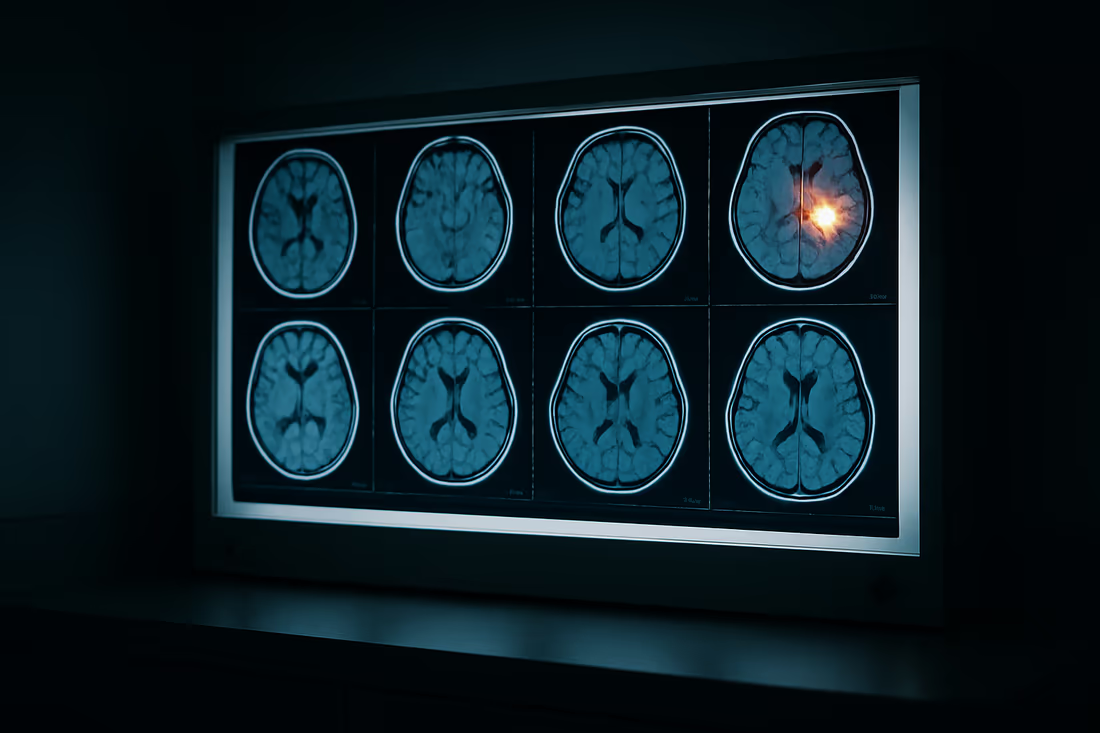 Brain Injury Traumatic brain injuries with long-term cognitive and physical effects.
 -
 Burn Injury Severe burns from fires, explosions, chemicals, and electrical contact.
 -
 Wrongful Death Claims brought by families after a fatal accident or act of negligence.
 -
 Construction Accidents Falls, struck-by, and equipment injuries on the job site.
 -
 Offshore Accidents Rig, platform, and vessel injuries beyond the shoreline.
 -
 Workers' Compensation On-the-job injuries and the benefits owed to injured workers.
How Long Do You Have to File a Brain Injury Lawsuit in Louisiana?
Every Louisiana injury claim runs against a filing deadline. Miss it, and the claim is gone no matter how strong the underlying facts are. The single most important step is to confirm, with a Louisiana attorney, the exact date your claim must be filed before any other decision gets made. Get that date in writing, tied to the statute that sets it, on the first call.
Confirm Your Filing Deadline With a Louisiana Attorney
The length of the filing window, and the date it begins to run, are set by Louisiana statute. Which rule controls and what your exact deadline is depends on your specific facts, including when the injury occurred. That is the first thing to nail down. The controlling statute can be read on the Louisiana Legislature website.
The precision matters because a claim that is timely under one set of facts can be barred under another, depending on the dates involved. The deadline that applies is specific to your case and tied to a citation, not a generic “about a year” or “a couple of years.” The rule turns on facts and dates that only counsel can confirm against the current statute.
Why Brain Injury Cases Should Be Investigated Immediately
Brain injuries argue for fast investigation even when the deadline feels distant. Symptoms can surface or worsen weeks after the event, which means the full scope of the injury is often unknown early. The evidence that proves how the injury happened degrades on its own schedule. Crash data gets overwritten. Surveillance footage at a casino, hotel, or store is routinely recorded over within days. Witnesses move and memories fade.
The filing deadline governs when you must sue. It says nothing about when the proof disappears, and that timeline is usually much shorter. Preserving black box data, scene photographs, incident reports, and witness contact information in the first weeks is what makes a strong case possible later. Evidence-preservation letters sent promptly after intake treat the filing deadline as a floor rather than a plan.
Exceptions That May Change When the Clock Runs
Certain circumstances can change when the filing clock starts or whether it pauses, and these come up in brain injury cases more than most. An injury that is not immediately apparent, the age of the injured person, and legal incapacity caused by the injury are all factors an attorney will examine against the controlling law. Whether any such doctrine applies to your facts is a legal question that turns on details specific to your case.
Do not rely on an exception to save a late filing. These rules are narrow, fact-intensive, and contested by insurers. Confirm with counsel whether any exception genuinely applies to you, and then proceed as though it does not. The safe assumption is always the earliest possible deadline.
Deadlines and Notice Rules for Claims Against Government Defendants
Claims against a public body can follow stricter timing and procedural rules than claims against a private driver or business. If your brain injury involves a defective road, a government vehicle, or a public property hazard, suing the responsible public entity can carry notice requirements and procedural prerequisites that ordinary claims do not. These rules can shorten your practical window and add steps that must happen before a lawsuit is filed.
This is an investigation focus rather than a deadline you should estimate on your own. Confirm with a Louisiana attorney whether a government entity is a potential defendant in your case, and what notice or procedural rules attach to that defendant, as early as possible. Public-entity claims are unforgiving of missed steps, and the analysis belongs at the front of the case, not the end. Get your specific deadline confirmed in writing against the controlling statute, start preserving evidence immediately, and do not assume an exception applies until counsel tells you it does.
How Does Comparative Fault Affect a Bossier City Brain Injury Claim?
Comparative fault decides how much of a brain injury award survives if the defense pins part of the blame on the injured person. Louisiana sets this rule in La. C.C. art. 2323. For causes of action arising on or after January 1, 2026, a brain injury victim found 51% or more at fault collects nothing. At 50% fault or less, the award stands but drops by the fault percentage. A jury that values a traumatic brain injury claim at $2 million and assigns the plaintiff 20% fault returns $1.6 million.
That single number, the fault percentage, is often the most contested figure in a head-injury case. The defense rarely disputes that a brain injury happened. It disputes who caused it, and it pushes the plaintiff’s share toward that 51% line because crossing it ends the claim.
Louisiana Comparative Fault Explained
The fault allocation under La. C.C. art. 2323 works in two steps. The jury first sets the total damages. Then it divides fault among everyone who contributed to the harm, and the percentages add to 100. The plaintiff’s damages are reduced by that slice and no more.
The January 1, 2026 change matters. For causes of action arising on or after that date, fault of 51% or higher is a complete bar, while a victim at 50% fault still receives half the award. One percentage point higher and the result is zero. That cliff is why fault allocation in serious head-injury cases carries so much weight.
How Insurance Companies Use Fault Arguments
Insurers build fault arguments to shrink the payout or eliminate it. In a brain injury case, the defense looks for any conduct it can tie to the victim. Speed. A missed seatbelt. A glance at a phone. Standing in a poorly lit area of a property. None of these has to cause the brain injury itself. They only have to persuade a jury to move the percentage up.
The tactic is sharper now that the 51% threshold under La. C.C. art. 2323 ends the case. An adjuster aiming to cut the bill has reason to push fault all the way to that bar. Expect the defense to frame ordinary behavior as recklessness and to lean on it during negotiation as leverage against settling.
Evidence That Can Reduce Unfair Blame
Fault is a factual question, and facts can be documented. The evidence that holds a fault percentage down is the same evidence that proves the case: the police report, scene photographs, traffic-signal data, surveillance footage, vehicle event-data-recorder downloads, and witness statements taken before memories fade or shift.
Independent reconstruction often carries weight. An engineer who can show the defendant’s speed, the sight lines, and the timing of the collision gives the jury a concrete basis to assign fault where it belongs. The closer a case sits to the 51% line in La. C.C. art. 2323, the more each piece of fault evidence is worth, which is why pinning down the fault percentage early shapes the value of the claim.
Multi-Defendant Cases: Allocation of Fault in Bossier Parish Courts
Many brain injury claims involve more than one defendant. A wreck might involve a driver and the employer who put an unfit driver on the road. A fall might involve a property owner and a maintenance contractor. Under La. C.C. art. 2323, the jury allocates a percentage to each party, and those percentages, together with any assigned to the plaintiff, total 100.
Spreading fault across defendants can work in a victim’s favor. If three defendants share 90% of the fault, the plaintiff’s 10% is the only reduction applied to the award, well clear of the 51% bar. Defendants will often point at each other, which can leave the plaintiff’s conduct looking minor by comparison. A lawyer who maps every responsible party early gives the jury more places to assign blame and keeps the plaintiff’s share small.
Shared-Fault Examples in Brain Injury Cases
A few illustrations show how the math runs under La. C.C. art. 2323. A motorcyclist suffers a traumatic brain injury when a driver turns left across traffic. The jury values the claim at $3 million, finds the driver 85% at fault and the rider 15% for traveling slightly over the limit. The rider receives $2.55 million.
Now shift the facts. The same rider is found 55% at fault because the jury concludes the speed, not the turn, caused the crash. For causes of action arising on or after January 1, 2026, that crosses the 51% bar and the award is zero. The difference between those two outcomes is a few percentage points of fault, which is exactly why the evidence that fixes those percentages drives the value of a Bossier City brain injury claim.
What Compensation Can a Bossier City Brain Injury Victim Recover?
A brain injury claim in Louisiana can compensate two broad groups of harm: economic losses you can document with bills and records, and non-economic losses that money is only a rough substitute for. A serious traumatic brain injury claim is valued on the actual life impact of the injury, not on a formula. How compensation works can differ with the type of claim and the defendant.
Economic Damages: Medical Bills, Future Care Costs, Lost Wages, Vocational Rehabilitation
Economic damages are the calculable, receipt-backed losses. Past medical bills cover emergency treatment, hospitalization, neurology, imaging, and the medications a brain injury demands. Future care costs are often the largest number in a severe TBI claim, because a damaged brain frequently needs years of therapy, monitoring, and supportive treatment after the case resolves.
Lost wages cover the income missed during treatment and healing. When a brain injury limits the kind of work a person can return to, the claim also reaches lost earning capacity, the gap between what someone could earn before the injury and what they can earn after. Vocational rehabilitation costs belong here too, including retraining for work compatible with new cognitive limits.
Projecting future earning capacity and medical needs involves economists and treating physicians, not a guess. That is the difference between a claim built for a quick payout and one built for the full cost of the injury.
Non-Economic Damages: Pain and Suffering, Loss of Enjoyment, Consortium Claims
Non-economic damages compensate the human consequences that do not arrive as invoices. Pain and suffering covers the physical pain and mental anguish a brain injury causes. Loss of enjoyment of life addresses the activities, relationships, and independence a TBI takes away, which for many brain injury survivors is the heart of the case.
Louisiana also recognizes loss of consortium claims, which let close family members claim damages for the harm a serious injury does to their relationship with the injured person. A spouse who loses companionship, or a child who loses a parent’s guidance and support, can assert that loss as part of the claim. Documenting these losses depends on the people in the injured person’s life, not on a stack of bills.
Rehabilitation, Therapy, Assistive Devices, and Long-Term Care
Brain injury claims frequently turn on long-term needs that surface over time. Physical, occupational, speech, and cognitive therapy are common, and many survivors need them for years. Assistive devices, home modifications, and in-home or facility-based care can each be substantial recurring costs.
These needs are documented through a life care plan, a structured projection of what the injury will require over a lifetime and what each item costs. The plan is how future rehabilitation and long-term care get converted from a medical reality into a number a jury or insurer can evaluate. A claim that ignores this work tends to undervalue exactly the part of a TBI that lasts longest.
Punitive Damages: When They Apply in Louisiana TBI Cases
Punitive damages, also called exemplary damages, are not a standard part of a Louisiana personal injury claim. Whether they are available at all in a given case depends on the specific facts and on whether a statute reaches those facts. The question has to be evaluated case by case rather than assumed.
Whether your facts could support a claim for exemplary damages is a question for an attorney to evaluate against the evidence, and the analysis turns on identifying the specific statute that reaches those facts.
Wrongful Death Damages After a Fatal Brain Injury
When a brain injury proves fatal, the claim changes form. Surviving family members can pursue wrongful death damages for their own losses, including the loss of the relationship, companionship, and support of the person who died. A survival action can also continue, allowing the estate to claim the damages the injured person suffered between the injury and death.
This is a different legal track from the injured person’s own claim, with its own categories of compensation and its own questions about who may bring it. A fatal brain injury does not end the right to compensation. It shifts to the family and the estate.
Compensation also interacts with health insurance and medical liens. How payments from independent sources affect a claim, and how liens are resolved before money reaches a client, are fact-specific questions that shape what a settlement number actually means in hand.
Past results do not guarantee future outcomes; each case is decided on its own facts. See our full case results.
What Is the Average Settlement for a Brain Injury in Louisiana?
There is no single “average” Louisiana brain injury settlement, and anyone who quotes you a flat figure is guessing. A concussion that resolves in weeks and a severe injury that ends a career sit at opposite ends of a very wide range. The honest answer is that value tracks the medical evidence, the lifetime cost of care, the strength of the liability proof, and how the injury changes what a person can do for the rest of their life. This section explains the factors that move those numbers and how the future cost of a brain injury gets measured.
Average Settlement Range and Factors That Shift Value
Brain injury values span from modest five-figure outcomes for mild, fully resolved injuries to seven and eight figures for catastrophic, permanent impairment. The spread is real, and it exists because no two brain injuries produce the same lifetime consequences. A settlement reflects medical bills already incurred, the projected cost of future treatment, lost income, diminished earning capacity, and the human cost of the injury.
Several specific factors push a number up or down. Severity and permanence rank first. A documented permanent cognitive deficit carries far more value than a temporary one. Age matters because a younger person faces more years of impairment and lost earning capacity. The defendant’s available insurance and assets set a practical ceiling, since a strong claim against an underinsured defendant can still leave damages uncollected. Liability strength matters too. A clear-fault rear-end collision settles differently than a disputed claim where the defense argues you share blame.
One point that surprises many people: who paid your medical bills usually does not reduce what the at-fault party owes. Under Louisiana’s collateral source rule, payments from sources independent of the wrongdoer, such as your own health insurance, generally do not cut the defendant’s liability. How the collateral source rule applies to your bills can change the net value of a claim.
Life Care Planning and Expert Testimony in High-Value TBI Claims
A serious brain injury case is built on expert testimony, not adjuster estimates. The central document in a high-value claim is the life care plan, a detailed projection of every medical and support service the injured person will need over a lifetime. A certified life care planner reviews the medical records, consults treating physicians, and itemizes future surgeries, therapy, medication, attendant care, assistive technology, and home modifications, each with a projected cost and frequency.
That plan does not stand alone. A neuropsychologist documents the cognitive and behavioral deficits through standardized testing. A treating neurologist or physiatrist explains the diagnosis and prognosis. A vocational expert measures how the injury reduces earning capacity. An economist then reduces the lifetime stream of costs and lost wages to present value, the lump sum needed today to fund those future needs.
These experts are also where defense attorneys concentrate their attack. Insurers retain their own physicians and life care planners to minimize projected costs and dispute permanence. Whether the plaintiff’s life care planners and neuropsychologists have held up under cross-examination often decides which projection a jury accepts.
How to Calculate Future Medical and Cognitive Rehabilitation Costs
Future cost calculation starts with the medical record and the prognosis, not a formula. Once treating physicians establish what care a brain injury survivor will need, each item is priced at current rates and projected across the person’s life expectancy. Cognitive rehabilitation, speech and occupational therapy, neurology follow-ups, psychiatric care, and medication all get individual line items with frequency and duration.
Attendant and custodial care frequently drives the largest share of a severe TBI projection. A survivor who cannot live independently may need hours of daily supervision or full-time care, and that cost compounds over decades. Home and vehicle modifications, durable medical equipment, and replacement schedules for that equipment are added. The total is then adjusted to present value by an economist so the settlement funds the full future need rather than running out early.
One Louisiana wrinkle changes the math in medical malpractice claims specifically. Under La. R.S. 40:1231.2, qualified malpractice claims carry a total cap of $500,000 combined economic and non-economic damages, but that cap excludes future medical care and related benefits, which are paid as incurred through the Patient Compensation Fund. That structure does not apply to ordinary negligence claims like car or truck crashes. Which framework governs your case determines how future care gets funded.
How Do Bossier City Brain Injury Lawyers Build and Prove Your Case?
A brain injury case is built on proof. Two questions drive the work. Did someone breach a duty that caused the event? And did that event cause a brain injury with the consequences claimed? Every record, image, and expert opinion described below exists to answer one of those two questions with documentation, not argument.
Defense lawyers and insurers attack both questions. A serious case answers both with evidence assembled early, not the week before trial. Documenting causation in a closed-head case is the harder of the two, and it is built from the records, imaging, and expert opinions described below.
Securing Medical Records, Imaging, and Neuropsychological Testing
The medical file is the spine of the case. That means emergency records from the date of injury, every follow-up note, all imaging studies, and the raw data behind them. Lawyers request the actual CT and MRI files, not just the radiologist’s one-line read, because a neuroradiologist retained as an expert can find findings a busy emergency report missed.
Neuropsychological testing is the measurement tool for cognitive harm. A neuropsychologist administers a battery that scores memory, processing speed, attention, and executive function against normed baselines. Those scores convert a vague complaint into a quantified deficit. When prior school, military, or employment records establish how a person functioned before the injury, the testing shows the drop. That before-and-after contrast is often the strongest single piece of causation evidence in a closed-head case.
Accident Reconstruction and Black Box Data for Bossier City Crashes
Liability proof starts at the scene. Photographs, the crash report, debris fields, and skid marks feed an accident reconstructionist who calculates speed, angle of impact, and the forces transmitted to the occupant. In a brain injury claim, those forces matter twice. They establish the other party’s fault, and they show the biomechanics that explain how the head was injured.
Modern vehicles store data. The event data recorder, often called the black box, can capture pre-impact speed, braking, throttle, and seatbelt status in the seconds before a collision. Commercial trucks carry additional electronic logging. That data must be preserved before a vehicle is repaired or scrapped, which is one reason a Bossier City crash should be investigated quickly. A preservation letter sent early keeps the evidence from disappearing.
Proving Brain Injury When CT or MRI Results Are Normal
A normal scan does not mean a normal brain. Standard CT and MRI imaging detects bleeding, swelling, and structural damage. It frequently misses the microscopic axonal injury that produces lasting cognitive and emotional symptoms. Many people with documented, disabling brain injuries have clean conventional imaging. Insurers know this and use a normal scan to argue that no injury exists.
The answer is proof that does not depend on a visible lesion. Advanced imaging such as diffusion tensor imaging can reveal white-matter tract damage invisible on routine MRI. Neuropsychological scores document measurable deficit. Testimony from family, coworkers, and treating clinicians describes the change in the person. Built together, that record establishes a brain injury the scan alone cannot show.
Neuropsychological Expert Witnesses and IME Defense Strategy
Expert witnesses translate medicine into evidence a jury can weigh. A treating neurologist, a neuropsychologist, and a life-care planner each carry part of the proof. The neurologist connects mechanism to diagnosis. The neuropsychologist quantifies the cognitive loss. The life-care planner projects what future care will cost. Their combined testimony is how a plaintiff supports both causation and the scope of the damages claimed.
The defense will demand an independent medical examination, the IME. Despite the name, the defense selects and pays that examiner, and the examiner often concludes the injury is minor or unrelated. Preparation matters. The plaintiff’s lawyer documents the IME conditions, limits its scope where the law allows, and has retained experts ready to rebut a slanted report. Treating that examination as adversarial, because it is, protects the case.
Defense Tactics: Pre-Existing Conditions and Malingering Claims
Two defense arguments recur in brain injury litigation. The first is the pre-existing condition: the defense claims the symptoms predate the accident or come from an old injury. The counter is the full prior medical and functional history, which documents the person’s actual baseline rather than the version the defense suggests. A clear record of how someone functioned before the injury answers the argument with facts.
The second is the malingering claim, the accusation that symptoms are exaggerated or faked for money. Modern neuropsychological batteries include validity and effort measures designed to detect exaggeration. When a person passes those measures, the test results themselves rebut the malingering charge. Consistent treatment, corroborating witnesses, and objective findings close the gap.
Your Bossier City Injury Attorneys
Founding partners Trey Morris and Justin Dewett lead every Bossier City injury case Morris & Dewett takes.


What Happens During a Brain Injury Claim in Bossier Parish?
A brain injury claim moves through five phases: an initial case evaluation, a documentation and investigation period, a demand to the insurer, negotiation or the filing of a lawsuit, and trial preparation if no fair settlement comes. Most claims resolve before trial, but the work that builds leverage happens long before any negotiation begins. Knowing the sequence helps you measure where your case stands and what should be happening at each step.
The phases below describe what the process looks like from the first call through resolution. Each step builds on the one before it, and skipping or rushing a step usually weakens the claim rather than speeding it up.
Free Consultation and Case Evaluation
The first step is a conversation about what happened, what injuries followed, and who may be responsible. A good evaluation looks past the obvious facts. It asks about loss of consciousness, memory gaps, post-accident confusion, and symptoms that surfaced days later, because brain injuries often present quietly at first.
This meeting costs nothing and creates no obligation. You can schedule a consultation, ask questions, and decide afterward whether to move forward.
Investigation and Medical Documentation
Once retained, the attorney begins gathering the proof that supports the claim. That means collecting medical records, emergency department notes, imaging, and any neurological or neuropsychological testing already performed. It also means securing the accident record itself: the police report, scene photographs, and witness contact information before memories fade and physical evidence disappears.
Investigation runs parallel to your ongoing treatment. The medical file documents the injury; the accident file documents fault. Both have to be complete before any number is put in front of an insurer, because a demand built on a thin file invites a low response.
Insurance Claim and Demand Package
When treatment has stabilized enough to project future needs, the attorney assembles a demand package. This document lays out liability, summarizes the medical evidence, and quantifies the losses: past medical bills, future care, lost income, and the human cost of the injury. It is sent to the insurer with supporting records attached.
The demand opens the negotiation. A complete package, backed by records and expert input, sets the terms of the conversation. A rushed demand sent before the full extent of a brain injury is known leaves money on the table, which is why the timing of this step matters as much as its content.
Settlement Negotiations and Filing Suit
After the demand, the insurer responds, and negotiation begins. Many claims resolve here through a series of offers and counteroffers grounded in the documented evidence. If the insurer refuses to negotiate in good faith or disputes liability, the next step is filing suit.
Filing does not end settlement talks. Most cases continue to negotiate through the discovery process, where both sides exchange records, take depositions, and test each other’s evidence. Filing sets a litigation timeline and signals that the claim will be tried if it is not resolved fairly.
Trial Preparation and Resolution
If the case does not settle, preparation for trial intensifies. The attorney lines up treating physicians and retained experts, prepares exhibits from the medical and accident files, and develops the testimony that explains an invisible injury to a jury. Brain injuries demand this work because the harm rarely shows on a single scan or photograph.
Most cases resolve before a verdict, either in continued negotiation or at trial. Reviewing a firm’s case results gives you a sense of how it has handled matters that went the distance. Resolution, whether by settlement or judgment, closes the claim and triggers the distribution of funds and the satisfaction of any medical liens.
What Should You Do After a Suspected Brain Injury in Bossier City?
The first hours after a head injury shape both your health and any claim that follows. A brain injury is not always obvious at the scene. People walk away from crashes, falls, and workplace impacts believing they are fine, then deteriorate over the next day or week. The steps below protect your medical interests first and your legal options second. Each one is something you can act on yourself, before you ever speak to a lawyer.
Get Immediate Medical Evaluation
See a doctor the same day, even if you feel functional. A head impact, a violent jolt, or a moment of confusion is reason enough to be evaluated, and emergency departments at the Bossier and Shreveport hospitals can perform the imaging and neurological checks that screen for bleeding or swelling. Tell the provider exactly how the injury happened and every symptom you noticed, including the ones that seem minor.
Same-day care also builds a clean medical timeline. A gap between the incident and the first visit gives an insurer room to argue the injury came from something else. The record of an immediate evaluation ties the injury to the event while the connection is documented and fresh.
Follow Up With Neurology or Specialist Care
A single emergency-room visit is a starting point, not a complete picture. Concussions and milder brain injuries often clear initial CT scans yet produce real, lasting deficits. Follow up with your primary doctor, and ask for a referral to a neurologist or neuropsychologist if symptoms persist or worsen. Specialist care matters for healing and for documentation, because specialists run the cognitive and balance testing that captures injuries imaging can miss.
Keep every appointment. Attend the therapy that is prescribed. Consistent treatment shows the injury is genuine and that you are working toward medical improvement. Missed appointments and long stretches without care are the openings a defense uses to question how serious the injury really was.
Preserve Photos, Reports, and Witness Information
Evidence disappears fast. Photograph the scene, the vehicles or hazard involved, your visible injuries, and anything that explains how the impact happened. If law enforcement responded, get the report number so you can request a copy. For a fall or workplace incident, ask whether an incident report was created and request one.
Collect names and phone numbers from anyone who saw what happened. A witness who can describe your confusion, slurred speech, or loss of consciousness at the scene gives an account that medical records alone cannot. Memories fade and people move, so gather contact details while everyone is still nearby.
Avoid Recorded Statements Without Legal Advice
An insurance adjuster may call within days and ask for a recorded statement. You are not required to give one to the other party’s insurer. Adjusters are trained to ask questions that can lock you into details before the full extent of a brain injury is known, and a casual “I feel okay” can later be used to minimize your claim.
This caution is sharpest with brain injuries, where symptoms can surface or worsen over time. Stick to the basic facts with your own insurer when reporting is required, and decline to speculate about fault or the severity of your condition. Reviewing the situation with an attorney before any recorded statement keeps an early conversation from undercutting a serious injury.
Track Symptoms, Missed Work, and Daily Limitations
Keep a simple daily journal. Note headaches, dizziness, memory lapses, mood changes, sleep trouble, and anything that feels different from before the injury. Brain injury symptoms fluctuate, and a contemporaneous record captures patterns that a single doctor visit will not. Date each entry.
Track the practical losses too. Write down work you missed, tasks you could no longer do, and activities you gave up. Save pay stubs, medical bills, and receipts for out-of-pocket costs. This record becomes the factual backbone of how the injury changed your life, and it is far more reliable than trying to reconstruct months of detail from memory later.
How Much Does a Bossier City Brain Injury Lawyer Cost?
Most brain injury lawyers in Bossier City work on a contingency fee. The attorney is paid a percentage of the compensation collected for you, and the firm collects no fee if the case produces no result. You pay no hourly rate and no retainer to get started. The structure means the cost of a lawyer does not depend on what is in your bank account the week after a head injury.
That basic answer hides a few details worth understanding before you sign anything. The fee percentage, how case expenses are handled, and what happens if the case does not succeed all vary between firms. Below is how the cost structure works and what to confirm in writing.
Contingency Fee Structure: No Fee Unless You Are Paid
A contingency fee ties the lawyer’s payment to the outcome. If the case settles or wins at trial, the firm takes an agreed percentage. If the case resolves with no compensation, the attorney collects no fee. The exact percentage and the way it is calculated belong in the written fee agreement you sign at the start.
Read that document before you sign. The percentage and the expense terms are points to discuss, not boilerplate you have to accept as printed.
The fee percentage sometimes changes if the case goes to trial rather than settling early. Some agreements use a tiered percentage that rises once a lawsuit is filed, so the tiers spelled out in the agreement determine what each stage of the case will cost you.
No Upfront Attorney Fees
A brain injury claim can take months of investigation before anyone offers a dollar. The contingency model means you do not fund that work out of pocket. There is no retainer, no hourly billing, and no invoice that arrives while you are still in treatment.
This matters more in brain injury cases than in minor claims. These cases often require neuropsychological testing, imaging review, and expert opinions before the value is even clear. A contingency arrangement lets the firm carry that work forward without billing you as it goes.
Case Costs, Expert Fees, and Medical Record Expenses
Attorney fees and case costs are two separate things. The fee is what the lawyer earns. Case costs are the out-of-pocket expenses needed to build the claim: copying medical records, obtaining imaging, paying court filing fees, hiring accident reconstruction help, and retaining medical and life-care experts who testify.
Brain injury claims carry higher case costs than most personal injury matters because the proof leans on specialists. Neuropsychologists, treating physicians, and economic experts all charge for their time. In many contingency agreements the firm advances these costs and is reimbursed from the settlement or verdict at the end.
The detail to confirm is what happens to those advanced costs if the case does not succeed. Some firms absorb them. Others contract to be reimbursed from the client. Get the answer in writing before you sign, because on a case with heavy expert involvement the difference is not trivial.
How Morris & Dewett Handles Fees and Costs
The written agreement is where the real terms live, and Morris & Dewett puts them in plain language before you sign:
- The fee is a percentage of the recovery, and the agreement states whether that percentage changes if the case is filed or tried.
- The agreement spells out whether case costs are deducted before or after the fee is calculated.
- The firm advances case costs and explains in writing what happens to those advanced costs if the case collects nothing.
- Outstanding medical bills and liens paid from the settlement are identified and handled as part of the resolution.
- You receive a written accounting that shows the gross amount, the fee, each cost, and the net amount paid to you.
When you are ready to talk through your case, expect direct answers to each of these.
What clients say
- ★★★★★
I hired Morris and Dewett back in November of 2025.
They helped me get through my hard times of being off work, stress, and worry. Anytime I had a question I could call and they always had an answer. Very nice and professtional people. Thank you Morris and Dewett for making this an easy process for me and my family.
- ★★★★★
Morris and Dewett and their team of attorneys and staff go above and beyond.
They always were there to support me and answer all my questions after a shoulder injury that included multiple surgeries. They are caring and compassionate and that goes a long way! Highly recommended!
- ★★★★★
Thanks Morris and Dewett for the excellent work you have done on my behalf.
I want to personally thank Sarah for her kindness.
- ★★★★★
Morris & Dewett does things the right way!
They put their clients first in measurable and impactful ways.
- ★★★★★
First time being injured and needing a lawyer they where very helpful.
They answered my questions Id have very well. Highly recommend them.
- ★★★★★
Wonderful experience with Morris and DeWitt, everyone was articulate and punctual, and open to all my questions about the process.
My case couldn't have been handled by a better team! Caity Nerren, Jessica Christian, and Meghan Nolen were all fantastic and helped every step of the way. Thanks again for all of your hard work.
Reviews reflect individual client experiences. Past results do not guarantee future outcomes.
How Do You Choose the Right Brain Injury Lawyer in Bossier City?
Choosing a brain injury lawyer comes down to whether the attorney has actually tried these cases, understands the medicine, and can fund the experts a serious traumatic brain injury claim demands. A TBI case is not a fender-bender claim with a bigger number on it. The injury is often invisible on standard imaging, the symptoms can take weeks to surface, and the future-care costs run into life-care plans that span decades.
How Morris & Dewett Builds a Bossier City TBI Case
Morris & Dewett brings experience specific to brain injuries, not personal injury generally, which is what separates a TBI claim from a routine one. The firm tries these cases, assigns team members to manage the medical evidence, and works with neurologists, neuropsychologists, and life-care planners to document the injury and project its long-term cost.
The law that governs a brain injury claim is concrete. Louisiana’s comparative fault rule under La. C.C. art. 2323 controls what an injured person can collect, and the filing deadline runs under La. C.C. art. 3492.
What Case Results and Trial Experience Actually Signal in TBI Law
Trial experience matters in brain injury cases because insurers price their offers around it. A firm that takes cases to verdict changes the calculation an adjuster makes when deciding what a claim is worth. A firm that always settles signals the opposite, and defense counsel reads that signal.
The results that matter most resemble the case at hand: severe TBI, disputed causation, normal imaging, and proof of injury built when the evidence was contested. Morris & Dewett case results are available to review and compare against other firms. Results do not guarantee any outcome, but a record of complex injury work reflects experience with claims of this kind.
Local Advantage: Bossier Parish Courts, Judges, and Jury Pool Knowledge
A lawsuit arising from a Bossier Parish injury is filed in the 26th Judicial District Court, which serves Bossier and Webster Parishes. An attorney who practices in that courthouse knows its procedures, its scheduling, and the way local juries tend to weigh evidence. That familiarity affects strategy, from how a case is framed to when a settlement demand carries the most weight.
How often an attorney appears in the 26th JDC and whether they have tried cases to a Bossier Parish jury affects how a case is handled there. Local knowledge is not a substitute for skill, but in a high-stakes TBI case it removes friction that an out-of-area firm has to learn on your dime.
Why Settling a TBI Claim Too Early Is Risky
A common mistake in a brain injury claim is settling before the full extent of the injury is known. TBI symptoms can emerge over months, and the cost of long-term cognitive rehabilitation is not clear in the first weeks after an accident. An attorney who pushes a quick settlement before a treating neurologist has assessed the lasting deficits may be leaving future medical costs uncovered. A signed release closes the claim for good, even if symptoms worsen later.
Waiting for maximum medical improvement or a documented prognosis before negotiating is what protects an injury this serious. The sound approach builds the medical record first and demands a number that accounts for care you will need years from now.
Access to Brain Injury Experts and Life-Care Planners
Serious TBI cases are won with experts, and experts cost money up front. A brain injury claim often requires a neuropsychologist to document cognitive deficits, a treating neurologist to establish causation, a life-care planner to project decades of care, and sometimes an accident reconstructionist. A firm without the resources to retain these professionals cannot build the case a severe injury requires.
Whether a firm advances expert and case costs and holds relationships with qualified TBI specialists determines whether it can carry a complex claim through to a full valuation rather than settling for what the medical bills alone show. Take your time, and reach out when you are ready.
Frequently Asked Questions
- Do I have a case if I was never knocked unconscious or my scan was normal?
- Yes, you can still have a case. Loss of consciousness is not required for a brain injury to be real or compensable. Many concussions and mild traumatic brain injuries occur without anyone blacking out, and people walk away from a crash, talk to police, and only later notice headaches, memory gaps, or trouble concentrating. A normal CT or MRI also does not close the door. Standard imaging is built to find bleeding and fractures, not the microscopic axonal damage that drives many brain injuries. Documentation of symptoms over time, treatment records, and specialized testing carry the medical proof when scans read clean. What matters legally is whether the injury can be shown by a preponderance of the evidence, meaning more likely than not. The absence of a dramatic moment of unconsciousness goes to how the case is proven, not to whether a claim exists.
- Can a child or an incapacitated victim bring a brain injury claim?
- Yes. A minor or an adult who cannot manage their own affairs does not lose the right to compensation because they cannot file on their own. Louisiana law allows a parent, tutor, curator, or other authorized representative to bring the claim on the injured person's behalf. For a child, a parent or court-appointed representative typically pursues the claim, and the law treats the child's interests as the priority. For an adult who has been left incapacitated by the injury, a curator or other legal representative steps in to act for them. Settlements involving minors and incapacitated persons often require court approval to confirm the terms protect the injured person. The practical point is that severity of the injury, including injuries that erase a person's ability to advocate for themselves, never erases the legal right to pursue damages. The representation question is a procedural one that a lawyer handles at the outset.
- Can family members recover damages after a fatal brain injury?
- Yes. When a brain injury ends in death, Louisiana law gives specific family members the right to bring a wrongful death claim under La. C.C. art. 2315.2. The article sets an order of who may sue, beginning with the surviving spouse and children, then parents, then surviving siblings, and then grandparents, with the closer class taking priority. These survivors can seek their own losses, including loss of the relationship, companionship, and financial support the deceased provided. That is separate from a survival action under La. C.C. art. 2315.1, which lets the estate pursue the damages the injured person suffered between the injury and death, such as pain and the medical care incurred before passing. A fatal brain injury case therefore often involves two distinct claims running together. Who qualifies to bring each one depends on the family relationships and the statutory order, which is among the first things an attorney sorts out.
- What if the at-fault driver had no insurance in Louisiana?
- You may still have a source of compensation through your own uninsured and underinsured motorist coverage. Louisiana requires insurers to offer UM coverage, and unless you rejected it in writing, your policy likely carries it. UM coverage steps in when the at-fault driver has no insurance, and underinsured coverage applies when the other driver's limits are too low to cover a serious brain injury. A brain injury frequently produces damages that exceed minimum liability limits, so underinsured coverage matters even when the at-fault driver carried a policy. Stacking and coordinating multiple coverages can expand what is available, and the analysis depends on the specific policy language. An uninsured defendant is not the end of the inquiry. There may also be other responsible parties, such as an employer if the driver was working, that a full investigation can identify.
- Should I accept the insurance company's first offer?
- The first offer deserves caution, especially in a brain injury claim. Brain injuries can take weeks or months to fully reveal their effects, and cognitive, emotional, and behavioral symptoms sometimes emerge well after the crash. Settling before the medical picture is complete can lock in a number that does not account for future treatment, lost earning capacity, or long-term care. An early offer is also made before the full value of the claim has been documented through medical records, expert evaluation, and a calculation of future costs. Once you accept and sign a release, the claim is closed, and you cannot return for more if the injury proves worse than the offer assumed. There is no rule requiring you to respond to a first offer on the insurer's timeline. Reviewing the offer against a complete accounting of your damages, ideally before signing anything, is how you avoid leaving real losses uncompensated.
Last updated June 28, 2026