

Morris & Dewett has handled maritime and offshore injury cases for over 25 years.
Offshore injury law is federal maritime law. Texas personal injury rules like the two-year statute of limitations, proportionate responsibility, and the workers’ comp opt-out may not apply to your case at all. The applicable law depends on where you were injured, what structure you were on, and what your job function was. Getting this wrong early can cost you an entire legal remedy.
Jones Act Seaman Status: Who Qualifies and Why It Matters
Jones Act
46 U.S.C. 30104. A federal law giving qualifying seamen the right to sue their employer directly for negligence. Seamen are the only American workers with this specific negligence right — other workers use state or federal workers’ comp systems.
The Jones Act gives qualifying seamen the right to sue their employer for negligence. That right does not exist under standard workers’ comp. The distinction matters because negligence claims can recover pain and suffering, future lost wages, and other damages that workers’ comp does not touch.
To qualify as a seaman under the Jones Act, a worker must meet a two-part test. First, they must contribute to the mission of a vessel. Second, they must spend at least 30% of their work time on a vessel in navigation. Both parts must be satisfied. A worker who spends time both onshore and offshore may or may not qualify depending on how that time breaks down.
“Vessel in navigation” includes drillships, semi-submersible rigs, liftboats, and floating production platforms. It does not include fixed platforms permanently attached to the seabed. That line between a vessel and a fixed structure is the single most important threshold in offshore injury law.
Workers from Marshall and Harrison County travel routinely to Gulf Coast platforms through staging areas in Houston, Lake Charles, and Port Fourchon. The Jones Act applies to their injuries regardless of where they live. Your Texas address does not change which federal law governs your claim. It follows the vessel, not your home state.
The Jones Act actually bundles three separate claims: negligence against the employer, unseaworthiness of the vessel, and maintenance and cure. These are distinct claims with different standards of proof. Morris & Dewett handles these claims as separate legal tracks because they require different evidence strategies and different damages calculations.
For serious injuries that may involve catastrophic harm, the Jones Act negligence claim is usually the primary route because it allows full tort damages.
Fixed Platforms vs. Floating Vessels: Why the Distinction Defines Your Claim
Fixed platforms are not vessels. They are attached to the seabed. Workers on fixed platforms cannot sue under the Jones Act because there is no vessel. That is not a technicality. It is the structural boundary of the entire statute.
OCSLA
Outer Continental Shelf Lands Act (43 U.S.C. 1331). A federal law governing the OCS that borrows the law of the “adjacent state” to fill gaps. For Gulf of Mexico platforms, the adjacent state is usually Texas or Louisiana.
If you were injured on a fixed platform on the Outer Continental Shelf, your claim likely falls under the OCSLA, which borrows the law of the adjacent state to fill gaps in federal regulation. For Gulf of Mexico platforms, adjacent state law is typically Texas or Louisiana depending on the specific block location. That matters because Texas and Louisiana have different statutes of limitation, different comparative fault rules, and different workers’ comp structures.
MODUs
Mobile Offshore Drilling Units. Drilling rigs designed to move from location to location. Types include drillships, semi-submersibles, and jack-up rigs. Whether a MODU qualifies as a “vessel” for Jones Act purposes depends on whether it is floating and in navigation.
MODUs are more complicated. Drillships and semi-submersibles afloat are almost always vessels. Jack-up rigs present a genuine legal dispute. A jack-up rests on the seafloor on legs when deployed. Courts have split on whether a deployed jack-up is a vessel. The answer matters enormously because it determines whether Jones Act or OCSLA governs.
Liftboats are generally vessels. They float, they travel between locations, and courts have consistently treated them as vessels in navigation. Workers assigned to liftboats routinely qualify as Jones Act seamen.
Misclassifying the structure where you were injured is one of the most common mistakes in offshore cases. It is not always obvious from the outside. An attorney needs to know what you were actually working on and how it was positioned at the time of the accident before they can tell you what law applies.
The Bureau of Safety and Environmental Enforcement (BSEE) regulates both fixed OCS platforms and MODUs. BSEE platform citations and Incidents of Non-Compliance are evidence that can be used in civil litigation regardless of whether your claim proceeds under Jones Act, OCSLA, or LHWCA.
What We Handle
Marshall Practice Areas
-
 Car Accidents Rear-end, intersection, and highway collisions across Louisiana.
 -
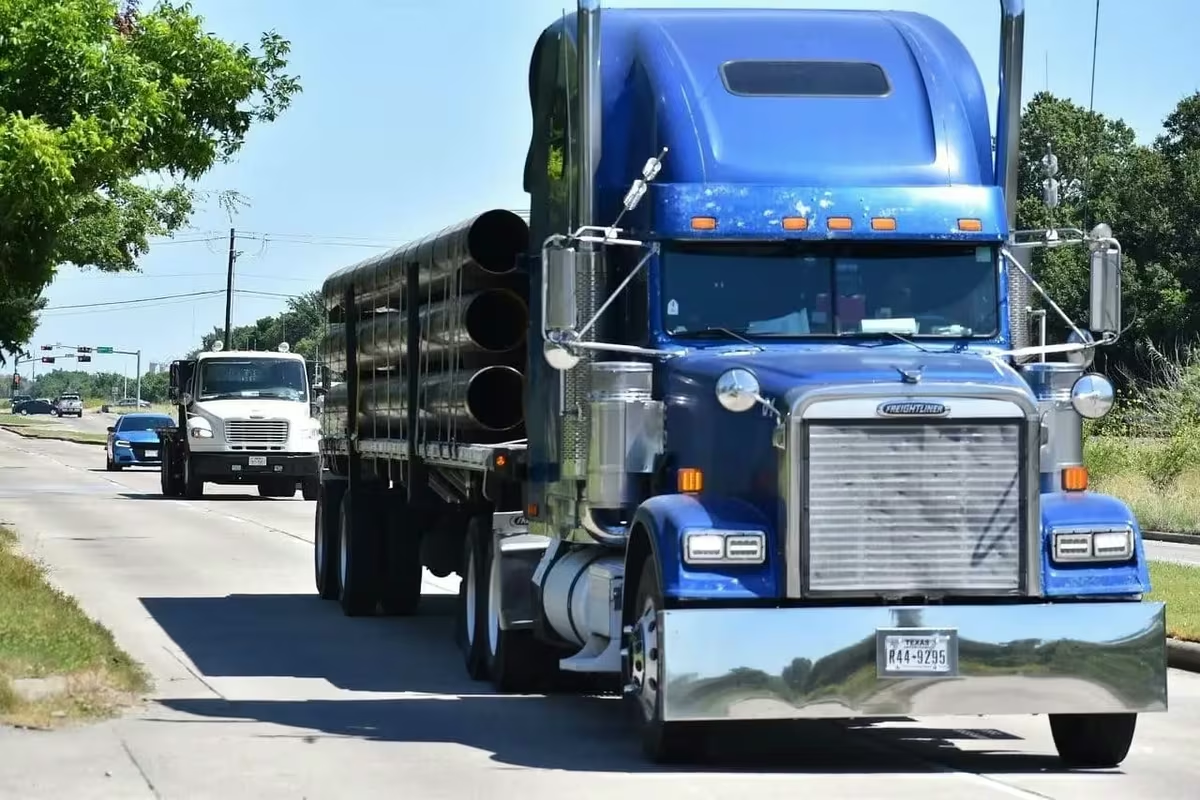 Truck Accidents 18-wheeler and commercial-vehicle wrecks governed by federal trucking rules.
 -
 Motorcycle Accidents Serious-injury motorcycle crashes where bias against riders is common.
 -
 Bus Accidents Transit, school, and charter-bus crashes involving public and private carriers.
 -
 Catastrophic Injury Brain, spinal-cord, amputation, and severe-burn injuries that change a life.
 -
 Brain Injury Traumatic brain injuries with long-term cognitive and physical effects.
 -
 Burn Injury Severe burns from fires, explosions, chemicals, and electrical contact.
 -
 Wrongful Death Claims brought by families after a fatal accident or act of negligence.
 -
 Construction Accidents Falls, struck-by, and equipment injuries on the job site.
 -
 Offshore Accidents Rig, platform, and vessel injuries beyond the shoreline.
 -
 Workers' Compensation On-the-job injuries and the benefits owed to injured workers.
Longshore and Harbor Workers’ Compensation Act (LHWCA)
LHWCA
Longshore and Harbor Workers’ Compensation Act (33 U.S.C. 901). A federal no-fault compensation system for maritime workers who do not qualify as Jones Act seamen. Covers longshoremen, harbor workers, shipbuilders, and many offshore workers on fixed structures.
The LHWCA covers maritime workers who do not qualify as Jones Act seamen. That includes longshoremen, harbor workers, shipbuilders, and offshore workers on fixed OCS structures. Coverage under LHWCA is not optional. Unlike Texas workers’ compensation, which employers can opt out of under Tex. Labor Code Section 406.002, LHWCA is a federal mandate with no employer opt-out provision.
LHWCA provides no-fault benefits: full medical treatment, wage replacement at two-thirds of your average weekly wage, and disability benefits for permanent impairment. You do not have to prove your employer was at fault to receive these benefits. The tradeoff is that LHWCA benefits are the exclusive remedy against your direct employer for covered work injuries.
Here is what most workers do not know: LHWCA does not prevent a lawsuit against third parties. Under LHWCA Section 905(b), a covered worker can collect LHWCA benefits from their employer AND file a separate negligence lawsuit against the vessel owner. These are not mutually exclusive. The vessel owner owes a duty of care to LHWCA-covered workers who come aboard, and that duty is actionable in court.
If your platform is on the Outer Continental Shelf, LHWCA coverage extends to you automatically under 43 U.S.C. 1333. The OCS extension plugs in the federal benefits system while OCSLA borrows adjacent state tort law for the negligence claim.
One settlement issue that surprises many clients: the LHWCA carrier has a lien against any third-party tort recovery. If you collect LHWCA wage and medical benefits and then win a lawsuit against the vessel owner, the LHWCA carrier gets reimbursed from that recovery. The lien can be negotiated, but it cannot be ignored. Morris & Dewett manages this lien structure as part of every offshore settlement to prevent it from consuming the recovery without proper handling.
Past results do not guarantee future outcomes; each case is decided on its own facts. See our full case results.
What Is Maintenance and Cure for Jones Act Seamen?
Maintenance and cure
A no-fault maritime remedy owed by employers to injured seamen. Maintenance is a daily living allowance. Cure is payment of all medical expenses until maximum medical improvement. Neither requires proving employer fault.
Maintenance and cure is one of the oldest doctrines in maritime law. It is separate from the Jones Act negligence claim. You can be entitled to maintenance and cure even if your employer did nothing wrong.
Maintenance is a daily living allowance paid to cover housing costs while you are injured and unable to work. The rate is set by your employment contract or, absent a contract term, by what courts determine is adequate. Historically, maintenance rates were very low. Courts have been pushing rates upward in recent years. An employer paying $35 per day when actual housing costs are $80 per day is not complying with the obligation even if it is technically paying “something.”
MMI
Maximum Medical Improvement. The point at which a patient’s condition has stabilized and is unlikely to improve further with additional treatment. Used in both maritime law and workers’ compensation to mark the end of the cure obligation.
Cure means the employer pays all reasonable medical expenses until you reach MMI. When you reach MMI, the cure obligation ends. That is important: reaching MMI does not end your Jones Act negligence claim. It only ends the employer’s obligation to pay for additional treatment. The negligence and unseaworthiness claims continue independently.
The employer’s duty to pay maintenance and cure is nearly absolute. Courts impose punitive damages and attorney fees on employers who willfully fail to pay maintenance and cure. Unjustified delay and early termination before MMI both trigger this exposure. It is one of the few areas where punitive liability is built directly into the remedial structure.
When maintenance and cure payments have not started after the accident, or the daily rate is below your actual housing costs, that is an active legal problem requiring immediate attention. Morris & Dewett routinely demands maintenance and cure payments as an early step in every Jones Act engagement. Delay is not a neutral choice. It is independently compensable.
Borrowed Servant Doctrine and Multiple Defendant Liability
borrowed servant doctrine
A legal doctrine that determines which employer controls an employee for liability purposes when that employee is loaned or assigned to a different entity. The borrowing employer may become the statutory employer and lose tort immunity — or gain it.
Offshore workers are rarely in a simple two-party employment relationship. A worker from Marshall may be on the payroll of an oilfield services company, working aboard a vessel chartered by an operating company, following directions from a company man employed by a third entity. Each of those companies has a potential role in the accident. The borrowed servant doctrine determines which employer bears legal responsibility.
The control test governs: which entity had the right to direct the details of the work at the time of injury? Not which company issued the paycheck. Not which company’s logo was on the hard hat. Which entity actually controlled what the worker was doing and how they did it? Courts examine operational control in detail. Supervision authority, the right to discharge, and the obligation to furnish equipment all factor into the analysis.
The stakes of the borrowed servant analysis run in both directions. If the borrowing entity is the statutory employer, it gains exclusive remedy protection against your tort claim. If the lending employer is the statutory employer, the borrowing entity may be a third party you can sue. Getting the analysis right before filing determines the viable defendants.
Multiple defendants are common in offshore cases. A single accident may involve a vessel owner, a platform operator, an equipment manufacturer, and one or more contractors. Each potentially contributed to the conditions that caused the injury. Maritime law permits claims against multiple parties simultaneously, and defendants will aggressively try to shift blame to each other. Having an attorney who understands the full defendant chain matters more in offshore cases than in almost any other practice area.
Document preservation is critical from the first day. Offshore employers and vessel owners conduct their own post-incident investigations immediately. Maintenance logs, crew records, toolbox talk records, safety management system records, and surveillance footage can be overwritten, lost, or selectively preserved. A written preservation demand to all potential defendants should go out within days of the accident. Morris & Dewett issues litigation hold letters to all identified parties at the outset of every offshore case.
Your Marshall Injury Attorneys
Founding partners Trey Morris and Justin Dewett lead every Marshall injury case Morris & Dewett takes.


BSEE Regulations and Platform Safety Standards
The Bureau of Safety and Environmental Enforcement (BSEE) is the federal agency that regulates offshore oil and gas operations on the OCS. Its regulations appear primarily in 30 CFR Parts 250 and 254. Compliance with BSEE regulations is not voluntary. Violation is both a federal enforcement matter and powerful evidence in civil litigation.
INC
Incident of Non-Compliance. A formal BSEE citation issued when a platform operator or contractor violates OCS safety regulations. INCs are public record and discoverable in civil litigation. They document specific regulatory violations that occurred at the time and place of an inspection.
INC documents are formal BSEE citations issued when a platform operator violates safety regulations. They are public record. They are discoverable in civil litigation. An INC issued for the same equipment or condition that caused your injury is direct evidence that the operator knew or should have known about the hazard.
BSEE regulations require offshore operators to maintain formal Safety and Environmental Management Systems (SEMS), conduct regular equipment inspections, and maintain comprehensive emergency response plans. Blowout preventers, firefighting suppression systems, crane load testing records, and personal protective equipment all have specific maintenance and certification requirements. A company that cannot produce current inspection records for the equipment that injured you has a document management problem that goes directly to whether they met the standard of care.
A BSEE violation at the time of the accident can support a negligence per se theory: the regulation set the standard of care, the operator violated the regulation, and the violation caused the injury. Courts treat BSEE regulations as evidence of the applicable standard even when the claim is filed under state tort law borrowed through OCSLA.
Workers who reported BSEE violations before or after an accident have federal whistleblower protections. Retaliation for safety reporting is separately actionable. If you were injured after raising safety concerns about equipment or procedures, those reports and any adverse employment action that followed are relevant evidence.
What clients say
- ★★★★★
I hired Morris and Dewett back in November of 2025.
They helped me get through my hard times of being off work, stress, and worry. Anytime I had a question I could call and they always had an answer. Very nice and professtional people. Thank you Morris and Dewett for making this an easy process for me and my family.
- ★★★★★
Morris and Dewett and their team of attorneys and staff go above and beyond.
They always were there to support me and answer all my questions after a shoulder injury that included multiple surgeries. They are caring and compassionate and that goes a long way! Highly recommended!
- ★★★★★
Thanks Morris and Dewett for the excellent work you have done on my behalf.
I want to personally thank Sarah for her kindness.
- ★★★★★
Morris & Dewett does things the right way!
They put their clients first in measurable and impactful ways.
- ★★★★★
First time being injured and needing a lawyer they where very helpful.
They answered my questions Id have very well. Highly recommend them.
- ★★★★★
Wonderful experience with Morris and DeWitt, everyone was articulate and punctual, and open to all my questions about the process.
My case couldn't have been handled by a better team! Caity Nerren, Jessica Christian, and Meghan Nolen were all fantastic and helped every step of the way. Thanks again for all of your hard work.
Reviews reflect individual client experiences. Past results do not guarantee future outcomes.
What Is the Statute of Limitations for Offshore Claims?
The Jones Act has a 3-year statute of limitations running from the date of injury under 46 U.S.C. 30106. Texas’s 2-year general statute of limitations under CPRC Section 16.003 does not apply to Jones Act claims. The federal 3-year period governs exclusively. If an attorney tells you the Texas 2-year deadline controls your Jones Act claim, that is a material error.
LHWCA has a 1-year deadline measured from the date of injury or the last voluntary payment of compensation, whichever is later. That deadline runs for filing a formal claim with the Office of Workers’ Compensation Programs (OWCP). Miss it and the LHWCA claim is barred. The LHWCA deadline is separate from and shorter than the Jones Act deadline. Both can apply to the same worker if their seaman status is disputed.
OCSLA claims borrow the adjacent state’s statute of limitations for the underlying tort claim. For platforms in Texas waters or on the Texas OCS, that is the 2-year Texas SOL. For platforms in Louisiana waters, it is the Louisiana prescriptive period. The adjacent state determination is a legal question based on the block location of the platform.
The Death on the High Seas Act (DOHSA) has a 3-year limitations period. DOHSA applies to deaths occurring beyond three nautical miles from the U.S. shoreline.
Jones Act limitations can be tolled for fraudulent concealment by the employer. If the employer actively hid information about the cause of the accident, the limitations clock may restart from when the worker discovered or should have discovered the true facts. This tolling theory requires specific pleading and evidence.
The practical reality: offshore evidence disappears faster than deadlines expire. Vessel logs are retained for limited periods. Platform maintenance records cycle out. Crew member assignments and contact information become difficult to trace. Waiting until near the deadline to hire an attorney means losing evidence that would have been available earlier. Morris & Dewett starts the evidence preservation process immediately, not after the case theory is fully developed.
For related injury types that often accompany offshore accidents, see our page on big truck accidents in Marshall. Workers who suffer offshore injuries and then are injured in transit face layered claims across multiple legal frameworks.
Frequently Asked Questions
- Do I have a Jones Act claim if I work on a Gulf Coast platform but live in Marshall, Texas?
- Residency does not determine whether the Jones Act applies to your injury. The Jones Act covers qualifying seamen regardless of their home state. If you work on a vessel in navigation on the Gulf of Mexico and meet the seaman status test (contributing to the vessel's mission and spending at least 30% of work time aboard), the Jones Act applies to your claim. Workers from Marshall and Harrison County who travel rotational schedules to Gulf Coast platforms are covered by federal maritime law, not Texas personal injury law.
- What is the difference between maintenance and cure and a Jones Act negligence claim?
- Maintenance and cure is a no-fault benefit. Your employer owes it regardless of whether they did anything wrong. Maintenance is a daily living allowance to cover housing while you're unable to work. Cure is payment of all medical expenses until you reach maximum medical improvement. The Jones Act negligence claim is separate and requires proving that your employer's negligence contributed to the injury. The negligence claim allows you to recover pain and suffering, future lost wages, and other full tort damages that maintenance and cure do not cover. Both remedies can run simultaneously.
- Can I receive both LHWCA benefits and sue the vessel owner at the same time?
- Yes. LHWCA benefits from your direct employer and a third-party negligence lawsuit against the vessel owner are not mutually exclusive. LHWCA Section 905(b) specifically preserves the right to sue a vessel owner for negligence even while collecting LHWCA wage and medical benefits. The important complication is that your LHWCA carrier acquires a lien against any third-party tort recovery. That lien must be managed in settlement negotiations. It is negotiable, but it cannot be ignored.
- How does the borrowed servant doctrine affect who I can sue after an offshore accident?
- The borrowed servant doctrine determines which company was your "statutory employer" at the time of injury. The test is control: which entity directed the specific work you were performing? If the borrowing company (the vessel operator or platform operator) took full control of your work and had the right to direct how you performed it, they may be your statutory employer. That can cut both ways. It may give you a Jones Act claim against the operator directly, or it may affect which entities can claim workers' comp immunity against tort suits. Multiple defendants often remain viable even after the borrowed servant analysis is applied.
- What is the statute of limitations for a Jones Act claim filed from Texas?
- Three years from the date of injury under 46 U.S.C. 30106. Texas's 2-year general statute of limitations does not govern Jones Act claims. The federal 3-year period is exclusive. If you also have an LHWCA claim, that has a separate 1-year deadline for filing with the Office of Workers' Compensation Programs. It is shorter and runs concurrently with the Jones Act period. If your claim is under OCSLA on a fixed platform, the adjacent state's limitations period applies, which is 2 years under Texas law or a different period under Louisiana law depending on platform location.
- What should I do immediately after being injured on an offshore platform or vessel?
- Report the injury to your employer in writing as soon as possible. Get medical attention and keep records of every treatment. Identify and preserve the names and contact information of witnesses. Do not give a recorded statement to any company representative without an attorney present. Do not sign any documents from your employer or their insurer before consulting a maritime attorney. Offshore employers begin their own incident investigation immediately. Their goal is to document the facts in a way that protects the company. A preservation demand should be sent to all potential defendants as soon as you have legal representation. Evidence on offshore platforms and vessels has a short shelf life.
- Does Texas proportionate responsibility law apply to Jones Act cases?
- No. Texas proportionate responsibility under CPRC Chapter 33 does not apply to Jones Act negligence claims. Maritime law uses a pure comparative fault system, meaning your recovery is reduced by your percentage of fault but is not eliminated even if you are 99% at fault. The 51% bar under Texas proportionate responsibility cuts off recovery entirely when your fault exceeds 50%. That bar does not apply to Jones Act claims. This is one of the most significant differences between Texas personal injury law and federal maritime law. For OCSLA claims borrowing Texas law, Texas proportionate responsibility may apply to the borrowed state-law elements. The analysis is fact-specific and depends on the exact legal framework in play.
Last updated June 5, 2026