

What Does a Texarkana, Texas Car Accident Lawyer Do?
A Texarkana car accident lawyer builds the case that turns a wreck into a paid claim. That work starts with gathering proof of what happened, continues through negotiation with the at-fault driver’s insurer, and ends, when negotiation fails, with a lawsuit and trial. Texarkana adds a wrinkle most cities do not have. The state line runs through the middle of town, so a single crash can touch courts on both sides of the border. A lawyer who practices here keeps that geography in mind from the first phone call.
What a car accident lawyer does for injured drivers
The core job is to prove someone else caused your injuries and to collect the money the law allows for them. An injured driver rarely has the time, leverage, or records access to do that alone while also healing. The lawyer takes over the parts that require legal procedure and insurance experience.
That means identifying every party that may owe you money, valuing the full cost of the injury rather than just the bills already in hand, and dealing with the insurance company so you are not negotiating against a trained adjuster on your own. The lawyer also manages deadlines, liens from health insurers or medical providers, and the paperwork that decides whether a claim survives.
Investigation and evidence collection
Most of the case is built in the first weeks, because evidence disappears fast. Skid marks fade. Vehicles get repaired or scrapped. Witnesses forget. A lawyer moves quickly to lock down the crash report, photographs, dashcam or surveillance footage, and statements while memories are fresh.
The investigating officer files a Texas crash report, and that document anchors the early record. From there, the lawyer gathers the deeper proof: the at-fault driver’s phone records in a distracted-driving case, vehicle data recorder downloads, medical records that connect the injury to the impact, and, in serious crashes, an accident reconstruction expert who can explain the physics. Texarkana firms that handle car and truck collisions build their cases on exactly this kind of documentary record.
The point of all this evidence is to remove the insurer’s room to argue. A claim backed by photographs, records, and expert analysis is far harder to lowball than a claim that rests only on a driver’s word.
Insurance negotiation and demand packages
After the evidence is assembled and the medical picture is clear, the lawyer prepares a demand package. This is the formal presentation sent to the insurer: a written explanation of how the crash happened, who is at fault, what injuries resulted, and what the claim is worth, supported by the records and bills behind every number.
A strong demand package does two things. It puts a defensible value on the case, and it signals that the lawyer is ready to file suit if the offer comes back too low. Adjusters track which firms actually litigate and which always settle cheap. The negotiation that follows is where most car accident claims resolve, and the quality of that demand package shapes the final number.
Litigation and trial representation
When the insurer will not pay a fair amount, the lawyer files a lawsuit. Litigation opens the discovery process, where each side must produce documents, answer written questions, and sit for depositions under oath. Discovery often surfaces facts the insurer hoped to keep buried, and it frequently moves a stalled negotiation toward a fair settlement.
If the case does not settle, it goes to trial, where a jury decides fault and damages. Few car accident claims reach a verdict, but the credible threat of trial is what gives a settlement demand its weight. A lawyer who has actually tried cases negotiates from a different position than one who has not. Texarkana personal injury practices that present themselves as trial-ready stake their reputation on this distinction.
When a wreck becomes a personal injury case
Not every fender-bender needs a lawyer. A wreck becomes a personal injury case when someone is hurt, when fault is disputed, or when the insurance coverage may not cover the full loss. Injuries that require ongoing treatment, time off work, or surgery push a claim well past what an unrepresented person can usually settle for full value.
The line is rarely obvious in the first days, because injuries like soft-tissue damage and concussions can worsen over weeks. That is why the work above starts early. The lawyer’s job is to treat a serious wreck as a potential injury case from the outset, preserve the evidence, and let the medical facts decide how far the claim needs to go.
Do I Need a Car Accident Lawyer in Texarkana, Texas?
Not every fender-bender needs a lawyer. A scraped bumper with no injuries and a cooperative insurer often resolves on its own. The honest answer depends on three things: whether you were hurt, how much the other driver disputes fault, and how the insurance company is treating you.
Signs you need a lawyer after a crash
Certain facts tilt a wreck toward needing legal help. Injuries that required an emergency room visit, ongoing treatment, or time off work change the math, because the dollars at stake grow and so does the insurer’s motivation to pay less. Watch for these markers:
- You were treated for anything beyond minor bruising, or symptoms appeared days later.
- The other driver or their insurer blames you, fully or in part.
- More than two vehicles were involved, or a commercial truck was in the crash.
- The at-fault driver was uninsured, underinsured, or fled the scene.
- The insurer has already asked for a recorded statement or floated a fast settlement.
Any one of these is a reason to talk to an attorney before you make decisions you cannot undo. The medical and fault questions tend to compound. A disputed-liability case with a serious injury is the kind of claim where representation usually matters most.
Do I need a lawyer after a minor car accident in Texarkana?
A genuinely minor crash, meaning no injuries and modest vehicle damage, may not need a lawyer at all. If you walked away unhurt, the other driver clearly caused the wreck, and their insurer accepts responsibility, you can often handle the property claim yourself. There is no shame in that, and a good attorney will tell you when a case does not need one.
The complication is that “minor” is not always obvious in the first 48 hours. Soft-tissue injuries, concussions, and back problems frequently show up after the adrenaline fades. If symptoms surface, a brief consultation early protects your options without committing you to litigation you may never need. A short call costs nothing and gives you a clearer read on whether your situation is the kind that benefits from a lawyer.
When to call before talking to the adjuster
The best time to get advice is before you give a recorded statement to the other driver’s insurer. Adjusters are trained to ask questions in a sequence designed to pin down admissions or minimize your injuries while your account is still unsettled. Once you have said it, that statement follows the claim.
You are not required to give the at-fault insurer a recorded statement. A short conversation with a lawyer before that call helps you understand what you must report, what you are free to decline, and how an early misstatement can shrink a claim later. The same logic applies before signing any medical authorization or release the insurer sends. A signature can give an insurer access to your entire medical history, including unrelated records they will use to argue your injuries predate the crash.
Cases insurance companies fight hardest
Insurers contest some claims more aggressively than others, and recognizing that pattern tells you when a lawyer earns their keep. The cases that draw the hardest pushback share common traits:
- Serious or permanent injuries, where the payout is large enough to justify a fight.
- Disputed fault, where the insurer argues you share blame to cut what it owes.
- Commercial-vehicle and trucking crashes, where a corporate defendant and its own legal team get involved.
- Uninsured and underinsured motorist claims, where your own insurer becomes the adversary on the value of your injuries.
- Crashes near the Texas-Arkansas line, where which court hears the case can become a point of leverage. A claim that touches both sides may land in Bowie County, Texas, or Miller County, Arkansas, and that choice affects how the case is handled.
When an insurer has a reason to dispute fault, value, or coverage, the gap between what it offers and what a claim is worth tends to widen. That is the situation where having someone who handles these cases for a living changes the outcome.
What Texas Car Accident Laws Apply in Texarkana Injury Cases?
A Texarkana crash on the Texas side of the line is handled under Texas law, and a handful of legal questions shape how any claim moves: who pays, what a person has to prove, and what coverage drivers carry.
How Texas Approaches Fault in Car Accident Cases
One of the first things to confirm is how Texas decides responsibility for a wreck and how payment connects to the driver who caused it. Some states route each driver to their own policy regardless of who was at fault, and other states tie payment to responsibility. Which approach Texas uses is a threshold question to verify directly with the current statutes and with counsel reviewing your case.
Negligence: Duty, Breach, Causation, Damages
Most car accident claims are built on negligence, and negligence is generally described in four parts. First, duty: a driver is expected to operate a vehicle with reasonable care. Second, breach: the at-fault driver did something a careful driver would not have done, or failed to do something a careful driver would have done. Speeding, running a light, following too closely, and driving distracted are common examples.
Third, causation: that breach actually caused the collision and the injuries that followed. Fourth, damages: the crash produced real, measurable harm, such as medical treatment, lost income, or property damage. All four have to connect. A driver can behave carelessly, but if that carelessness did not cause the harm, the claim does not hold together.
This structure is why evidence matters so much. Each element has to be supported with something concrete.
Minimum Auto Insurance Requirements
How much insurance Texas drivers are required to carry is another point to confirm against the current Transportation Code, because the available coverage often determines how much money is on the table. States set minimum liability limits, those minimums function as floors rather than ceilings, and many drivers carry more than the minimum. The exact requirements and dollar figures should be verified against the current statute before anyone relies on them.
This matters most in a serious crash, where injuries can exceed what a basic policy covers. When that happens, the available coverage becomes a central question, and other sources of payment may come into play.
Duties After a Crash
Texas law also addresses what drivers are expected to do immediately after a collision, and the specifics are worth confirming against the current code. As a general practical matter, drivers involved in a crash are expected to stop at the scene, remain there, help anyone who is injured, and exchange identifying and insurance information with the other parties. Whether and how each of those obligations is codified, and what penalties attach to ignoring them, should be verified with counsel and against the current Texas statutes.
These steps also matter for the injury case itself. Following them produces a record. An officer responds, information gets exchanged, and the events are documented while they are fresh. Failing to follow them can become evidence about the other driver’s conduct.
How Is Fault Determined in a Texas Car Accident Claim?
Fault in a Texas car accident claim turns on negligence: which driver failed to use reasonable care, and how much that failure caused the crash. Investigators, adjusters, and ultimately a jury assign each party a percentage of responsibility. That percentage controls everything downstream, including how much any award is reduced. Two drivers can both bear some blame for the same collision, and a proportional system accounts for that rather than treating fault as all-or-nothing.
The specific statutory rules that set any fault threshold for barring a claim, and that govern how damages are reduced, are confirmed against Texas authority before this page is published.
How a comparative-fault system assigns responsibility
A comparative-fault system assigns each party to a crash a share of the blame, expressed as a percentage that adds up to 100 across everyone involved. A driver who is partly responsible can still be compensated under this kind of system, with the fault percentage reducing the award rather than wiping it out. Some states draw a line above which a claimant cannot be compensated at all, and the exact placement of any such line is a question of the governing statute.
This approach differs from a pure comparative system, where a plaintiff can be compensated even when mostly at fault. It also differs from the contributory negligence rules in a handful of states, where any fault at all defeats the claim.
How shared fault affects compensation
In a proportional system, when a claimant carries some fault, the award is reduced in proportion to that fault. The mechanics are straightforward. A jury first decides total damages, then assigns fault percentages, and the claimant’s percentage comes off the total. If damages are set at $100,000 and the claimant is found 20% at fault, the reduction takes $20,000 off, leaving $80,000.
That arithmetic matters most when fault is genuinely split. A claimant found 40% responsible still sees compensation, but the reduction is steep. A claimant found 10% responsible keeps nearly the full award. This is why both sides argue hard over a few percentage points. Each point shifts real money. The party defending the claim has every reason to push a claimant’s share of fault as high as the evidence allows.
How fault affects settlement value
Most car accident claims settle before trial, and the projected fault split drives the negotiation. Insurers value a claim by estimating what a jury would award and then discounting for the claimant’s likely share of fault and for litigation risk. A claim with clean liability, where the other driver plainly caused the crash, settles for more than an identical injury claim where fault is contested.
Adjusters use disputed fault to justify lower offers. They will point to a claimant’s speed, a missed signal, or a lane position to argue the claimant contributed to the collision. The percentage they assign in their own internal valuation is rarely the percentage a jury would assign.
Disputing liability with comparative fault arguments
Because fault is a percentage and not a yes-or-no question, liability disputes are won and lost on evidence. The crash report, scene photographs, vehicle damage patterns, skid marks, witness accounts, and event data recorder downloads all feed the fault analysis. A reconstruction expert can place the vehicles, calculate speeds, and show which driver had the last clear chance to avoid the collision.
The defense will mirror that work to push fault back onto the claimant. The goal of the claimant’s case is to keep the assigned percentage low, both to guard against any threshold that would defeat the claim and to limit any reduction in damages. When a case involves more than two vehicles, fault gets divided among several parties, and the analysis grows more complex. A lawyer who handles these cases knows how to gather the proof while it still exists, before vehicles are repaired and memories fade, and how to counter the contributory-fault arguments an insurer will raise.
What We Handle
Texarkana Practice Areas

How Long Do I Have to File a Car Accident Claim in Texarkana, Texas?
Every car accident claim carries a filing deadline, and missing it can end the case before the facts ever matter. For a crash on the Texas side of Texarkana, including wrecks on I-30, US-59, and the roads feeding into Bowie County, the practical first task is to confirm the exact deadline that applies to your specific situation. Deadlines are set by statute, they are unforgiving, and an insurer will not remind you about them.
The deadline question sounds simple. The details are where claims get lost. A wrongful death claim runs on its own trigger date. A claim against a city, county, or state vehicle can carry a much shorter, separate notice window. A handful of circumstances can move the clock in either direction. Confirm the controlling dates early, in writing, with a lawyer who will calendar them.
Texas filing deadline for injury claims
A car accident lawsuit must be on file with the proper court before the limitations deadline passes. Confirm that exact deadline at the outset of your case, because it is fixed and it does not pause on its own. For most Texarkana crashes the triggering event is a single, datable wreck, which makes the start of the clock easy to identify but easy to underestimate.
Settlement talks with an adjuster do not stop the clock. Insurers sometimes keep negotiations friendly and slow right up until the deadline is nearly gone, knowing that an unfiled claim loses its leverage the moment the period expires. Filing suit and settling a claim are different acts. The deadline only stops when a lawsuit is actually filed, so never let negotiation timing substitute for getting suit on file.
Wrongful death filing deadline
When a Texarkana crash is fatal, the surviving family’s wrongful death claim carries its own filing deadline. The key difference is the trigger date. A wrongful death claim can run from the date of death rather than the date of the collision, and those are not always the same. If a crash victim survives in the hospital for a period before passing, that gap can shift the start of the clock.
Wrongful death and survival claims involve different family members and different categories of damages, and they can be brought together. Sorting out who has the right to bring the claim, and from what date the deadline runs, is one of the first questions to settle after a fatal wreck. Confirm the controlling date with counsel, because getting it wrong can foreclose the entire claim.
Claims involving government vehicles or public entities
A crash involving a city truck, a county vehicle, a school district bus, or a state-owned vehicle changes the timeline in a way that catches people off guard. Claims against governmental units in Texas can require formal written notice well before the ordinary lawsuit deadline, and individual cities may impose even shorter notice windows through their own charters. Treat any government-vehicle crash as carrying a separate, earlier deadline until you confirm otherwise.
That notice requirement is distinct from the deadline for filing suit, and missing it can bar the claim even when the suit-filing window is still open. If a government vehicle was involved in your Texarkana wreck, identifying the responsible entity and confirming its specific notice deadline is an urgent first step rather than something to leave for later. The exact window depends on which entity is involved, so verifying it early is the practical priority.
What happens if you miss the deadline
If the filing period passes without a lawsuit on file, the defendant will raise limitations as a defense, and the court will dismiss the claim. At that point the strength of the evidence stops mattering. A driver who was plainly at fault, a clear police report, and serious documented injuries all become irrelevant once the deadline is gone.
This is among the most unforgiving rules in injury litigation. There is no informal grace period for being in treatment, for waiting on the insurer, or for not knowing the deadline existed. The cost of acting early is small. The cost of acting late can be the entire claim.
Exceptions that can shorten or extend time
A few circumstances move the clock, and they cut both ways. Government notice rules can shorten the practical deadline. In the other direction, the limitations period can pause in narrow situations, such as when the injured person is a minor or when the at-fault party leaves the state. These exceptions are fact-specific and should never be assumed without confirming how they apply to your case.
The safe approach is to treat the filing deadline as a hard ceiling and to identify any earlier notice requirements right away.
What Compensation Can You Recover After a Texarkana Car Accident?
After a Texarkana crash, the damages available fall into recognizable categories: the money you have already lost or will lose, the harm that does not arrive as a bill, the cost of repairing or replacing your vehicle, and, in fatal crashes, what the family can claim. Each category is proven differently. The size of any award also turns on liability, the evidence, and the limits of available insurance.
Economic damages: medical bills, lost wages, future earning capacity
Economic damages are the out-of-pocket losses that can be tied to a number. These include emergency treatment, hospital stays, surgery, imaging, physical therapy, prescriptions, and follow-up care. They also include wages lost while you could not work and, when an injury limits what you can do going forward, the value of reduced future earning capacity.
Future losses are where many claims are undervalued. A back or neck injury that needs ongoing treatment, or one that forces a career change, carries costs that extend years past the settlement. Proving them usually requires medical records, billing summaries, employment records, and sometimes testimony from a treating physician or a vocational expert.
Non-economic damages: pain, suffering, loss of consortium
Non-economic damages compensate for harm that does not come with a receipt. Physical pain, mental anguish, disfigurement, physical impairment, and loss of enjoyment of life all fall here. Loss of consortium allows a spouse, and in some situations a parent or child, to claim the damage the injury did to the family relationship.
These damages are real but harder to quantify, which is why insurers resist them. There is no simple formula that converts pain into dollars. The value comes from the severity and permanence of the injury, the treatment record, and how the harm changed daily life. Whether any statutory limit applies to non-economic damages in your situation is a question to confirm with counsel against the current statute for your specific facts, because the rules turn on the type of case. Pain and suffering is a recognized, compensable category.
Vehicle damage and out-of-pocket costs
Property damage is its own line of compensation. This covers repair of the vehicle, or its actual cash value if it is totaled, plus related costs like a rental car while yours is in the shop, towing, and storage fees. Diminished value, the loss in resale worth a repaired car carries after a serious wreck, can also be part of the claim.
Smaller out-of-pocket costs add up and belong in the demand: mileage to medical appointments, medical equipment, modifications to a home or vehicle made necessary by an injury, and replacement of personal property damaged in the collision. Keep every receipt. These items are easy to prove and easy to overlook, and an organized file makes them harder for an adjuster to strip out.
Wrongful death damages after a fatal crash
When a crash is fatal, the claim changes character. Texas wrongful death law allows certain surviving family members to seek compensation for the losses the death caused them, and a survival claim separately addresses the harm the deceased suffered before death. These are distinct from the categories above and follow their own rules about who may file and what may be claimed.
Wrongful death damages can include the loss of financial support the deceased would have provided, the loss of companionship and household services, and the family’s mental anguish and grief. A survival action can reach the medical expenses and conscious pain the person experienced before passing, along with funeral and burial costs. These cases carry exacting deadlines and standing rules.
Punitive damages: when Texas courts award them
Punitive damages, called exemplary damages in Texas, are not about compensating a loss. They are meant to punish conduct that goes beyond ordinary carelessness and to deter similar conduct. They are not available in most car accident claims, where simple negligence is the issue. They come into play only when the at-fault conduct rises to a higher level of wrongdoing, such as gross negligence or drunk driving in some circumstances.
Whether exemplary damages are available in your case, what proof a court requires, and whether any limit applies are questions to confirm against the current statute for your specific facts rather than assumed. For most claims, the realistic question is not whether punitive damages apply but how strong the case is for full compensatory damages. Exemplary damages are an investigation focus reserved for the rare case where the evidence supports them.
What Should You Do After a Car Accident in Texarkana, Texas?
The minutes and days after a crash shape the strength of any later claim. The steps below protect your health first and preserve the evidence a Texarkana attorney needs second. None of this requires legal training. It requires staying methodical when the moment is anything but calm.
Call 911 and Report the Crash
Call 911 from the scene. An officer who responds documents the position of the vehicles, statements from drivers and witnesses, and visible injuries while the details are fresh. That record becomes a foundation if liability is later disputed. Reporting a crash to law enforcement also creates a contemporaneous timeline, which matters when an insurer questions whether and when the collision happened.
Get Medical Care as Soon as Possible
See a doctor the same day when possible, even if you feel functional. Adrenaline masks pain, and injuries to the neck, back, and brain often surface hours or days later. A same-day or next-day exam ties your injuries to the crash in the medical record. A long gap between the wreck and the first treatment is one of the most common reasons an adjuster argues an injury came from something else.
Exchange Information and Avoid Admissions
Trade names, contact details, driver’s license numbers, license plates, and insurance information with the other driver. Collect names and phone numbers for any witnesses before they leave. Stick to facts when you speak. Do not apologize, speculate about who caused the crash, or guess at how fast you were going. A casual “I’m sorry” at the scene can be repurposed later as an admission, even when you were not at fault.
Photograph the Vehicles, Injuries, and Scene
Photograph everything before the vehicles are moved if it is safe to do so. Capture damage to all vehicles, the resting positions, skid marks, debris, traffic signals and signage, and the broader intersection or roadway. Photograph your visible injuries that day and again as bruising develops. Vehicles get repaired, scenes get cleared, and intersections change. Images taken at the scene preserve facts that cannot be reconstructed later.
Request the Crash Report and Contact an Attorney
When officers work a crash in Texarkana, the responding officer usually writes up what happened, including the people involved, the officer’s own observations, and often a sketch of how the collision unfolded. Ask the responding agency how to get a copy, then keep it with your other records. Having that write-up early gives you and your attorney a clear account of what the officer saw at the scene. Talking with a car accident attorney before you give the insurer a recorded statement lets someone review the report, the photos, and the medical records together, so the claim is built on a complete record rather than a rushed one.
Past results do not guarantee future outcomes; each case is decided on its own facts. See our full case results.
Where Do the Most Severe Car Accidents Happen in Texarkana, Texas?
The most severe Texarkana crashes cluster on the high-speed corridors that move interstate freight and the busy arterials that feed the Texas-Arkansas line. Speed, traffic volume, and the mix of commercial and passenger vehicles drive injury severity more than any single intersection does. Knowing where a crash happened matters for the case, because location shapes the available evidence, the likely traffic patterns, and sometimes which state’s law governs.
I-30 Car Accidents in Texarkana
Interstate 30 carries the heaviest commercial traffic through the city, and crashes there tend to be the most serious. Higher speeds mean greater force on impact, and the presence of 18-wheelers alongside passenger cars increases the risk of catastrophic injury. Rear-end pileups during congestion, lane-change collisions, and wrecks near on-ramps and merge points are common patterns on this corridor.
A high-speed interstate crash often involves multiple vehicles and disputed accounts of who moved when. That makes early evidence preservation important: dashcam footage, electronic data from commercial trucks, and the positions of the vehicles before they are towed.
US-59 and Loop 151 Crashes
US-59 and Loop 151 carry through-traffic and local commuters at speeds that produce hard impacts when drivers misjudge gaps or run lights. Loop 151 functions as a bypass, so it mixes drivers traveling at sustained speed with those entering and exiting at interchanges. The result is a familiar set of collision types: rear-end strikes in slowed traffic, angle crashes at ramp terminals, and run-off-road wrecks.
State Line Avenue Accidents Near the Texas-Arkansas Border
State Line Avenue runs along the boundary between Texas and Arkansas, and crashes there raise a wrinkle that crashes elsewhere in the city do not. A wreck on or near the line can put the point of impact in Bowie County, Texas, or in Miller County, Arkansas, depending on exact location. That distinction can affect which state’s law applies and where a suit may be filed, so pinning down the precise crash position is more than a formality on this street.
The avenue also carries dense commercial and retail traffic, which produces frequent intersection collisions, left-turn crashes, and rear-end impacts in stop-and-go conditions.
Richmond Road and Summerhill Road Collisions
Richmond Road and Summerhill Road are heavily traveled commercial arterials lined with shopping centers, driveways, and signalized intersections. The constant entering and exiting traffic creates angle and left-turn crashes, and the volume of cars produces rear-end collisions when drivers follow too closely. Injuries here range widely, but T-bone impacts at intersections can cause serious harm even at moderate speeds.
Why Local Crash Location Evidence Matters
Where a crash occurred drives what evidence exists and how a claim is built. Texas crash reports are filed by the investigating officer and obtainable through the Texas Department of Transportation, and the report’s location data anchors much of the later analysis. The exact spot can determine traffic-signal timing, sight-line obstructions, posted speed, and which nearby cameras may have captured the wreck.
Location also feeds the legal questions that come up elsewhere on this page: who had the right of way, how fault is assigned, and on a state-line street, which jurisdiction governs. Documenting the scene early, before vehicles are moved and conditions change, preserves the facts that decide those questions.
What Types of Car Accident Cases Do Texarkana Attorneys Handle?
Texarkana car accident attorneys handle the full range of motor vehicle collisions, from low-speed rear-end taps to fatal highway wrecks. The crash type shapes everything that follows: how injuries present, what evidence proves fault, and which insurance coverage applies. A rear-end collision and a T-bone at an intersection raise different liability questions, and a wreck involving a commercial truck pulls in parties and records a two-car case never touches. The categories below describe how these cases sort out in practice.
Rear-End, Head-On, and T-Bone Intersection Crashes
Rear-end collisions are the most common crash type and usually the most straightforward on fault. The trailing driver carries a duty to maintain a safe following distance, so when one car strikes another from behind, the trailing driver is generally responsible. Even rear-end cases get complicated when the lead driver stopped suddenly, had non-working brake lights, or when a chain reaction involves three or more vehicles.
Head-on collisions produce the most severe injuries because the combined speed of two vehicles drives the impact force. These often trace back to wrong-way driving, crossing the center line, or passing on a two-lane road. T-bone crashes, where the front of one vehicle strikes the side of another, happen most at intersections and turn on who had the right of way. Proving fault in a T-bone case frequently comes down to traffic signal timing, witness accounts, and the physical damage pattern on both vehicles.
Truck and Commercial Vehicle Accidents on I-30
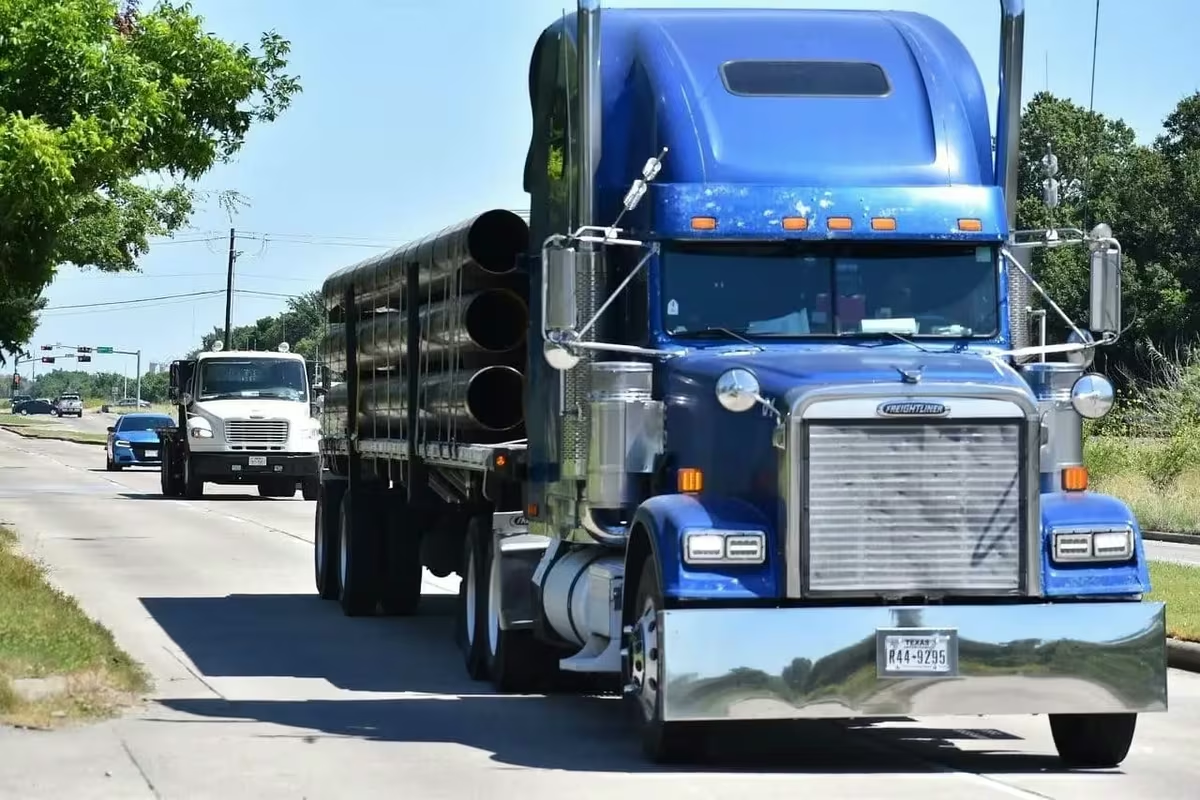
A crash involving an 18-wheeler or commercial vehicle on I-30 is a different kind of case than a two-car wreck. Commercial trucks carry far more mass, so the injuries tend to be catastrophic. More parties can share responsibility: the driver, the trucking company that employed the driver, the company that loaded the cargo, and sometimes a maintenance contractor. Commercial carriers carry larger insurance policies, which means their insurers and defense lawyers move quickly to limit exposure.
These cases also involve records that ordinary car wrecks do not, including driver logs, electronic control module data, maintenance histories, and cargo manifests. Much of that evidence can be lost or overwritten if no one moves to preserve it early. The federal regulations that govern interstate carriers add another layer that a general practitioner may not know. Trucking cases reward attorneys who understand both the evidence and the parties hiding behind the corporate structure.
Drunk and Distracted Driving Crashes
Crashes caused by an impaired or distracted driver share a common feature: the at-fault driver did something clearly wrong, which can strengthen the injured person’s claim. A drunk driving crash often produces a criminal case running alongside the civil claim, and the criminal record, breath or blood test results, and arrest documentation become useful evidence on the civil side. Conduct that rises to the level of gross negligence can open the door to additional categories of damages beyond ordinary compensation.
Distracted driving cases turn on proof. Cell phone records, app data, and vehicle telematics can show that a driver was texting, scrolling, or otherwise not watching the road at the moment of impact. That evidence does not surface on its own. It takes preservation requests and sometimes subpoenas to obtain it before it disappears.
Hit-and-Run and Uninsured/Underinsured Motorist Claims
When the at-fault driver flees the scene or carries no insurance, the case shifts away from the other driver’s policy and toward the injured person’s own coverage. Hit-and-run crashes require fast work to identify the fleeing driver through surveillance footage, witness descriptions, and physical evidence left at the scene. When the driver is never found, an uninsured motorist claim through the injured person’s own policy may be the path forward.
These claims involve a different dynamic than a standard third-party case. The insurer paying the claim is the injured person’s own company, and that company still investigates, still values the claim conservatively, and can still dispute the extent of injuries. Treating your own insurer as an adversary feels counterintuitive, but uninsured and underinsured motorist claims often require the same documentation and persistence as a claim against a stranger’s carrier.
Pedestrian, Bicycle, and Motorcycle Collisions
Pedestrians, bicyclists, and motorcyclists have almost no physical protection in a collision, so even a low-speed impact can cause serious or fatal injury. These cases often carry a built-in bias to overcome, because some adjusters and jurors assume the vulnerable road user must have done something careless. Countering that assumption takes evidence: crosswalk markings, signal timing, the driver’s line of sight, and the point of impact.
Motorcycle cases face the added challenge of the perception that riders are inherently reckless, which can color how an insurer values the claim from the first phone call. The physics rarely favor the rider, and the injuries are frequently severe. Documenting road conditions, the driver’s actions, and the rider’s lawful conduct at the scene matters more in these cases than in a routine fender bender. An attorney who handles pedestrian, bicycle, and motorcycle cases knows that the work starts with dismantling the assumption that the most exposed person on the road was at fault.
Your Texarkana Injury Attorneys
Founding partners Trey Morris and Justin Dewett lead every Texarkana injury case Morris & Dewett takes.


What If the Other Driver Has No Insurance in Texas?
When the driver who hit you carries no insurance, or not enough to cover your injuries, the claim does not end. It shifts to your own policy. A driver who holds uninsured and underinsured motorist coverage can turn to their own insurer for the same kinds of damages they would have pursued from the at-fault driver. The first thing to check after a Texarkana crash with an uninsured driver is what coverage you already hold.
Using your own UM/UIM coverage
Uninsured motorist (UM) coverage applies when the at-fault driver has no liability insurance at all. Underinsured motorist (UIM) coverage applies when that driver has a policy, but the limits run out before your medical bills and lost wages are paid. Both pay from your own auto policy.
Your declarations page shows whether UM/UIM coverage is on the policy and at what limit. A driver may carry it without remembering having selected it, so the document controls the question. An attorney reviews that declarations page and the carrier’s file to confirm what is available before deciding how to proceed.
Filing a UM/UIM claim means making a claim against your own insurer. That carrier now stands in the place of the absent at-fault driver and has every incentive to dispute fault, injury severity, and value. The relationship turns adversarial, which is why the claim is handled the same way as a third-party liability claim.
Texas uninsured/underinsured motorist claims
A UIM claim requires showing that the at-fault driver’s liability limits do not cover your full damages. When a small policy is in play, serious injuries can exhaust those limits quickly. Once they are tendered, the UIM coverage on your own policy covers the gap up to your chosen limit.
A UIM claim can move differently from an ordinary liability claim. Your insurer may not pay UIM benefits until liability and damages are established by judgment or agreement. That procedural step can slow payment, and adjusters use it. Documenting the at-fault driver’s lack of coverage, your medical treatment, and your damages early keeps the claim moving.
Stacking, offsets, and the interaction between UM/UIM and personal injury protection vary by policy language. The exact terms of your declarations page control how much is available, so the policy itself is the starting document for any uninsured-driver claim.
Hit-and-run claims
A driver who flees the scene leaves you with no one to bill. Under many UM policies, a hit-and-run driver is treated as an uninsured motorist, so your own UM coverage can apply even when the at-fault driver is never identified. The crash still has to be reported and documented, and physical evidence of contact often matters to the carrier.
Report a hit-and-run to law enforcement promptly and request the Texas crash report. Photographs of the damage, any debris, and witness contact information support a UM claim that the carrier may otherwise treat with suspicion. The sooner the scene is documented, the harder it is for the insurer to argue the contact never happened.
What to do if the at-fault driver is from Arkansas and uninsured
Texarkana sits on the state line, so the driver who hit you may carry an Arkansas plate and no insurance. The location of the crash and the terms of your own Texas policy drive how the claim proceeds. If you hold a Texas auto policy with UM/UIM coverage, that coverage generally responds to your injuries regardless of where the other driver lives or registered the car.
An uninsured Arkansas driver raises the same practical problem as an uninsured Texas driver: there is no liability policy to collect from. Your UM coverage fills that void. The added wrinkle is that a state-line crash can raise questions about which state’s law governs the underlying tort and where any suit is filed. Those jurisdiction and venue questions are handled separately, but they do not stop you from opening a UM/UIM claim with your own carrier while the analysis is sorted out.
Confirm your coverage, document the crash, and decline to give a recorded statement before you understand what your policy provides. An attorney can read the declarations page, confirm what coverage applies, and pursue the UM/UIM claim so the uninsured driver’s lack of coverage does not become your loss.
Does Texas or Arkansas Law Apply to a Texarkana State-Line Crash?
It depends on where the crash physically happened and where the drivers live, and those two answers are not always the same in Texarkana. The city straddles the state line. A collision a few feet apart can land in different states, which changes the law that governs fault, the deadlines that apply, and the courthouse where a suit gets filed. This is one of the few places in the country where which state’s law controls is a live question in an ordinary car wreck.
Why State Line Avenue crashes raise jurisdiction questions
State Line Avenue runs down the actual Texas-Arkansas border. The center of the road is roughly the boundary. A driver in the westbound lane is in Texas. A driver in the eastbound lane is in Arkansas. When two cars collide near that line, the location of impact can determine which state’s law applies to the claim.
The same problem shows up at intersections that feed into State Line Avenue and along streets that cross from Bowie County, Texas into Miller County, Arkansas. A crash that begins on one side and ends on the other adds a layer most drivers never think about until they file a claim. The physical point of impact, the responding agency, and the residency of each driver all become facts that matter.
Whether Texas or Arkansas law applies
Courts generally apply the law of the state where the injury occurred. If the impact happened on the Texas side, Texas substantive law on negligence, fault, and damages usually governs. If it happened on the Arkansas side, Arkansas law may govern instead. The line on the pavement does real legal work here.
Residency complicates it. A Texas resident hit by an Arkansas resident on the Texas side, or any other combination, can raise conflict-of-laws questions about which state’s rules apply to specific issues. These questions are fact-driven and turn on the exact location of impact, the home states of the parties, and the connections each claim has to each state. The practical takeaway is that nailing down the precise crash location early, through the official report and physical evidence, often decides which legal framework the rest of the case runs on.
Where the lawsuit may be filed
Which courthouse hears the case is a separate question, and each state answers it through its own procedural code rather than through any single shared rule. The facts that drive the answer are the same ones that decide which law applies: where the crash happened and where the defendant lives. Because the controlling rule lives in each state’s own statutes and depends on the exact facts, the correct forum for a specific crash is something to confirm with counsel against the governing code, not something to assume from a general description.
Venue can be contested, and more than one court may qualify on the same facts. Where a case is filed affects more than the drive to the courthouse. It can shape the jury pool, the procedural rules, and often which state’s substantive law the court applies. Defendants and insurers sometimes argue for the forum they expect to favor them. The filing decision is strategic, not clerical.
Texas fault system vs. Arkansas rules
Texas and Arkansas use different fault systems, which is why the choice of law can change the value of a claim. Both states use a form of modified comparative fault, but the precise threshold and the way shared fault reduces or bars compensation are set by each state’s own statutes. The mechanics of the Texas fault bar and damage reduction are covered in the fault section of this page. The point here is that a crash governed by Arkansas law may apply a different threshold than a crash governed by Texas law.
Deadlines differ too. The filing period for an injury claim and the rules for claims against public entities are not identical across the two states. A claimant who assumes the Texas timeline applies to an Arkansas-governed claim, or the reverse, can lose the case by waiting too long. Confirming which state’s deadline controls is one of the first things a state-line crash demands.
How insurance companies exploit dual-state confusion
Insurers understand the border better than most drivers do. An adjuster handling a Texarkana crash may steer the conversation toward whichever state’s rules reduce the payout, or delay while the injured driver remains unsure which state’s deadline applies. Uncertainty about jurisdiction works in the insurer’s favor, not the claimant’s.
Pinning down the controlling state and the correct courthouse before negotiating is concrete work: locate the exact point of impact from the crash report and scene evidence, identify each driver’s residency, compare the two states’ fault and deadline rules, and confirm the proper forum against the governing procedural code. Getting that sequence right early is what keeps a Texarkana border crash from being undervalued or filed in the wrong place.
How Do Insurance Claims Work After a Texarkana Car Accident?
After a Texarkana wreck, most claims start with the at-fault driver’s insurer, not a courtroom. You report the crash, the insurer assigns an adjuster, and that adjuster decides what the company is willing to pay. The process looks administrative. It is adversarial. The adjuster works for the insurer, and the insurer pays less when the claim is documented poorly or settled fast. Understanding each step is how you keep a low first number from becoming your final number.
Filing a Claim With the At-Fault Driver’s Insurer
The first claim usually goes to the liability carrier for the driver who caused the crash. You provide the basic facts: date, location, vehicles involved, and the police report number. The insurer opens a file, assigns a claim number, and routes it to an adjuster who reviews the report and contacts you.
Two tracks often run at once. The property-damage track handles your vehicle. The bodily-injury track handles medical treatment and other losses. These move at different speeds, and a fair check for your bumper does not mean the injury side is being valued fairly. Keep every document: the report, repair estimates, medical bills, and a record of who said what and when.
Why Adjusters Undervalue Claims and the Recorded-Statement Trap
An adjuster’s job is to resolve the file for as little as the facts allow. That is not a character flaw. It is the business. Early in the process, the adjuster will often ask for a recorded statement, framed as a routine step to “get your side.” Texas law does not require you to give a recorded statement to the other driver’s insurer.
The recorded-statement request is where many claims lose value. Soft-tissue injuries can take days to surface, so an early “I feel okay” gets quoted back later as proof you were not hurt. A guess about speed or distance becomes an admission. Casual phrasing gets parsed for fault. Anything you say can be used to argue you share blame, which matters because Texas reduces or bars a claim based on your percentage of fault. Stick to verifiable facts, decline to speculate, and you take away the easiest tool the adjuster has to discount your claim.
Settlement Demand Letters and Negotiation
When treatment is complete or your condition has stabilized, the claim moves to a demand. A demand letter lays out liability, summarizes the injuries with supporting medical records and bills, documents lost wages, and states a dollar figure. The strength of the demand comes from the evidence behind it, not the size of the number.
Negotiation follows. The insurer responds with a counter, usually far below the demand, and the figures move toward a middle through several exchanges. Each round is an argument about liability and the value of the harm, backed by records. A demand built on complete documentation gives the adjuster less room to dismiss the injuries as exaggerated or unrelated to the crash.
Why Quick Settlement Offers Are Too Low
A settlement offer that arrives within days of the crash is almost always too low, and it arrives fast for a reason. Once you accept and sign a release, the claim is closed permanently. You cannot reopen it when a back strain turns into a herniated disc or a concussion produces symptoms weeks later.
Early offers are made before the full medical picture exists. They rarely account for future treatment, future lost earnings, or the lasting effect of a serious injury. The release language is broad and final. Settling before you know the true extent of your injuries trades a real claim for a quick check, and there is no second demand once that check clears.
What Happens If the Insurer Denies Liability
Sometimes the insurer refuses to pay, arguing its driver was not at fault or that you were the one mostly to blame. A denial is a position, not a verdict. It can be challenged with the crash report, scene photographs, witness statements, and reconstruction of how the collision happened.
When a carrier will not move, the next step is filing suit within the Texas deadline for injury claims. Filing does not guarantee trial; most cases that go into litigation still resolve through negotiation, but a lawsuit forces the insurer to defend its denial with evidence and changes what the claim is worth. The denial becomes a question for a Bowie County court rather than the adjuster’s last word.
What clients say
- ★★★★★
I hired Morris and Dewett back in November of 2025.
They helped me get through my hard times of being off work, stress, and worry. Anytime I had a question I could call and they always had an answer. Very nice and professtional people. Thank you Morris and Dewett for making this an easy process for me and my family.
- ★★★★★
Morris and Dewett and their team of attorneys and staff go above and beyond.
They always were there to support me and answer all my questions after a shoulder injury that included multiple surgeries. They are caring and compassionate and that goes a long way! Highly recommended!
- ★★★★★
Thanks Morris and Dewett for the excellent work you have done on my behalf.
I want to personally thank Sarah for her kindness.
- ★★★★★
Morris & Dewett does things the right way!
They put their clients first in measurable and impactful ways.
- ★★★★★
First time being injured and needing a lawyer they where very helpful.
They answered my questions Id have very well. Highly recommend them.
- ★★★★★
Wonderful experience with Morris and DeWitt, everyone was articulate and punctual, and open to all my questions about the process.
My case couldn't have been handled by a better team! Caity Nerren, Jessica Christian, and Meghan Nolen were all fantastic and helped every step of the way. Thanks again for all of your hard work.
Reviews reflect individual client experiences. Past results do not guarantee future outcomes.
How Much Does a Texarkana Car Accident Lawyer Cost?
Most Texarkana car accident lawyers handle injury cases on a contingency fee, which means the fee comes out of the money the lawyer obtains for you rather than out of your pocket up front. You pay nothing to start. The fee is a percentage of the settlement or award, agreed before any work begins. The fee, the case costs, and what happens if the case does not succeed are set out in writing in the fee agreement that car accident attorneys provide before any work starts.
Contingency fee basics
A contingency fee ties the lawyer’s payment to the outcome of your case. Instead of billing by the hour, the lawyer takes an agreed percentage of the amount obtained. Most firms set that percentage at the outset and put it in a fee agreement you review and sign, so the terms are clear before the work starts. The agreement states the percentage, whether it changes if the case goes to trial, and how the fee is calculated against the gross or net amount obtained.
No fee unless the case produces money
Under a contingency arrangement, the attorney’s fee depends on obtaining money in your case. If there is no settlement and no award, there is no attorney’s fee. This structure means the lawyer carries the risk of the outcome alongside you, and it aligns the lawyer’s incentive with the strongest result the facts support.
Case costs and litigation expenses
A contingency fee covers the attorney’s labor. It is separate from case costs, which are the out-of-pocket expenses a case generates: filing fees, deposition transcripts, medical records, accident reconstruction, and expert witnesses. Many firms advance these costs while the case is pending and then deduct them from the final amount obtained. Whether the firm advances them, whether you owe them if the case does not succeed, and whether they come out before or after the fee is calculated all change what actually reaches you at the end.
Free consultation
Most Texarkana car accident firms offer a free initial consultation. That meeting is where you describe what happened, learn how the firm reads your case, and review the fee agreement before signing anything.
Frequently Asked Questions
- How soon should I talk to a lawyer after a Texarkana crash?
- Sooner helps. Skid marks fade, vehicles get repaired or scrapped, and witnesses move or forget. An attorney who gets involved early can preserve evidence, send letters telling insurers to retain records, and handle adjuster contact before a recorded statement is given. There is no charge to ask a question early, and the two-year filing deadline runs in the background from the day of the crash.
- Which court would hear my Texarkana car accident case?
- A crash on the Texas side of Texarkana generally falls within Bowie County, where the district and county courts sit in Boston and New Boston. The Bowie County Courthouse handles civil filings for the area. Texas venue rules allow a suit to be filed where the crash happened or where the defendant lives, so a case can also belong elsewhere depending on the parties. A crash on the Arkansas side raises Miller County and Arkansas court questions, which is why state-line wrecks need a careful look before anything is filed.
- Do I have to go to court to settle my claim?
- Most car accident claims resolve through negotiation without a trial. A demand package, supporting medical records, and back-and-forth with the adjuster settle the majority of cases. Filing a lawsuit becomes necessary when the insurer denies liability, disputes the injuries, or refuses a fair number. Even after a suit is filed, many cases still settle before trial. Hiring a lawyer who tries cases changes how an insurer values the file, because the threat of a verdict is real.
- Can I still get compensation if I was partly at fault?
- Texas follows modified comparative fault. A claimant who is 50 percent or less at fault can still recover, with the award reduced by their share of fault. A claimant found more than 50 percent at fault recovers nothing. So a driver assigned 20 percent of the blame on a $100,000 claim would see the award reduced by that percentage. How fault gets divided is often the central fight in a disputed claim.
- What if the at-fault driver had no insurance?
- Texas insurers must offer uninsured and underinsured motorist coverage, and a driver can reject it only in writing. If you carry UM or UIM coverage, it can pay when the other driver has no insurance, too little insurance, or fled the scene in a hit-and-run. The dual-state nature of Texarkana adds wrinkles when the at-fault driver lives across the line in Arkansas. These claims run against your own insurer, which does not always make them simple.
- Will hiring a lawyer cost me money up front?
- Car accident representation runs on a contingency fee. The lawyer is paid a percentage of the amount obtained, and there is no fee unless compensation is obtained. Texas requires the contingency fee agreement to be in writing and signed by the client, so the terms are spelled out before any work begins. Consultations are free.
- What should I do before I talk to the insurance adjuster?
- Get medical care first, document the scene, and read your own policy. An adjuster, even a friendly one, works for the insurer. Recorded statements taken early can be used to minimize a claim later, and a quick settlement offer is often lower than the claim is worth once the full extent of injuries is known. You are not required to give the other driver's insurer a recorded statement. Talking to a lawyer before that conversation costs nothing and protects the file.
- How long do I have to file a Texarkana car accident lawsuit?
- Texas sets a two-year window for personal injury claims, and claims against a city or other governmental unit carry a separate, much shorter notice requirement. Missing either deadline can end a claim before it is heard, so the calendar matters from day one.
Last updated June 15, 2026