

Monroe and the Roads That Generate Injury Claims
Monroe sits at the intersection of I-20, US-80, and Hwy 165 in Ouachita Parish. These three corridors carry a substantial volume of commercial truck traffic every day. I-20 is the primary interstate connecting Shreveport to Jackson, Mississippi, and it runs directly through the heart of Ouachita Parish.
US-80 parallels I-20 through the Twin Cities of Monroe and West Monroe. It’s a secondary corridor for commercial traffic and sees a steady mix of passenger vehicles and delivery trucks. Hwy 165 runs south from Monroe toward Alexandria, carrying oilfield workers, construction crews, and agricultural equipment.
maritime
Relating to navigation and commerce on water. Maritime injury claims involve different legal rules than land-based accidents, including federal admiralty law that can override state tort law.
The Ouachita River divides Monroe and West Monroe. Industrial facilities line its banks, and commercial barge activity creates maritime injury exposure that few people anticipate. Monroe Regional Airport (MLU) adds an aviation exposure layer for workers and passengers.
The I-20 interchange near Hwy 165 is a documented high-incident area for rear-end and multi-vehicle crashes. Heavy through-traffic, merging lanes, and the mix of commercial and passenger vehicles create conditions where serious injuries happen regularly.
What We Handle
Monroe Practice Areas
-
 Car Accidents Rear-end, intersection, and highway collisions across Louisiana.
 -
 Truck Accidents 18-wheeler and commercial-vehicle wrecks governed by federal trucking rules.
 -
 Motorcycle Accidents Serious-injury motorcycle crashes where bias against riders is common.
 -
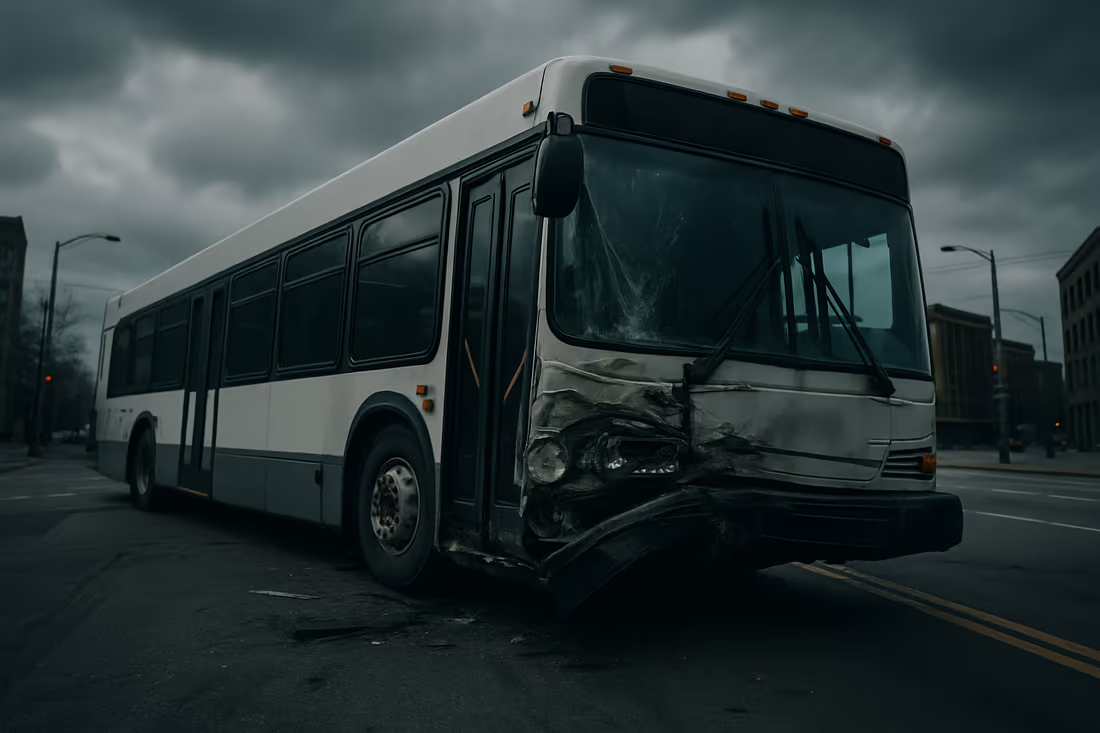 Bus Accidents Transit, school, and charter-bus crashes involving public and private carriers.
 -
 Catastrophic Injury Brain, spinal-cord, amputation, and severe-burn injuries that change a life.
 -
 Brain Injury Traumatic brain injuries with long-term cognitive and physical effects.
 -
 Burn Injury Severe burns from fires, explosions, chemicals, and electrical contact.
 -
 Wrongful Death Claims brought by families after a fatal accident or act of negligence.
 -
 Construction Accidents Falls, struck-by, and equipment injuries on the job site.
 -
 Offshore Accidents Rig, platform, and vessel injuries beyond the shoreline.
 -
 Workers' Compensation On-the-job injuries and the benefits owed to injured workers.
Serving Monroe
Served from our Ruston office -- serving all of Ouachita Parish.
1831 N Trenton St, Ste 2
Ruston, LA 71270
Open 24/7 for injured Monroe residents
Get directions →Practice Areas Served in Monroe and Ouachita Parish
Morris & Dewett handles the full range of personal injury cases that arise from life in Monroe and Ouachita Parish. Car accidents on I-20 and US-80 are the most common. Rear-end collisions, intersection crashes on Louisville Avenue and DeSiard Street, and highway multi-car pileups all generate claims we handle.
Major employers in the area include Lumen Technologies (formerly CenturyLink), Graphic Packaging, St. Francis Medical Center, and manufacturing operations along the Ouachita River. Work-related injuries at these facilities generate both workers compensation and potential third-party tort claims.
Practice areas with dedicated pages:
- Truck accidents: commercial carrier crashes on I-20 and Hwy 165
- Motorcycle accidents: rider injuries on area roads
- Bus accidents: common carrier and school bus cases
- Construction site accidents: third-party claims and contractor liability
- Offshore accidents: Ouachita River and Louisiana maritime exposure
- Workers compensation claims: Ouachita Parish workplace injuries
- Wrongful death claims: fatal accident cases
- Catastrophic harm: brain injury, spinal trauma, amputation
What to Do After an Injury in Monroe
Stop and call 911. Do not move injured persons. Wait for Monroe Police or the Ouachita Parish Sheriff’s Office to respond and file an accident report. That report is your first documented evidence.
Get a medical evaluation even if you feel okay. St. Francis Medical Center and Glenwood Regional Medical Center both have emergency departments. Adrenaline is real. Pain from soft tissue damage and internal injuries often appears hours or days after impact. A same-day medical record connecting your injuries to the accident is worth more than a delayed diagnosis.
Document the scene if you are able. Photos of vehicle positions, road conditions, signage, skid marks, and visible injuries preserve facts that disappear quickly. Witnesses leave. Skid marks fade. Traffic cameras overwrite.
Do not give a recorded statement to the at-fault driver’s insurance company without an attorney. Their adjusters are trained interviewers. Recorded statements are used to minimize claims. You are not required to give one before filing.
Do not sign anything from an insurance adjuster. A release signed before you know the full extent of your injuries is nearly impossible to undo in Louisiana.
Contact a personal injury attorney early. The insurance company has assigned a claims professional to your case already. The first call usually sets the framing for the entire claim. Preserve your medical records, bills, and any documentation of missed work from day one.
Proving Negligence Under Louisiana Law
negligence
A legal standard requiring proof of four elements: (1) a duty owed to the injured person, (2) a breach of that duty, (3) causation connecting the breach to the injury, and (4) actual damages resulting from the injury.
Louisiana personal injury law requires proof of negligence: duty, breach, causation, and damages. These four elements must all be present. Missing one means no recovery.
Duty varies by context. Drivers owe other road users a duty to follow traffic laws and operate vehicles safely. Property owners owe visitors a duty to maintain safe conditions. Employers owe workers a duty to provide a reasonably safe workplace.
Breach is where most disputes begin. The at-fault driver ran a red light. The property owner knew about the hazard and didn’t fix it. An employer ignored OSHA requirements. The breach must be established through evidence, not assumption.
Causation requires showing that the breach was a substantial contributing factor to your injury. Louisiana courts use a “but for” analysis in most cases: but for the defendant’s action, would the injury have occurred? In cases with multiple causes, the analysis is more complex.
Actual damages must be provable. Medical records, imaging reports, treatment notes, and expert testimony establish the nature and extent of injuries. Lost wage documentation establishes economic harm. Future damages require expert testimony from economists and vocational specialists.
The key evidence categories in a Monroe personal injury case are the accident report, witness statements, surveillance and traffic camera footage, photographs, medical records, and expert testimony. Get all of it before it’s gone. Surveillance footage is often overwritten within 30 to 60 days.
Insurance companies run their own investigations in parallel. Their adjusters collect the same evidence and build the same picture, just from a different angle. Without an attorney involved early, their version of events often becomes the controlling narrative.
Past results do not guarantee future outcomes; each case is decided on its own facts. See our full case results.
Louisiana Comparative Fault and the 51% Bar
Comparative Fault
A legal rule that reduces your recovery by your percentage of fault. In Louisiana, if you are 51% or more at fault, you recover nothing. If you are 50% or less at fault, your damages are reduced proportionally.
Louisiana follows Comparative Fault under La. C.C. Art. 2323. The 51% bar became effective January 1, 2026, as part of Louisiana’s ongoing tort reform legislation.
Here’s how it works in practice. If you are 20% at fault in an accident and your total damages are $200,000, you recover $160,000. If you are 51% at fault, you recover nothing. The cutoff is hard.
Insurance adjusters understand this math. Their defense strategy in almost every case is to push your fault percentage as high as possible. They pull accident reports, request your phone records, gather witness statements, and review surveillance footage looking for anything that shifts fault toward you. The higher your fault percentage, the less they pay.
Early attorney involvement counters this. The Monroe Police Department and Ouachita Parish Sheriff investigate accidents, but their reports are a starting point, not the end. Morris & Dewett works with accident reconstruction experts to establish fault percentages before the insurance company builds its narrative.
Medical Care After an Injury in Monroe
St. Francis Medical Center at 2700 Jackson Street is the primary trauma facility for Ouachita Parish. It handles the region’s highest-acuity injuries and maintains trauma surgery capability. For serious injuries from crashes on I-20 or Hwy 165, this is where ambulances go.
Glenwood Regional Medical Center at 503 McMillan Road in West Monroe provides emergency and surgical care on the west bank of the Ouachita River. Residents of West Monroe and the surrounding Ouachita Parish area use this facility for emergency care.
LSU Health Monroe and the University Health System serve the region for specialist referrals, follow-up care, and complex diagnostic workups.
Your choice of medical provider affects your claim. Treatment must be documented, consistent, and medically appropriate for the injuries you’re claiming. A gap in treatment is one of the most effective arguments an insurance company uses. If you stopped treating for two months and then resumed, they will argue the injury resolved or was not serious. Your treating physician’s documentation of causation connecting your injuries to the accident is critical evidence.
Your Monroe Injury Attorneys
Founding partners Trey Morris and Justin Dewett lead every Monroe injury case Morris & Dewett takes.


What Compensation Does Louisiana Law Allow After an Injury?
Compensatory Damages
Money awarded to compensate an injured person for actual losses. Divided into economic damages (measurable financial losses) and non-economic damages (losses that don’t have a specific dollar value, like pain and suffering).
Louisiana law provides two main categories of Compensatory Damages: economic and non-economic.
Economic damages cover your measurable financial losses. Past and future medical expenses, lost wages, lost earning capacity, rehabilitation costs, in-home care, and out-of-pocket expenses all fall here. One significant change from the 2024 tort reform: La. R.S. 9:2800.27 limits recoverable medical expenses to the amount actually paid by the insurer, not the amount billed. If your hospital charged $80,000 and your insurer paid $30,000, your recoverable medical expense is $30,000. This change reduces the damages floor in many cases. Documenting all out-of-pocket costs is more important than before.
Loss of Consortium
A legal claim available to a spouse for the loss of companionship, affection, and support caused by the injured person’s condition. It is a separate damage category from the injured person’s own claims.
Non-economic damages cover losses without a price tag. Physical pain and suffering. Emotional distress. Permanent disfigurement. Disability and loss of function. Loss of enjoyment of life. Loss of Consortium is available to spouses of seriously injured persons.
Punitive damages are available only in limited circumstances. Louisiana does not award them liberally. Drunk driver cases fall under La. R.S. 9:2798.4, which specifically authorizes exemplary damages for DWI-related injuries.
UM/UIM
Uninsured/Underinsured Motorist coverage. A provision in your own auto insurance policy that pays you when the at-fault driver has no insurance (UM) or not enough insurance (UIM) to cover your damages. Louisiana law requires insurers to offer it, and it can stack across multiple vehicles on your policy.
Louisiana minimum auto liability coverage is $15,000 per person, $30,000 per accident, and $25,000 for property damage. Serious injury cases routinely exceed these limits. When the at-fault driver is underinsured, your own UM/UIM coverage becomes the primary recovery source.
Workers compensation has a separate benefit structure. It pays medical bills and a percentage of lost wages, but bars most tort claims against your employer. If a third party was also at fault, a parallel tort claim against that party may be available. The distinction matters for how and where you file.
Filing Deadlines: Louisiana Prescriptive Period
La. C.C. Art. 3493.1 sets the personal injury deadline at 2 years from the date of injury, effective July 1, 2024. The prior deadline was 1 year. If your injury occurred before July 1, 2024, the old 1-year rule may still apply. If your attorney quotes you 3 years, that is incorrect and has never been the Louisiana rule for personal injury.
Government entity claims have shorter deadlines. Claims against the City of Monroe, Louisiana DOTD, or Ouachita Parish require a formal tort claim notice within 90 days under La. R.S. 13:5107. Missing this notice deadline can bar your claim entirely. This applies to accidents on state highways, parish roads, and municipal property.
Workers compensation requires the injury be reported to your employer within 30 days. The formal claim must be filed within 1 year.
For injured children, the 2-year clock begins running when they turn 18. The discovery rule applies in some latent injury cases: the period runs from the date the injury was known or should have been known.
The 2-year deadline is hard. Courts do not extend it because you were busy, forgot, or were waiting to see how the injury resolved. If you’re close to the deadline, that is the first thing to address.
Ouachita Parish Courts and Jurisdiction
Personal injury lawsuits in Monroe are filed in the 4th Judicial District Court, Ouachita Parish, located at 300 St. John Street, Monroe, LA 71201. Judge assignments in the 4th JDC are random. Morris & Dewett attorneys have tried cases in this courthouse and know its procedures, local rules, and judicial preferences.
Federal cases can be filed in the U.S. District Court for the Western District of Louisiana, Monroe Division, when federal jurisdiction applies. Maritime claims arising from Ouachita River incidents often fall under federal admiralty jurisdiction. Cases with out-of-state defendants and damages exceeding $75,000 may qualify for diversity jurisdiction in federal court.
Workers compensation claims go to the Office of Workers Compensation, District 1E, which serves Monroe and Ouachita Parish.
Government tort claims against the City of Monroe or Ouachita Parish must comply with the Louisiana Governmental Claims Act, La. R.S. 13:5101 et seq. These claims have pre-suit notice requirements and procedural steps that don’t apply to standard tort claims.
Ouachita Parish jury pools include residents from both Monroe and West Monroe. The Twin Cities have distinct demographics and community perspectives. Local trial experience in this courthouse is not interchangeable with trial experience elsewhere in Louisiana.
What clients say
- ★★★★★
I hired Morris and Dewett back in November of 2025.
They helped me get through my hard times of being off work, stress, and worry. Anytime I had a question I could call and they always had an answer. Very nice and professtional people. Thank you Morris and Dewett for making this an easy process for me and my family.
- ★★★★★
Morris and Dewett and their team of attorneys and staff go above and beyond.
They always were there to support me and answer all my questions after a shoulder injury that included multiple surgeries. They are caring and compassionate and that goes a long way! Highly recommended!
- ★★★★★
Thanks Morris and Dewett for the excellent work you have done on my behalf.
I want to personally thank Sarah for her kindness.
- ★★★★★
Morris & Dewett does things the right way!
They put their clients first in measurable and impactful ways.
- ★★★★★
First time being injured and needing a lawyer they where very helpful.
They answered my questions Id have very well. Highly recommend them.
- ★★★★★
Wonderful experience with Morris and DeWitt, everyone was articulate and punctual, and open to all my questions about the process.
My case couldn't have been handled by a better team! Caity Nerren, Jessica Christian, and Meghan Nolen were all fantastic and helped every step of the way. Thanks again for all of your hard work.
Reviews reflect individual client experiences. Past results do not guarantee future outcomes.
What Morris & Dewett Offers Monroe Clients
Morris & Dewett has handled personal injury cases across Louisiana for 25 years. More than 1,500 clients have left five-star Google reviews. The firm holds an AV Preeminent rating from Martindale-Hubbell, the highest designation awarded by peer review, and has received Super Lawyers recognition.
Contingency Fee
A fee arrangement where the attorney is paid a percentage of the recovery and only if there is a recovery. The client pays nothing upfront and owes no attorney fees if the case is unsuccessful.
The Contingency Fee arrangement means no upfront legal fees. You pay nothing unless there is a recovery.
Morris & Dewett offices are in Shreveport and Bossier City. Monroe clients are served remotely and in person. Initial consultations are available at no cost.
View our case results and client reviews to see how we handle specific case types.
Frequently Asked Questions
- How long do I have to file a personal injury lawsuit in Monroe, Louisiana?
- Under La. C.C. Art. 3493.1, the deadline is 2 years from the date of injury, effective July 1, 2024. The prior deadline was 1 year, so the rule that applies depends on when your injury occurred. Government entity claims require a 90-day pre-suit notice under La. R.S. 13:5107 before the 2-year deadline runs. Workers compensation injury reports must be filed within 30 days of the accident.
- Does comparative fault affect my case if I was partially at fault?
- Yes. Under La. C.C. Art. 2323, Louisiana reduces your recovery by your percentage of fault. If you are 20% at fault on a $100,000 case, you recover $80,000. As of January 1, 2026, the 51% bar applies: if you are 51% or more at fault, you recover nothing. Insurance adjusters specifically try to push fault percentages above 50% to eliminate or reduce claims. Early attorney involvement helps document the facts before the insurance company establishes its version.
- What hospitals treat serious injuries in Monroe, Louisiana?
- St. Francis Medical Center at 2700 Jackson Street in Monroe is the primary trauma facility for Ouachita Parish. Glenwood Regional Medical Center at 503 McMillan Road in West Monroe handles emergency and surgical cases on the west bank. LSU Health Monroe provides specialist and follow-up care. For legal purposes, consistent treatment at a documented facility is important: gaps in care are used by insurance companies to minimize injury claims.
- Where are personal injury lawsuits filed in Ouachita Parish?
- Most personal injury lawsuits are filed in the 4th Judicial District Court at 300 St. John Street, Monroe, LA 71201. Maritime cases and claims with out-of-state defendants may be filed in the U.S. District Court for the Western District of Louisiana, Monroe Division. Workers compensation claims go to the Office of Workers Compensation, District 1E, which serves Monroe and Ouachita Parish.
- What is the difference between workers compensation and a personal injury lawsuit in Louisiana?
- Workers compensation is a no-fault system: you report your injury to your employer and receive medical benefits and a percentage of lost wages without proving negligence. The tradeoff is that workers compensation generally bars tort claims against your employer. A personal injury lawsuit requires proving negligence by a third party and allows recovery of full damages including pain and suffering. In some workplace accidents, both claims exist simultaneously. Workers comp runs against your employer. A separate tort claim runs against the equipment manufacturer, property owner, or contractor who caused the hazard.
- What does a contingency fee arrangement mean for my case?
- Under a contingency fee, your attorney is paid a percentage of the recovery and only if there is a recovery. You pay no upfront legal fees, no retainer, and no hourly fees. If the case results in no recovery, you owe no attorney fees. The specific percentage varies by case type and stage. Morris & Dewett handles personal injury cases on a contingency basis.
- How does Louisiana's 2024 tort reform affect personal injury cases filed in Monroe?
- The 2024 tort reform made two significant changes that affect cases filed in Monroe. First, the prescriptive period extended from 1 year to 2 years under La. C.C. Art. 3493.1 (effective July 1, 2024). Second, recoverable medical expenses are now limited to amounts actually paid by the insurer rather than amounts billed, under La. R.S. 9:2800.27. A third change effective January 1, 2026 imposed the 51% bar on comparative fault under La. C.C. Art. 2323, replacing the prior 50% threshold. These changes affect case valuation and litigation strategy.
- Can I file a personal injury claim against a government entity in Monroe?
- Yes, but the process has additional requirements. Under the Louisiana Governmental Claims Act, La. R.S. 13:5101 et seq., claims against the City of Monroe, Ouachita Parish, or Louisiana DOTD require a formal written notice within 90 days of the accident. This pre-suit notice is a prerequisite to filing suit. Failing to file timely notice can bar the claim entirely. Government liability cases also have their own procedural rules regarding discovery, damages caps in some contexts, and immunity defenses not applicable to private defendants.
- Should I accept the first settlement offer from the insurance company?
- No. The first offer from an insurance company is almost never the maximum they will pay. Insurance adjusters make early offers before the full extent of injuries is known and before medical treatment is complete. Accepting a settlement before reaching MMI means you give up the right to any additional compensation if your condition worsens. An attorney can evaluate whether a settlement offer reflects the actual value of your claim, including future medical costs and lost earning capacity.
- What is the difference between a settlement and going to trial in Louisiana?
- A settlement is a voluntary agreement between you and the at-fault party (or their insurer) to resolve the claim for an agreed amount. You give up your right to sue in exchange for the payment. Most personal injury cases in Louisiana settle before trial. A trial puts the outcome in the hands of a jury or judge and produces a verdict, which may be higher or lower than any settlement offer. Trials are longer and more expensive than settlements, but they can produce larger recoveries in cases with clear liability and serious injuries. An experienced attorney assesses whether a settlement offer is fair relative to trial risk and likely jury verdict range in the 4th Judicial District.
Last updated June 5, 2026