

Contingency Fee
A fee arrangement where the attorney is paid a percentage of the recovery and only if there is a recovery. The client pays nothing upfront and owes no attorney fees if the case is unsuccessful.
Morris & Dewett has handled serious injury cases across Louisiana for 25 years. We handle catastrophic cases on a Contingency Fee basis. There is no upfront cost and no fee unless there is a recovery.
What Qualifies as a Catastrophic Injury in Louisiana?
Louisiana courts define catastrophic injury functionally rather than by statute. There is no single Louisiana law that creates a list. Courts apply the label to conditions that cause permanent disability, substantially eliminate work capacity, or require lifelong medical care.
TBI
Traumatic Brain Injury. Damage to the brain caused by external physical force. Ranges from mild concussion to severe, irreversible cognitive impairment requiring long-term supervised care.
SCI
Spinal Cord Injury. Damage to the spinal cord resulting in full or partial loss of motor function and sensation below the level of injury. Can produce paraplegia or quadriplegia.
Common injury types that meet this standard include TBI with persistent cognitive or neurological effects. SCI with partial or complete paralysis also qualifies. Amputation, severe burns requiring surgical grafting, and permanent vision or hearing loss round out the primary categories.
Expert classification is not optional. A life care planner, vocational rehabilitation specialist, and medical economist typically all need to establish the injury’s permanent scope before a catastrophic designation carries legal weight. Without all three, the defense will challenge whether the injury truly meets the standard.
The primary crash corridors in Ouachita Parish are US-165, I-20, and US-80. Construction and industrial incidents are the next leading cause after motor vehicle crashes. If your injury occurred in a different type of incident, the same catastrophic standards apply. The cause determines liability theory, not whether the injury qualifies.
Separate pages address brain trauma, spine trauma, and severe burns by injury type. The Louisiana catastrophic injury overview provides statewide context.
Serving Monroe
Served from our Ruston office -- serving all of Ouachita Parish.
1831 N Trenton St, Ste 2
Ruston, LA 71270
Open 24/7 for injured Monroe residents
Get directions →Liability Theories in Monroe Catastrophic Injury Cases
Four primary liability frameworks govern catastrophic injury claims in Louisiana: negligence under La. C.C. Art. 2315, product defects under the LPLA, premises liability under Arts. 2317 and 2322, and employer liability under Art. 2320. Which framework applies depends on how the injury occurred and who created the conditions that caused it.
Vehicle accidents in Ouachita Parish fall under general negligence principles in La. C.C. Art. 2315. The defendant can be the driver, the road operator, or a government entity responsible for the highway. Liability can attach to any of them or to all of them simultaneously. Product defects fall under the Louisiana Products Liability Act (LPLA), which governs claims against manufacturers, sellers, and distributors.
respondeat superior
Latin for “let the master answer.” A legal doctrine holding employers liable for negligent acts committed by employees within the scope of their employment.
Premises incidents fall under La. C.C. Arts. 2317 and 2322. A property owner is liable when they have custody of something that creates an unreasonable risk of harm and fail to repair or warn of it. Employer liability for non-workers’-compensation third-party claims runs through La. C.C. Art. 2320, the respondeat superior doctrine.
Catastrophic cases often involve multiple defendants. A vehicle manufacturer, a trucking company, a road authority, and a property owner can all share fault for the same incident. Each party is assigned a fault percentage, and liability runs proportionally. This matters because insurers for each defendant immediately begin building arguments to shift fault percentages onto each other and onto you.
Comparative Fault
A legal rule that reduces your recovery by your percentage of fault. In Louisiana, if you are 51% or more at fault, you recover nothing. If you are 50% or less at fault, your damages are reduced proportionally.
Comparative Fault under La. C.C. Art. 2323 is the governing standard. As of January 1, 2026, Louisiana uses a 51% bar. If you are 51% or more at fault, you recover nothing. This is not a sliding scale at that threshold. It is a hard cutoff.
When multiple defendants each try to push fault onto others and onto the plaintiff, Morris & Dewett works with accident reconstructionists to establish fault percentages before the defense builds its narrative.
What We Handle
Monroe Practice Areas
-
 Car Accidents Rear-end, intersection, and highway collisions across Louisiana.
 -
 Truck Accidents 18-wheeler and commercial-vehicle wrecks governed by federal trucking rules.
 -
 Motorcycle Accidents Serious-injury motorcycle crashes where bias against riders is common.
 -
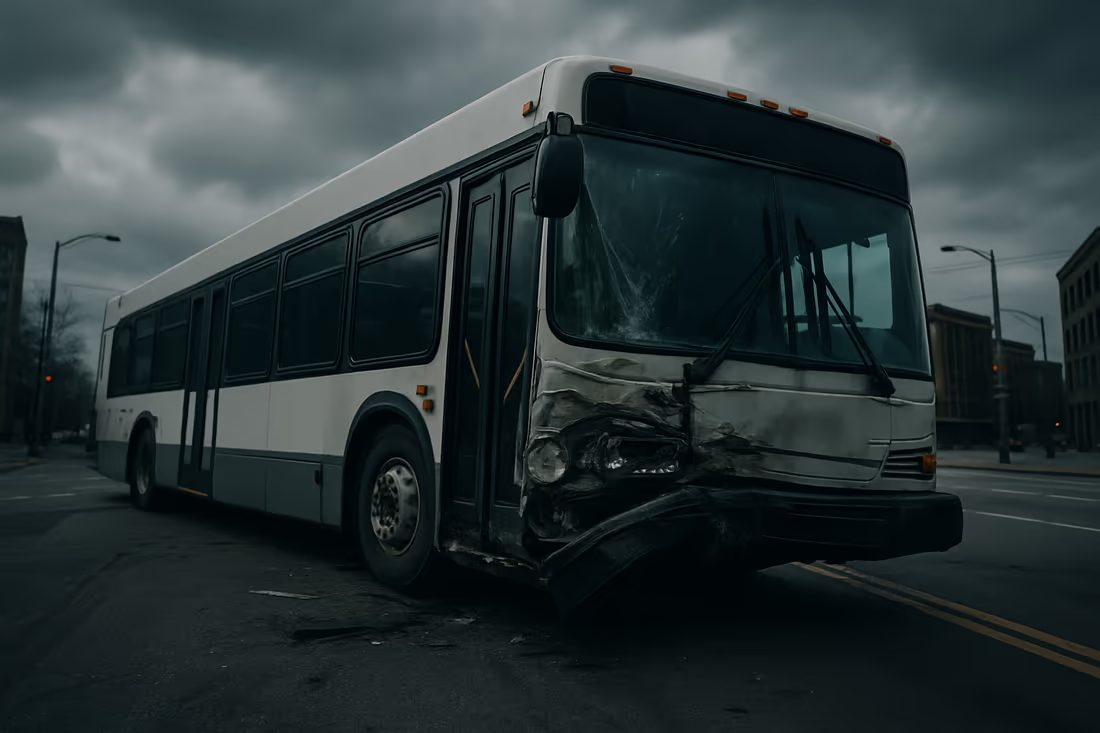 Bus Accidents Transit, school, and charter-bus crashes involving public and private carriers.
 -
 Catastrophic Injury Brain, spinal-cord, amputation, and severe-burn injuries that change a life.
 -
 Brain Injury Traumatic brain injuries with long-term cognitive and physical effects.
 -
 Burn Injury Severe burns from fires, explosions, chemicals, and electrical contact.
 -
 Wrongful Death Claims brought by families after a fatal accident or act of negligence.
 -
 Construction Accidents Falls, struck-by, and equipment injuries on the job site.
 -
 Offshore Accidents Rig, platform, and vessel injuries beyond the shoreline.
 -
 Workers' Compensation On-the-job injuries and the benefits owed to injured workers.
Calculating Future Damages in Catastrophic Cases
Three expert witnesses establish the economic value of a Louisiana catastrophic injury case: a life care planner, a vocational rehabilitation expert, and a medical economist. Without all three, the defense will successfully challenge the forward-looking damages that make catastrophic cases worth litigating.
Life Care Planner
A certified professional who documents all anticipated future medical needs of a catastrophically injured person, including surgeries, rehabilitation, adaptive equipment, home modifications, and in-home care costs. Their report becomes the foundation for future medical damages in the lawsuit.
Loss of Earning Capacity
The difference between what you could have earned over your working lifetime and what you can earn now after the injury. Calculated by a vocational expert and converted to present value by an economist.
Three expert categories address this. A Life Care Planner documents all anticipated future medical needs: surgeries, rehabilitative therapy, adaptive equipment, home modifications, and in-home care costs over the plaintiff’s projected lifetime. A vocational rehabilitation expert assesses work capacity reduction and documents Loss of Earning Capacity across the plaintiff’s remaining work-life expectancy. A medical economist converts those projections to present value, accounting for inflation and discount rates.
Defense experts will challenge all three. They challenge treatment necessity, the likelihood of the life care plan actually being followed, the plaintiff’s remaining work capacity, and the discount rates used by the economist. This is standard. An experienced catastrophic injury attorney anticipates these challenges and builds the initial expert reports to withstand them.
The 2024 tort reform under La. R.S. 9:2800.27 changed how future medical damages are calculated. Recoverable future medical costs are now limited to amounts actually paid or payable, not the full billed amount. This directly affects life care plan projections because the gross costs listed in the plan must be adjusted to reflect contracted rates and actual payment obligations.
Loss of Consortium
A legal claim available to a spouse for the loss of companionship, affection, and support caused by the injured person’s condition. It is a separate damage category from the injured person’s own claims.
Loss of Consortium is available to the injured person’s spouse under La. C.C. Art. 2315. It requires its own calculation and its own evidentiary foundation. It is a separate damage claim from the injured person’s own recovery and should not be overlooked.
General damages carry no statutory cap in Louisiana personal injury cases. These include pain and suffering, permanent disability, and loss of enjoyment of life. The only cap context in Louisiana is medical malpractice under the MMA. Outside malpractice, general damages are uncapped and require persuasive trial presentation to reach appropriate values.
Past results do not guarantee future outcomes; each case is decided on its own facts. See our full case results.
Filing Deadlines and the Fourth Judicial District Court
Prescriptive Period
Louisiana’s term for statute of limitations. The legal deadline to file a lawsuit. For personal injury, it is two years from the date of injury under La. C.C. Art. 3493.1 (effective July 1, 2024).
Louisiana’s Prescriptive Period for personal injury is two years from the date of injury under La. C.C. Art. 3493.1, effective July 1, 2024. Before that date, the period was one year. If your injury occurred on or after July 1, 2024, you have two years.
Product defect claims under the LPLA carry a different prescriptive rule: one year from the date you discovered or should have discovered the damage, but no more than three years from the date of purchase or the manufacturer’s last act giving rise to the claim. The governing period depends on when you knew or should have known. Your attorney needs to confirm which period controls your specific claim.
If a government entity is a defendant, La. R.S. 13:5108.1 requires a 90-day notice of claim before filing suit. Road authorities, public entities, and state agencies all qualify as government defendants. Failure to file the notice within 90 days of gaining knowledge of the claim can bar recovery entirely. This deadline runs concurrently with the prescriptive period, not in addition to it.
Monroe catastrophic injury cases are filed in the Fourth Judicial District Court (4th JDC) at 300 St. John St., Monroe, LA, which serves Ouachita and Morehouse parishes. Catastrophic cases require detailed scheduling orders governing expert designation deadlines, discovery cutoffs, and trial settings. Multi-year litigation timelines are typical. The complexity of the expert testimony, the volume of medical records, and the scale of the damages all extend the timeline.
St. Francis Medical Center at 2700 Jackson St., Monroe is the primary regional trauma facility for Ouachita Parish. Glenwood Regional Medical Center at 503 McMillan Rd., West Monroe is also available. Complex neurological or spinal cord cases often transfer to LSU Health Shreveport for specialized treatment. The treating hospital’s medical records form the initial evidentiary foundation for the case.
Your Monroe Injury Attorneys
Founding partners Trey Morris and Justin Dewett lead every Monroe injury case Morris & Dewett takes.


How Do Insurance Companies Handle Catastrophic Injury Claims?
Insurers assign specialized adjusters or outside defense counsel to catastrophic injury cases immediately and begin their own investigation before the injured party has retained an attorney. Their investigation starts while you are still in the hospital.
Their investigation begins before you have legal counsel. Adjusters contact witnesses. They review the accident scene. They pull available surveillance footage. By the time you are still in the ICU, the insurer has already begun building a file on your case.
Early settlement offers follow. They are presented before the full scope of future damages is established. The life care plan is not complete. The vocational assessment is not done. The full extent of permanent impairment is not yet documented. Accepting an early offer eliminates future medical claims, future earnings loss, and loss of consortium claims permanently. The release is final.
The insurer may also ask for a recorded statement shortly after the incident. There is no legal obligation to provide one without your attorney present. Statements given without counsel are often used to establish inconsistencies or admissions that the defense uses to push your fault percentage higher.
Delay is a standard defense tool. Insurers know that lengthy litigation depletes plaintiff resources. Repeated discovery motions, rescheduled depositions, IME scheduling delays, and expert designation disputes are all part of the defense playbook for catastrophic cases.
IME
Independent Medical Examination. A physical examination of the injured plaintiff scheduled by the insurance company’s defense team. Despite the name, the examining physician is selected and paid by the insurer, not by the court. IME reports are used to challenge the treating physician’s findings and dispute life care plan projections.
IME doctors are paid by and selected by the insurer. Their reports routinely challenge treatment necessity, dispute life care plan projections, and find that the plaintiff has more remaining work capacity than the plaintiff’s own doctors documented. An experienced catastrophic injury attorney prepares for this before trial.
Morris & Dewett’s approach is to engage quickly, issue preservation demands, and position the case on a litigation track before the insurer completes its own investigation.
What clients say
- ★★★★★
I hired Morris and Dewett back in November of 2025.
They helped me get through my hard times of being off work, stress, and worry. Anytime I had a question I could call and they always had an answer. Very nice and professtional people. Thank you Morris and Dewett for making this an easy process for me and my family.
- ★★★★★
Morris and Dewett and their team of attorneys and staff go above and beyond.
They always were there to support me and answer all my questions after a shoulder injury that included multiple surgeries. They are caring and compassionate and that goes a long way! Highly recommended!
- ★★★★★
Thanks Morris and Dewett for the excellent work you have done on my behalf.
I want to personally thank Sarah for her kindness.
- ★★★★★
Morris & Dewett does things the right way!
They put their clients first in measurable and impactful ways.
- ★★★★★
First time being injured and needing a lawyer they where very helpful.
They answered my questions Id have very well. Highly recommend them.
- ★★★★★
Wonderful experience with Morris and DeWitt, everyone was articulate and punctual, and open to all my questions about the process.
My case couldn't have been handled by a better team! Caity Nerren, Jessica Christian, and Meghan Nolen were all fantastic and helped every step of the way. Thanks again for all of your hard work.
Reviews reflect individual client experiences. Past results do not guarantee future outcomes.
What to Do After a Catastrophic Injury in Monroe
Seek emergency medical care first, then preserve evidence, and consult an attorney before giving any statements or signing any releases. The actions taken in the first days after a catastrophic injury directly affect the strength of the resulting legal claim.
Seek emergency medical care first. St. Francis Medical Center at 2700 Jackson St., Monroe is the primary regional trauma facility for Ouachita Parish. Glenwood Regional Medical Center at 503 McMillan Rd., West Monroe is the second option. Complex TBI or spinal cord cases may be transferred to LSU Health Shreveport for specialized treatment capacity. Getting to the right facility quickly affects both medical outcomes and the quality of the initial medical record.
Document everything as soon as you are physically able. Photographs of the scene, the vehicles, the defective product, or the premises condition. Witness names and contact information. Police reports. Employer incident reports. Property owner incident reports. This documentation becomes harder to obtain as time passes and conditions change.
Do not post about the injury or the incident on social media. Defense counsel and insurance adjusters review social media as part of standard investigation in serious cases. Posts about your condition, your activities, or the incident can be used to challenge injury severity or to establish inconsistencies with your medical records.
Preserve physical evidence. Do not repair a damaged vehicle. Do not discard clothing or a defective product. Do not allow the at-fault party to inspect, remove, or photograph evidence before your attorney has issued a preservation demand. Once physical evidence is gone, it is gone.
Consult an attorney before giving any recorded statement to an insurer or signing any release forms. Releases signed before the full scope of injury is documented are binding and permanent. A release signed three days after an injury permanently closes the claim. Future treatment costs, future lost income, and consortium claims are all waived.
For plaintiffs who are incapacitated after a TBI or spinal cord injury, the prescriptive period under La. C.C. Art. 3493.1 may be suspended under Louisiana’s interdiction and tolling rules. An attorney can advise on the specific tolling rules that apply to your situation.
Frequently Asked Questions
- How long do I have to file a catastrophic injury lawsuit in Monroe, Louisiana?
- Louisiana's prescriptive period for personal injury is two years from the date of injury under La. C.C. Art. 3493.1, effective July 1, 2024. For accidents that occurred before July 1, 2024, the old one-year period may apply depending on the specific facts. Product defect claims under the LPLA carry their own period: one year from discovery of damage, with a three-year cap. If a government entity is involved, a 90-day notice of claim under La. R.S. 13:5108.1 must be filed before suit. That deadline runs concurrently with the prescriptive period, not in addition to it.
- What does the 2024 tort reform mean for my catastrophic injury case?
- La. R.S. 9:2800.27, effective 2024, limits recoverable medical expenses to amounts actually paid or payable, not the amounts originally billed. In catastrophic cases, hospital bills often show large gross charges that are reduced significantly by insurer-contracted rates. Under the reform, your recoverable medical damages reflect what was actually paid, not the gross billed amount. This affects both past and future medical damages calculations. Life care planners working on Louisiana catastrophic cases now adjust projected future costs to post-reform billing assumptions.
- Can a family member file on behalf of someone who is incapacitated after a catastrophic injury?
- Yes. A family member can seek to be appointed as a legal representative, called a curator in Louisiana, for an incapacitated adult under Louisiana interdiction law. The curator then has standing to bring the lawsuit on behalf of the incapacitated person. For minors, a parent or legal guardian has standing directly. The prescriptive period for incapacitated plaintiffs may be suspended under Louisiana's tolling rules. An attorney can advise on the process and timeline for establishing legal representation in your specific situation.
- What if I was partially at fault for my own catastrophic injury?
- Louisiana follows comparative fault under La. C.C. Art. 2323, as amended effective January 1, 2026. If you are 50% or less at fault, your damages are reduced proportionally by your percentage of fault. If you are found 51% or more at fault, you recover nothing. This is a hard cutoff. Insurance adjusters know this rule and often build their defense strategy around getting the plaintiff's fault percentage to or above 51%. The specific facts of how the incident occurred determine fault allocation, including who had what opportunity to avoid it.
- How is the value of a catastrophic injury case calculated in Louisiana?
- A Louisiana catastrophic injury case value is built from three categories. Economic damages include all past and future medical expenses (calculated under La. R.S. 9:2800.27 at amounts paid or payable, not billed), lost income to date, and loss of earning capacity for the remainder of the plaintiff's working life. A spouse's loss of consortium is a separate economic damage category. General damages, including pain and suffering, permanent disability, and loss of enjoyment of life, have no statutory cap in Louisiana personal injury cases. They require life care planner, vocational expert, and economist testimony to fully support at trial.
- Does Morris & Dewett handle catastrophic injury cases on a contingency fee basis?
- Yes. Morris & Dewett handles catastrophic injury cases on a contingency fee basis. There is no upfront cost and no attorney fee unless there is a recovery. Case costs such as expert fees, court filings, and depositions are advanced by the firm and resolved at the time of settlement or verdict. You can discuss the specific fee structure and cost arrangement with us at no charge.
Last updated June 5, 2026