

Offshore work in Calcasieu Parish is not like other employment. The Port of Lake Charles is one of the ten largest ports in the country. The Calcasieu Ship Channel runs crew boats and supply vessels to deepwater Gulf platforms. LNG terminals and petrochemical facilities line the Calcasieu Pass. The workers who keep these operations running (deckhands, crane operators, drilling crew, production platform workers) operate under federal maritime law when they are injured. That law is different from anything in the standard workers’ compensation system.
Which Federal Law Governs Your Offshore or Maritime Claim?
Jones Act
The federal statute (46 U.S.C. § 30104) that gives seamen the right to sue their employers for negligence. Unlike workers’ compensation, there are no caps on damages. A seaman qualifies if they spend at least 30% of their work time on a vessel in navigation.
Four separate federal frameworks govern offshore injury claims, and which one applies to you depends on your job classification, the type of structure you worked on, and where the injury occurred. The Jones Act does not automatically cover every offshore worker. Getting the classification wrong limits your recovery. The four frameworks are:
- Jones Act (46 U.S.C. § 30104): protects seamen who spend at least 30% of their work time on a vessel in navigation
- LHWCA covers workers not qualifying as seamen who work on or near navigable waters
- OCSLA: covers workers on fixed platforms in federal OCS waters
- General maritime law unseaworthiness: a separate theory available to seamen regardless of the other frameworks
Worker classification is the first legal question. Seaman, maritime worker, or independent contractor. Employers dispute it most often. Independent contractor status does not automatically remove you from Jones Act coverage. Courts look at the actual working relationship, not just what your paperwork says.
Our Lake Charles Office
4865 Ihles Road
Lake Charles, LA 70605
Open 24/7 for injured Lake Charles residents
Get directions →Jones Act Claims for Lake Charles Seamen
Vessel in Navigation
A vessel that is floating, capable of movement, and used as a worksite or for transportation on navigable waters. Supply vessels, crew boats, drillships, and MODUs qualify. Permanently fixed platforms generally do not.
The Jones Act allows seamen to sue their employers directly for negligence. The damages available are not capped the way workers’ compensation payments are. You can recover lost wages, future earning capacity, medical expenses past and future, and pain and suffering.
MODU
Mobile Offshore Drilling Unit. A vessel-like structure used for offshore drilling. MODUs include semisubmersibles, jackups, and drillships. Workers on MODUs may qualify as seamen under the Jones Act.
The negligence standard is lower than ordinary tort law. Your employer is liable if their negligence contributed to your injury in any way, however slight. A wet deck not cleaned up, a safety procedure not followed, equipment not inspected. Any one of those can establish liability. The Calcasieu Ship Channel puts Lake Charles workers on crew boats, supply vessels, drillships, and MODUs on a regular basis. Those workers are seamen under federal law.
Jones Act claims can be filed in federal admiralty court or state court. Venue matters strategically. Some forums are more favorable to plaintiffs; some move faster. An experienced maritime attorney evaluates venue as part of the initial case strategy.
Maintenance and Cure: What Seamen Are Owed Without Proving Fault
Maintenance and Cure
A no-fault seaman’s remedy. Maintenance is a daily living allowance paid during recovery. Cure is the employer’s obligation to pay all reasonable medical costs until the seaman reaches Maximum Medical Improvement (MMI). You do not need to prove the employer caused the injury to receive these benefits.
Maintenance and Cure applies regardless of fault. It is owed the moment you are injured in service of the vessel.
MMI
Maximum Medical Improvement. The point at which your treating physician determines that further treatment will not significantly improve your condition. Employers use MMI as a cutoff to terminate cure payments.
Maintenance rates are set by contract or by court order when the employer pays too little. Historically low daily rates have been challenged and increased in litigation. Cure continues until you reach MMI. The dispute over when MMI occurs is one of the most common flashpoints in maritime cases. Employers often claim MMI prematurely, and workers who accept that determination may be cut off before their treatment is complete.
Willful withholding of maintenance and cure triggers punitive damages. Punitive damages apply when an employer refuses to pay knowing they are obligated. Proving punitive damages requires showing the refusal was willful, not mistaken.
What We Handle
Lake Charles Practice Areas
-
 Car Accidents Rear-end, intersection, and highway collisions across Louisiana.
 -
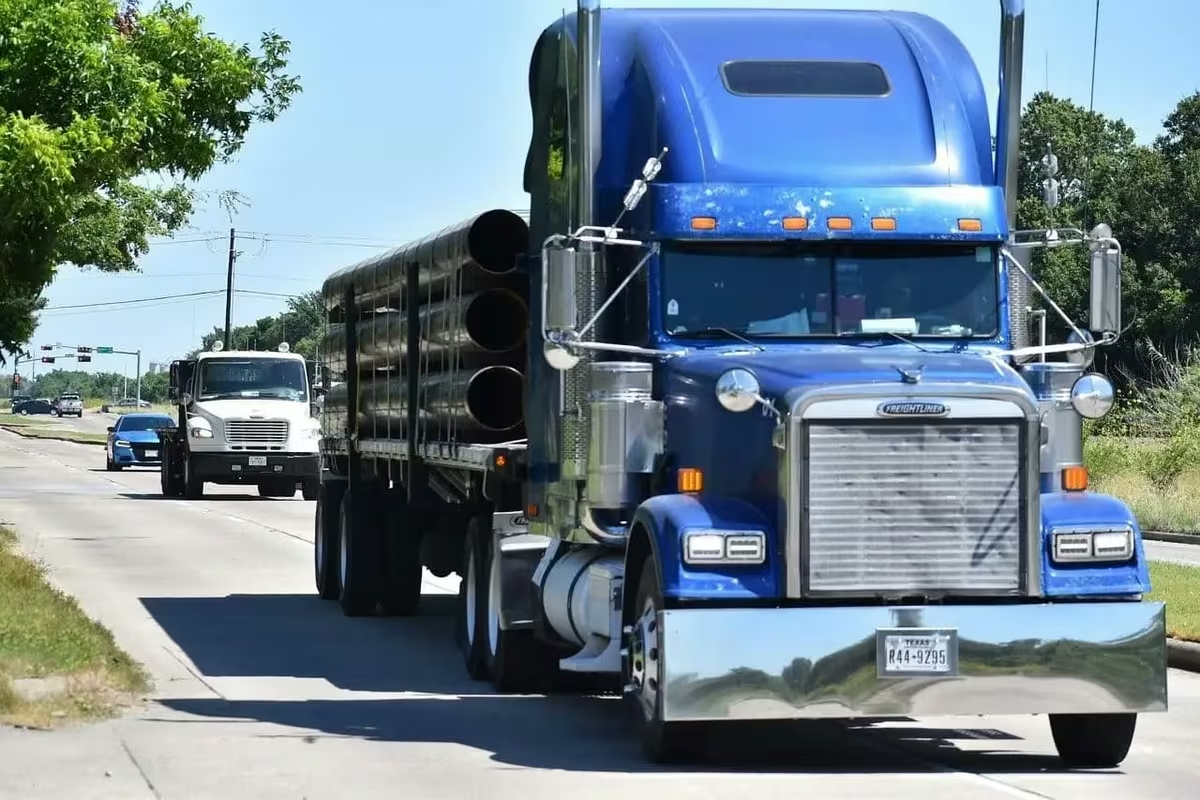 Truck Accidents 18-wheeler and commercial-vehicle wrecks governed by federal trucking rules.
 -
 Motorcycle Accidents Serious-injury motorcycle crashes where bias against riders is common.
 -
 Wrongful Death Claims brought by families after a fatal accident or act of negligence.
 -
 Construction Accidents Falls, struck-by, and equipment injuries on the job site.
 -
 Industrial Accidents Plant, warehouse, and heavy-equipment injuries in industrial settings.
 -
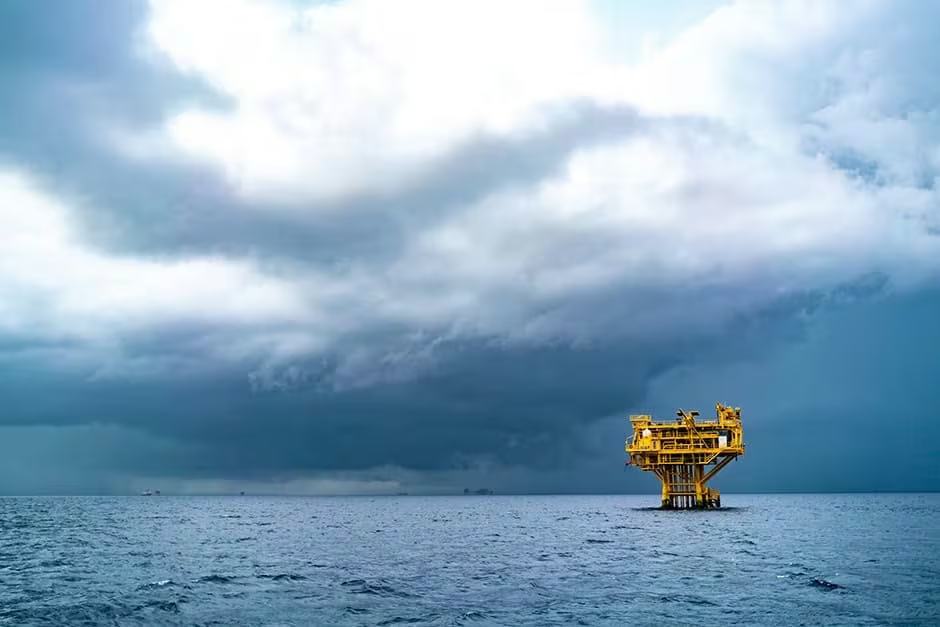 Offshore Accidents Rig, platform, and vessel injuries beyond the shoreline.
 -
 Maritime & Jones Act Jones Act and general-maritime claims for seamen and vessel crews.
 -
 Workers' Compensation On-the-job injuries and the benefits owed to injured workers.
 -
 Nursing Home Abuse Neglect and abuse of residents in long-term-care facilities.
Longshore and Harbor Workers’ Compensation Act (LHWCA)
The LHWCA is a federal workers’ compensation system for maritime workers who do not qualify as seamen. It covers dockworkers, cargo handlers, crane operators, vessel repairers, and harbor workers. It also covers workers on adjoining land areas including piers, wharves, dry docks, and terminals.
Port of Lake Charles operations and Calcasieu Ship Channel worker activities fall squarely within LHWCA coverage zones. If you work on the dock, in the cargo handling system, or at a waterfront terminal, LHWCA is likely your primary framework. Benefits include medical treatment, wage replacement at two-thirds of your average weekly wages, and permanent disability awards.
LHWCA does not eliminate third-party negligence claims. If a negligent vessel owner, equipment manufacturer, or contractor caused your injury, you can sue them separately even while receiving LHWCA benefits. LHWCA claims are filed with the U.S. Department of Labor, Office of Workers’ Compensation Programs. The 1-year filing deadline is strict.
See also our page on workers’ compensation claims in Lake Charles for cases involving overlapping state and federal remedies.
Outer Continental Shelf Lands Act (OCSLA) and Fixed Platform Claims
Workers on fixed offshore platforms in federal OCS waters are governed by OCSLA. That includes production platforms, caissons, and artificial islands. The act extends federal jurisdiction to these structures and incorporates the law of the adjacent state as surrogate federal law. For Gulf of Mexico platforms off Louisiana, that means Louisiana law applies within the OCSLA framework.
MODUs
Mobile Offshore Drilling Units. Floating drilling structures including jackup rigs, semisubmersibles, and drillships. When actively drilling, they may be classified as vessels, making workers eligible for Jones Act coverage rather than OCSLA.
Workers on MODUs in active drilling mode may fall under the Jones Act instead of OCSLA because MODUs are vessels, not fixed platforms. The distinction between drilling mode and production mode determines which framework applies. That line is frequently disputed.
Lake Charles workers rotate to deepwater platforms throughout the Gulf. Whether your platform was fixed or floating matters. Whether it was in state or federal OCS waters matters. Your job duties and classification all affect which law governs your injury.
Common Causes of Offshore and Maritime Injuries in the Gulf
The Bureau of Safety and Environmental Enforcement (BSEE) records more than 200 offshore injuries annually from U.S. OCS operations, alongside fire, collision, and lifting incidents. The types of incidents that injure workers consistently fall into recognizable categories:
- Equipment failures: crane collapses, winch failures, pressure vessel failures, blowout preventer malfunctions
- Fires and explosions: oil and gas ignition events, hydrogen sulfide releases, gas kicks
- Falls: from platforms, gangways, vessel decks, ladders, and equipment
- Vessel collisions and allisions: crew boats, supply vessels, and tugs striking platforms or other vessels
- Chemical exposures: hydrogen sulfide, benzene, drilling mud components, corrosion inhibitors
- Deck and lifting accidents: improperly rigged loads, dropped objects, crane radius violations
The Port of Lake Charles and the Calcasieu Ship Channel are active transit corridors. Workers on vessels in this channel are in maritime employment. They are covered by federal maritime law when they are injured.
Past results do not guarantee future outcomes; each case is decided on its own facts. See our full case results.
Transportation Injuries: Helicopters and Crew Boats
Workers injured traveling to or from offshore platforms by helicopter or crew boat have valid maritime injury claims. This surprises many workers who assume that only on-platform incidents qualify. Transport to and from a platform is part of the offshore employment relationship. Maritime law coverage applies to injuries that occur during that transport, not only on the platform itself.
Helicopter incidents include hard landings, crashes, and rotor strikes. Relevant evidence includes weather decision logs, maintenance records, pilot fatigue documentation, and helipad condition inspections at the platform. Crew boat injuries include falls on wet decks, vessel collisions during transit, and capsizing in Gulf weather conditions.
When workers use third-party transport companies (charter helicopter operators, contract crew boat services), the employer may still be liable depending on the employment relationship. The Calcasieu Pass and Gulf helicopter corridors connecting Lake Charles facilities to deepwater platforms are active routes. Workers injured on those routes should not assume that using a third-party carrier ends their claim against the primary employer.
Transportation injury claims involve distinct evidence: transport contractor records, weather documentation, Coast Guard reports. They require a specific investigative approach.
Unseaworthy Vessel Claims
Unseaworthiness is a separate cause of action available to seamen, distinct from Jones Act negligence. You do not need to prove the employer knew about the defect. The condition itself creates liability. If the vessel or its equipment was not reasonably fit for its intended purpose and that condition caused your injury, you have an unseaworthiness claim.
What qualifies as unseaworthy: a malfunctioning winch, an improperly maintained gangway, a crew that was undertrained for the task they were assigned, contaminated potable water, defective personal protective equipment supplied by the vessel. The standard is whether the vessel was reasonably fit. Not whether it was perfect. Courts apply that standard broadly.
Unseaworthiness claims have a 3-year prescriptive period under general maritime law. The damages overlap with Jones Act damages: medical expenses, lost wages, future earning capacity, and pain and suffering. Many cases proceed under both theories simultaneously. Pursuing only one when both may apply is a strategic error.
Lake Charles Maritime and Offshore Industry Context
The Port of Lake Charles is one of the ten largest ports in the United States by cargo tonnage. The Calcasieu Ship Channel connects the port to the Gulf of Mexico and carries constant vessel traffic: supply boats, crew boats, tugs, barges, and tankers. Workers on this channel are in maritime employment.
Lake Charles is also a major LNG and petrochemical production center. Multiple LNG export terminal projects operate along the Calcasieu Pass corridor. The petrochemical industry employs thousands of workers who rotate between onshore facilities and offshore platforms on regular schedules. Those workers commute via crew boat and helicopter to Gulf platforms as a standard part of their jobs.
Workers in this corridor include supply vessel deckhands, crane operators on fixed platforms, production platform workers, well service technicians, and LNG facility workers with offshore assignments. Each job classification carries different legal rights. A deckhand on a crew boat is a seaman. A crane operator at a fixed terminal may be a LHWCA worker. A production platform worker may be covered under OCSLA. Getting the classification right determines which remedies are available.
Your Lake Charles Injury Attorneys
Founding partners Trey Morris and Justin Dewett lead every Lake Charles injury case Morris & Dewett takes.


Evidence Preservation in Offshore Cases
Evidence preservation is time-critical in offshore cases. Offshore personnel rotate on fixed schedules. Witnesses who were on-site during an incident can be unreachable within days. Vessel voyage data recorders and black box data can be overwritten if no one issues a preservation demand. Maintenance logs, safety inspection records, and work permits are purged on standard retention schedules.
BSEE incident investigation reports are available through FOIA and contain U.S. Coast Guard and BSEE findings. Those reports can support or rebut liability claims. They are created independently of the parties. Requesting them is part of any thorough initial investigation.
Marine safety consultants and accident reconstruction experts establish causation in complex cases. Common employer defense tactics: attributing the incident to the worker’s safety violation, disputing the injury’s connection to the incident, and citing pre-existing conditions to reduce damages. Anticipating those defenses requires building the evidentiary record quickly.
Morris & Dewett sends evidence preservation demands within 24 hours of engagement. Injured workers in the Lake Charles area are typically transported to Lake Charles Memorial Hospital or CHRISTUS Ochsner Lake Area Hospital. Documenting your treatment from the first contact is part of the evidentiary record. Evidence that is gone cannot be recovered. The timeline matters.
Louisiana Comparative Fault and the 51% Bar
Comparative Fault
A legal rule that reduces your recovery by your percentage of fault. Under Louisiana law as of January 1, 2026, if you are 51% or more at fault for an accident, you recover nothing. If you are 50% or less at fault, your damages are reduced proportionally by your fault percentage.
Comparative Fault applies to state-law claims and to OCSLA claims governed by Louisiana law. As of January 1, 2026, La. C.C. Art. 2323 sets a hard cutoff: 51% or more fault means zero recovery.
Offshore employers and their insurers routinely build comparative fault arguments around safety procedure violations. If you were injured without wearing required PPE, or if you were in an area you were not supposed to be, those facts become the basis for a fault allocation argument. Expect it.
Pure Jones Act claims use a different standard. Under the Jones Act, any employer negligence, however slight, creates liability. The 51% bar does not apply to Jones Act claims the way it applies to Louisiana state tort claims. Understanding which framework governs fault allocation on your specific claim is critical to accurate case valuation.
What clients say
- ★★★★★
First time being injured and needing a lawyer they where very helpful.
They answered my questions Id have very well. Highly recommend them.
- ★★★★★
Great experience working with this Injury law firm.
Very professional and helpful team overall , especially Trey Morris. Communication was great throughout my case, and they made the process much less stressful. My case is now over, and I really appreciated how responsive and organized everyone was, from the case manager to their receptionist.
- ★★★★★
I hired Morris and Dewett back in November of 2025.
They helped me get through my hard times of being off work, stress, and worry. Anytime I had a question I could call and they always had an answer. Very nice and professtional people. Thank you Morris and Dewett for making this an easy process for me and my family.
- ★★★★★
Morris and Dewett and their team of attorneys and staff go above and beyond.
They always were there to support me and answer all my questions after a shoulder injury that included multiple surgeries. They are caring and compassionate and that goes a long way! Highly recommended!
- ★★★★★
Thanks Morris and Dewett for the excellent work you have done on my behalf.
I want to personally thank Sarah for her kindness.
- ★★★★★
Morris & Dewett does things the right way!
They put their clients first in measurable and impactful ways.
Reviews reflect individual client experiences. Past results do not guarantee future outcomes.
Filing Deadlines for Offshore Injury Claims
Prescriptive Period
Louisiana’s term for the legal deadline to file a lawsuit. Missing this deadline ends your right to sue regardless of the merits of your case.
The filing deadline for an offshore injury claim in Louisiana depends on which framework applies: Jones Act (3 years), LHWCA (1 year), OCSLA under Louisiana law (2 years), or general maritime law (3 years). Getting the framework wrong means getting the deadline wrong. The specific deadlines:
- Jones Act claims: 3 years from the date of injury under 46 U.S.C. § 30106
- LHWCA claims: 1 year from the date of injury or the last payment of compensation under 33 U.S.C. § 913
- OCSLA claims governed by Louisiana law: 2 years under La. C.C. Art. 3493.1 (effective July 1, 2024, per Louisiana tort reform)
- General maritime law unseaworthiness claims: 3 years
Federal maritime and Jones Act claims from Calcasieu Parish workers are filed in the U.S. District Court, Western District of Louisiana (Lake Charles Division). State-law claims and OCSLA claims governed by Louisiana law are filed in the 14th Judicial District Court, Calcasieu Parish.
Frequently Asked Questions
- Do I qualify for Jones Act coverage as an offshore worker?
- The Jones Act covers seamen who spend at least 30% of their work time on a vessel in navigation. A vessel in navigation is a floating, mobile worksite: crew boats, supply vessels, drillships, and MODUs qualify. Fixed platforms generally do not. Your job title does not control. Courts look at your actual duties and the time you spent on the vessel. Independent contractor status does not automatically disqualify you. If you rotated between shore and a floating vessel as a regular part of your job, you likely qualify. An attorney needs to review your actual employment conditions to confirm.
- What is maintenance and cure and how long does it last?
- Maintenance is a daily living allowance your employer owes you while you are recovering from an injury that occurred in service of the vessel. Cure is your employer's obligation to pay your reasonable medical expenses during that same period. Neither requires you to prove fault. Both continue until you reach Maximum Medical Improvement (MMI), which is the point at which your treating physician determines your condition has stabilized. The end of cure is tied to that MMI date. Disputes over when MMI actually occurred are common. Willful withholding of cure by an employer triggers punitive damages under federal maritime law.
- Can I file a claim if I was injured on a crew boat or helicopter traveling to an offshore platform?
- Yes. Transportation to and from an offshore platform is part of the offshore employment relationship. Workers injured on crew boats or helicopters during platform transport are covered by maritime law. For crew boat injuries, the Jones Act and unseaworthiness doctrines apply if the worker qualifies as a seaman. Helicopter transport injuries are evaluated based on the employment relationship and whether the transport was part of offshore duties. Using a third-party transport operator does not automatically eliminate a claim against the primary employer. These cases require evaluating multiple parties and the employment contracts involved.
- What is the difference between the Jones Act and the LHWCA?
- The Jones Act is a negligence claim available to seamen. Seamen are workers who spend at least 30% of their time on a vessel in navigation. It allows a direct lawsuit against the employer with no cap on damages. The LHWCA is a federal workers' compensation system for maritime workers who do not qualify as seamen: dockworkers, cargo handlers, crane operators, and harbor workers. LHWCA benefits are capped at two-thirds of average weekly wages. LHWCA does not require proving employer negligence. It also preserves third-party negligence claims against vessel owners and other parties. The two frameworks do not overlap. Determining which one applies is the first step in evaluating your case.
- What evidence matters most in an offshore injury case?
- The most time-sensitive evidence is voyage data recorder and black box data from the vessel. That data can be overwritten if no preservation demand goes out quickly. Witness availability is also critical: offshore crew rotate on fixed schedules and can be unreachable within days of an incident. Beyond that: BSEE and U.S. Coast Guard incident investigation reports, maintenance and inspection logs, safety meeting records, and your own medical records from the injury date forward. In equipment failure cases, marine safety consultants and accident reconstruction experts examine the equipment before it is repaired or replaced.
- How long do I have to file an offshore injury claim in Louisiana?
- The deadline depends on which legal framework applies. Jones Act claims: 3 years from the date of injury. LHWCA claims: 1 year from the date of injury or the last compensation payment. This is a hard deadline with limited exceptions. OCSLA claims governed by Louisiana law: 2 years under La. C.C. Art. 3493.1, which was amended by Louisiana tort reform effective July 1, 2024. General maritime law unseaworthiness claims: 3 years. Getting the framework wrong means getting the deadline wrong. If your claim is LHWCA and someone tells you 3 years, that is incorrect.
- What does it cost to hire a maritime injury attorney?
- Maritime injury cases are handled on a contingency fee basis. You pay nothing upfront. If there is no recovery, you owe no attorney fees. The attorney's fee is a percentage of the recovery, and the terms are disclosed in the engagement agreement before you sign anything. This means that a worker who cannot afford to pay for legal representation can still access competent representation. The contingency structure also aligns the attorney's interest with yours: a larger recovery is better for both.
- My employer is calling my injury a workers' compensation claim. Does that mean I cannot sue?
- Not necessarily. Standard state workers' compensation does not apply to most offshore maritime workers. Your employer may be mischaracterizing your situation, intentionally or not. If you qualify as a seaman under the Jones Act, you are entitled to a direct negligence lawsuit with uncapped damages. That is not a workers' compensation payment. If you are covered by the LHWCA, you have federal benefits and also retain the right to sue negligent third parties separately. Workers who accept a state workers' compensation settlement without evaluating their maritime law rights may be settling claims that are worth substantially more under federal law.
- How do employers and their insurance carriers fight Jones Act claims?
- Employers and their insurers use predictable defense tactics. They dispute seaman status by arguing the worker did not meet the 30% vessel time threshold. They argue the structure was a fixed platform, not a vessel, to defeat Jones Act coverage. They attribute the accident to the worker's own safety violation to establish comparative fault. They cite pre-existing conditions to reduce damages. They dispute the MMI date to terminate maintenance and cure payments early. Employers act quickly after an incident. Incident reports are prepared by employer representatives. Recorded statements are taken from injured workers before an attorney is involved. Knowing these tactics before you speak to anyone at the company or their insurer matters.
- What makes a vessel "unseaworthy" under maritime law?
- A vessel is unseaworthy when it is not reasonably fit for its intended purpose. The standard applies to the vessel itself and to its equipment and crew. Specific examples: a winch that malfunctions under normal operating load, a gangway with missing non-skid material, a crew that was assigned to a task they were not trained for, defective personal protective equipment supplied by the vessel. The unseaworthiness doctrine uses a strict liability standard. The vessel owner does not need to have known about the defect. The condition existing and causing injury is sufficient. Unseaworthiness is a separate legal theory from Jones Act negligence and can be pursued at the same time.
Last updated June 5, 2026