

The law that applies to an offshore or maritime injury depends on where you were, what you were doing, and how your employer classified you. Get those questions wrong and you are in the wrong court, under the wrong statute, with a missed deadline.
Which Federal Law Governs Your Offshore or Maritime Claim?
Three separate federal frameworks govern offshore and maritime injuries in Louisiana. Which one applies to your claim determines your rights, your deadlines, and how much you can recover.
The Jones Act (46 U.S.C. 30104) covers seamen injured aboard vessels in navigation. The Longshore and Harbor Workers Compensation Act (LHWCA) (33 U.S.C. 901 et seq.) covers maritime workers who do not qualify as seamen. The Outer Continental Shelf Lands Act (OCSLA) (43 U.S.C. 1331 et seq.) governs injuries on fixed offshore structures like Gulf of Mexico platforms.
The Red River corridor through Rapides Parish creates Jones Act and general maritime law jurisdiction for waterway incidents. Barge workers, towboat crews, and ferry operators on the Red River who are injured on the job may have Jones Act claims. Jones Act jurisdiction extends to navigable inland waterways, not just the Gulf of Mexico.
Many offshore companies classify workers as independent contractors to avoid Jones Act liability. Independent contractor status does not automatically bar Jones Act coverage. If you spent a substantial amount of your work time on a vessel and contributed to its function, you may qualify as a seaman regardless of what your contract says.
Serving Alexandria
Served from our Lake Charles office -- serving all of Rapides Parish.
4865 Ihles Road
Lake Charles, LA 70605
Open 24/7 for injured Alexandria residents
Get directions →Jones Act Claims: Rights of Injured Seamen
Jones Act
46 U.S.C. 30104. A federal law that allows seamen injured due to employer negligence to sue for damages, separate from standard workers compensation. Seamen are workers assigned to a vessel in navigation who contribute to its function.
The Jones Act gives injured seamen a direct negligence claim against their employer. You do not need to prove the employer knew about the danger. The causation standard is lower than ordinary tort law: the employer’s negligence only needs to have played “any part” in causing your injury. This is sometimes called the “featherweight” causation standard.
Unseaworthiness
A strict liability doctrine holding vessel owners responsible when the ship, its equipment, or its crew are not reasonably fit for the intended voyage. No proof of negligence is required.
The Jones Act also gives seamen an unseaworthiness claim against the vessel owner. Unseaworthiness does not require proof of negligence. If the vessel or its equipment was unfit for its purpose and that caused your injury, the owner is liable.
Maintenance and Cure
A seaman’s right to a daily living allowance (maintenance) and payment for medical care (cure), owed by the employer regardless of fault. Continues until the seaman reaches Maximum Medical Improvement.
MMI
Maximum Medical Improvement. The point at which a treating physician determines your condition has stabilized and further treatment will not significantly change the outcome.
A third right belongs to seamen alone: Maintenance and Cure The employer owes maintenance and cure regardless of fault. Maintenance is a daily living stipend while you are unable to work. Cure is payment for medical treatment. These continue until you reach MMI Willful failure to pay maintenance and cure can result in punitive damages.
Jones Act claims have a three-year statute of limitations from the date of injury. This is longer than Louisiana’s general prescriptive period, but it is still a hard deadline. Contested Jones Act cases are litigated in federal admiralty court. Morris & Dewett handles Jones Act cases from initial preservation demand through trial.
Longshore and Harbor Workers Compensation Act (LHWCA)
LHWCA
Longshore and Harbor Workers Compensation Act. 33 U.S.C. 901 et seq. A federal workers compensation law covering maritime workers who are not Jones Act seamen, including longshoremen, dock workers, ship repairers, and harbor construction workers.
The LHWCA covers maritime workers who do not meet the Jones Act’s seaman definition. Longshoremen, dock workers, ship repairers, and harbor construction workers typically fall under the LHWCA.
Benefits under the LHWCA include medical treatment and disability compensation at two-thirds of average weekly wage. Temporary total disability pays two-thirds of your wage while you cannot work at all. Permanent partial disability pays a scheduled benefit depending on which body part was injured. Death benefits extend to surviving dependents of fatally injured workers. These benefits are administered through the Department of Labor’s Office of Workers Compensation Programs.
The LHWCA does not bar you from suing a third party. Under Section 905(b) of the Act, an injured worker can file a tort claim against a vessel owner for negligence even while receiving LHWCA benefits from their employer. This is a significant right because LHWCA administrative benefits are capped, but third-party tort damages are not.
The LHWCA filing deadline is one year from the date of injury or last voluntary payment of compensation. This is the shortest deadline of any offshore framework and it is a hard cutoff. Missing it usually means losing your right to benefits. See also our page on Louisiana industrial injury lawyers for related workplace injury claims.
What We Handle
Alexandria Practice Areas
-
 Car Accidents Rear-end, intersection, and highway collisions across Louisiana.
 -
 Truck Accidents 18-wheeler and commercial-vehicle wrecks governed by federal trucking rules.
 -
 Motorcycle Accidents Serious-injury motorcycle crashes where bias against riders is common.
 -
 Bus Accidents Transit, school, and charter-bus crashes involving public and private carriers.
 -
 Catastrophic Injury Brain, spinal-cord, amputation, and severe-burn injuries that change a life.
 -
 Brain Injury Traumatic brain injuries with long-term cognitive and physical effects.
 -
 Wrongful Death Claims brought by families after a fatal accident or act of negligence.
 -
 Construction Accidents Falls, struck-by, and equipment injuries on the job site.
 -
 Offshore Accidents Rig, platform, and vessel injuries beyond the shoreline.
 -
 Workers' Compensation On-the-job injuries and the benefits owed to injured workers.
Outer Continental Shelf Lands Act (OCSLA) and Fixed Platform Claims
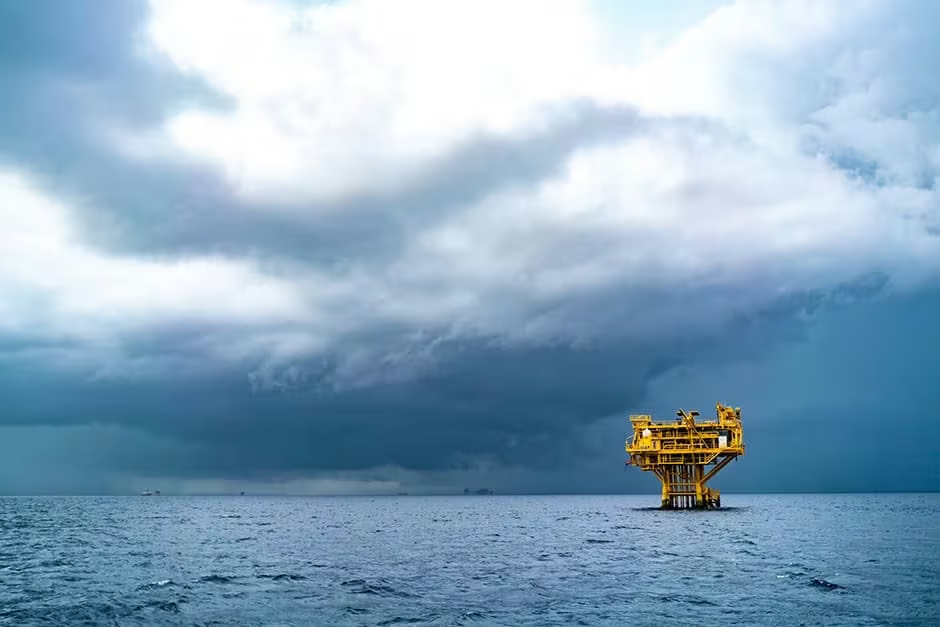
OCSLA (43 U.S.C. 1331 et seq.) governs injuries that occur on fixed offshore structures: platforms, wellheads, and production facilities on the outer continental shelf. If you were injured on a fixed platform in the Gulf of Mexico, OCSLA likely applies.
OCSLA extends federal jurisdiction to the outer continental shelf and typically applies adjacent state law as surrogate federal law. For Gulf of Mexico platforms near Louisiana, that means Louisiana law controls substantive legal questions in most cases. Injured workers on fixed platforms access LHWCA benefits as their primary workers compensation remedy.
Prescriptive Period
Louisiana’s term for statute of limitations. The legal deadline to file a lawsuit. For personal injury, it is two years from the date of injury under La. C.C. Art. 3493.1, effective July 1, 2024.
OCSLA also allows injured workers to bring third-party tort claims against contractors, equipment manufacturers, and vessel operators who contributed to the injury. These third-party claims operate under Louisiana negligence and products liability rules. The two-year Prescriptive Period under La. C.C. Art. 3493.1 (effective July 1, 2024) applies to these third-party tort claims.
See our page on oil field accidents for related claims involving oilfield operations.
Louisiana Oilfield Indemnity Act and Contractor Liability
Louisiana law voids oilfield contract clauses that shift injury liability from operators to contractors. Many Rapides Parish workers who go offshore are employed by contractors or subcontractors, not by the operator directly. Contractors carry their own independent liability, and oilfield contracts routinely contain indemnity clauses that attempt to transfer that liability onto the contractor.
The Louisiana Oilfield Indemnity Act (La. R.S. 9:2780) voids these indemnity clauses. A contract provision that requires a contractor to indemnify an operator for the operator’s own negligence in an oilfield context is unenforceable under Louisiana law. This statute protects injured workers whose claims might otherwise be extinguished by boilerplate contract language that most workers never read and would not understand even if they did.
Product liability claims are also available against equipment manufacturers. Under the Louisiana Products Liability Act (La. R.S. 9:2800.51 et seq.), a manufacturer is liable for injuries caused by an unreasonably dangerous product. Defective lifting equipment, faulty blowout preventers, and malfunctioning safety systems have each been the subject of products liability claims in Louisiana.
Alexandria sits near active central Louisiana oilfield operations. Workers from Rapides Parish commute to Gulf facilities on rotational schedules. If you were injured on that rotation, you may have claims against the operator, the contractor, a subcontractor, and an equipment manufacturer simultaneously. See oil field accidents for more on the legal framework.
Past results do not guarantee future outcomes; each case is decided on its own facts. See our full case results.
Common Causes of Offshore and Maritime Injuries
The Bureau of Safety and Environmental Enforcement (BSEE) reports more than 200 offshore injuries annually from outer continental shelf operations, with up to 126 fire incidents and 18 collision incidents per year. Those numbers represent real people with real injuries, and the majority involve preventable causes.
Equipment failures are a consistent source of serious injury. Crane malfunctions during material lifts, blowout preventer failures during drilling, failing hydraulic systems, and inadequate lifting gear all create catastrophic injury potential on platforms and vessels. Lockout/tagout violations under OSHA 29 C.F.R. 1910.147 occur when workers service or maintain equipment that was not properly de-energized. These violations cause electrocutions, crush injuries, and amputations.
Falls are a leading cause of offshore injury: unguarded deck openings, wet and slippery surfaces from wave action or chemical spills, improperly rigged scaffolding, and gangway failures during vessel boarding. Fires and explosions result from gas leaks near ignition sources, welding operations near flammable materials, and pressure control failures. Toxic exposure to hydrogen sulfide (H2S), benzene, drilling muds, and chemical solvents causes both acute and long-term health consequences.
Red River incidents present a different risk profile for Rapides Parish workers. Barge and towboat allisions, mooring failures during high-water events, and flooding-related collisions all occur on the Red River corridor. These incidents fall under Jones Act and general maritime law, not Louisiana state personal injury law.
Inadequate training and unqualified crew assignments are underlying causes in many offshore incidents across all categories. When an employer assigns untrained workers to hazardous tasks, that decision creates both a Jones Act negligence claim and a potential OSHA regulatory violation. For related industrial injury claims, see plant and refinery accidents.
Transportation Injuries: Helicopters and Crew Boats
Injuries sustained traveling to or from an offshore platform are compensable under maritime law. Workers from Alexandria and Rapides Parish typically travel to Gulf platforms by helicopter from staging areas or by crew boat from Louisiana ports. The injury does not have to occur on the platform itself.
Helicopter crashes, hard landings, and in-flight incidents during platform transport create Jones Act claims for workers classified as seamen, or general maritime law negligence claims for others. The helicopter operator owes a duty of reasonable care to passengers. Operator error, mechanical failure, weather mismanagement, and fatigued pilots are all documented contributing causes in Gulf transport accidents.
Crew boat injuries during passenger transport fall under general maritime law. The vessel operator owes passengers a duty of reasonable care. Rough seas, weather-related delays in medical response, and inadequate safety equipment have each contributed to fatalities and serious injuries during crew boat transport. Gulf of Mexico transport to platforms involves extended distances and delayed rescue capability in remote waters. A worker injured at sea may wait hours for evacuation to a hospital.
If you were hurt traveling to or from a platform, the legal analysis starts with your job classification, who operated the helicopter or crew boat, and what caused the incident. These questions have specific answers that determine which federal framework applies and who bears liability. Morris & Dewett evaluates classification questions at the initial consultation. See Louisiana maritime injury lawyers for the broader maritime practice.
Your Alexandria Injury Attorneys
Founding partners Trey Morris and Justin Dewett lead every Alexandria injury case Morris & Dewett takes.


Evidence Preservation in Offshore Injury Cases
Evidence in offshore injury cases disappears fast. Black box data on helicopters and vessels can be overwritten within days. Maintenance logs and crew manifests may not be retained beyond standard record-keeping cycles. Vessel inspection records are sometimes lost after personnel rotate. A preservation demand letter sent to the employer and vessel operator immediately after injury is the most important single step in protecting a claim.
Witness statements from co-workers and crew members are time-sensitive in a way that shore-based injury cases are not. Offshore workers rotate on fixed schedules, often two weeks on and two weeks off. Personnel who witnessed an incident may be back on a platform or departed from Louisiana before you have found an attorney. Getting statements while witnesses are accessible is a practical priority.
The U.S. Coast Guard and Bureau of Safety and Environmental Enforcement (BSEE) both conduct incident investigations for offshore accidents. Their reports and inspection records are public record and often contain factual findings that support injury claims. Incident reports filed by operators are discoverable during litigation.
Medical records from offshore medics, first responders, and the receiving hospital establish onset, causation, and initial injury documentation. At Rapides Regional Medical Center in Alexandria, emergency records from offshore worker admissions become part of the evidentiary record. These records are controlled by HIPAA, but your attorney can secure authorization to obtain them quickly.
Accident reconstruction experts and marine safety consultants provide independent analysis of what caused the incident. They work from physical evidence, maintenance records, vessel logs, and BSEE/Coast Guard inspection data to establish causal factors and equipment condition at the time of injury.
Louisiana Comparative Fault and the 51% Bar
Which fault standard governs your claim depends on which federal framework controls. This matters significantly.
Comparative Fault
A legal rule that reduces your recovery by your percentage of fault. In Louisiana (for OCSLA/state claims), if you are 51% or more at fault, you recover nothing. Under federal maritime common law, pure comparative fault applies and recovery is reduced proportionally regardless of your fault percentage.
Under federal maritime common law, Comparative Fault is pure: your damages are reduced by your percentage of fault, but you can recover even if you are 99% at fault. There is no cutoff. This is more favorable to injured workers than Louisiana’s rule.
Under La. C.C. Art. 2323 (effective January 1, 2026), Louisiana’s modified comparative fault applies a 51% bar. If you are found 51% or more at fault, you recover nothing. This rule applies to OCSLA third-party claims heard under Louisiana substantive law and to general maritime claims in Louisiana state courts.
Offshore employers and contractors routinely blame worker error as a defense strategy. “The worker failed to follow safety procedures” is the most common defense in offshore injury cases. Your attorney’s job is to establish the causal role of the employer’s negligence, the vessel owner’s unseaworthiness, or the contractor’s failure to provide a safe work environment. That requires evidence gathered before it disappears and expert opinions developed before depositions occur.
What clients say
- ★★★★★
I hired Morris and Dewett back in November of 2025.
They helped me get through my hard times of being off work, stress, and worry. Anytime I had a question I could call and they always had an answer. Very nice and professtional people. Thank you Morris and Dewett for making this an easy process for me and my family.
- ★★★★★
Morris and Dewett and their team of attorneys and staff go above and beyond.
They always were there to support me and answer all my questions after a shoulder injury that included multiple surgeries. They are caring and compassionate and that goes a long way! Highly recommended!
- ★★★★★
Thanks Morris and Dewett for the excellent work you have done on my behalf.
I want to personally thank Sarah for her kindness.
- ★★★★★
Morris & Dewett does things the right way!
They put their clients first in measurable and impactful ways.
- ★★★★★
First time being injured and needing a lawyer they where very helpful.
They answered my questions Id have very well. Highly recommend them.
- ★★★★★
Wonderful experience with Morris and DeWitt, everyone was articulate and punctual, and open to all my questions about the process.
My case couldn't have been handled by a better team! Caity Nerren, Jessica Christian, and Meghan Nolen were all fantastic and helped every step of the way. Thanks again for all of your hard work.
Reviews reflect individual client experiences. Past results do not guarantee future outcomes.
Filing Deadlines for Offshore Injury Claims
Each federal framework has a different deadline, and missing any of them typically ends the claim entirely.
Prescriptive Period
Louisiana’s term for statute of limitations. The legal deadline to file a lawsuit. For personal injury, it is two years from the date of injury under La. C.C. Art. 3493.1, effective July 1, 2024.
Jones Act claims must be filed within three years of the injury under 46 U.S.C. 30106. Prescriptive Period LHWCA administrative claims must be filed within one year of injury or last voluntary payment of compensation under 33 U.S.C. 913. OCSLA third-party tort claims follow Louisiana’s two-year prescriptive period under La. C.C. Art. 3493.1 (effective July 1, 2024). General maritime claims under federal common law are governed by the laches doctrine: no fixed statutory limit, but unreasonable delay that prejudices the defendant can bar recovery.
State law claims from Alexandria-area workers are filed in the 9th Judicial District Court in Rapides Parish. Federal maritime and Jones Act claims go to the U.S. District Court for the Western District of Louisiana, Alexandria Division.
Rapides Regional Medical Center is the primary trauma treatment facility for workers seriously injured offshore who are evacuated back to Alexandria. If you were treated there after a Gulf incident, those records are part of your claim from day one.
Morris & Dewett serves clients throughout Rapides Parish and central Louisiana. If you have questions about which deadline applies to your situation, contact us for an initial consultation.
Frequently Asked Questions
- I work on the Red River, not the Gulf. Does the Jones Act apply to me?
- The Jones Act applies to seamen assigned to a vessel in navigation. The Red River qualifies as a navigable waterway under federal maritime law. Barge workers, towboat crew members, and others who spend a substantial part of their work time on Red River vessels may qualify as seamen and have Jones Act rights, including the right to sue their employer for negligence and to receive maintenance and cure. The geographic location is the river, not the Gulf.
- What is the difference between the Jones Act and the LHWCA?
- The Jones Act covers seamen: workers assigned to and contributing to the function of a vessel in navigation. The LHWCA covers maritime workers who do not qualify as seamen, including longshoremen, dock workers, and ship repairers. The key differences are your rights and your remedies. Jones Act seamen can sue their employer for negligence and claim unseaworthiness. LHWCA workers receive administrative compensation benefits at two-thirds of their average weekly wage, plus the right to bring third-party tort claims against vessel owners under Section 905(b).
- What is maintenance and cure?
- Maintenance and cure is a right that belongs to Jones Act seamen. Maintenance is a daily living allowance the employer must pay while the seaman cannot work due to injury sustained in service of the vessel. Cure is payment for all medical treatment related to the injury. Both are owed regardless of fault: even if the seaman contributed to the accident, the employer still owes maintenance and cure until the seaman reaches Maximum Medical Improvement (MMI). Willful withholding of maintenance or cure can result in punitive damages under federal maritime law.
- How long do I have to file an offshore injury claim in Louisiana?
- The deadline depends on which federal framework governs your claim. Jones Act: three years from the date of injury under 46 U.S.C. 30106. LHWCA: one year from the date of injury or last voluntary compensation payment under 33 U.S.C. 913. OCSLA third-party claims: two years under Louisiana's prescriptive period, La. C.C. Art. 3493.1, effective July 1, 2024. General maritime laches claims: no fixed period, but delay that prejudices the defendant may bar your claim.
- Can I sue my employer for an offshore injury, or am I limited to workers compensation?
- It depends on your classification. Jones Act seamen can sue their employer directly in federal court for negligence. This is not workers compensation: it is a tort claim with full damages including pain and suffering, lost wages, and future earning capacity. LHWCA workers receive administrative benefits from their employer and cannot sue the employer directly, but can sue third parties like vessel owners under Section 905(b). In both frameworks, third-party claims against contractors, equipment manufacturers, and other responsible parties remain available alongside the primary remedy.
- Does the Louisiana Oilfield Indemnity Act affect my claim?
- Yes, if your employer is a contractor or subcontractor working on an oil or gas well, pipeline, or storage facility. The Louisiana Oilfield Indemnity Act, La. R.S. 9:2780, voids contract clauses that require a contractor to indemnify an operator for the operator's own negligence. Without this statute, oilfield contracts would routinely strip contractors of their ability to pursue claims against the operator. With it, those indemnity clauses are unenforceable, and each party remains responsible for its own negligence. This affects how liability is allocated when multiple defendants are involved in your case.
- What should I do immediately after an offshore or maritime injury?
- Report the injury to your supervisor or vessel master immediately and make sure it is documented in the official incident report. Get medical attention as soon as possible: offshore medics, the platform clinic, or the nearest emergency facility. Do not refuse or delay medical treatment. Keep copies of all documentation: your own account of what happened, any photographs you can take, names and contact information of witnesses. Do not give a recorded statement to the employer's insurance representative before speaking with an attorney. Contact a maritime injury attorney as soon as possible. Evidence preservation demands need to go out quickly. Offshore personnel who witnessed the incident rotate off platforms on fixed schedules and may not be reachable within days.
- How much does hiring a maritime injury attorney cost?
- Maritime injury attorneys, including Morris & Dewett, work on a contingency fee basis. A Contingency Fee means you owe no attorney fees unless your case results in a recovery. The attorney's fee is a percentage of whatever is recovered. You pay nothing to begin working with the firm. Initial consultations are free.
- I was injured traveling to or from an offshore platform by helicopter or crew boat. Do I have a claim?
- Yes, in most cases. Injuries sustained while being transported to or from an offshore platform are compensable under maritime law. If you were a seaman being transported in connection with your vessel assignment, your Jones Act rights may apply. If you were a passenger on a crew boat, the vessel operator owes you a duty of reasonable care under general maritime law. Helicopter transport creates claims under general maritime law against the operator for negligence, including mechanical failure, pilot error, and weather mismanagement. The key facts are your employment classification, the type of transport, and what caused the incident.
Last updated June 5, 2026