

Car accidents in Alexandria happen on I-49, on MacArthur Drive, and at intersections across Rapides Parish every day.
Car Accident Liability Under Louisiana Law
Louisiana car accident claims are built on negligence under La. C.C. Art. 2315. Four elements are required: the at-fault driver owed a duty of care, they breached that duty, the breach caused the crash, and you suffered real damages. Every car accident claim in Louisiana runs through this framework.
negligence per se
A legal doctrine where violation of a safety statute automatically proves the breach element of negligence, without needing to show what a reasonable person would have done.
When a driver violates a traffic statute, that violation establishes negligence per se without further proof of unreasonable conduct. Running a red light, speeding, and driving under the influence are examples. The traffic citation is evidence, but it is not the end of the analysis. Insurance companies dispute citations. You still need to connect the violation to your specific injuries.
Direct Action Statute
La. R.S. 22:1269, which allows an injured person to sue the at-fault driver’s insurance company directly, not just the driver. This matters when the driver lacks assets.
UM/UIM
Uninsured/Underinsured Motorist coverage. A provision in your own auto insurance policy that pays you when the at-fault driver has no insurance or not enough insurance to cover your damages.
Louisiana’s Direct Action Statute (La. R.S. 22:1269) allows you to sue the at-fault driver’s insurer directly. This matters when the driver has no meaningful assets. Louisiana sets minimum auto liability coverage at $15,000 per person, $30,000 per occurrence for bodily injury, and $25,000 for property damage. In serious crashes, these minimums run out fast. When they do, your own UM/UIM coverage and any other available policies become critical.
respondeat superior
A legal doctrine holding employers liable for negligent acts committed by employees within the scope of their employment.
If the at-fault driver was working at the time of the crash, their employer may be liable under respondeat superior. Delivery drivers, commercial vehicle operators, and employees running work errands can trigger employer liability.
Serving Alexandria
Served from our Lake Charles office -- serving all of Rapides Parish.
4865 Ihles Road
Lake Charles, LA 70605
Open 24/7 for injured Alexandria residents
Get directions →Common Causes of Car Accidents in Alexandria
MacArthur Drive, I-49, and US-165 are the primary crash corridors in Alexandria, Rapides Parish. MacArthur Drive (US-71) runs north-south through the commercial center of the city. Multiple signalized intersections, high retail traffic density, and frequent lane changes produce elevated rear-end and angle crash rates along this corridor. These are the crashes where fault is often disputed. Two drivers. Two accounts of what the signal showed.
I-49 brings commercial truck traffic through Alexandria connecting Shreveport and Baton Rouge. Speed differentials between heavy freight vehicles and passenger cars produce merging conflicts and lane-change crashes, particularly in the interchange areas. US-165 crosses the metro area east-west; intersection conflicts at Washington Street and Bolton Avenue corridors are documented in local crash data.
The Red River valley’s terrain contributes to winter fog events. Low-lying areas near the river lose visibility rapidly, and multi-vehicle chain collisions are a documented pattern when fog settles. A claim arising from a fog-related crash involves different evidence: the timing of the weather event, visibility data, and whether any vehicle failed to slow appropriately.
The mechanism of the crash matters for evidence. Rear-end collisions create different injury patterns and different fault arguments than T-bone impacts or head-on crashes. Rideshare and delivery driver crashes add a layer of corporate liability that does not exist in private-vehicle accidents.
What We Handle
Alexandria Practice Areas
-
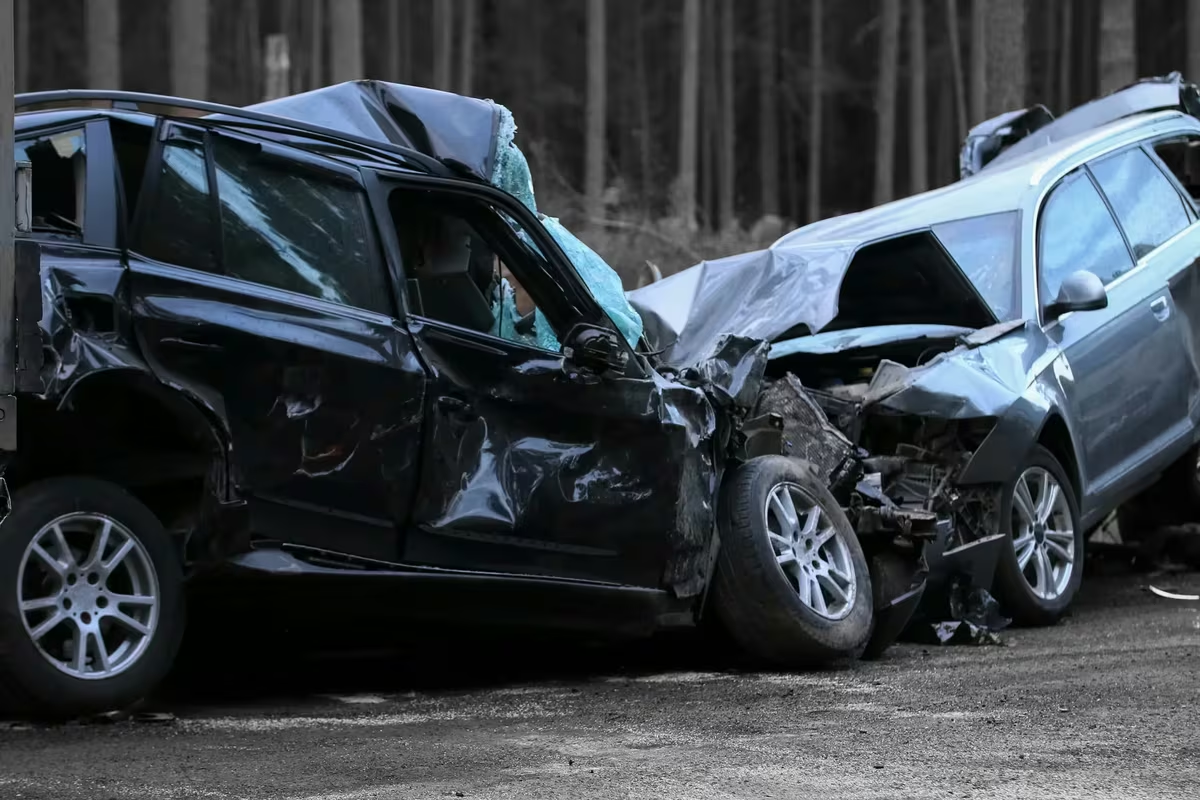 Car Accidents Rear-end, intersection, and highway collisions across Louisiana.
 -
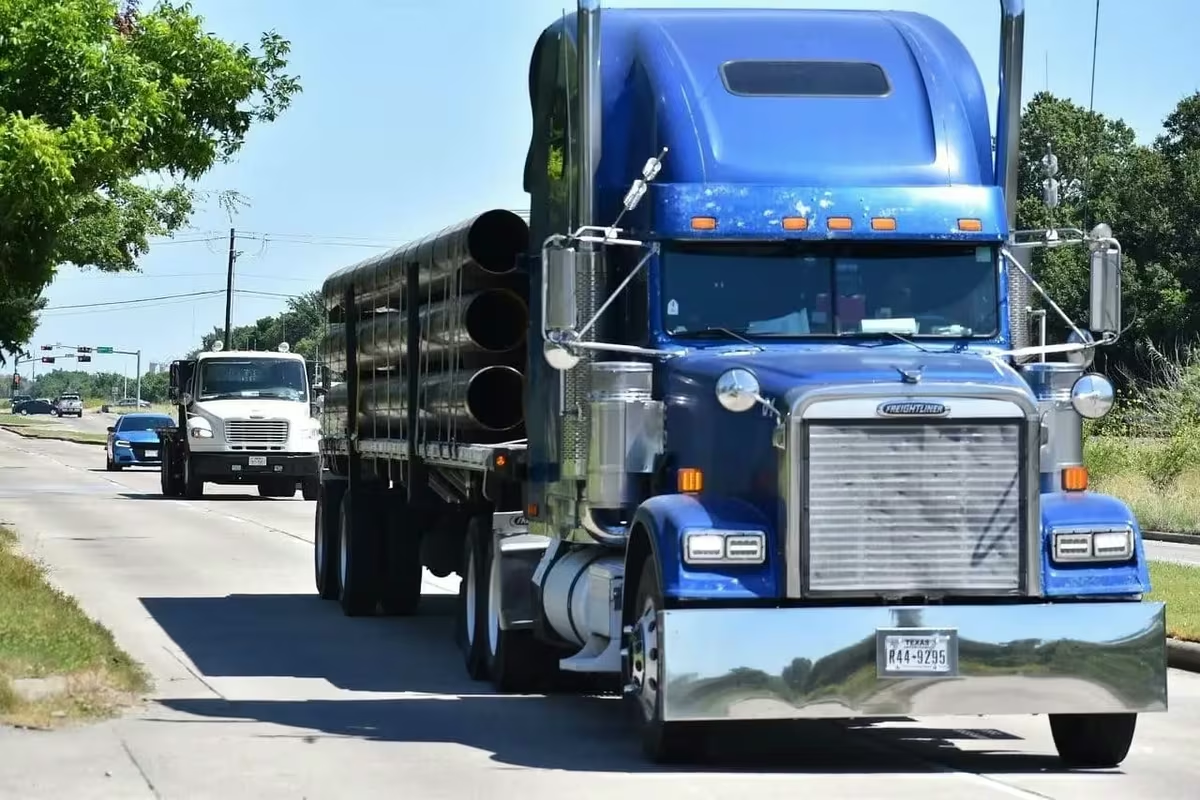 Truck Accidents 18-wheeler and commercial-vehicle wrecks governed by federal trucking rules.
 -
 Motorcycle Accidents Serious-injury motorcycle crashes where bias against riders is common.
 -
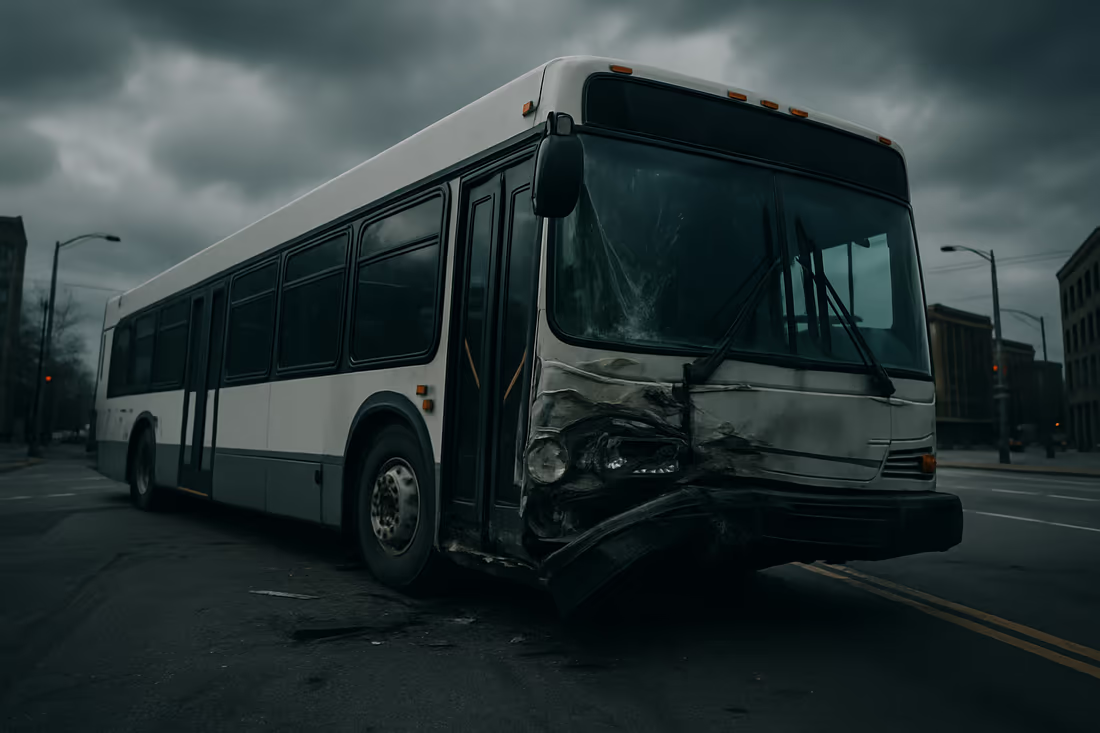 Bus Accidents Transit, school, and charter-bus crashes involving public and private carriers.
 -
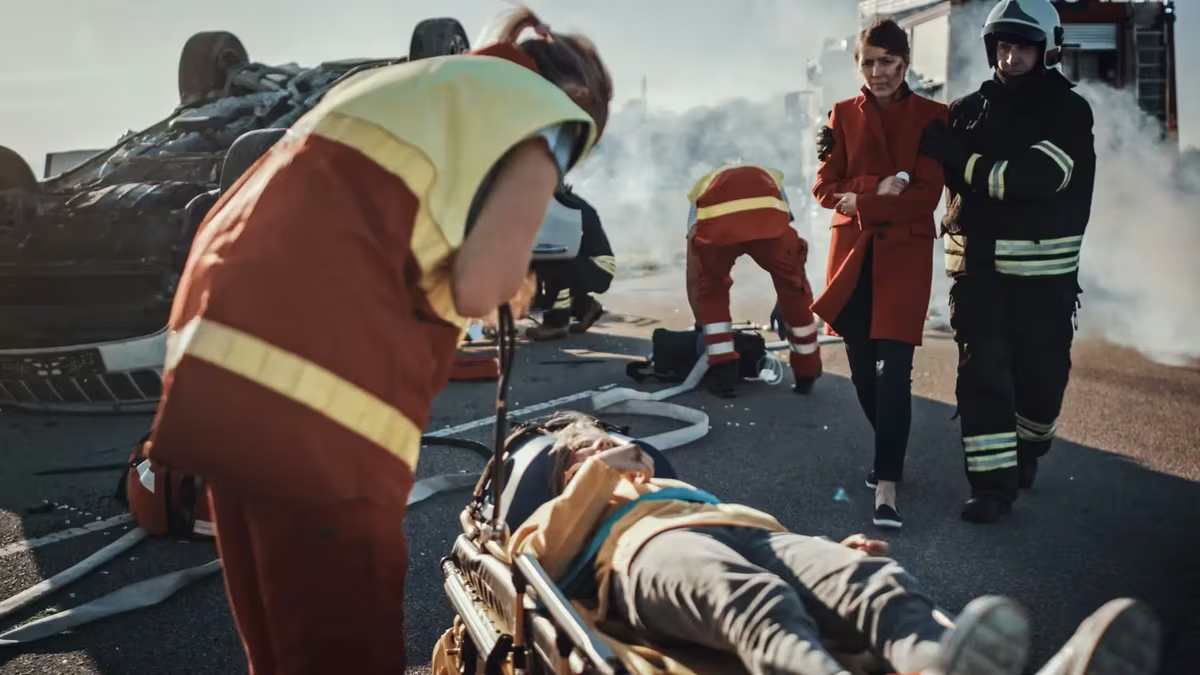 Catastrophic Injury Brain, spinal-cord, amputation, and severe-burn injuries that change a life.
 -
 Brain Injury Traumatic brain injuries with long-term cognitive and physical effects.
 -
 Wrongful Death Claims brought by families after a fatal accident or act of negligence.
 -
 Construction Accidents Falls, struck-by, and equipment injuries on the job site.
 -
 Offshore Accidents Rig, platform, and vessel injuries beyond the shoreline.
 -
 Workers' Compensation On-the-job injuries and the benefits owed to injured workers.
How Car Accident Cases Are Investigated
The Alexandria Police Department handles crashes inside city limits. The Rapides Parish Sheriff’s Office covers parish roads outside the city. Either agency issues a crash report with a report number. That report documents officer observations, fault notations, citations issued, and the drivers’ statements. Get the report number at the scene.
What most people do not know is that critical evidence starts disappearing within days. Dashcam footage overwrites. Traffic camera systems retain video for limited periods. Event data recorders (vehicle black boxes) can be overwritten or lost when a vehicle is repaired or totaled. Preservation demands go out immediately when Morris & Dewett is engaged. These are formal legal notices that stop parties from destroying or overwriting evidence.
For disputed-liability cases, accident reconstruction provides the technical analysis. Skid marks, point of impact, vehicle damage patterns, and road geometry are analyzed to establish what happened before impact. Medical records from Rapides Regional Medical Center (Level II trauma center, 211 Fourth Street, Alexandria) or Christus St. Frances Cabrini Hospital tie your injuries to the crash. Causation is the element insurance companies attack hardest.
Civil cases that cannot be resolved by negotiation go to the 9th Judicial District Court, 701 Murray Street, Alexandria. That court handles Rapides Parish civil cases valued above $50,000. The City Court of Alexandria handles smaller claims. Knowing which court your case belongs in matters for strategy.
Past results do not guarantee future outcomes; each case is decided on its own facts. See our full case results.
Comparative Fault and the 51% Bar
Comparative Fault
A legal rule that reduces your recovery by your percentage of fault. In Louisiana, if you are 51% or more at fault, you recover nothing. If you are 50% or less at fault, your damages are reduced proportionally.
Louisiana follows Comparative Fault under La. C.C. Art. 2323. If you are partly responsible for a crash, your recovery is reduced by your percentage. If you are 20% at fault on a $100,000 case, you receive $80,000.
Act 15 of the 2025 Regular Session (HB 431) of the 2024 Regular Session changed the threshold. Under La. R.S. 9:2800.68, effective January 1, 2026, any plaintiff found 51% or more at fault recovers nothing. Zero. The prior law barred recovery at 50%. This matters because insurance adjusters now have a specific target: get you to 51%. They build their entire evaluation around pushing your fault percentage above that cutoff.
Understanding this changes how you approach the evidence. Fault is not established at the scene. It is argued through the investigation, the police report, the witness statements, and the reconstruction analysis. The insurance company builds their fault argument from day one. Your attorney needs to build yours from day one too.
Two other rules affect your recovery. Louisiana’s No Pay No Play statute (La. R.S. 32:866) bars uninsured drivers from recovering the first $15,000 in bodily injury damages and the first $25,000 in property damage. If you were uninsured at the time of the crash, this provision applies regardless of who caused the accident. Separately, under La. R.S. 32:295.1(E), failure to wear a seat belt cannot be used to reduce your damages for injuries unrelated to the failure to buckle. An insurance company cannot cite a seat belt omission to cut your recovery for a head injury in a side-impact crash.
Morris & Dewett’s approach starts at the accident scene. We work to establish the factual record before the insurance company’s version becomes the default.
Filing Deadlines: The Prescriptive Period
Prescriptive Period
Louisiana’s term for statute of limitations. The legal deadline to file a lawsuit. Missing it permanently bars your claim, regardless of how strong it would have been.
Louisiana car accident victims have two years to file suit under La. R.S. 9:2800.67 if the accident occurred on or after July 1, 2024. The Prescriptive Period depends on your accident date.
For accidents on or after July 1, 2024, La. R.S. 9:2800.67 gives you two years from the date of injury to file suit. Act 423 of the 2024 Regular Session created this extended period. For accidents before July 1, 2024, the one-year period under La. C.C. Art. 3492 still applies. These are separate rules governing separate time periods. If someone quotes you three years, they are working from law that does not exist. If someone quotes you one year for a 2025 crash, they have not updated their knowledge.
Claims against government entities have a different structure. Written notice to the state under La. R.S. 13:5107 is required within 90 days of the accident. Separate deadlines apply for city and parish claims. Failing to give proper notice can bar your claim against a government defendant even if it is filed within the prescriptive period.
Louisiana’s discovery rule can suspend the prescriptive period when an injury was not immediately apparent. A delayed-onset injury that became evident days or weeks after the crash may qualify. This is not automatic. It requires meeting specific legal criteria, and courts apply it narrowly. Do not rely on it as a backup plan. Consult an attorney as soon as you know you have been injured.
Your Alexandria Injury Attorneys
Founding partners Trey Morris and Justin Dewett lead every Alexandria injury case Morris & Dewett takes.


What Compensation Does Louisiana Law Allow After a Car Accident?
Economic damages cover concrete, calculable losses. Past and future medical expenses. Lost wages from missed work. Loss of earning capacity if your injuries reduce what you can earn over your working life. Vehicle repair or replacement costs. Out-of-pocket expenses. Louisiana imposes no general cap on economic damages in car accident cases.
Non-economic damages cover the losses that do not produce a bill: physical pain, mental anguish, loss of enjoyment of life, permanent disfigurement, and disability. Louisiana does not cap non-economic damages in most personal injury cases. The value of these damages is argued through medical records, physician testimony, and evidence of how your daily life has changed.
Punitive damages are available in a specific circumstance. La. C.C. Art. 2315.4 allows punitive damages when the at-fault driver was operating a vehicle while intoxicated and that intoxication caused the crash. Punitive damages are not compensation for your losses. They are designed to punish the specific conduct of drunk driving. Courts treat them separately from compensatory damages.
Collateral Source
A legal rule that historically prevented defendants from reducing a plaintiff’s damages because the plaintiff’s own insurance paid some bills. Act 391 of 2024 modified how medical billing amounts are presented to juries when treatment has not yet been paid.
Act 391 of the 2024 Regular Session modified Louisiana’s Collateral Source rule for medical billing. This affects how the cost of medical treatment is presented to juries when bills have not yet been paid or have been adjusted by insurance. The practical impact on your case value requires a case-by-case evaluation.
When the at-fault driver is uninsured or underinsured, your own UM/UIM coverage fills the gap. Louisiana law requires insurers to offer this coverage. If your policy includes it, your own insurer pays what the at-fault driver’s policy cannot. View Morris & Dewett’s client results.
What clients say
- ★★★★★
I hired Morris and Dewett back in November of 2025.
They helped me get through my hard times of being off work, stress, and worry. Anytime I had a question I could call and they always had an answer. Very nice and professtional people. Thank you Morris and Dewett for making this an easy process for me and my family.
- ★★★★★
Morris and Dewett and their team of attorneys and staff go above and beyond.
They always were there to support me and answer all my questions after a shoulder injury that included multiple surgeries. They are caring and compassionate and that goes a long way! Highly recommended!
- ★★★★★
Thanks Morris and Dewett for the excellent work you have done on my behalf.
I want to personally thank Sarah for her kindness.
- ★★★★★
Morris & Dewett does things the right way!
They put their clients first in measurable and impactful ways.
- ★★★★★
First time being injured and needing a lawyer they where very helpful.
They answered my questions Id have very well. Highly recommend them.
- ★★★★★
Wonderful experience with Morris and DeWitt, everyone was articulate and punctual, and open to all my questions about the process.
My case couldn't have been handled by a better team! Caity Nerren, Jessica Christian, and Meghan Nolen were all fantastic and helped every step of the way. Thanks again for all of your hard work.
Reviews reflect individual client experiences. Past results do not guarantee future outcomes.
How Do You Prove Negligence in a Car Accident Case?
Proving negligence requires four elements under Louisiana law. The at-fault driver owed a duty of reasonable care to other road users. They breached that duty through an act or omission. The breach caused your specific crash. The crash caused your actual injuries and losses.
Burden of proof is preponderance of the evidence. That means more likely than not. That is a lower standard than criminal law, but it still requires evidence. The police crash report and any traffic citations are starting points. They are not the end. Insurance companies dispute them with their own investigation, their own photographs, and their own witness interviews. The driver who was cited can still argue comparative fault on your part.
Traffic citations establish a presumption of negligence, not proof of causation. You must still show the breach caused your specific injuries. This is where medical causation becomes the center of the case. Treating physicians link your diagnosed conditions to the forces of the crash. Independent medical examiners retained by the insurance company will often dispute that link. Competing expert opinions are common in serious injury cases.
Expert witnesses handle the pieces that require technical knowledge. Accident reconstructionists establish what the physical evidence shows about speed, angle of impact, and vehicle positions. Vocational rehabilitation experts calculate loss of earning capacity when injuries limit your future work options. Medical economists convert future care costs to present value.
Frequently Asked Questions
- How long do I have to file a car accident lawsuit in Alexandria, Louisiana?
- For accidents that occurred on or after July 1, 2024, Louisiana gives you two years from the date of injury to file suit under La. R.S. 9:2800.67. For accidents before July 1, 2024, the one-year prescriptive period under La. C.C. Art. 3492 still applies. Claims against government entities require written notice within 90 days regardless of which prescriptive period governs the case.
- What happens if the other driver has no insurance?
- Your own uninsured motorist (UM) coverage pays when the at-fault driver carries no insurance. Louisiana law requires insurers to offer UM/UIM coverage, and if your policy includes it, your own insurer steps into the at-fault driver's role. You can also pursue the uninsured driver directly for a judgment, though collecting from an uninsured individual is often difficult. Louisiana's No Pay No Play rule (La. R.S. 32:866) only affects uninsured plaintiffs, not uninsured defendants. If you were insured and the other driver was not, the rule does not reduce your recovery.
- Can I still recover compensation if I was partially at fault?
- Yes, as long as your fault is 50% or less. Under La. R.S. 9:2800.68 (effective January 1, 2026), Louisiana's 51% bar means that plaintiffs found 51% or more at fault recover nothing. Plaintiffs at 50% or less recover damages reduced by their fault percentage. If you are 30% at fault on a $200,000 case, you receive $140,000. The fault percentage is argued through the investigation and evidence. It is not set by the police report or the insurance company's initial evaluation.
- What is the No Pay No Play rule and does it affect my case?
- La. R.S. 32:866 bars drivers who were uninsured at the time of the accident from recovering the first $15,000 in bodily injury damages and the first $25,000 in property damage, even when the other driver was entirely at fault. This applies to the uninsured plaintiff only. If you carried valid auto insurance when the crash occurred, No Pay No Play does not affect your claim.
- How does comparative fault work under Louisiana's 2026 law?
- Louisiana's comparative fault rule under La. C.C. Art. 2323 assigns each party a percentage of responsibility. Act 15 of the 2025 Regular Session (HB 431) of the 2024 Regular Session, effective January 1, 2026, changed the threshold: a plaintiff at 51% or more at fault recovers nothing. Under prior law, the cutoff was 50%. Under current law, a plaintiff who is found exactly 50% at fault still recovers half their damages. A plaintiff found 51% at fault recovers zero. Insurance adjusters understand this rule and argue aggressively to push plaintiff fault above 50%.
- What should I do immediately after a car accident in Alexandria?
- Call 911 if anyone is injured or if vehicles cannot be moved safely. The Alexandria Police Department handles crashes within city limits; the Rapides Parish Sheriff's Office covers parish roads. Get the crash report number before you leave the scene. Photograph vehicle positions, damage, skid marks, and any visible injuries. Exchange insurance and contact information with all drivers. Do not give a recorded statement to any insurance company before speaking with an attorney. Seek medical evaluation promptly. Delayed treatment creates gaps that insurers use to dispute causation.
- What does a car accident lawyer actually do for my case?
- A car accident lawyer handles the investigation, evidence preservation, legal analysis, insurance negotiations, and litigation if the case does not settle. That means sending preservation letters, obtaining the police report, coordinating with medical providers, analyzing all available insurance coverage, calculating your damages, and negotiating with the insurer. If negotiations fail, your attorney files suit in the 9th Judicial District Court in Alexandria and prepares the case for trial. Morris & Dewett handles car accident cases on a Contingency Fee basis. You pay no attorney fees unless there is a recovery.
- When does a car accident case go to trial instead of settling?
- Most car accident cases settle before trial. Trials happen when the liability is genuinely disputed, when the damages are disputed, or when the insurance company's settlement offer does not reflect the actual value of the claim. Cases with contested fault, severe injuries, or significant non-economic damages are more likely to go to trial. At Morris & Dewett, we prepare every case as if it will go to trial. That preparation is what drives better settlement outcomes. Insurers pay more when they know the plaintiff's attorney is ready to try the case in front of a Rapides Parish jury.
Last updated June 5, 2026